

Overview
Directions
- The established village approach is through Covehithe from the A12 at Wrentham and the B1127. Use lawful roadside spaces before the village’s restricted road end, keeping gateways and passing places clear. Follow current signed public footpaths rather than the closed road towards the cliff.
- For a longer alternative with formal parking, start at Church Road beach car park in Kessingland and follow the beach south only when conditions allow. The Broad and cliff approaches change with erosion; do not attempt to cross open water, a breached shingle barrier or a fenced bird-nesting area.
- Much of Benacre National Nature Reserve is private. Keep to public rights of way and obtain permission for access elsewhere; a reserve designation does not make all tracks public.
- Locality reference: 52.38985°N, 1.72233°E.
Location photographs
Swipe to browse · Select a photograph to enlarge


Fossil Hunting
Benacre is primarily a place to study sediment and coastal change, with occasional fossils among loose pebbles. Flint can preserve the outlines of echinoids or sponges, while chalk fragments and other transported rocks may contain shells or belemnites. These fossils are older than the gravel or beach that now holds them.
Look over naturally washed pebbles, turning small loose stones rather than digging into the cliff. Shape alone is unreliable: weathered flint commonly resembles bones or teeth without being a fossil. Photograph promising pieces from several angles and retain locality notes.
The foreshore may also carry peat and wood eroded from younger coastal deposits. Their presence does not identify a Norwich Crag fossil horizon. A loose vertebrate fragment likewise needs specialist assessment before an age or source bed is assigned.
Discoveries and milestones
Significant fossil, geological and conservation milestones at Benacre.
1956 – Migration of Benacre Ness analysed
Williams documented the history of the adjacent ness and its northward movement, establishing an important framework for understanding the changing coast around Benacre.
2003 – Coastal landforms assessed in the GCR
The Benacre Ness assessment brought together evidence for cliff retreat, beach-ridge development and the mobile shingle foreland. Its relevance is geomorphological rather than a new fossil discovery.
2005 – Wider protected coast re-notified
The Pakefield to Easton Bavents SSSI was re-notified, including the coastal geomorphology of Benacre Ness and important adjoining coastal habitats.
References
May and Hansom (2003), Benacre Ness, GCR 28
Natural England, Pakefield to Easton Bavents SSSI citation (2005), hosted copy
Geology
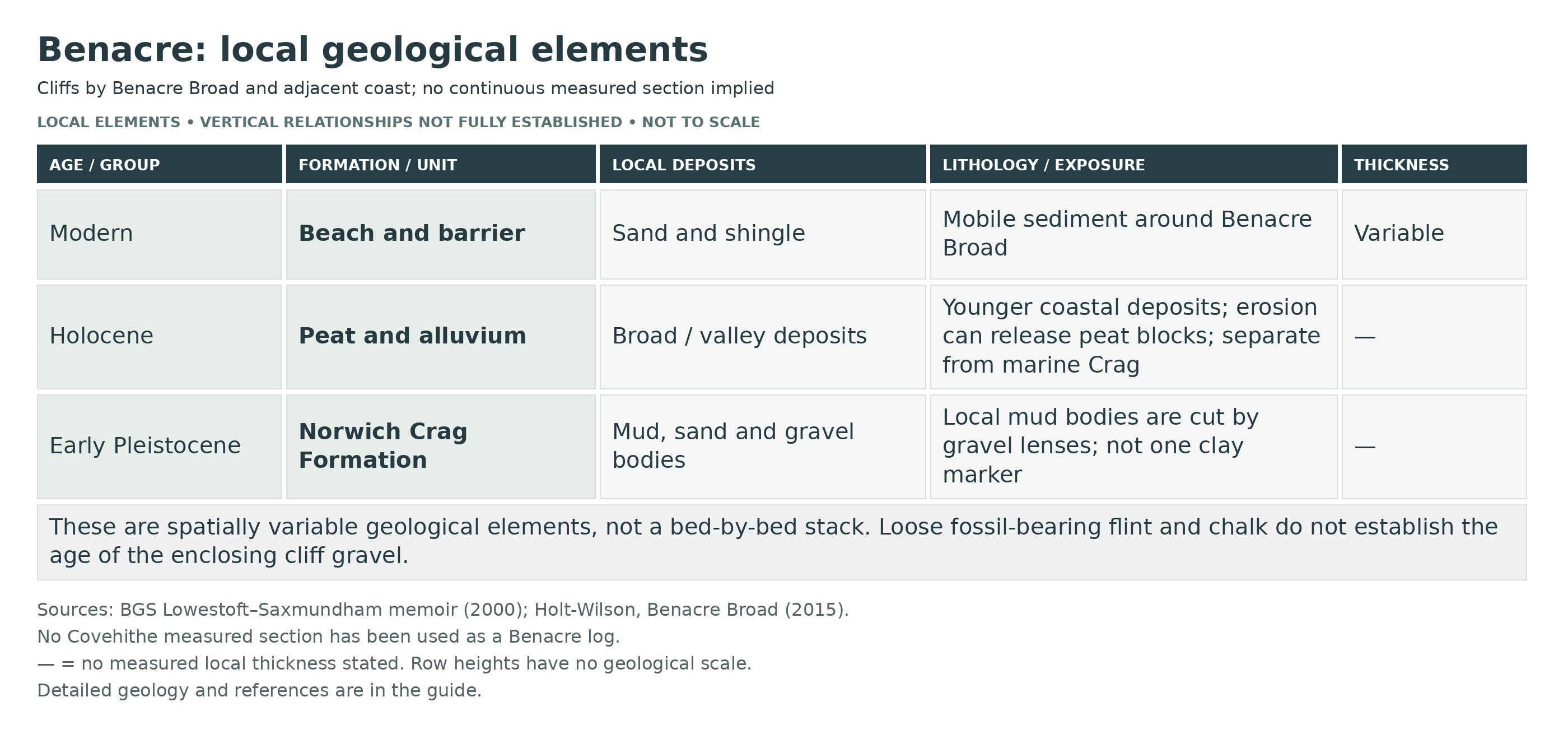
Benacre’s soft coastal cliffs include marine sand and clay of the Norwich Crag Formation, deposited before the present beach and broad developed. The fine muddy sediment records quieter conditions than the associated sand and gravel. These materials do not form a simple stack of uniform layers: mud bodies extend towards Benacre Ness and are cut by gravel lenses. A gravel-filled cut can interrupt a clay exposure over a short distance, helping to explain why different visits or neighbouring faces show different combinations of sediment.
The older description of the clay as ‘Baventian’ is a regional correlation, rather than an exact numbered-bed scheme for this cliff. Nor is every gravel necessarily glacial. Older fossil-bearing flint and chalk occur among the transported and recycled stones, but their presence alone does not identify the formation or age of the deposit that last carried them. A fossil in a loose flint records the rock from which that flint originated, not necessarily the marine environment represented by the adjacent Crag sand or clay.
Modern coastal change supplies a separate set of materials. Peat and alluvium beneath the broad’s valley extend offshore, and erosion can release peat blocks onto the beach. Waves redistribute sand and shingle into the barrier separating the broad from the sea and into the shifting Benacre Ness. These young coastal deposits and landforms should be distinguished from the older cliff succession: a peat block, fossil-bearing pebble and shell-bearing sediment found together on the shore need not share an origin or age.
Detailed geology and bed-by-bed succession
The supported stratigraphy and its local variations at Benacre.
CRAG GROUP
Preglacial marine deposits in the coastal cliffs.
Norwich Crag Formation
Sand and clay are confirmed at Benacre. Mud bodies extend towards Benacre Ness and are cut by gravel lenses. They should not be portrayed as one continuous clay marker bed.
Local mud, sand and gravel bodies
The old guide calls the clay Baventian. This is a regional correlation rather than a numbered local bed scheme for this cliff.
Glacially derived and recycled pebble material
The loose assemblage includes older fossil-bearing flint and chalk. Transported clasts do not by themselves determine the age or formal formation of each cliff gravel.
Peat, alluvium and modern coastal sediment
Peat and marine alluvium underlie the broad’s valley and extend offshore; erosion supplies peat blocks. Modern sand and shingle form the beach and barrier and must remain outside the Norwich Crag hierarchy.
References
BGS (2015), British regional geology: East Anglia
Moorlock et al. (2000), Geology of the country around Lowestoft and Saxmundham, sheets 176 and 191
A very brief introduction to the Quaternary; background illustrated at Benacre
Holt-Wilson (2015), Tides of Change: Benacre Broad
Safety
Cliffs can slump abruptly and high water may remove the safe passage at their foot. Keep well away from overhangs, fallen trees and soft clay. Never attempt a lagoon-bar crossing where the sea has breached it. This is a remote stretch, so allow for the full return walk and carry a phone; a falling tide does not make a stormy beach safe.
Equipment
Sturdy footwear, tide information, water, a phone, a hand lens and a few small padded boxes are sufficient for looking over loose pebbles. Hammers and digging tools are unnecessary for the recommended search.
Cleaning And Treating
Sound flint specimens can normally be dry-brushed and, if needed, briefly rinsed in clean water. Let them dry naturally. Do not use acids or bleach, and do not split every oddly shaped flint. Fragile chalk, peat or bone should remain supported and should not receive the same wet cleaning treatment as solid flint.
Identify Your Finds
Need help identifying a fossil? Share clear photos, where you found it and its size with the community.
Further Reading
A very brief introduction to the Quaternary; background illustrated at Benacre
Holt-Wilson (2015), Tides of Change: Benacre Broad
May and Hansom (2003), Benacre Ness, GCR 28
Moorlock et al. (2000), Geology of the country around Lowestoft and Saxmundham, sheets 176 and 191
Natural England, Suffolk national nature reserves: Benacre
Natural England, Pakefield to Easton Bavents SSSI citation (2005), hosted copy
Access Rights
Benacre National Nature Reserve includes private land, and the coast forms part of the wider Pakefield to Easton Bavents protected-site system. Keep to lawful public access, respect reserve signs and avoid nesting and roosting birds. Do not enter private tracks or fenced areas, excavate cliffs or remove protected deposits without the necessary permissions.
It is important to follow our ‘Code of Conduct’ when collecting fossils or visiting any site. Please also read our ‘Terms and Conditions’.
Links
♦ Fossil Discussions
♦ Fossil Articles
♦ Buy Fossils, Tools and Equipment
♦ Buy Crystals, Meteorites, and Artefacts
♦ Join Fossil Hunts
♦ UK Fossils Network


