Blue Anchor exposes a thin but highly productive Rhaetian bone bed within the Penarth Group, yielding abundant reptile, shark and fish remains, similar to the famous Aust site on the Severn Estuary. The foreshore is scattered with blocks ideal for splitting, while the overlying Jurassic beds also produce ammonites and occasional reptile material, making this a varied and rewarding location.


FIND FREQUENCY: ♦♦♦♦ – Blue Anchor is very productive but you have to work for your finds. The bone bed is very hard. Search permitted loose material and examine natural broken surfaces with a hand lens; where sampling and tool use are allowed, take small representative pieces for careful preparation rather than smashing large boulders. You will be surprised how rich this bed is for teeth.
CHILDREN: ♦♦♦ – The hard bone-bed material needs careful preparation, and the foreshore has tidal and uneven-ground hazards. This location is not suitable for young children.
ACCESS: ♦♦♦♦ – Access to the beach at Blue Anchor is easy. Park along the seafront and walk down to the beach by means of the concrete slipway.
TYPE: Blue Anchor is a cliff and foreshore location, although fossils are only really found within the rocks from the bone bed, which can be found scattered along the beach. At the Blue Anchor headland, where you will see some very large rocks, all the beds going eastwards are Jurassic and are covered in our Watchet guide.
DIRECTIONS
♦ From the A39, take the B319 or the road from Bilbrook through Old Cleeve to Blue Anchor. Please note, forma access from the B3191, which runs between Watchet and Minehead is now permanently closed to cars due to erosion. Park at the most Eastern side along the promenade and walk east towards Watchet.
♦ On a good day and tides permitting, you can walk from Watchet to Blue Anchor and back. However, the tide can reach very high up the beach at some points and you can be completely cut off. So be careful and make sure you allow plenty of time to get back if you choose this route.
♦ A ramp gives access to the foreshore from the promenade, but there is no fixed safe access window after high tide. Check the day’s local tide times and heights, weather and actual sea conditions, and leave ample time to return before the rising water cuts off the ramp or headlands.
♦ Postcode to main parking area: Postcode: TA24 6JR
♦ What3Words to the main collecting site: ///cashiers.cactus.indulgent
DOWNLOAD THE UKF BOOKLET TO FOSSIL HUNTING AT BLUE ANCHOR
VIDEO FILM
FOSSIL HUNTING
Small bones are very common at Blue Anchor, including many fish remains, teeth, spines, small bone fragments and vertebrae. In fact, the fossiliferous Westbury Beds are packed with fish remains. There is also a huge variety of small bones found here, but getting them out and getting them home is a completely different story. It may be easier to look for smaller blocks around the foreshore instead of trying to get bones out of the hard larger blocks, unless you have the right equipment.
The red Triassic cliffs do not contain any fossils, so you will need to walk towards the start of the grey cliffs. At Blue Anchor Point, blocks of bone bed can be seen on the foreshore. Some of these can be huge. Search around these blocks and look for any interesting bones. Once you find a good block, it can take a long time to split it into small pieces. Alternatively, you can take some samples back home for further splitting. Sometimes, nodules can be found that contain larger bones. These tend to be found in sandy pockets together with giant limestone nodules.


Some of the most significant fossil discoveries and scientific milestones from Blue Anchor include the early record of a possible mammal tooth, classic work on the Rhaetian succession, the formal naming of the Blue Anchor Formation, the first modern detailed study of its bone-bed microvertebrates, and the discovery of a giant ichthyosaur jaw.
1864 – Hypsiprymnopsis rhaeticus named from Blue Anchor Point
A supposed mammalian tooth from near the top of the Blue Anchor Formation at Blue Anchor Point was named Hypsiprymnopsis rhaeticus by Boyd Dawkins in 1864. Although the specimen is problematic and its interpretation has long been debated, it remains one of the classic historic fossil records from the site.
1908 – Ussher described the main geological features of the Blue Anchor coast
W. A. E. Ussher’s work helped establish Blue Anchor as an important coastal section through the latest Triassic into the earliest Jurassic. This early description laid the groundwork for later fossil and stratigraphic study of the locality.
1911 – Richardson publishes the first detailed local stratigraphic description
L. Richardson published the first detailed stratigraphic description of the Blue Anchor succession. His measured account established a framework for comparing its Rhaetian beds and fossil-bearing horizons, and remains an important reference when distinguishing the site’s different historical logs.
1935 – Pachystropheus rhaeticus is named partly from Blue Anchor material
E. von Huene named the reptile Pachystropheus rhaeticus using vertebrae and limb bones from the basal Westbury Formation at Blue Anchor and material from Westbury Garden Cliff in Gloucestershire. Blue Anchor fossils therefore contributed to the original description, adding an important vertebrate record to the locality’s Rhaetian fossil history.
1980 – the Blue Anchor Formation was formally introduced, with Blue Anchor as the type locality
Modern Triassic stratigraphic revision formally introduced the Blue Anchor Formation in 1980. Blue Anchor Point became the type locality of the formation, giving the site a major place in British Triassic stratigraphy as well as fossil collecting.
1984 – the complete local Rhaetian succession at Blue Anchor Point was described in detail
Detailed work on the Blue Anchor Point section showed the full local Rhaetian succession from the Grey Marls up into the Blue Lias. This helped confirm the importance of the site for fishes, reptiles, coprolites and other fossils from the Triassic–Jurassic transition.
May 2020 – giant ichthyosaur jaw found by Justin and Ruby Reynolds
In May 2020, Justin and Ruby Reynolds found pieces of a gigantic lower jaw on the beach at Blue Anchor. The specimen later proved to belong to one of the largest marine reptiles ever discovered and became one of the most important modern fossil finds from the Somerset coast.
2024 – Ichthyotitan severnensis named from the Blue Anchor and Lilstock jaw material
The huge jaw material from Blue Anchor, together with related material from Somerset, was formally named Ichthyotitan severnensis in 2024. This confirmed Blue Anchor as one of the key localities for the last giant ichthyosaurs of the Triassic.
2024 – first modern detailed study of the Blue Anchor bone-bed microvertebrates
A major 2024 study provided the first modern detailed account of the microvertebrate assemblages from the two Rhaetian bone beds at Blue Anchor Bay. It showed that the site preserves a richer and more informative fish and small-vertebrate fauna than had previously been described in detail.
GEOLOGY
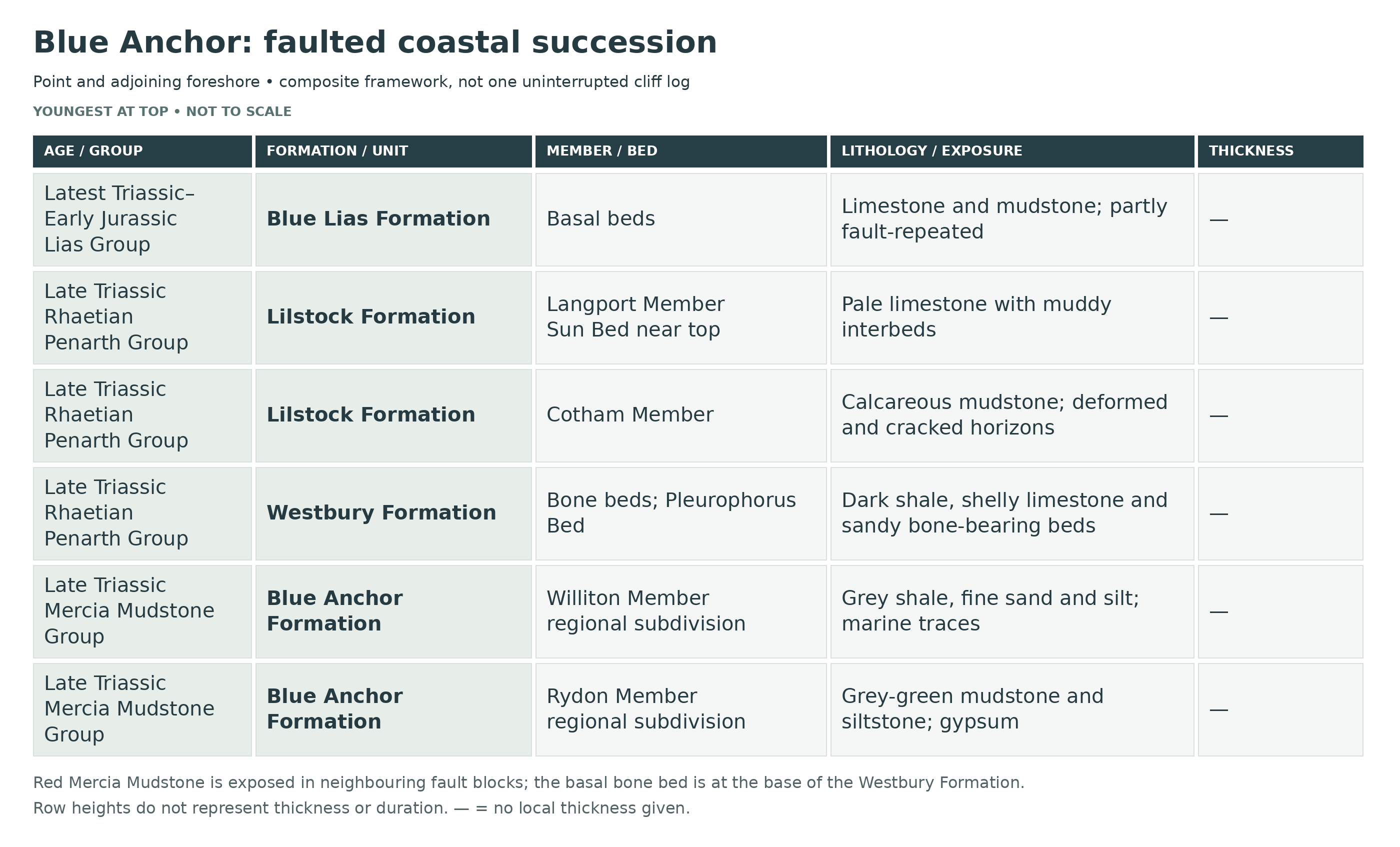
Blue Anchor Point and its adjoining foreshore expose a faulted Triassic–Jurassic succession. The Blue Anchor Formation, Penarth Group and basal Blue Lias occur in different cliff and foreshore exposures. Faulting also places red Mercia Mudstone against younger rocks, so the shore is not one uninterrupted vertical log.
The Blue Anchor Formation contains grey-green dolomitic mudstone and siltstone, with gypsum nodules and veins. The Rydon and Williton subdivisions are retained in regional descriptions. Its upper beds contain evidence of increasing marine influence before the main Westbury marine transgression.
The Westbury Formation begins with the basal bone bed, rather than having that bed at its top. Dark shale, sandstone and shelly limestone overlie it. Higher bone-bearing horizons include an upper composite bed beneath the Pleurophorus limestone. Recent work distinguishes the bony-fish-dominated basal assemblage from the more shark-rich upper assemblage.
The Lilstock Formation contains the Cotham and Langport members. Deformed beds and desiccation cracks are important Cotham features; pale micritic limestone, including the Sun Bed, characterises the upper succession. Grey calcareous mudstone leads into the Blue Lias Formation, whose base must not be used automatically as the Triassic–Jurassic time boundary.
Published logs vary with exposure and historical interpretation. The detailed section retains local bed measurements where clearly sourced, but does not combine them into a single supposed cliff height. Gypsum-bearing mudstones, repeated faults, folds and varying beach cover all affect what can be seen.


This is a detailed stratigraphic breakdown of the Upper Triassic to Lower Jurassic succession at Blue Anchor, Somerset. The section is the type locality of the Blue Anchor Formation and exposes the transition from Mercia Mudstone sabkha deposits upward through the bone-bed-rich Westbury Formation, the White Lias of the Lilstock Formation, and into the basal Blue Lias.
This is a composite of the Point, cliff and neighbouring foreshore exposures. BA labels in the earlier guide were editorial identifiers rather than a published bed-number system; the supported names and lithological horizons are retained below. Historical measured sections differ in position and interpretation, so their totals are not combined.
MERCIA MUDSTONE GROUP
Red Mercia Mudstone — Separate Cliff Facies
The reddish-brown cliffs immediately east of Blue Anchor, between ST 0337 4356 and ST 0391 4371, expose older Mercia Mudstone below the Blue Anchor Formation in the regional succession. The BGS account distinguishes four lithofacies here. These numbers describe recurring rock types and textures, not four successive measured beds; faulting also interrupts the coastal succession.
Lithofacies 1 — Better-Bedded Silty Mudrock
Dark reddish-brown to chocolate-coloured silty claystone and siltstone form relatively well-defined beds, generally 0.1–0.3 m thick, with sharp boundaries. Some beds become lenticular laterally and have irregular or scoured upper surfaces. Their interiors are largely massive, with occasional cavities; bedding-plane shears and a near-vertical fabric occur locally.
Lithofacies 2 — Brick-Red Mudrock With A Crumb Fabric
Poorly bedded brick-red claystone and silty claystone break into flattened mud fragments smaller than 1 cm. Green reduction laminae, numerous small cavities and local mud-filled desiccation cracks are characteristic. The BGS interprets this crumb texture as modification by soil-forming processes and drying.
Lithofacies 3 — Desiccation-Brecciated Mudstone
Angular mudstone fragments form a breccia produced by disruption of the first two facies. Polygonal drying cracks and overlapping crack fills record repeated wetting and drying, locally intense enough to break up the sediment completely.
Lithofacies 4 — Evaporite-Modified Brecciated Claystone
Brecciated claystone contains remnant evaporite nodules, possibly after gypsum, together with wavy or convoluted bedding, green laminae and rare branching gypsum veins close to bedding. Evaporite growth and dissolution contributed to the disturbed fabric.
Desiccation, soil formation and evaporite alteration have obscured much of the original depositional fabric. The BGS favours cohesive mud or debris flows for the relatively massive first facies and allows sediment supply by sheetfloods; the textures should not be treated as proof of one uninterrupted lake deposit or as a new numbered stratigraphic log.
Blue Anchor Formation (Upper Triassic — Norian to Rhaetian)
Rydon Member
Lower Green And Grey Mudstones And Siltstones (c. 30 m)
Interbedded dark green, greenish-grey and locally pale grey dolomitic mudstones and siltstones, rarely pebbly, forming the lower part of the Blue Anchor Formation at its type locality. The basal boundary is placed at the lowest dark grey mudstone, although the change from the underlying red Mercia Mudstone is gradational over about a metre. These beds represent dominantly terrestrial to marginal-marine sabkha or evaporitic lacustrine conditions, with repeated flooding, evaporation and low-energy sheet sedimentation on a very low-relief coastal plain.
Rydon Gypsum Marker Units A, B And C
The published type-section framework distinguishes lower marker A and the higher nodular-gypsum-rich units B and C. These are correlation markers within the Rydon Member, not additional formations. Unit A combines a thin gypsum layer with green blocky mudstone and a wispy-bedded layer. The precise depths and B–C thicknesses quoted for the cliff west of Watchet apply to that separate exposure and are not imposed on Blue Anchor Point.
Gypsiferous Rydon Mudstones And Siltstones
Thin beds of greenish-grey and dark grey mudstone with paler shales, gypsum nodules and conspicuous veins. At Blue Anchor these include pink or white alabaster nodules in laminated mudstones, white fibrous gypsum veins parallel to bedding and pink satin-spar veins cutting across the beds. In places the gypsum has been replaced partly by silica. These beds record supratidal to intertidal sabkha conditions with algal-mat development, penecontemporaneous sulphate growth and small-scale syndepositional movement in soft sediment.
Williton Member
Grey shale with fine sand and silt marks the shallow-marine upper part of the Blue Anchor Formation. Flaser and lenticular bedding, desiccation cracks and small syndepositional faults are recorded at Blue Anchor. Its base is an erosion surface cut by Diplocraterion burrows; a thin local conglomerate can occur above that surface. The BGS reports about 3 m at Blue Anchor, within a district range of approximately 2.5–4 m.
Upper Sully Beds / Tidal Blue Anchor Beds (top c. 1.8–4.2 m of the formation)
The uppermost Blue Anchor beds become more obviously marine-influenced, with dark green-grey mudstones and siltstones, local burrowed surfaces and horizons yielding body fossils. Trace fossils include Arenicolites, Diplocraterion, Muensteria, Planolites, Rhizocorallium and Siphonites. Body fossils include bivalves and palynomorphs, while fish remains occur from about 3 m below the top and within the highest 1.83 m of the unit. Historical records, using the names in the cited older accounts, include Saurichthys apicalis, Acrodus minimus, Gyrolepis alberti and Gyrolepis tenuistriatus, with rare indeterminate reptilian bones. These beds represent shallow-water, probably tidally influenced conditions immediately before the main Rhaetian transgression. The historical lost tooth named Hypsiprymnopsis rhaeticus was reported below the basal Westbury succession, in relation to the underlying Sully interval; it is not an upper Westbury bone-bed record and its identification cannot now be rechecked.
Blue Anchor Formation Thickness: Approximately 34 m In The Older Generalised GCR Summary; 36.54 m In The BGS Type-Section Account
PENARTH GROUP
Westbury Formation (Upper Triassic — Rhaetian)
Basal Bone-Bed Interval
Basal Bone Bed (c. 0.15 m)
A sandstone bone bed resting sharply on an eroded and bioturbated surface at the top of the Blue Anchor Formation. The bed includes sand-sized quartz grains and pebbles, phosphatic material, coprolites and abundant vertebrate debris. Rip-up cream-coloured clasts derived from the Sully Beds of the underlying Blue Anchor Formation occur in the lag. This is the main transgressive concentration horizon at Blue Anchor and marks the base of the Penarth Group.
Fossil Content
The basal Blue Anchor bone bed is unusual because it is dominated by osteichthyan teeth rather than sharks. Common taxa include Lepidotes, Gyrolepis, Birgeria and Saurichthys, with chondrichthyans such as Lissodus and Rhomphaiodon subordinate. Coprolites, denticles and fish scales are abundant. Renaud and colleagues record a tooth tentatively identified as ?Eomesodon from the basal bone bed. They also attribute the historical Pachystropheus record to the basal Westbury bone bed.
Interpretation
This bed represents the initial Rhaetian marine transgression and a high-energy lag concentration formed by reworking on the flooded top of the Blue Anchor Formation.
Lower Westbury Black Shales And Shelly Limestones (c. 1.5 m above the basal bed)
Dark grey to black fissile shales, shelly mudstones and thin limestones overlying the basal bone bed. Some limestones contain concentrations of reworked shell debris, channelled lower surfaces and rippled upper surfaces, while fibrous calcite occurs in parts of the limestone facies. These beds record establishment of low-oxygen marine conditions after the main flooding surface, interrupted by brief higher-energy shell and silt events.
Intermediate Bone-Bearing Horizon / Sandstone Lens
Older generalized accounts of the Blue Anchor Point section record a second bone-bearing horizon about 1.5 m above the basal bed. This horizon is not always easy to trace in modern exposures, but where recognised it consists of sandy or calcareous bone-bearing material within the lower black shale succession, with quartz grains, abraded bone fragments and scattered vertebrate remains.
Upper Bone Bed Beneath The Pleurophorus Bed (c. 0.28 m composite bed, about 5–6 m above the basal bed)
The upper bone bed occurs immediately below the Pleurophorus Bed and is the second principal fossil bone bed sampled in recent work. It is a composite unit of hard grey calcareous sandstone and black shale, finer and more clay-rich at the base and coarsening upwards. It includes thin layers of calcareous bone-bed sandstone, black shale laminae, fibrous calcite and a calcareous sandy bone-bed cap. Quartz grains from the base show solution pits, whereas higher in the bed euhedral quartz overgrowths reflect later cementation in more porous sediment. Pyrite and marcasite are characteristic, showing more strongly anoxic conditions than in the basal bone bed.
Fossil Content
The upper bone bed is dominated by hybodont chondrichthyans, especially Lissodus and Rhomphaiodon, with rarer Parascylloides turnerae, Synechodus and Pseudodalatias. Osteichthyans are much less common than in the basal bed. These upper-bed records should not be conflated with vertebrate discoveries from the basal bone bed or the underlying Sully interval.
Detailed Westbury Bed Log
The following bottom-to-top inventory follows the generalised Sykes section reproduced in the GCR. Its local bed thicknesses must not be summed and substituted for Richardson’s broader Blue Anchor foreshore formation thickness. The five lettered layers belong to the upper composite bone bed, not five additional separate regional bone beds.
Basal shelly mudstone (0.12 m)
Shell fragments become more abundant upwards. Quartz, worn bone and fragments eroded from the Blue Anchor Formation occur, especially near the base.
Thin sandy limestone (0.025 m)
Scattered vertebrate fossils are recorded in this thin bed above the basal shelly mudstone.
Lower black fissile shale (at least 0.9 m)
This shale lies above the thin sandy limestone; its published minimum thickness indicates an incompletely constrained interval.
Dark bivalve-bearing limestone
The next limestone contains bivalves; the source does not determine its thickness.
Limestone and shale interval (0.9 m)
Dark limestone and variable black shale include thin silty layers. Some shale is bedded and unfossiliferous; other parts are less clearly bedded.
Poorly exposed shale and limestone (0.91 m)
The historical log records this mixed interval but exposure limits its finer description.
Nodular-based limestone (0.15 m)
Limestone nodules characterise the lower part, with fibrous calcite near the top.
Black shale (0.12 m)
A separate shale bed succeeds the nodular-based limestone.
Limestone-based shale–limestone interval
The source records limestone at the base of a mixed interval but provides no determined thickness.
Massive grey limestone (0.6 m)
A more massive limestone passes into limestone and shale near its top.
Bivalve-rich black shale (0.15 m)
Fissile shale with numerous bivalves immediately precedes the upper composite bone bed.
Upper bone-bed layer (e): sandy basal part (0.018 m)
The base of the composite bed is calcareous and sandy, with shells lower down and a more silty upper part.
Upper bone-bed layer (d): fibrous calcite (up to 0.03 m)
A variable-thickness fibrous calcite layer is recorded separately in the published subdivision.
Upper bone-bed layer (c): rippled sandstone and shale (0.07 m)
Thin calcareous bone-bearing sandstone alternates with non-calcareous fissile black shale. Bivalves can lie on sandstone surfaces; vertebrate remains are sparse in the sandstone.
Upper bone-bed layer (b): transitional interval (0.05 m)
Calcareous sandstone, black shale and limestone pass into the overlying gritty bed. The interval fines downwards and contains less quartz than the cap.
Upper bone-bed layer (a): gritty cap (up to 0.12 m)
Massive calcareous grit contains numerous vertebrate fossils and rare coprolites. Thin white veins may cut both rock and fossils.
Black shale above the upper bone bed (0.2 m)
Fissile shale containing bivalves separates the composite bone bed from the overlying Pleurophorus limestone.
Pleurophorus Bed (0.23 m)
Medium-grey shelly limestone with fibrous calcite forms the recognisable cap above the upper bone-bed and shale interval.
Upper Westbury Shell Beds
Above the upper bone bed are medium-grey shell-bearing limestones and black fissile shales, including the Pleurophorus Bed, which makes the upper bone bed easy to recognise in the field. These beds contain abundant bivalves and fibrous calcite and record fully marine but still shallow and fluctuating shelf conditions.
Thickness Note: Richardson’s Blue Anchor Foreshore Westbury Log Is 14.09 m; This Must Be Distinguished From The Shorter Generalised GCR Bone-Bed Log
Lilstock Formation (Upper Triassic — Rhaetian)
Cotham Member
Cotham Member Limestones, Shales And Deformed Beds
Grey and grey-green shales, mudstones and limestones resting unconformably on the Westbury Formation. At Blue Anchor the Cotham beds commonly show ripple marks, desiccation cracks and rarer septarian-type nodules, indicating repeated emergence and very shallow-water or lagoonal conditions. A deformed bed attributed to seismic activity is well exposed here and is one of the classic sedimentary structures of the section.
Lower Deformed Interval And Shrinkage-Crack Surface
The BGS coastal account distinguishes contorted calcareous siltstone in the lower Cotham Member, followed by a polygonal shrinkage-crack surface. Calcarenite fills the fissures and can connect them in a thin layer across the surface.
Upper Cotham Shale And Calcareous Lenses
Above the cracked surface, greenish-grey shale with silt wisps and harder calcareous lenses completes the member. The BGS records approximately 1.62 m for the Cotham Member in Richardson’s Blue Anchor foreshore log; the thicker generalised GCR interval should not be treated as the same measured section.
Langport Member (White Lias)
Lower White Lias / Porcellanous Limestone
Pale cream to very light grey, hard, fine-grained micritic limestone forming the classic White Lias facies. These resistant porcellanous limestones record a widespread shallow-marine carbonate phase at the very top of the Triassic and form some of the most recognisable pale beds in the succession.
Upper Langport Calcareous Mudstones
Calcareous mudstones above the porcellanous limestones, representing the muddier upper part of the Langport Member. The local succession includes the upper limestone marker known as the Sun Bed. The BGS memoir places grey calcareous mudstone above it, passing upwards into basal Lias shale; the formation boundary should not be equated automatically with the Triassic–Jurassic time boundary.
Local Thickness Note: Richardson’s Blue Anchor Foreshore Record Gives About 2.3 m For The Lilstock Formation
LIAS GROUP
Blue Lias Formation (Triassic–Jurassic Boundary Interval And Hettangian)
Basal Blue Lias
Basal Paper Shales
Dark, well-laminated mudstones forming the lowest Blue Lias beds visible at Blue Anchor Point. These shales mark the onset of the classic Jurassic limestone–shale cyclicity and represent low-oxygen marine conditions following final drowning of the White Lias platform.
Lowest Blue Lias Limestone–Shale Couplets
Thin tabular limestones interbedded with darker laminated shales forming the basal Blue Lias cycles at the top of the section. These beds record marine deposition around the Triassic–Jurassic transition at Blue Anchor, with repeated switches between muddier and more carbonate-rich shelf deposition. In the wider west Somerset basal Blue Lias framework, early Psiloceras faunas occur in these lowest Hettangian beds.
Fossil Content
Early Jurassic bivalves, shell debris and basal Hettangian ammonites of the Psiloceras group in the wider Blue Anchor–Watchet coast succession.
Exposure Note: At Least 6 m Of Pre-planorbis Beds Were Logged On The Foreshore East Of Blue Anchor Cliff; This Is Not A Complete Blue Lias Thickness
Depositional Environment
The Blue Anchor section records a full environmental progression from supratidal sabkha and evaporitic coastal plain deposits in the upper Mercia Mudstone, into shallow tidally influenced marine conditions at the top of the Blue Anchor Formation, then fully marine Rhaetian black shales and bone beds of the Westbury Formation, followed by very shallow lagoonal and carbonate-platform conditions in the Cotham and White Lias, and finally the open marine Jurassic limestone–shale cycles of the basal Blue Lias.
Composite-Section Note: Faulting And Differing Historical Logs Prevent A Single Total Being Applied To Every Blue Anchor Exposure
References
Warrington, G. & Whittaker, A. (1984). The Blue Anchor Formation and Rhaetian succession of west Somerset.
Hamilton, D. & Whittaker, A. (1977). Coastal exposures near Blue Anchor, Watchet and St. Audrie’s Bay, North Somerset. In Savage, R.J.G. (ed.), Geological Excursions in the Bristol District, pp. 101–109. University of Bristol.
Renaud, M., Duffin, C.J., Hildebrandt, C. & Benton, M.J. (2024). Microvertebrates from the Rhaetian bone beds at Blue Anchor Bay, Somerset.
British Geological Survey Lexicon: Blue Anchor Formation, Westbury Formation and Lilstock Formation.
Blue Anchor Point GCR account and west Somerset field guides.
Benton, Cook & Turner (2002), Blue Anchor Point, GCR 24
Edwards (1999), BGS Minehead district memoir
Renaud et al. (2024), Blue Anchor bone beds
BGS Lexicon: Blue Anchor Formation
Howard et al. (2008), Mercia Mudstone framework
ACID PREP
The Blue Anchor bone bed (often referred to as part of the Rhaetian bone-bed horizon within the Westbury Formation) is typically a thin, locally patchy layer formed as a high-energy lag deposit when the sea advanced over older Triassic mudstones. Rather than preserving fossils neatly “in place,” it commonly concentrates tough, durable material: vertebrate teeth and bone fragments, fish debris (scales, denticles), phosphatic pebbles, small clasts ripped up from underlying mudstones, and occasional shell or limestone fragments.
That mix is exactly why acid-based preparation can be useful for this bed: the cement and matrix are often carbonate-rich, while many of the collectible microfossils (especially the smaller vertebrate elements) are more phosphate-rich and can survive careful, controlled chemical prep better than the surrounding carbonate.
What acid prep is best for (and what it isn’t)
Acid prep is usually most effective here when your aim is bulk recovery—freeing lots of small, isolated fossils for sorting—rather than producing a single “display specimen.” Bone-bed material is commonly reworked and fragmentary, so the payoff is often in the microfossils you can’t easily extract by hand.

A practical, non-technical workflow overview
The published microvertebrate study used controlled, buffered laboratory preparation. The observations below explain its principles and are not a home-use protocol: acid choice, buffering, exposure and rinsing must be designed for the actual fossil and matrix by an experienced preparator.
- Start by understanding your matrix. A small test on non-valuable matrix can tell you whether the rock is likely to respond (carbonate-rich material reacts readily; clay-rich material may not).
- Work in controlled cycles. Short exposures with long rinses between them are generally safer than prolonged soaking, because they reduce the chance of softening or etching fossil surfaces.
- Rinsing matters as much as the acid. Bone-bed residues can trap dissolved salts; if those salts crystallise during drying they can crack or flake delicate pieces. Thorough rinsing and patience reduces this risk.
- Expect a lot of “non-fossil” residue. Because the bed is a lag deposit, you’ll often process plenty of pebbles and mudstone clasts along with the fossils. The real results come from sieving and careful picking under magnification.
- Fragile pieces may need stabilising. Small bones and teeth can be porous or fractured; some collectors use suitable consolidants (applied sparingly) to help pieces survive handling and drying.
Common pitfalls with Blue Anchor bone-bed material
- Over-prepping: Rushing the process can leave fossils chalky, etched, or weakened—even if they don’t fully dissolve.
- Hidden weak spots: Some fossils look solid until they dry, then split along old cracks. Gentle handling and slow drying help.
- Iron sulphides (pyrite): Dark, organic-rich horizons can contain minerals that cause long-term deterioration if stored damp or sealed without care. Keeping material dry and well-ventilated after proper rinsing is important.
Safety note
Even “mild” acids are hazardous. If you choose to do chemical preparation, treat it like proper chemical handling: use appropriate eye/skin protection, good ventilation, acid-safe containers, and follow local rules for neutralisation and disposal. If you’re not set up for safe chemical work, stick to mechanical preparation and selective collecting.
SAFETY
Common sense when collecting at all locations should always be used and tide times should always checked before visiting. You can easily be cut off by the tide at Blue Anchor, as the sea reaches the cliff, especially round the first headland. You can walk to Watchet from here, but you should ensure you have left enough time for your return or to reach your destination. Care must be taken when splitting, hitting and breaking these rocks, as rock splinters can penetrate the body, especially the eyes. Therefore, you should always wear safety goggles. When using chisels, care must be taken to prevent breaking fingers or damaging hands.
EQUIPMENT
Many fossils can simply be collected from the fragments of bone bed along the foreshore, especially along the tide line. A hand lens, wrapping and rigid boxes are useful for small permitted finds. The hard bone bed can break unpredictably, so do not attempt to smash large boulders. Use a hammer and chisel only on suitable loose material where collecting and tool use are permitted, with eye protection and bystanders kept clear.
CLEANING AND TREATING
Begin with careful dry brushing and retain the surrounding bone-bed matrix. A brief fresh-water rinse may suit sound, stable rock, but do not apply a fixed soak to every specimen. Pyritic or marcasite-bearing material, fragile bone and teeth, and friable shale need individual assessment. Allow stable rinsed material to dry slowly at room temperature, without heat.
Do not routinely seal every fossil. If a specimen needs stabilising, obtain advice on a compatible reversible consolidant such as Paraloid B-72 and record the treatment. A coating is not a dependable cure for pyrite or marcasite decay. Store sulphide-bearing finds dry and monitor them; leave significant vertebrate material unprepared for specialist assessment.
IDENTIFY YOUR FINDS
Need help identifying a fossil? Share clear photos, where you found it and its size with the community.
FURTHER READING
Deposits Magazine – Fossils of the West Somerset coast (regional coast overview)
GCR / GeoGuide – Blue Anchor Point, Somerset
GCR / GeoGuide – Blue Anchor–Lilstock Coast, Somerset (regional stratigraphy)
Watchet Market House Museum – Fossils of the Watchet-area coast (regional collection)
ACCESS RIGHTS
Blue Anchor forms part of the Blue Anchor to Lilstock Coast SSSI. Obtain the landowner’s permission before collecting and establish whether conservation consent is needed for the proposed activity. Natural England’s site-specific list includes mineral extraction, clearance of loose rock and modification of rock faces; it is not a blanket ban on every loose fossil or automatic permission to collect. Do not hammer bedrock, excavate cliffs or break up large foreshore blocks without the necessary permissions. See the SSSI citation and operations requiring consent.
It is important to follow our ‘Code of Conduct’ when collecting fossils or visiting any site. Please also read our ‘Terms and Conditions’
LINKS
♦ Fossil Discussions
♦ Fossil Articles
♦ Buy Fossils, Tools and Equipment
♦ Buy Crystals, Meteorites, and Artefacts
♦ Join Fossil Hunts
♦ UK Fossils Network