

Danes Dyke’s flintless Chalk is known for sponges and beautifully preserved crinoid plates. The shore on either side of the wooded ravine crosses different parts of the Late Cretaceous succession, making loose beach blocks rewarding to examine when tides and conditions are suitable.


FIND FREQUENCY: ♦♦♦♦♦ – Productive Chalk fossils occur in suitable loose blocks, but beach cover and recent falls make results variable.
CHILDREN: ♦♦♦♦♦ – The main beach can suit supervised families in calm conditions; the cliff foot and distant tidal shore are unsuitable play areas.
ACCESS: ♦♦♦♦ – A pay-and-display car park and a steep surfaced pedestrian route reach the beach; the slope and rough shore limit accessibility.
TYPE: – Loose fossil-bearing Chalk blocks and pebbles; in-situ cliff and foreshore geology can be observed without excavation.
DIRECTIONS
♦ Approach from Bridlington on the B1255 towards Flamborough and follow the brown signs to Danes Dyke. Use the signed entrance and exit roads.
♦ Park at Danes Dyke Car Park, YO15 1AA. Parking is charged; check the current signs and payment arrangements.
♦ Walk down the steep surfaced road from the car park to the shore. Visitor vehicles are not permitted on this beach-access road.
♦ Search loose material near the bay first. Longer walks east or west require a suitable falling tide and an assured return route; use the clifftop path instead when the shore is unsafe.
♦ Ref: 54.10431°N, 0.14204°W
FOSSIL HUNTING
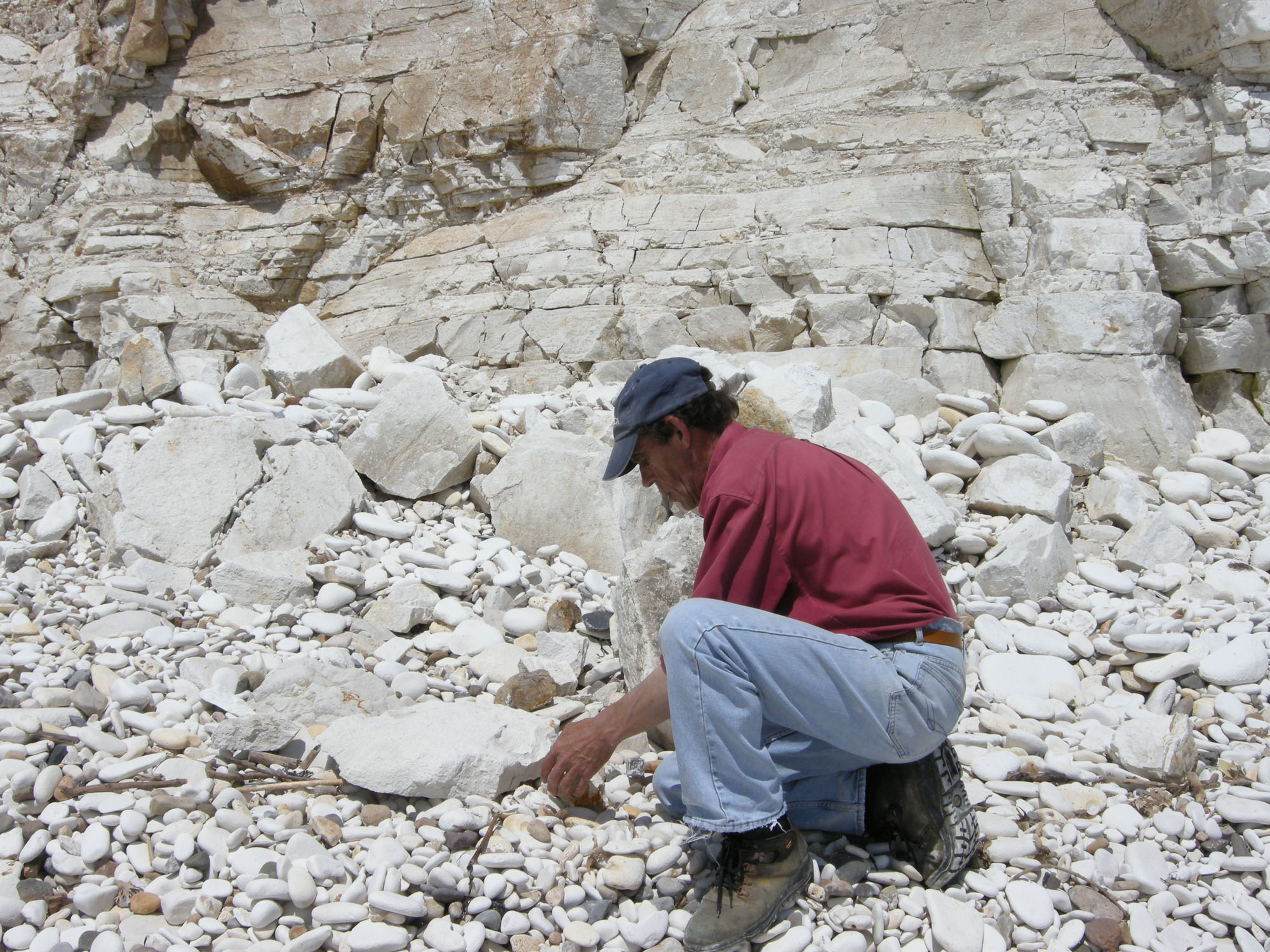
Start with the loose Chalk blocks and pebbles on the foreshore, keeping clear of the cliffs. Sponges are a major attraction, alongside echinoids, brachiopods, bivalves and belemnites. Different horizons yield different concentrations, so avoid treating every white block as the same bed.
The upper Santonian Chalk around the ravine contains Marsupites testudinarius, commonly recognised by separate ornate calyx plates and occasionally by joined plates. Older beds eastwards towards Hartendale Gutter contain Uintacrinus socialis. A collection with exact positions and retained matrix is more informative than an unlabelled mixture of loose specimens.
Younger Chalk to the west includes the famous sponge-rich succession. Look for fossil outlines on weathered block surfaces, but distinguish fossils from modern piddock borings. Do not excavate the cliff or damage attached rock platforms; take photographs of important in-situ finds and seek advice before attempting removal.


Significant fossil discoveries and geological research at Danes Dyke.
1904 – Coastal fossil zones described
A. W. Rowe’s account of the Yorkshire Chalk documented the fossil zonation of the coastal sections, including Danes Dyke, forming a basis for later bed-by-bed revisions.
1929 – An articulated starfish collected west of the ravine
E. V. and C. W. Wright found an articulated starfish west of Danes Dyke. W. K. Spencer identified it as Metopaster parkinsoni; the specimen stimulated the brothers’ later research on Chalk starfishes.
1931 – Catherine Wright finds a rare echinoid
Catherine Wright collected the near-complete cidarid echinoid that later became the type specimen of a species named in her honour. Its recorded locality is Danes Dyke West.
1989 – The echinoid is formally named
A. B. Smith and C. W. Wright described Catherine Wright’s specimen as Phalacrocidaris catherinae. The naming date is distinct from its discovery in 1931.
1993 – The Danes Dyke Member is established in a detailed coastal framework
Felix Whitham published the Flamborough Chalk member scheme and named marl markers, providing a measured framework for the Danes Dyke and Sewerby successions.
1994 – Crinoid-zone boundaries refined
Simon Mitchell’s bed-by-bed work between South Landing and Danes Dyke revised the local fossil zonation and recognised additional markers, including the Maidland Tilestone.
1995 – Upper marl markers and younger crinoids clarified
Further work recognised Danes Dyke Upper Marls 2 and 3 above the member-boundary marl and documented Uintacrinus anglicus in the younger coastal succession, refining correlation around the Santonian–Campanian transition.
2002 – Danes Dyke becomes a Local Nature Reserve
The wooded ravine and surrounding landscape were designated a Local Nature Reserve, recognising their wildlife and community value alongside the already important coastal geology.
2002–2004 – Valley-fill research develops
The research project developed following a 2002 field meeting examining deposits between the Chalk and glacial till at Danes Dyke and neighbouring sites. Formal group fieldwork began in 2004.
2012 – Periglacial and lake deposits logged
A detailed field guide distinguished Chalk-rich slope deposits, overlying laminated lake sediments and glacial till in the west-side valley fill, showing that the deposits record more than a single episode of till deposition.
GEOLOGY
The bedrock is Flamborough Chalk Formation within the White Chalk Subgroup and Chalk Group. It formed from carbonate-rich marine sediment during the Late Cretaceous. Around Danes Dyke, flintless Chalk alternates with thin clay-rich marl seams; fossil concentrations and these seams help trace the succession.
The Danes Dyke Member passes upwards into the Sewerby Member at the base of Danes Dyke Upper Marl 1. The relevant shore includes late Santonian crinoid-bearing beds and younger, early Campanian Chalk westwards. The South Landing Member belongs to the older succession farther east and should not be listed as though all three members crop out at the ravine.
The ravine follows a fault zone, and disturbed Chalk is visible near its mouth. Glacial sediment fills the valley and covers an eroded Chalk surface. Fault displacement, beach cover and falls mean the locality is not one simple continuously exposed vertical log.

The local Chalk succession and younger deposits at Danes Dyke.
This account follows the local coastal source succession, with younger superficial deposits described separately. Thicknesses below refer to published marker measurements, not to an uninterrupted section visible at every visit.
CHALK GROUP
WHITE CHALK SUBGROUP
Flamborough Chalk Formation
The formation is predominantly flintless marine Chalk with marl seams. Here the important distinction is between the crinoid-bearing Danes Dyke succession and the younger Sewerby Chalk; the full formation and all of its members are not simultaneously exposed at one access point.
Danes Dyke Member
The member’s full type succession extends from South Landing towards Danes Dyke; only its higher portion is relevant to the immediate ravine and the eastward Hartendale approach. Alternating harder and softer Chalk, pressure-solution seams and marl markers accompany the Uintacrinus socialis and Marsupites testudinarius fossil intervals.
Hartendale Marl
At Hartendale Gutter, east of Danes Dyke, this grey silty marl is normally about 20–30 mm thick, but can broaden into a chalk-and-marl interval around 100 mm thick. It lies in the Uintacrinus socialis Zone.
Maidland Tilestone
This conspicuous interval of closely spaced Chalk beds is about 1.8 m thick in the published coastal section, with individual beds around 0.1 m thick. It contains a concentration of Uintacrinus socialis remains and provides a marker in the succession east of the ravine.
Maidlands Lower Marls
Three grey, chalk-rich marl seams, approximately 20–50 mm thick, occur within about 1.4 m of Chalk. They belong to the Uintacrinus socialis interval; these are source-section measurements, not a promised exposure at a particular tide.
Maidlands Upper Marls
The two marls are separated by roughly 2.6 m of Chalk. The lower is a grey silty seam around 20–40 mm thick, locally split into two; the upper is a more chalky, gradational seam about 40–50 mm thick. Their position helps locate the lower part of the Marsupites testudinarius succession.
Danes Dyke Lower Marls
This group comprises three pale grey, partly gradational silty marls, each about 20–30 mm thick, in the Marsupites testudinarius Zone. They are useful markers within the upper Danes Dyke Member, below the member boundary.
Sewerby Member
This is the upper part of the coastal Flamborough Chalk succession. Its basal beds retain late Santonian Marsupites; younger beds westwards contain the early Campanian sponge-rich succession. Loose beach specimens need not come from the nearest visible bed. The member’s full coastal thickness is not the height of the local cliff.
Danes Dyke Upper Marl 1
The base of this grey chalky marl defines the base of the Sewerby Member. The seam is about 30–40 mm thick in the measured coastal succession and remains within the Marsupites testudinarius Zone.
Danes Dyke Upper Marl 2
The second marl is one of two additional seams recognised above the original boundary marker. It is about 15–20 mm thick and lies within the 5.8 m of Chalk above Upper Marl 1, in the basal Sewerby Member.
Danes Dyke Upper Marl 3
The third seam, also about 15–20 mm thick, is the higher of those two additional marls in the same 5.8 m interval. Upper Marls 2 and 3 are markers within the member, not further member boundaries.
Daneswood Lower Marl
A sharp-based, grey silty marl with compressed marly Chalk, about 90 mm thick. It is associated with the Uintacrinus anglicus interval above the Marsupites beds.
Daneswood Middle Marl
A compact grey seam containing silt and chalk, about 40–50 mm thick, in the younger part of the Sewerby succession traditionally assigned to the Inoceramus lingua Zone.
Daneswood Upper Marl
This approximately 50 mm grey clay-rich marl lies below the principal Flamborough Sponge Bed. Its relationship to the sponge-rich Chalk is more useful than colour alone when tracing a weathered section.
Flamborough Sponge Bed
The principal sponge-rich interval is about 11 m thick in the published coastal log. It begins roughly 2 m above the Daneswood Upper Marl and continues to about 5 m above the Longwood Marl. Sponges are distributed through a substantial thickness of Chalk, rather than confined to a single paper-thin layer.
Longwood Marl
A grey marl about 60 mm thick, containing silt and compacted clay, lies within the upper part of the principal sponge-rich interval. It is a marker within that interval, not the top of all sponge-bearing Chalk.
Alongshore limits and faulting
The Danes Dyke fault disrupts the otherwise traceable Chalk sequence. Older basal member markers such as the East Nook Marls lie farther towards South Landing; higher markers around Sewerby Hall and Sewerby Steps lie farther west. They are not added to the ravine’s local log merely because they belong to the same formation.
Periglacially fractured Chalk
At the ravine mouth, the top of the bedrock is broken and weathered beneath the valley-fill deposits. Faulting and cold-climate processes both contributed to this disturbed contact.
Lower coarse Chalk-rich slope deposit
Angular Chalk fragments in coarse silt overlie bedrock on the west side of the valley. The deposit is interpreted as cold-climate slope material with wind-blown silt incorporated into its matrix.
Upper bedded Chalk-rich slope deposit
The lower deposit grades into better-bedded, smaller Chalk fragments with thin silt layers dipping towards the valley centre. The published 2012 section gives the slope-deposit unit a maximum thickness of 2.5 m; this is not a separate thickness for each subdivision.
CALEDONIA GLACIGENIC GROUP
NORTH SEA COAST GLACIGENIC SUBGROUP
Holderness Formation
Laminated muds and sands
Up to 1.75 m of laminated mud grading upwards into laminated and ripple-marked sand overlies the slope deposits in the published west-side section. It was interpreted as sediment deposited in a lake impounded during glacier advance.
Skipsea Till Member
Till overlies the water-laid sediments as part of a complex glacial valley fill with associated sands and gravels. Its transported stones contrast with the predominantly local Chalk debris below; no complete thickness is inferred from the present cliff.
References
Flamborough Quaternary Research Group (2012): Barmston, Danes Dyke and South Landing field guide
BGS (2022): Danes Dyke valley-fill deposits and geological hazards
Whitham (1993): coastal member and marker descriptions, summarised by BGS
BGS: Danes Dyke Member and referenced studies
BGS: individual Chalk marker horizons
Geological Conservation Review: Flamborough Head
Local geological excursion: Chalk of Flamborough Head
SAFETY
Check tides and weather before setting out. Visit the rocky shore on a suitable falling tide and allow enough time to return before the route narrows; onshore winds and waves can make conditions worse than tide tables alone suggest.
Keep well away from the Chalk cliff base, overhangs and fresh falls. Blocks can fall without warning, while wet Chalk, algae and loose boulders are slippery. Do not shelter under cliffs or climb onto large unstable fallen blocks.
The steep route at Danes Dyke can be difficult for anyone with restricted mobility; use the surfaced pedestrian approach and do not try shortcuts down the ravine or cliff.
Carry a charged phone and tell someone your plan. In an emergency call 999 or 112 and ask for the Coastguard.
EQUIPMENT
Sturdy footwear, tide information, a hand lens, a camera, labels, soft wrapping and rigid specimen boxes are more useful than a heavy toolkit for a first visit.
A hammer is not essential for finding loose fossils. Avoid the cliff and attached foreshore; if work on a loose block is permitted, use eye protection and keep everyone else well clear. Leave difficult or scientifically important finds for specialist assessment.
CLEANING AND TREATING
Wrap Chalk fossils separately, keeping any loose plates with their specimen. Crinoid cups, sponges and echinoid tests can break at weak surfaces, so retain a supporting block rather than trying to remove every trace of matrix on the beach.
Dry damp finds slowly, then use a soft brush and careful work under magnification. Do not soak crumbly marl, fragile shells or iron-stained specimens indiscriminately. Chalk and many fossil shells are carbonate: household acids will damage both. Avoid bleach, wire brushes and routine varnish.
For hard Chalk, mechanical preparation is slow and delicate; stop when fossil and matrix break together. Seek experienced advice before treating unstable pyrite or marcasite, or attempting to expose a complete crinoid or starfish. Potentially significant specimens should be documented and left unprepared for specialist assessment.
IDENTIFY YOUR FINDS
Need help identifying a fossil? Share clear photos, where you found it and its size with the community.
FURTHER READING
Deposits: a fossil hunter’s guide to the Yorkshire coast (regional background)
BGS field guide: Chalk of Flamborough Head
Geological Conservation Review: Flamborough Head Chalk
BGS: Danes Dyke Member
Early collectors and significant Chalk specimens
ACCESS RIGHTS
The protected Chalk cliffs and foreshore towards Sewerby are part of the Flamborough Head Site of Special Scientific Interest (SSSI). At Danes Dyke the access route also crosses a Local Nature Reserve and an important scheduled earthwork.
Follow current signs, barriers and reserve instructions. Observe the rock sequence without cutting the cliff or damaging the foreshore, keep collecting to modest loose material where permitted, and seek the landowner or site manager’s advice if a find would require excavation.
Do not disturb the earthwork, vegetation or wildlife. Use the established paths and leave cliff and seabird habitats undamaged.
The Flamborough Head No Take Zone extends between Sewerby Steps and Danes Dyke and 700 m seawards. Do not remove living marine animals or plants, or stones carrying them. Follow the current local conservation guidance before collecting within this zone.
It is important to follow our ‘Code of Conduct’ when collecting fossils or visiting any site. Please also read our ‘Terms and Conditions’.
LINKS
♦ Fossil Discussions
♦ Fossil Articles
♦ Buy Fossils, Tools and Equipment
♦ Buy Crystals, Meteorites, and Artefacts
♦ Join Fossil Hunts
♦ UK Fossils Network


