

East Mersea preserves ancient river channels and their fossil wildlife beside the tidal shore at Cudmore Grove. Early Eocene London Clay underlies much younger deposits containing shells, wood and mammal remains. The Middle Pleistocene channel at Cudmore Grove is distinct from younger hippopotamus-bearing deposits farther west, and both need careful protection.


FIND FREQUENCY: ♦♦♦♦ – Loose finds depend on erosion and beach cover. Rich scientific assemblages do not mean abundant large bones on every visit.
CHILDREN: ♦♦♦♦ – The country park suits families, but fossil searching requires close supervision away from cliffs and mudflats.
ACCESS: ♦♦♦ – Use Cudmore Grove Country Park parking and signed beach access; check the Strood tide before travelling.
TYPE: Tidal foreshore and eroding river deposits, with older London Clay beneath.
DIRECTIONS
♦ Head to Mersea Island via the B1025, then turn east towards East Mersea and follow signs to Cudmore Grove Country Park. Broman’s Lane leads to the large country-park car park, CO5 8UE. Parking charges apply; check the gate-closing time before setting off.
♦ From the car park, follow the park paths to the foreshore and head southwest (right) towards the collecting stretch.
♦ The Strood causeway can flood at high tide. Plan both journeys around conditions and never drive through floodwater; wait for the road to be safe.
♦ At the shore, follow current notices and search only accessible beach material. Do not descend the eroding cliff or cross the mudflats to reach a channel deposit.
♦ Locality reference: 51.79041°N, 0.99496°E
♦ What3Words collecting area: ///celebrate.warm.sport
FOSSIL HUNTING
The London Clay provides the oldest fossil material, but East Mersea’s greatest scientific importance lies in its Pleistocene river channels. Beach finds must be recorded carefully because erosion mixes deposits of different ages, and modern shells occur alongside older material. Not every shell on the shore is a fossil.
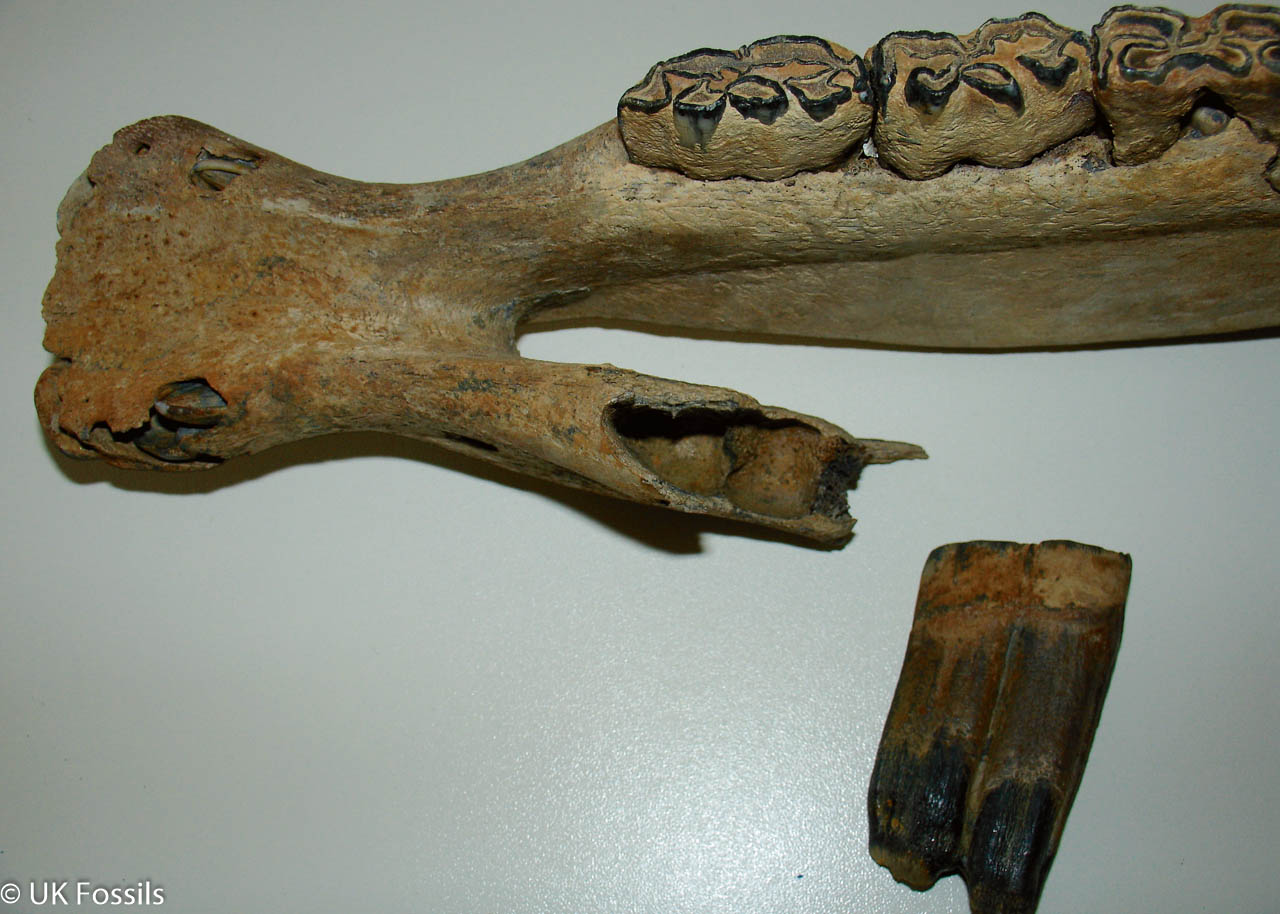
Specialist investigation of the Cudmore Grove channel recovered a rich assemblage from a thin detritus-rich mud. It includes macaque, beaver, bear and other mammals, together with fish, amphibians, reptiles and birds. Published examples include Macaca sylvanus, Castor fiber and Ursus arctos. These carefully sampled scientific records should not be presented as common loose beach finds.
Younger channels farther west contain a different fauna, including hippopotamus. The Restaurant Site and the Hippopotamus Site are separate exposures and should not be merged with the older Cudmore Grove assemblage. The changing shoreline may hide scientifically important layers beneath beach sediment.
Search naturally eroded loose material only. Photograph unusual bone or possible archaeology where it lies, note its position and matrix, and seek specialist advice. Do not dig into a channel, remove large sediment samples or pull a fragile bone from the bank merely because the beach is publicly accessible.


A chronological record of fossil discoveries and geological research at East Mersea.
1908 – Interglacial sediments recognised
Dalton compared East Mersea’s fossiliferous sediments with those at Clacton, providing an early geological interpretation of the island’s Pleistocene record.
1917–1933 – Rich mammal-bearing deposits recorded
Warren documented the bone-rich deposits associated with the later Restaurant Site. These early records should not be transferred indiscriminately to the separate Cudmore Grove Channel.
1934 – Restaurant Site excavation
Dorothea Bate and J. Reach investigated the fossil-bearing deposits, contributing specimens and records to the study of the locality.
1964 – Hippopotamus informs the age interpretation
Sutcliffe recognised the importance of hippopotamus in assigning the younger East Mersea deposits to the Ipswichian interglacial rather than the older Hoxnian sequence.
Late 1960s – Further investigation of the younger channel
Work by Ruth Gruhn, Alan Bryan and H. E. P. Spencer added to the fossil collections and sedimentary record of the Restaurant Site.
1987 – Cudmore Grove investigated
A Geological Conservation Review excavation at Cudmore Grove coincided with a Geologists’ Association excursion and helped document the fossiliferous channel sequence beneath the beach.
1988 – Distinct channel systems described
Bridgland and colleagues distinguished the older Cudmore Grove deposits from the younger Restaurant and Hippopotamus sites, clarifying the complex local succession.
1990 – Exceptional reptiles and amphibians reported
Holman and colleagues documented the rich Cudmore Grove herpetofauna, including important additions to the British Pleistocene record.
1994 – A detailed conservation synthesis
The Geological Conservation Review brought together the sedimentary, fossil and river-history evidence for the East Mersea sites.
2009 – Cudmore Grove age and stratigraphy revised
Roe and colleagues combined pollen, animal fossils, amino-acid evidence and sea-level history to favour MIS 9 for Cudmore Grove, while retaining an Ipswichian interpretation for the younger hippopotamus-bearing channel. They formally defined the Cudmore Grove Member and distinguished six principal units in the full sequence.
GEOLOGY
The Eocene London Clay forms the bedrock beneath several much younger river channels. At Cudmore Grove, sand and gravel on the channel floor are overlain by estuarine and organic sediments that preserve an unusually detailed record of an interglacial landscape.
Modern multidisciplinary work correlates the Cudmore Grove Member with Marine Isotope Stage 9, roughly 300,000 years ago. This revises the older Hoxnian interpretation. Its layered fill includes sandy clay, silty clay, shelly silt, a fossil-rich detritus mud, organic clay and a thin upper grey clay. Each records a different part of the changing river and estuary.
The overlying Mersea Island Member consists of sands and gravels with erosional contacts and evidence of later freezing and ground disturbance. Its lower and upper units vary laterally, so measurements from different parts of the cliff cannot simply be added into one universal thickness.
The younger Restaurant and Hippopotamus sites belong to a separate last-interglacial landscape, generally correlated with the Ipswichian or Marine Isotope Stage 5e. They are not a continuous younger layer stacked directly above the Cudmore Grove channel. The expanded section below keeps these different exposures distinct.

Detailed geology and stratigraphy of East Mersea.
Two different Pleistocene channel systems are represented along East Mersea. The following main sequence is the Cudmore Grove Channel; the younger Restaurant and Hippopotamus sites are described separately and must not be treated as additional beds in the same vertical section. Measurements come from published cliff, foreshore and borehole investigations and vary laterally.
THAMES GROUP
London Clay Formation
Eocene bedrock
Marine London Clay forms the substrate into which much younger rivers cut their channels. Its member-level assignment is not established here. Later freezing, thawing and slope movement locally distorted or remobilised the clay.
A separate Pleistocene river-deposit framework
The much younger deposits below are not part of the Eocene Thames Group. Their detailed local subdivision follows Roe and colleagues’ 2009 scheme. The current BGS Lexicon treats Lower Thames Formation as an obsolete name within its Maidenhead Formation framework; an explicit modern BGS reassignment of the named Mersea members has not been established here, so their published local terminology is retained with that qualification.
Lower Thames Formation (Roe et al., 2009 terminology)
Cudmore Grove Member
Roe and colleagues formally defined this member in 2009 for Units 1–5, using borehole CG1 as the stratotype. Their combined fossil, amino-acid and sea-level evidence favoured Marine Isotope Stage 9, superseding the older correlation with the Hoxnian deposits at Clacton.
Unit 1 — basal sands and gravels
The channel-floor deposit reaches 3.10 m in borehole CG1 but thins towards the south-western margin to a pebble lag only 1–2 cm thick in the later survey. Its mixed clast assemblage records reworking from several older deposits; deposition by the Thames–Medway or an associated tributary was considered. It rests directly on the eroded London Clay.
Unit 2a — sandy clays
Massive dark grey sandy clay occupies the basal part of Unit 2. It is commonly 0.5–1 m thick and reaches 1.2 m in CG1, thinning towards the channel margin.
Unit 2b — lower silty clays
Brown-grey silty clay contains thin horizontal or gently inclined sand layers and occasional shell fragments. A thickness of about 3 m was recorded between boreholes CG1 and MM5.
Unit 2c — shelly silts
Massive dark grey silt contains dispersed shell debris. It ranges from less than 1 m towards the south-west to approximately 5 m near MM5. Farther east it is truncated by younger Holocene estuarine sediment.
Unit 2d — upper silty clays
Green-grey silty clay, approximately 0.5 m thick, includes occasional horizontal sand beds, scattered wood and shell fragments.
Unit 3 — shelly detritus mud
Dark brown silty clay with abundant broken shell rests sharply on Unit 2, with coarse sand marking the contact. This exceptionally fossiliferous deposit yielded small vertebrates, molluscs and insects. Earlier observations recorded up to 0.30 m; the later survey found a maximum of 0.15 m near MM3, with rapid thinning into a 2–3 cm sandy layer and eventual disappearance. These are changing local observations, not a uniform bed thickness.
Unit 4 — organic clays and compressed wood
Organic clay abruptly replaces shell-rich detritus mud. The unit reaches 2.5 m in the south-western part of the site. A basal 0.20–0.50 m interval of compressed wood interlayered with organic clay is overlain by approximately 1–2 m of more massive organic clay with scattered wood. Three tree trunks were recorded, one retaining roots. Compaction and local deformation affect both parts. The unit thins against the rising London Clay and is cut out north-eastwards by Unit 6.
Unit 5 — grey clays
Massive grey clay, 0.05–0.30 m thick, completes the channel fill. Its lower contact may be transitional or abrupt. Eastwards it can rest directly on Unit 2 before disappearing. This separate unit was not distinguished in the older five-bed GCR summary.
Mersea Island Member
Unit 6 — upper sands and gravels
The member, formerly called the Mersea Island Gravel, forms approximately 4–5 m of the Cudmore Grove cliff sequence. The maximum thicknesses of its component facies occur at different places and must not be added together to create a single measured section.
Unit 6a — lower cross-bedded sands
The lower 2–3 m consists chiefly of sand with subsidiary gravel, resting sharply on the fine-grained channel deposits. Foresets 15–50 cm thick dip at approximately 5–20 degrees and indicate flow towards the north-north-east. Thin grey clay layers, locally 1–5 cm thick, interrupt the sandy facies.
Unit 6b — upper clast-supported gravels
The upper gravel-rich facies locally reaches about 3 m and truncates the lower sands. Smaller cross-sets indicate south-easterly flow. Ice-wedge casts and other deformation record periglacial conditions. Towards the south-west, gravel is interspersed with oxidised silty-clay lobes interpreted as soliflucted London Clay.
Separate younger channel — Restaurant Site
About 1.5 km south-west of the main Cudmore Grove exposure, a different channel contains the local Restaurant Gravel. The historical measured sequence comprises approximately 0.4 m of mammal-bearing gravel, 0.2 m of grey sandy silt with bones and shells, and 1.0 m of weathered brown clayey silt, above London Clay. The fossil assemblage and later analysis support an Ipswichian, or MIS 5e, age and deposition within the Blackwater drainage system.
Separate younger channel — Hippopotamus Site
Bone-bearing silty pockets occur in the London Clay foreshore near TM 066 143, interpreted as basal scours associated with the same younger system. Similar gravel is largely hidden beneath beach material. Nearby cliffs expose more than 2 m of bedded silt, sand and gravel stringers, with later cold-stage aggradation inferred. The limited fauna at this particular exposure should not be expanded by copying every species from the Restaurant Site.
Periglacial modification between the channels
Gravel-filled involutions, remobilised clay and displaced pockets of older gravel record freezing, thawing and ground movement. These structures can juxtapose sediment of different origins without representing normal depositional superposition.
The rich Cudmore Grove detritus-mud fauna includes woodland and aquatic animals such as Macaca sylvanus, Castor fiber and Ursus arctos. Hippopotamus belongs to the separate younger channel assemblage. Preserving the exact find location and sedimentary context is therefore essential.
References
BGS: Maidenhead Formation and previous terminology
Roe et al. (2009): Cudmore Grove stratigraphy and age
GCR: East Mersea Restaurant and Hippopotamus sites
GCR: Quaternary of the Thames, Essex chapter
SAFETY
The Strood causeway floods at some high tides. Never attempt to drive through floodwater: wait and reassess the journey. Check beach tides separately and keep a safe return route.
Stay away from eroding cliff faces and deep mud. Firm-looking patches do not prove that surrounding sediment will support a person. Supervise children near the water and avoid entering mudflats to reach fossil-bearing sediment.
EQUIPMENT
Take sturdy footwear, tide information, a charged phone, a hand lens and a camera. Small padded rigid boxes and labels are more useful than excavation tools for ordinary beach searching. Leave fragile bones supported in matrix and do not bring a spade to dig into scientific channel deposits.
CLEANING AND TREATING
Bone, thin shells and organic wood can be fragile and only partly mineralised. Support them in matrix or a padded rigid box and avoid rubbing, soaking, acids, bleach and varnish. Robust loose teeth may be gently brushed.
Waterlogged wood and fragile wet bone should not be dried rapidly. Seek conservation advice before treatment, and keep potentially significant material unprepared with its find details for museum or specialist review.
IDENTIFY YOUR FINDS
Need help identifying a fossil? Share clear photos, where you found it and its size with the community.
FURTHER READING
Deposits: The geology of Essex (regional background)
Roe and colleagues (2009): Cudmore Grove interglacial deposits
GCR: Thames–Medway deposits (historical age interpretations)
GCR: East Mersea Restaurant Site
Explore Essex: Cudmore Grove visitor and collecting information
Essex Fire Service: Strood flooding safety warning
ACCESS RIGHTS
Cudmore Grove and the associated geological exposures form part of the protected Colne Estuary area. Follow the country park’s advice to search on the beach and keep away from eroding cliffs. Access does not permit excavation of the scientifically important channel fills; obtain the relevant permission for any sampling and avoid disturbing wildlife or habitats.
It is important to follow our ‘Code of Conduct’ when collecting fossils or visiting any site. Please also read our ‘Terms and Conditions‘
LINKS
♦ Fossil Discussions
♦ Fossil Articles
♦ Buy Fossils, Tools and Equipment
♦ Buy Crystals, Meteorites, and Artefacts
♦ Join Fossil Hunts
♦ UK Fossils Network


