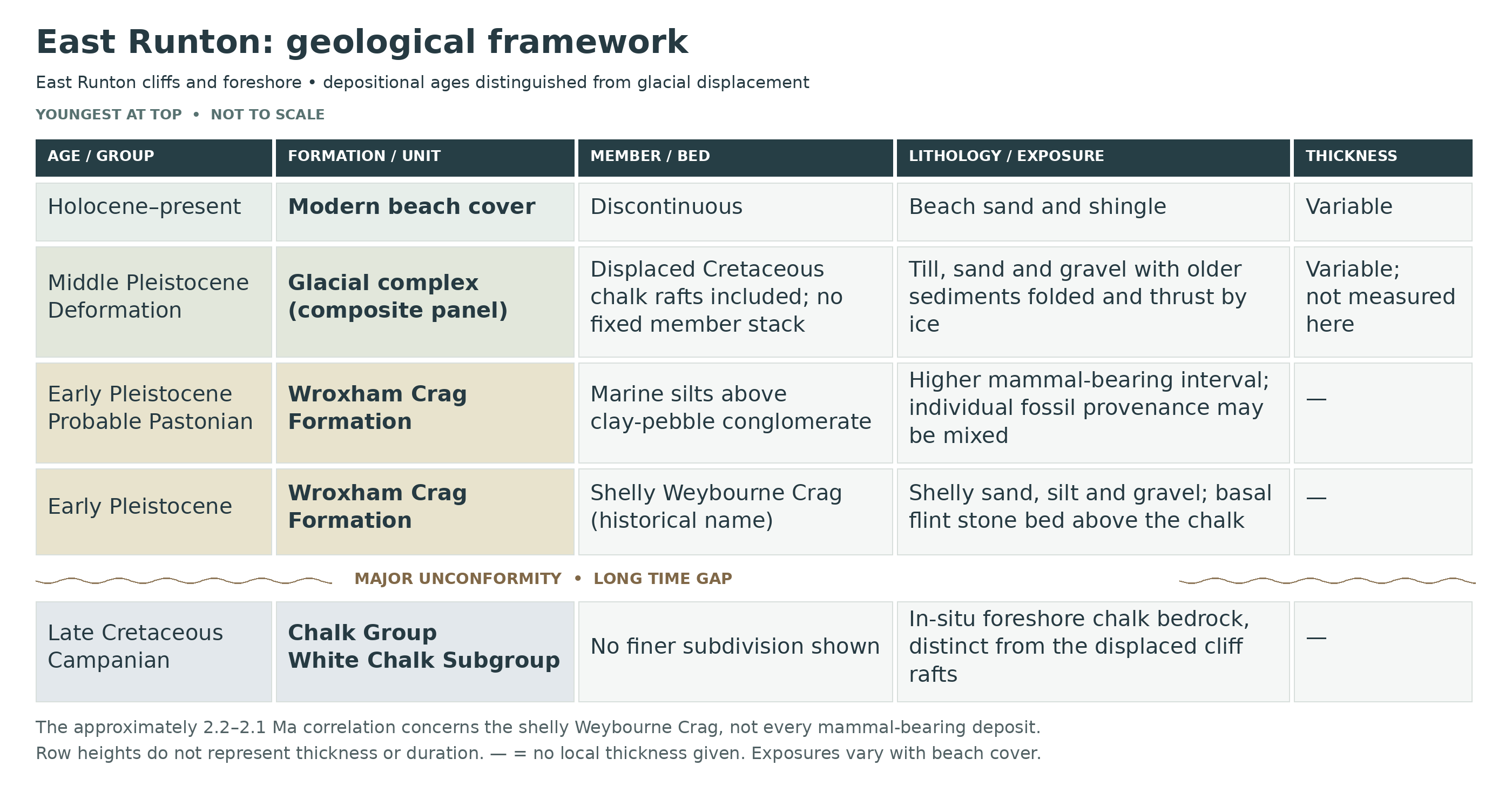
At East Runton, ancient mammal remains occur beside evidence of powerful Ice Age deformation. Shelly Early Pleistocene deposits appear on the foreshore when sand is stripped away, while enormous glacially displaced chalk rafts rise within the cliffs towards Wood Hill. Loose belemnites, echinoids, bone fragments and occasional teeth make careful beach searching worthwhile, although exposure and preservation vary greatly. This is a different fossil assemblage from the famous Freshwater Bed at West Runton. Keep a precise record of where each specimen was found and explore only while the tide leaves a safe route back to East Runton Gap.


FIND FREQUENCY: ♦♦♦♦♦ Fossils occur in loose beach material, but shifting sand and recent erosion strongly affect what is exposed.
CHILDREN: ♦♦♦♦ The open beach can suit supervised family visits; keep well away from cliffs and return before the tide restricts access.
ACCESS: ♦♦♦ Use the established beach access; shingle, wet chalk and soft sediment can make walking uneven.
TYPE: Cliff geology and loose foreshore material.
DIRECTIONS
♦ Follow the A149 west from Cromer to East Runton and take the signed turning towards the beach. North Norfolk District Council lists the Beach Road car park at NR27 9PA; it is a grass-surfaced, chargeable car park with a height restriction and nearby toilets. Check the entrance signs for current charges and vehicle limits.
♦ Follow the established slope through East Runton Gap to the shore. The Wood Hill chalk rafts and fossil-bearing foreshore lie west, or left, of the access when facing the sea. Keep the walk within your low-tide window and do not assume that a route beneath the cliffs remains passable as the tide rises.
♦ What3Words collecting area: ///comical.poets.toenail

A FIELD GUIDE TO COLLECTING BRITISH CENOZOIC FOSSILS
by Steve Snowball & Alister Cruickshanks
£21.99 (PAPERBACK)
FULL COLOUR – 190 PAGES
Available worldwide exclusively through Amazon
- Fossil identification plates
- Stunning locality and fossil photos
- Up-to-date geological & site information
- Best fossil-bearing sites in southern and eastern Britain described in detail
- Illustrations of life in deep time by Andreas Kurpisz
FOSSIL HUNTING
Search shingle and washed-out material. Look among loose flints and pebbles for the smooth, bullet-shaped guards of belemnites, rounded echinoid tests and dark fragments of bone or antler. A tooth may retain shiny enamel or repeated ridges despite being broken. Sand cover can conceal nearly all of the underlying beds, so an unproductive visit does not mean the locality has ceased to yield fossils.
Keep the mammal horizons distinct. East Runton’s historically important large-mammal collection includes southern mammoth Mammuthus meridionalis and comb-antlered deer Eucladoceros tetraceros. The extinct elk Cervalces gallicus has also been reported from shelly Crag at the site. Fossils of horses, rhinoceroses and carnivores form part of the documented fauna, but many old large specimens were collected loose and cannot be tied securely to one bed. Do not identify every mammoth tooth as the younger steppe mammoth familiar from West Runton.
Much of the large-mammal material came from a ferruginous clay-pebble conglomerate above the lower shelly “Weybourne Crag”. Small-mammal teeth are more securely associated with the lower Crag. Published records include Borsodia newtoni, Pitymimomys pitymyoides, Mimomys pliocaenicus, Mimomys tigliensis and Mimomys reidi. These minute fossils are significant for dating the deposits; they are not conspicuous targets for a casual beach walk.
Marine shells and Chalk fossils. The shelly Crag preserves a shallow-marine fauna, with dog-whelk Nucella lapillus used in modern dating comparisons. Chalk-derived finds include belemnites, echinoids and other marine invertebrates. A local collection records Micraster, but loose chalk fossils may come from the shore platform, displaced chalk masses or reworked material. Record the rock attached to a find rather than assigning its source from its position alone.
Leave embedded fossils and undisturbed beds intact unless the appropriate permissions have been obtained. For a significant bone, antler or tooth, take photographs, note its exact position and retain attached sediment. Do not follow an exposed fossil into the cliff or underneath a chalk mass.


A chronological record of fossil discoveries, geological research and conservation milestones at East Runton.
1882 – Runton beds documented
Clement Reid’s Geological Survey work described the local Crag and associated deposits, providing a baseline for later investigations of their fossils and relationships.
1890 – Mammal-bearing conglomerate distinguished
Reid described the occurrence of larger mammal remains in the conglomerate above the shelly Crag at East Runton, a distinction that remains important when evaluating old collections.
1953 – Fossil deer reassessed
Augusto Azzaroli’s study of Norfolk fossil deer considered East Runton material, including an extinct elk jaw reported from shelly Crag above the stone bed. Such recorded provenance helped separate specimens from the broader loose coastal assemblage.
1980 – Preglacial sequence and pollen reviewed
Richard West’s coastal synthesis described the East Runton section and its Pastonian pollen evidence. The work linked the mammal-bearing conglomerate with the overlying marine silts.
1985 – East Runton Cliffs SSSI notified
The site was notified as a distinct protected cliff and foreshore section, incorporating part of the earlier West Runton Cliffs SSSI and an extension.
1986 – Early Pleistocene voles revised
David Mayhew and Anthony Stuart’s revision of eastern English fossil voles included the East Runton Crag assemblage, strengthening its value for comparing and dating Early Pleistocene deposits.
1996 – Mixed fossil provenance examined
Adrian Lister’s stratigraphic analysis drew attention to the unusually varied deer assemblage at East Runton and the possibility that the large-mammal material represented more than one episode.
2020 – Crag fauna and chronology re-evaluated
A major study compared the East Runton molluscs and small mammals with other British and North Sea sequences. The work reinforced the need to distinguish the older shelly Crag from the overlying large-mammal-bearing conglomerate.
GEOLOGY
Chalk in two settings. Upper Cretaceous chalk underlies the coast and can emerge through the beach at low tide. The conspicuous white masses in the cliff towards Wood Hill have a different structural position: ice detached and displaced chalk, sometimes together with its younger sedimentary cover. Consequently, old chalk can now stand above younger Pleistocene deposits without representing normal deposition in that order.
An older coastal fauna. The Early Pleistocene shore deposits include a basal flint-rich stone bed, shelly sands traditionally called “Weybourne Crag”, and younger clay-pebble conglomerate and marine silts. Modern work includes the Weybourne Crag within the Wroxham Crag Formation. The fossil assemblages and pollen distinguish more than one episode; the whole foreshore must not be assigned one age simply because the sediments look similar.
The older shelly horizon has been linked by modern work to an interval around 2.2–2.1 million years ago. The overlying, commonly called Pastonian, large-mammal-bearing deposits should not automatically inherit that date. Some historic large-mammal collections may combine material from different horizons or locations. This explains why precise provenance is especially valuable at East Runton.
Ice-disturbed upper cliffs. Glacial till, sand and gravel were folded, thrust and mixed, producing the historical “Contorted Drift”. Sand-filled basins and chalk rafts interrupt the apparent layering. Older diagrams that put glacial sand, Crag and “Beeston Chalk” into a uniform vertical stack oversimplify a section whose defining feature is displacement. The foreshore and cliff must be interpreted together, with separate attention to depositional age and later glacial movement.


Detailed geology and stratigraphy of East Runton.
Local beds and displaced masses
The original order below is reconstructed from the East Runton foreshore and adjoining cliff descriptions. It is not a uniform vertical section through Wood Hill: chalk and preglacial cover were moved by ice, and modern beach sediment conceals different parts at different times.
Chalk Group
Late Cretaceous chalk occurs both as foreshore bedrock and in displaced masses. A chalk slab within till remains Cretaceous; its elevation records later movement rather than a younger depositional age.
White Chalk Subgroup
The coastal literature identifies Upper Campanian chalk along the Runton shore. Individual rafts cannot be assigned a complete regional succession from their colour or position alone.
Paramoudra Chalk Member
The East Runton–Cromer foreshore exposes chalk traditionally assigned to this division. Large cylindrical flints and ordinary flint seams are useful lithological features, but an individual flint does not identify a unique bed. No complete named-flint log has been verified for the exact East Runton collecting area, so higher Overstrand marker beds are not imported here.
Eroded Chalk surface
Where the original foreshore contact survives, the base of the preglacial sequence rests on eroded chalk. This is a major unconformity. Within a raft, a chalk–Crag contact can remain internally intact although the entire package has moved.
Crag Group
The fossil-bearing marine foreshore beds belong to the marine Crag succession, not automatically to the freshwater Cromer Forest-bed Formation.
Wroxham Crag Formation
Modern usage includes both the older Weybourne Crag and younger marine deposits formerly grouped more broadly with the Forest-bed succession. The bed descriptions below distinguish their relative positions without assigning every loose mammal fossil to one horizon.
Basal stone bed — West’s bed b
Iron-stained flint gravel occurs on the Chalk surface. This basal lag is distinct from the younger clay-pebble conglomerate above the shelly Crag.
Shelly Weybourne Crag — West’s bed c
Shelly sands and associated fine sediment overlie the stone bed. Most securely provenanced small mammals, molluscs and ostracods belong to this interval; the marine fauna indicates shallow coastal water.
Dunwich Group — intervening freshwater deposition
Freshwater sediment between the older marine Crag and the younger marine return is separated here from the marine formation.
Cromer Forest-bed Formation: freshwater interval
The freshwater muds fit the freshwater formation framework, but the cited historical account does not establish a secure modern member assignment for this exact horizon.
Freshwater muds above the Weybourne Crag
Stuart’s East Runton account records freshwater muds above the shelly Crag, with pollen assigned by West to Pre-Pastonian d. The d denotes a pollen substage here; no bed letter or thickness is inferred from it. A later marine return follows in the local record.
Crag Group — younger marine return
Marine deposition resumed after the intervening freshwater episode.
Wroxham Crag Formation: younger marine deposits
The higher conglomerate and overlying silts belong to the younger marine part of the local record.
Paston Member: higher marine interval
The Pastonian marine sediments are included in the Wroxham Crag Formation in the modern BGS coastal classification. The freshwater interlude and erosional break separate the older and younger marine records.
Erosional break above the shelly Crag
The higher conglomerate rests on an eroded surface. It must not be treated as the uppermost part of one continuously accumulated shell bed.
Clay-pebble conglomerate — West’s bed e
Ferruginous gravel contains reworked clay fragments and marine shells. Many historic antlers and elephant teeth came from this higher interval; their assemblage may combine more than one episode.
Overlying marine silts
Marine silts above the conglomerate preserve pollen attributed to Pastonian zone Pa II. This is a pollen correlation, not a numerical date applicable to all East Runton finds.
Thickness and fossil provenance
The older textbook description estimated the clay conglomerate at probably 2–3 m thick. That is a qualified historical estimate, not a current exposed thickness. The lower Crag’s small-mammal assemblage and the higher conglomerate’s large-mammal assemblage must be kept separate. No secure thickness has been recovered for every individual East Runton bed.
Albion Glacigenic Group
The cliff sequence above and around the preglacial beds has undergone intense folding, detachment and mixing. Individual depositional beds and later shear zones need to be distinguished.
Sheringham Cliffs Formation — BGS framework
The BGS framework includes the local Runton and Bacton Green tills and sand-and-gravel basins. Its regional member list is not a complete measured East Runton cliff log.
Runton Till Member
Dark grey to brown diamicton contains drawn-out sand and chalk lenses and reworked older till. A sharp basal surface can truncate marine Crag; the transition upward into Bacton Green Till is more gradational. Although the member extends to East Runton, its quoted 9 m maximum is from the Beeston-area stratotype and is not an East Runton measurement.
Bacton Green Till Member
Stony till alternates with sorted sand, silt and clay, recording a mixture of glacial sediment supply and water deposition. Later deformation can strongly alter the original layering. Its type locality is at Bacton Green; neither that section’s thickness nor every bed in it is transferred to East Runton.
Runton Cliffs Sand and Gravel Member
The unit extends between East Runton and Sheringham. Cross-bedded, rippled and channelised sand alternates with gravel and occupies basins within underlying till. Basal scour and subsequent loading complicate the geometry; the basin fill is not a laterally continuous flat cap.
Wood Hill chalk rafts and structural repetition
Historic direct observations record repeated sets of chalk beds near East Runton, with overthrust slices and folds truncated by later movement. Some masses retain Crag cappings. This evidence explains why older chalk appears high in the cliff and why a depositional chart cannot be read straight onto the cliff face.
Later structural terminology
Lee and colleagues’ 2017 framework recognises mélange and successive deformation surfaces across the Runton coast. It reorganises parts of the same glacial complex rather than adding an extra stack above the BGS members. A locally traced structural contact is needed before assigning a particular face to the alternative units.
References
Preece and colleagues (2020). Weybourne Crag palaeontology and dating, especially East Runton section3.1.1.3.
BGS. Cromer district, Sheet131.
Natural England. East Runton Cliffs citation.
Stuart (1982). Pleistocene Vertebrates in the British Isles: East Runton account.
BGS Lexicon. Runton Till Member.
BGS Lexicon. Bacton Green Till Member.
BGS Lexicon. Runton Cliffs Sand and Gravel Member.
Lee and colleagues (2017). Middle Pleistocene glacial evolution of northern East Anglia.
SAFETY
Time the walk for a falling tide and return early. The sea can reach the base of the cliffs and cut off the route west of the gap; do not rely on climbing a slip or cliff face to escape. Keep clear of groynes and submerged projections when waves are breaking.
The chalk rafts and surrounding soft deposits can shed material without warning. View them from the open beach rather than standing beneath them. Avoid recent landslips and soft mud, and expect slippery seaweed, pools and sharp flints underfoot. Children need close supervision on the rocky foreshore.
EQUIPMENT
Bring tide information, sturdy footwear, a hand lens, camera, labelled bags and padded rigid boxes for fragile teeth and bone. The recommended visit is a surface search: leave hammers, picks and chisels out of the collecting routine rather than using them to break protected beds or cliff material.
CLEANING AND TREATING
Do not pull a tooth or bone free from hard iron-cemented gravel. That matrix can hold a fragile specimen together, and forcing it away often removes the surface needed for identification. Photograph and label finds before any cleaning; loose chalk fossils and Crag mammals should remain separately labelled.
Begin with a soft brush on sound, dry specimens. A stable chalk or flint fossil may tolerate gentle fresh-water rinsing, but crumbly bone, cracked teeth and soft shelly matrix should not be soaked or scrubbed. Avoid acids, bleach, varnish and aggressive tools. Let ordinary stable wet specimens dry gradually; seek conservation advice promptly for very soft or waterlogged material. Significant specimens are best assessed before preparation or consolidation.
Identify your finds
Need help identifying a fossil? Share clear photos, where you found it and its size with the community.
FURTHER READING
Deposits Magazine: fossil voles as stratigraphic aids
BGS: geology of the Cromer district
Preece and colleagues: Weybourne Crag fossils and dating
Natural England: East Runton Cliffs SSSI
Field guide: West Runton to East Runton
Jonathan Stewart collection: East Runton specimens
Norfolk Museums and council: responsible fossil collecting
ACCESS RIGHTS
East Runton Cliffs SSSI protects the preglacial foreshore sequence and the glacially displaced cliff deposits. Check current signs and landowner arrangements; access to the beach is not permission to excavate. Concentrate on loose beach material in accordance with current Norfolk Museums and council advice, and obtain the relevant permissions before disturbing an exposure. Important finds should retain exact locality information and clear ownership if they are offered to a museum.
It is important to follow our ‘Code of Conduct’ when collecting fossils or visiting any site. Please also read our ‘Terms and Conditions‘
LINKS
♦ Fossil Discussions
♦ Fossil Articles
♦ Buy Fossils, Tools and Equipment
♦ Buy Crystals, Meteorites, and Artefacts
♦ Join Fossil Hunts
♦ UK Fossils Network