Porchfield is the name used locally here for a remote and largely unnamed stretch of coastline west of Burnt Wood, on the north-western side of the Isle of Wight. The locality is best known for exposures associated with the Bembridge Insect Bed, one of Britain’s most important fossil insect horizons. Exceptionally preserved insects, plants and other delicate fossils can occur within the fine-grained limestone and marl, making this a specialist but potentially very rewarding location.


FIND FREQUENCY: ♦♦♦ – Porchfield is a specialist fossil-insect locality rather than a site where fossils are found quickly. The Bembridge Insect Bed can produce exceptionally preserved insects and other delicate fossils, but considerable patience is required. Suitable material needs to be located, split carefully and examined closely, often with a hand lens, and several hours of work may produce only a small number of worthwhile specimens.
CHILDREN: ♦ – This is not an ideal locality for children. The walk is long, the collecting is highly specialised and most fossils are very small and difficult to recognise. There is also little immediate reward compared with more traditional fossil beaches, making the site better suited to experienced collectors.
ACCESS: ♦♦ – Access is fairly demanding. Parking around Porchfield can be difficult and the walk to the collecting area is lengthy. The route also passes close to the military firing range, and road or access restrictions may occasionally be in place. Always check local signs and obey any closures or MOD instructions.
TYPE: Remote coastal cliff and foreshore locality. The site consists of low cliffs, slipped material and intermittent exposures of Bembridge Marls and insect-bearing limestone. Collecting is specialist in nature and is best suited to careful, experienced fossil hunters.
DIRECTIONS
♦ Parking close to the locality is very limited. The nearest practical starting point is around Porchfield Village Hall, although the small parking area there is intended for hall users. If visiting, avoid obstructing the hall and only use the very end of the lay-by area where appropriate. Postcode: PO30 4LT; Google Maps.
♦ From Porchfield, follow the public footpath along Elmsworth Lane, continuing through Elsworth Farm. The route then turns north-west and follows the countryside towards the coast, passing through farmland and over several stiles.
♦ Keep Burnt Wood to your right as you continue along the footpath. The walk is fairly long and can be muddy, especially during the winter months or after prolonged rain.
♦ Eventually the footpath reaches the shoreline. From here, turn west and continue along the coast. The unnamed cliffs used for this guide lie further along this stretch beyond Burnt Wood.
♦ The area lies close to the military firing range, so access can occasionally be affected by closures or restrictions. Always obey warning signs, barriers and any MOD instructions in place at the time of your visit.
♦ What3Words collecting area: ///moats.brush.blurs
VIDEO FILM
FOSSIL HUNTING
The principal reason for visiting Porchfield is the famous Bembridge Insect Bed, which occurs close to the base of the Bembridge Marls Member. Although often called the Insect Limestone, it is not represented everywhere by a single continuous limestone layer. The fossil-bearing interval can include thin tabular limestone, harder marl and irregular concretionary limestone surrounded by much softer clay and mudstone.
The extremely fine-grained nature of the limestone allowed very delicate organisms to be preserved. Fossil insects may include wings, legs, bodies and occasionally remarkably complete specimens. Many are extremely small and can easily be overlooked, so freshly exposed surfaces should always be examined carefully with a hand lens.
Ants and other Hymenoptera form a particularly important part of the fauna. Fossil ants are exceptionally diverse, together with numerous wasps and much rarer bees. Fossil species of the weaver-ant genus Oecophylla are among the better-known elements of the Bembridge insect fauna; the genus also has living representatives.
Beetles are also extremely diverse. Recorded forms from the Bembridge Insect Bed include Agabus latissimus, Ilybius gratshevi, Spercheus punctatus, Spercheus wightensis, Hydrochara woodwardi, Berosus barclayi, Aphodius vectis, Scirtes wightensis, Contacyphon insularis, Eucinetes nikolaevae and Macropunctum rossi. Both aquatic and terrestrial beetles occur, reflecting the mixture of wetland, freshwater and surrounding terrestrial habitats.
Flies are another major part of the assemblage, together with caddis-flies such as Beraeodes vectensis, Beraeodes anglicus, Bembridgea insularia, Plectrocnemia incompleta, Wormaldia longaeva and Paleodicella anomala. Cockroaches including Phyllodromica protosardea, Balta protosimilis and Malaccina wightensis have also been described, while praying mantises, earwigs and a wide variety of other insect groups occur.
The bed is equally interesting for fossils other than insects. The crustaceans Branchipodites vectensis and Eosphaeroma margarum are characteristic examples, while the freshwater ostracod Potamocypris brodiei may also occur. Fossil spiders are known from the assemblage, together with occasional exceptionally delicate remains such as bird feathers.
Molluscs provide further evidence of the environment in which the bed formed. Freshwater gastropods include Galba longiscata, Planorbarius discus, Gyraulus similis, Hippeutis headonensis, Viviparus lentus and Viviparus angulosus. Tarebia acuta indicates somewhat more brackish conditions, while the bivalve Polymesoda obovata also occurs.
Plant remains are particularly important and the Insect Bed is the main source of the famous Bembridge flora. Leaves, seeds, fruits and other plant material accumulated alongside the insects, providing evidence for marshes, open water, shrubs and wooded habitats around the ancient lagoon.
Vertebrate remains are much rarer but can include fish, lizards, birds and mammals. These are generally represented by very small bones, teeth or fragments, although exceptionally delicate material such as lizard skin and bird feathers has also been recorded from the wider Insect Bed.
Collecting here is very different from searching for large fossils on a Jurassic beach. The best specimens can be tiny and may appear only as a faint dark outline or wing impression on a freshly split surface. Loose pieces of suitable fine-grained limestone should therefore be split carefully and examined closely.
Once an insect or other delicate fossil has been recognised, further splitting should stop. Complete specimens can be destroyed extremely easily, and preparation is best carried out slowly under magnification rather than attempted on the beach.


Key fossil discoveries, geological records and collecting-history milestones from the Porchfield coast west of Burnt Wood, Isle of Wight.
c.1859 onwards – A’Court Smith’s collecting ground established
E.J. A’Court Smith began collecting fossils from the north-west Isle of Wight coast between West Cowes and Newtown River by the mid-19th century. Many older fossils from the Bembridge Insect Bed were later labelled Gurnet Bay or Gurnard Bay, so exact find-spots can be difficult to separate, but this collecting coast includes the Burnt Wood and Saltmead Ledge exposures now often treated locally as the Porchfield stretch.
1874 – first published arthropod record
A’Court Smith’s notice of fossil plants and insects from the Insect Bed near Cowes marked the beginning of the published scientific record for this delicate fossil horizon. It showed that the fine limestone and marl near the base of the Bembridge Marls could preserve fragile terrestrial arthropods as well as plant remains.
1878–1879 – insects and crustaceans brought into early study
Early work on the Bembridge Insect Bed recorded a varied assemblage of insects and aquatic crustaceans. Important early names included Branchipodites vectensis and an isopod first described as Eosphaeroma fluviatile, later treated within the Eosphaeroma margarum record, helping establish that the bed preserved both land-derived insects and shallow-water life.
1883–1888 – Bembridge Flora recognised from the Insect Limestone
The Insect Limestone became known as one of the main sources of the Bembridge Flora. Fruits, seeds, fern remains, conifers and aquatic plants showed that the insect-bearing bed was also a major plant-fossil horizon, preserving wetland and woodland vegetation from around the Eocene–Oligocene transition.
1888–1889 – spider, ostracod and lepidopteran records added
The fossil spider Eoatypus woodwardii, the ostracod Potamocypris brodiei and Lithopsyche antiqua, originally described as a moth and treated by de Jong (2017) as a butterfly of uncertain affinities, were added to the Insect Bed record. These tiny and delicate fossils helped show why the horizon is exceptional: it can preserve organisms that are normally absent from ordinary coastal fossil sites.
1913–1923 – classic insect naming phase
Early 20th-century work greatly expanded the named insect fauna, including termites, ants, flies and other groups from older Insect Bed collections. Fossils such as Mastotermes anglicus and Oecophylla perdita helped demonstrate that the fauna was diverse, warm-climate in character and far richer than a normal British Palaeogene insect assemblage.
1926 – Bembridge Flora described in detail
A major study of the Bembridge Flora used A’Court Smith’s old collections and established the Insect Limestone as a key plant horizon. The flora included aquatic and wetland plants, conifers and many angiosperm fruits and seeds, making the Burnt Wood–Saltmead part of the wider Insect Bed coast important for both insects and plants.
1966 – Thorness Bay SSSI protection
The wider Thorness Bay coast, including the Saltmead Ledge and Burnt Wood side of the section, was notified as a Site of Special Scientific Interest for its biological and geological value. This protected the cliff and foreshore setting of the Bembridge Insect Bed and recognised the importance of the locality beyond casual collecting.
1971 – Porchfield Anticline movement recognised
Work on the beds around Burnt Wood and Saltmead Ledge showed that the Bembridge Marls rest on an eroded and locally warped Bembridge Limestone surface. This evidence for early movement on the Porchfield Anticline made the locality important for understanding Palaeogene earth movements as well as fossil preservation.
1972 – Insect Bed isopods revised
The fossil isopods from the Insect Bed were re-examined, clarifying the record of Eosphaeroma margarum. This strengthened the interpretation of the bed as a quiet, shallow, fresh to brackish-water setting where aquatic crustaceans, insects, plants and occasional vertebrate traces could accumulate together.
1975 – whole fertile Azolla recorded
Whole fertile plants of Azolla prisca were recognised from the Insect Limestone. These tiny floating water ferns are unusually complete and are important because they preserve delicate reproductive structures, adding rare botanical detail to the site’s wetland environment.
1976–1977 – Saltmead and Burnt Wood section logged
Fieldwork on the coast west of Burnt Wood recorded the Insect Bed before the western end of Saltmead Ledge and traced it eastwards in the lower cliff and shore blocks. The logged bed was less than a metre thick, with several calcareous courses, showing how a very thin limestone and marl unit could produce one of Britain’s most important fossil insect faunas.
1980 – major insect fauna review
A full review of the Bembridge Marls insects confirmed the Insect Bed as the only sizeable British Tertiary insect fauna above the lower Eocene. Thousands of specimens were assessed, with Hymenoptera, Diptera and Coleoptera especially abundant, and the Burnt Wood–Saltmead exposures became part of the key field evidence for understanding the horizon.
1998 – exceptional preservation explained
Study of the Insect Limestone showed that some fossils are preserved in three dimensions within very fine micritic limestone. Cuticle, colour patterns and even internal structures can survive, explaining why this thin bed can preserve insects, spiders and other delicate fossils in a way sometimes compared with opaque amber.
1999–2000 – rare plant structures and rodent gnaw marks recorded
Further work on the Insect Limestone flora recognised delicate pappus-bearing seeds and feeding marks on seeds attributed to small rodents. These records are important because they add direct evidence of plant dispersal structures and animal behaviour to the Porchfield–Thorness Insect Bed story.
2001 – water-spider anatomy preserved
The fossil spider Vectaraneus yulei was described from the Bembridge Marls Insect Bed, with respiratory structures preserved by calcium carbonate replacement. Alongside the older Eoatypus woodwardii record, it showed that the Insect Bed could preserve details useful for spider evolution and palaeoecology, not just outlines of bodies.
2014 – flora and Hymenoptera reassessed
Modern studies re-examined the Insect Limestone flora and hymenopteran insects. The plant work refined which old records truly came from the Insect Limestone and highlighted wetland plants such as Typha, Acrostichum, Azolla, Potamogeton and Sparganium, while the Hymenoptera work showed an exceptionally diverse ant, wasp and bee-related fauna from a well-wooded late Eocene landscape.
2019 – rare vertebrates recorded from Saltmead Ledge
Rare vertebrate material from the Insect Limestone was reviewed, including a rodent incisor of Isoptychus sp. from Saltmead Ledge. The same work brought together fish, lizard, bird and skin or feather records, showing that very occasional land and shoreline vertebrate remains also entered the insect-bearing lagoonal deposits.
2019 – new lacewings and wider arthropod revisions
New lacewings from the coastal outcrop west of Burnt Wood behind Saltmead Ledge included Sympherobius yulei, adding to the delicate insect record from the exact Porchfield-side exposure. The same modern phase of work also revised cockroaches, true flies, crustaceans and other arthropods from the Insect Limestone, including the clam shrimp Paraleptestheria mitchelli.
2024 – new dragonfly evidence from the wider Bembridge Insect Bed
Nel and Ross published new dragonfly material from the Upper Eocene Insect Bed assemblage. This is regional context for the Porchfield section: the result should not be assigned to a particular Burnt Wood–Saltmead course or collecting ledge without specimen-level provenance.
GEOLOGY
Porchfield lies within the Solent Group, a sequence of late Palaeogene sediments that records lakes, lagoons, marshes and river systems across the Isle of Wight towards the end of the Eocene.
The locality lies on the southern side of the shallow Thorness Bay Syncline, where intermittent exposures continue westwards beyond Burnt Wood. The geological structure means that parts of the same succession seen around Thorness and Gurnard reappear on this side of the syncline.
The most important unit for fossil collecting is the Bouldnor Formation, particularly the lower part of the Gurnard Member, termed Bembridge Marls Member in BGS (2015). The Bembridge Marls consist principally of grey, green and darker mudstones and clays with marls, shell beds and occasional limestone horizons. They were deposited during the latest Eocene, within a landscape dominated by shallow water, marshes, lagoons and sluggish waterways.
Near the base of the Bembridge Marls occurs the Bembridge Insect Bed. Around Burnt Wood and the western part of this coastal section, the insect-bearing horizon has historically been identified within the local bed succession as BW IV.

Despite the familiar name Insect Limestone, the horizon is much more variable than a single limestone band. In some places there is a thin, hard, fine-grained limestone, while elsewhere the same interval consists of hard marl or discontinuous limestone concretions.
The limestone is composed of exceptionally fine carbonate mud. This very fine sediment was crucial to the preservation of insects, allowing tiny wings, legs and other structures to survive that would normally have been destroyed in a higher-energy environment.
The Insect Bed formed in extremely quiet water. The wider fossil assemblage suggests a complex environment where freshwater and brackish conditions alternated. Marshes, shallow lakes, sluggish channels and lagoons were present, surrounded by terrestrial vegetation from which insects and plant debris were transported into the water.
Salinity did not remain constant. Freshwater molluscs occur alongside organisms capable of tolerating brackish conditions, indicating repeated changes in the influence of the sea. Some evidence from the succession even suggests short periods of unusually saline conditions.
Below the Bembridge Marls lies the Bembridge Limestone Formation, which consists of freshwater and marginal-lacustrine limestones, marls and mudstones. Around the southern side of Thorness Bay and Burnt Wood, the relationship between the Bembridge Limestone and overlying Bembridge Marls is particularly important because an erosional surface records geological movement occurring during the Palaeogene itself.
This deformation is associated with the Porchfield Anticline. Movement along this structure began while these sediments were still relatively young, producing gentle uplift and erosion before later beds were deposited.
The result is a surprisingly complicated geological section. Although the cliffs are generally low and exposures can be intermittent or obscured, the rocks record changing freshwater, lagoonal and brackish environments together with early tectonic movement.
For such a thin horizon, the Bembridge Insect Bed is extraordinarily important. Its combination of fine sediment, quiet water and rapid burial produced one of the richest and best-preserved Palaeogene insect assemblages in Britain.

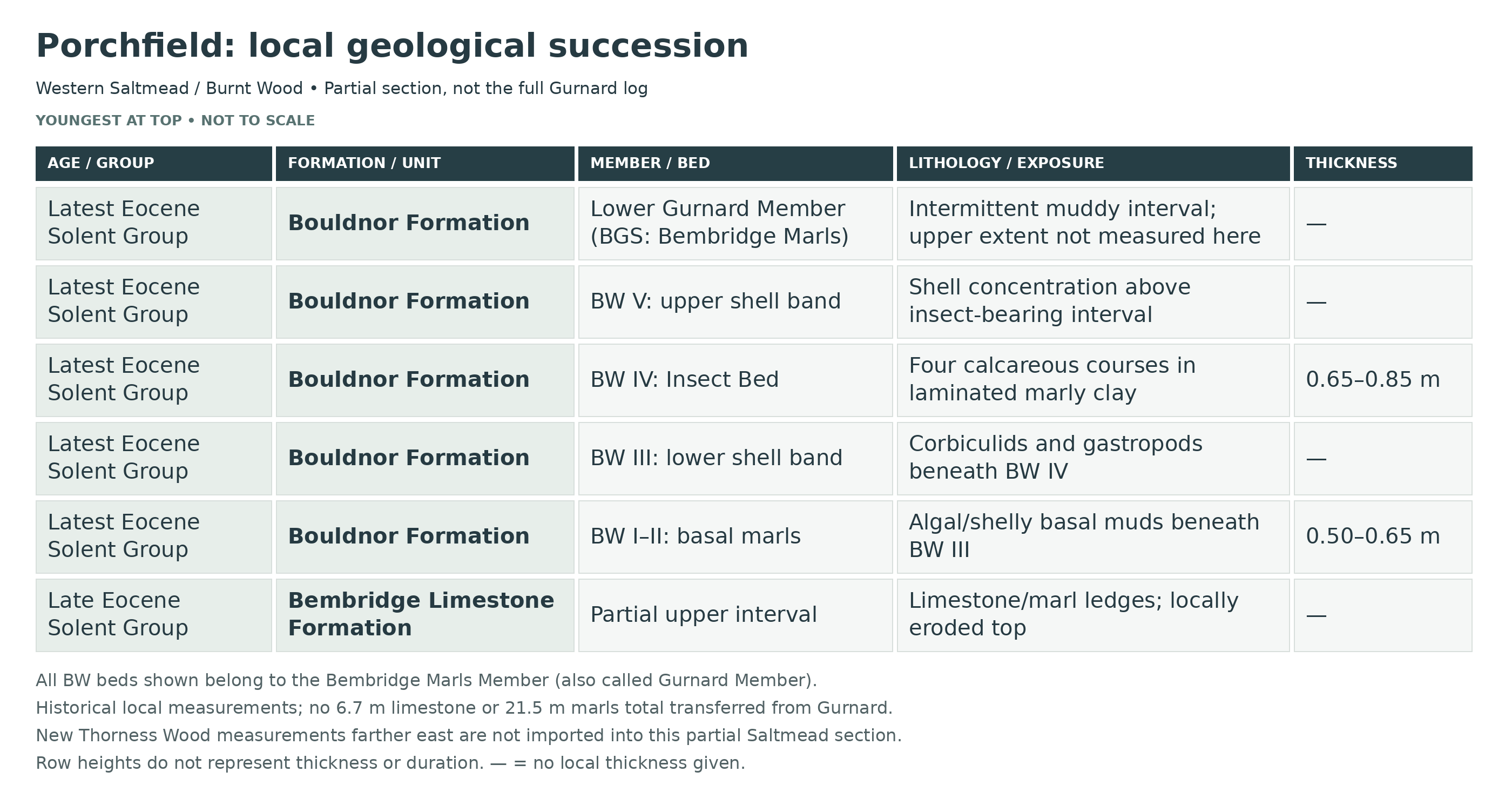
This is a detailed composite stratigraphic breakdown of the remote coastal section locally referred to here as Porchfield, centred on the western end of Saltmead Ledge and the largely unnamed shore west of Burnt Wood on the north-west Isle of Wight. The locality is internationally important because it exposes Bed BW IV, the latest Eocene Bembridge Insect Bed, in which exceptionally fine limestone, hard marl and laminated clay preserve insects, spiders, plants, molluscs, crustaceans and rare vertebrate remains in extraordinary detail.
Locality Scope And Published Names
“Porchfield” is an informal local and website name for this particular stretch of coast rather than a formally defined geological locality. In the scientific literature, the fossil-bearing section is usually described as the western end of Saltmead Ledge, the section west of Burnt Wood, or the southern side of the wider Thorness Bay–Gurnard outcrop. The principal published Bembridge Insect Bed exposure begins near National Grid Reference SZ 433 927, shortly before the western end of Saltmead Ledge, and was traced eastwards for about 500 m to approximately SZ 438 928. This page is restricted to that western section and should not be interpreted as a repetition of the full Thorness Bay or Gurnard Ledge succession.
Bed Numbering Used Below
The BW bed codes are the published Burnt Wood bed designations used by Daley and later authors for the basal Bembridge Marls succession. Bed BW IV is the formal local horizon containing the Bembridge Insect Bed, while Beds BW III and BW V are the shell-bearing marker horizons immediately below and above it. The PC numbers used for the underlying Osborne Member, Bembridge Limestone and incompletely exposed beds above BW V are practical site-use identifiers only; they are not formal published bed numbers.
SOLENT GROUP
Headon Hill Formation (Upper Eocene / Priabonian)
Osborne Member
Bed PC1 — Upper Osborne Member Context Beds
Intermittent exposures south-west and west of Burnt Wood include green, olive, grey and red calcareous clays, lime-rich muds and discontinuous concretionary limestones belonging to the upper Osborne Member. These soft beds are commonly obscured by vegetation, beach material and slipped sediment, but they provide the underlying context for the more resistant Bembridge Limestone ledges. The changing colours reflect alternating waterlogging, oxidation and soil development in a low-lying landscape of shallow lakes, lagoons, marshes and periodically exposed mudflats.
Typical Fossils
Fossils are generally less conspicuous than in the overlying units, but freshwater and low-salinity molluscs, charophytes, ostracods and plant material may occur in the calcareous muds and concretionary limestones. The assemblage is consistent with shallow lacustrine to marginal-lagoonal conditions rather than a fully open marine environment.
Bembridge Limestone Formation (Upper Eocene / Priabonian)
The full 6.7 m Bembridge Limestone reference succession measured at Gurnard Ledge must not be transferred directly to Porchfield. Around western Saltmead Ledge and west of Burnt Wood, only parts of the formation are intermittently available, and its upper beds change laterally because of erosion and contemporaneous structural movement. The PC divisions below therefore describe the locally relevant upper part of the formation rather than a complete measured log.
Bed PC2 — Upper Bembridge Limestone At Western Saltmead Ledge
Pale buff, cream and grey micritic limestone, clayey limestone, marl and lime-rich mud form low ledges and scattered foreshore blocks beneath the Bouldnor Formation. The limestones may be dense and finely crystalline or more porous where molluscan shells have dissolved, and they commonly weather much paler than the overlying grey and green marls. Freshwater gastropods, planorbids, charophytes, ostracods and aquatic plant remains characterize the formation, although fossil abundance and preservation vary considerably from bed to bed.
Depositional Environment
The upper Bembridge Limestone accumulated in shallow hard-water lakes, ponds and palustrine areas on a low-relief coastal plain. Fine carbonate mud formed in relatively clear alkaline water, while clay-rich intervals record greater influx of suspended sediment. Burrowing, root structures, calcareous soil development and local exposure surfaces show that the margins of these water bodies periodically dried or became shallow enough to support emergent vegetation.
Bed PC3 — Eroded Top Of The Bembridge Limestone And Porchfield Omission Surface
The top of the Bembridge Limestone beneath the lower Bouldnor Formation is irregular, locally burrowed, weathered and eroded rather than representing a simple uninterrupted bedding plane. The upper limestone unit changes laterally towards Burnt Wood and Saltmead Ledge, and parts of it were removed before deposition of the overlying marls. Reworked carbonate fragments may occur immediately above the surface where erosion was strongest.
This junction is important evidence for intra-Palaeogene movement along the Porchfield Anticline. Gentle uplift and warping altered the local topography while the Solent Group was still being deposited, allowing the upper Bembridge Limestone to be differentially eroded before renewed flooding established the muddy environments of the Bouldnor Formation.
Bouldnor Formation (Uppermost Eocene At This Locality)
Gurnard Member (Bembridge Marls Member in BGS 2015)
The BGS 2015 explanation retains Bembridge Marls Member and discusses the proposed name Gurnard Member for the same basal division of the Bouldnor Formation. Both names occur in the literature. Here they are shown together to aid comparison, without treating them as separate stacked units. The succession consists predominantly of laminated clay, silt, marl and lime-mudstone with thin shell beds and discontinuous limestone courses.
Gale (2026), following King (2016), uses Gurnard Member and correlates the lower marker sequence around the northwestern coast. His new Thorness Wood measurements lie farther east than this guide’s narrow western Saltmead/Burnt Wood shore. The 27.8 m Gurnard and 22 m partial Hamstead section at Thorness Wood therefore provides regional comparison, not a measured Porchfield column. The local BW I–V account below remains the controlling bed framework.
Only the basal part of the member is consistently relevant to Porchfield. The published 21.5 m complete reference thickness at Gurnard Ledge includes many higher horizons that cannot be demonstrated as a continuous section along this remote western shore and are therefore not reproduced here.
Beds BW I–II — Basal Algal, Shelly And Laminated Marl Interval
The basal Bembridge Marls comprise black, grey, green and blue-grey marls, lime-rich muds and finely laminated clay resting on the eroded Bembridge Limestone surface. Oyster-bearing shell material occurs near the base, but the thick sandy Bembridge Oyster Bed developed at Whitecliff Bay is absent from this north-western section. Instead, the basal flooding is represented by thinner shell-rich seams within predominantly argillaceous sediment.
Jarzembowski’s Figure 2 gives 0.50–0.65 m for the local BW I–II interval beneath the BW III shell band. This is a Saltmead measurement; the different Gurnard basal figure is not substituted here.
Bed BW I near Burnt Wood contains small stromatolitic and oncolitic algal structures. These appear to be the only well-documented examples of this kind from the Palaeogene succession of southern England and indicate shallow water in which microbial coatings developed around grains, shells or small fragments. The associated oysters and low-diversity shells show that the first waters spreading across the eroded limestone surface were brackish and intermittently connected to more saline environments.
Bed BW II continues upward as laminated marly clay and lime-rich mud beneath the more conspicuous BW III shell band. Fine lamination, limited burrowing and the absence of coarse current structures indicate low-energy deposition in a quiet lagoon, lake-margin pool or sheltered estuarine embayment.
Bed BW III — Lower Shell Band Beneath The Bembridge Insect Bed
Bed BW III is a concentrated shell-bearing marker lying immediately beneath the insect-producing BW IV interval. Published logs of the Saltmead section show corbiculid bivalves together with small Tarebia-type gastropods and larger potamidid gastropods. The shells may be complete, fragmented, etched or concentrated into a thin lag, reflecting a short episode of brackish-water colonization and minor reworking before exceptionally quiet Insect Bed sedimentation began.
The low diversity but locally high abundance of the fauna indicates environmentally stressed water, probably subject to changing salinity. BW III is therefore an important field marker and not merely a fossiliferous part of BW IV: it defines the shell-rich lower boundary of the main insect-bearing unit.
Bed BW IV — Bembridge Insect Bed / Insect Limestone Unit (c. 0.65–0.85 m)
Bed BW IV is the principal fossil horizon at Porchfield and one of the most important Palaeogene insect deposits in Britain. During fieldwork in 1976–77, Jarzembowski traced it for approximately 500 m through the lower cliff from near SZ 433 927 to around SZ 438 928, with fossiliferous blocks also occurring on the shore. The unit is approximately 0.65–0.85 m thick, although individual limestone and hard-marl courses vary laterally and may pinch out over short distances.
The traditional name “Insect Limestone” can be misleading because BW IV is not one continuous bed of solid limestone. It is a predominantly argillaceous interval of laminated marly clay containing four recognisable calcareous courses. These range from thin hard-marl lenses and tabular fine-grained limestone to isolated micritic concretions. Fresh material is generally blue-grey, while weathered surfaces develop a buff, ochre or brownish-yellow rind. The rock is exceptionally fine grained and commonly breaks with a curved or conchoidal fracture.
Thin silty and carbonaceous laminae contain ostracods, minute shell debris, reed and other plant fragments, seeds and insect remains. Small-scale folding, loading and irregular deformation developed before complete lithification, while early carbonate cementation protected delicate fossils from later flattening. Salt or gypsum pseudomorphs, shrinkage structures and the mixture of freshwater and salt-tolerant organisms show that water chemistry fluctuated and could become strongly evaporative at times.
Published Calcareous-Course Structure Of BW IV
The four BW IV sublayers described below are practical website divisions of the four calcareous courses figured in the published Saltmead Ledge section. The suffixes BW IVa–d are not formal bed numbers and should not be presented as replacements for the published collective designation BW IV. No unique fossil assemblage has been proved for each individual course, so the fauna and flora should normally be recorded as coming from BW IV unless the exact position is known. The following descriptions of carbonate bodies are read from the published Saltmead section; statements about fossil relief, preservation and depositional processes apply to BW IV as a whole, not to independently sampled assemblages in BW IVa–d.
Bed BW IVa — Lowest Calcareous Course And Basal Laminated Marl (site-use sublayer)
The lowest part of the Insect Bed begins above the BW III shell concentration with finely laminated marly clay containing an irregular course of hard marl and small micritic limestone bodies. The calcareous material is discontinuous and locally passes laterally into less strongly cemented marl. Fine plant detritus, ostracods and arthropod remains are recorded from BW IV as a whole; a unique assemblage is not assigned to this lower course.
This lower course records the first phase of early carbonate cementation within the exceptionally quiet BW IV depocentre. The lower shell band gives way to much less shell-rich laminated sediment. This records a change in depositional conditions; the figure alone does not establish a separate freshening or stratification event for this particular course.
Bed BW IVb — Second Limestone And Hard-Marl Course (site-use sublayer)
The second calcareous course is the limestone and hard-marl course shown above the lower nodular course in Jarzembowski’s Saltmead log, enclosed by laminated clay. Published sections show a mixture of partly cemented marl and more completely lithified limestone bodies rather than a uniform tabular bed. The boundaries are gradational or irregular because carbonate cement developed around localized nuclei within water-rich sediment.
Early cementation could preserve insect bodies, wings, spiders and small crustaceans with substantial relief, while specimens enclosed only in the more argillaceous laminae tend to show greater compression. This contrast in preservation is one reason apparently similar BW IV blocks can vary greatly in fossil quality.
Bed BW IVc — Thin Upper-Middle Calcareous Course (site-use sublayer)
The third course is the very thin hard-marl course in Jarzembowski’s Saltmead log, occurring within laminated marly clay. It may be locally reduced where large concretions developed in the overlying course. The original fine lamination can continue around the cemented body, showing that concretion growth took place shortly after deposition rather than representing a later limestone bed inserted into the succession.
Carbonaceous plant material and delicate arthropods are features of BW IV as a whole. The source does not establish a separately sampled fauna for this thin third course; fossil-rich pockets vary within the broader interval.
Bed BW IVd — Upper Large-Concretion Course (site-use sublayer)
The uppermost BW IV course contains the largest and most conspicuous micritic limestone concretions, commonly surrounded by less completely cemented hard marl. Some concretions are broad and lenticular and can occupy much of the thickness available, locally accounting for the thinning of the course beneath them. This is the most massive calcareous development in the Saltmead section but remains discontinuous along the outcrop.
Fine blue-grey micrite elsewhere within the Insect Bed preserves insects and spiders with exceptionally fine detail; rare feathers, vertebrate traces and articulated aquatic crustaceans demonstrate the preservational potential of the horizon as a whole. These are not established as a distinct BW IVd fauna. The upper concretions pass into laminated marly clay beneath the BW V shell band.
Bed BW V — Upper Shell Band Above The Bembridge Insect Bed
Bed BW V is the shell-bearing marker immediately above BW IV. Published Saltmead logs show a concentration of corbiculid bivalves with small Tarebia-type gastropods and larger potamidid gastropods at this level. The shells occur in laminated marly clay and may be disarticulated or concentrated along a bedding surface.
The return of abundant brackish-water molluscs marks renewed salinity change and greater water movement after deposition of the Insect Bed. BW III and BW V therefore bracket BW IV between two stressed brackish shell assemblages, making the three horizons especially useful for identifying correctly positioned blocks and temporary cliff exposures.
Bed PC4 — Lower Gurnard Member Marls Above BW V (partial interval)
Above BW V, intermittent exposures continue into grey, blue-grey, green and locally black laminated clay, silt and marl with occasional lime-mudstone, shell seams and small concretions. Some beds preserve quiet-water lamination, while others contain shell concentrations, burrows, shrinkage surfaces or evidence of temporary exposure. These features record continuing oscillation between brackish lagoonal water, freshwater pools, marshes and very shallow marginal environments.
The higher Bembridge Marls marker beds documented at Gurnard Ledge, including the main Corbicula and Nystia horizons, should not automatically be assigned to the narrowly defined Porchfield section. Exposure west of Burnt Wood is too intermittent to demonstrate a complete upward succession, and no artificial continuity should be created between isolated cliff and foreshore patches.
Typical Insects Of Bed BW IV
The fossil lists below describe the published Bembridge Insect Bed assemblage. Historic specimens labelled Gurnet or Gurnard Bay may derive from a wider northwestern collecting coast, and these lists are not a claim that every named species was found in the narrowly defined Porchfield exposure or in one of its four courses. Locally documented Saltmead specimens are distinguished where their sources allow.
The Bembridge Insect Bed has produced approximately 220 described insect species and representatives of about fifteen orders. Particularly important groups include beetles, true flies, ants, bees and wasps, true bugs, termites, dragonflies and damselflies, lacewings, caddisflies, bark lice, thrips, stoneflies, scorpionflies, orthopterans and rare butterflies or moths. The fauna is dominated numerically by insects living in leaf litter, low vegetation and wetland habitats, although forms from trees, open water and the air above the lagoon are also present.
Named insects from the wider Bembridge Insect Bed assemblage include the lepidopteran Lithopsyche antiqua, treated by de Jong (2017) as a butterfly of uncertain affinities, the termite Mastotermes anglicus, the dragonflies Aeschnophlebia andreasi and Anglogomphaeschna eocenica, and numerous ants, wasps, flies and aquatic insect larvae. Nel and Ross (2024) describe three dragonfly wings from the wider Insect Bed assemblage, including its first definite libellulid record. That published result is not assigned here to a particular Porchfield course or collecting ledge without verified specimen provenance.
Spiders, Crustaceans And Ostracods
Spiders are represented by several dozen specimens, including the named forms Eoatypus woodwardii and Vectaraneus yulei. Aquatic arthropods include the anostracan or fairy shrimp Branchipodites vectensis, the isopod Eosphaeroma margarum, the ostracod Potamocypris brodiei and the clam shrimp Paraleptestheria mitchelli. Complete articulated examples of Branchipodites may occur together with insect remains, although exceptionally rich concentrations are highly localized.
Molluscs
Molluscs are much scarcer within BW IV than in the shell beds immediately above and below. The commonest Insect Bed species is the freshwater pulmonate Galba longiscata, traditionally recorded as Lymnaea (Galba) longiscata. Other recorded freshwater gastropods include Planorbarius discus, Gyraulus similis, Hippeutis headonensis, Viviparus lentus and the rare Viviparus angulosus. The more salt-tolerant Tarebia acuta is uncommon within the limestone itself, and Polymesoda (Pseudocyrena) obovata is the only confirmed bivalve from the Insect Limestone.
The mixture of freshwater hard-water gastropods, occasional brackish forms, salt pseudomorphs and salt-tolerant crustaceans suggests changing water chemistry. Many molluscs may have been washed into the quiet depositional centre from vegetated pond margins, freshwater channels or adjacent brackish shallows rather than living permanently in the deepest part of the water body.
Plants And The Bembridge Flora
BW IV is the principal source of the historic Bembridge Flora, although plant fossils occur in localized concentrations and are much less uniformly distributed than older collection labels sometimes imply. Reed-like leaves and fragments of Typha are among the most characteristic remains, accompanied by Azolla, Potamogeton, seeds, fruits, twigs, leaf fragments and minute carbonaceous plant debris. Winged and plumed seeds show that wind transport also contributed material to the lagoon.
Older collections combined material from several nearby horizons and localities, so not every plant historically labelled “Bembridge Insect Limestone” came from BW IV. Modern revision has excluded some supposed elements, including the palms, from the confirmed Insect Limestone flora. The most secure interpretation is of a wetland landscape with aquatic and marginal vegetation, reeds, herbs, shrubs and nearby trees rather than a single uniform tropical forest.
Rare Vertebrates
Vertebrate fossils are exceptionally uncommon but scientifically important. Recorded material includes unidentified teleost fish, lizards including a scincoid, unidentified birds, bird feathers and the theridomyid rodent Isoptychus. Fragmentary lizard skin and microscopic skeletal elements demonstrate that the same early cementation responsible for insect preservation could also retain extremely delicate vertebrate tissues. These finds should be regarded as exceptional rather than typical collecting material.
Fossil Preservation And Field Recognition
Fresh Insect Limestone is a very fine blue-grey micrite or argillaceous micrite, commonly surrounded by hard marl and weathering to a buff or brownish-yellow rind. The limestone tends to split along curved surfaces rather than perfectly flat bedding planes, and a fossil may occur partly on each half of a broken block. Insects can be preserved as dark or brown carbonaceous films, pale external moulds or partly three-dimensional bodies with calcite-replaced internal tissues.
The exceptionally fine matrix can retain minute wing veins, body segmentation, hairs and soft anatomical detail. This unusual preservation has led the rock to be compared with opaque amber, although it is a micritic limestone rather than fossil resin. Insect bodies in the more clay-rich laminae are generally more compressed, while those enclosed by early-cemented limestone may retain greater relief.
Fossiliferous debris can be more productive where marine erosion has released BW IV blocks from the lower cliff, but the lithology must be identified carefully. Many apparently suitable blue-grey limestone fragments contain only ostracods, shell debris or plant specks, and some contain no visible fossils. Rich insect-bearing pockets are localized, so the historical abundance of museum specimens should not be taken to mean that every BW IV block is fossiliferous.
Age And Correlation
Bed BW IV is late Priabonian in age and therefore belongs to the latest Eocene. Older publications often placed the Bembridge Marls and their insect fauna in the earliest Oligocene because the position of the Eocene–Oligocene boundary was then uncertain. Modern stratigraphical correlation places the Insect Bed below that boundary.
The Burnt Wood horizon BW IV correlates with Bed GUR IV at Gurnard Ledge and with equivalent developments of the Bembridge Insect Bed elsewhere around the northern Isle of Wight. Its local four-course architecture at Saltmead Ledge differs from the two principal calcareous courses seen near Gurnard and the single concretionary development present at some eastern localities. These variations demonstrate that carbonate cementation was controlled locally within one laterally extensive muddy horizon.
Depositional Environment
The Porchfield succession records the replacement of shallow Bembridge Limestone lakes and palustrine areas by a broader muddy wetland system. Basal shell bands in Beds BW I–III record brackish flooding across the eroded limestone surface. BW IV then accumulated in an exceptionally quiet shallow lake, lagoon or sheltered estuarine pool, probably with freshwater inflow but subject to changing salinity, evaporation and occasional hypersaline conditions. BW V records the return of a more obviously brackish molluscan community.
Fine suspended sediment settled with very little disturbance in the BW IV depocentre. Terrestrial insects, seeds and plant fragments were blown or washed from surrounding vegetation, while aquatic crustaceans, ostracods and some molluscs lived in the water body or its margins. Rapid burial, early micritic cementation and limited scavenging protected fragile remains before decay and compaction could destroy them.
The wider environment was probably subtropical to warm temperate and seasonally wet, with extensive marsh, reed beds, freshwater pools, sluggish channels and locally wooded ground. Salt pseudomorphs and periodic shrinkage show that dry or strongly evaporative phases interrupted the wetter conditions, so the setting should not be reconstructed as continuously humid.
Structural Style And Exposure
The strata at Porchfield lie on the eastern limb of the Porchfield Anticline and descend gently eastwards towards the Thorness Bay Syncline. This structure was already beginning to influence sedimentation during the Palaeogene, as shown by the local erosion and overstep at the Bembridge Limestone–Bouldnor Formation junction. The present-day coast therefore exposes beds that were deposited across a subtly uneven and tectonically active surface.
The modern exposure is a low, discontinuous cliff-and-foreshore section rather than a single permanent rock face. Vegetation, slumping, mud, storm-beach material and tidal deposits repeatedly conceal parts of the succession. The Insect Bed was historically traceable for about 500 m, but its present visibility varies greatly, and fossiliferous pebbles diminish a short distance east of Saltmead Ledge. Isolated blocks cannot always be placed precisely without reference to the BW III and BW V shell bands.
Stratigraphic And Palaeontological Significance
Porchfield is one of the most important specialist fossil localities on the Isle of Wight because it includes the four-course Saltmead development of the Bembridge Insect Bed. For a unit less than one metre thick, BW IV has produced an extraordinary record of insects, spiders, crustaceans, molluscs, plants, feathers and rare vertebrates and is one of Britain’s finest examples of a Konservat-Lagerstätte.
The section is also geologically significant beyond its fossils. The eroded Bembridge Limestone surface, lateral changes in limestone development and relationship to the lower Bouldnor Formation provide important evidence for intra-Palaeogene movement along the Porchfield Anticline. It therefore records both an exceptional latest Eocene ecosystem and the local structural processes controlling deposition and preservation.
Total Thickness Covered Here
No defensible single total thickness can be assigned to the locally named Porchfield section because the Osborne Member, Bembridge Limestone and lower Gurnard Member are exposed intermittently in separate cliff and foreshore patches. The best-constrained unit is Bed BW IV itself, which is approximately 0.65–0.85 m thick and contains four calcareous courses. The page otherwise covers only the partial upper Bembridge Limestone and the basal few metres of the overlying Gurnard or Bembridge Marls Member; the complete 6.7 m Bembridge Limestone and 21.5 m Bembridge Marls measurements from Gurnard Ledge should not be transferred to this narrower locality.
References
Bristow, H.W., Reid, C. & Strahan, A. (1889). The Geology of the Isle of Wight.
White, H.J.O. (1921). A Short Account of the Geology of the Isle of Wight.
Reid, E.M. & Chandler, M.E.J. (1926). The Bembridge Flora.
Daley, B. (1969, 1972, 1973, 1974, 1999) on the palaeoenvironment, deformation structures, bed numbering, macroinvertebrates and stratigraphy of the Bembridge Marls.
Daley, B. & Edwards, N. (1971). Intra-Palaeogene earth movements in the Isle of Wight; and Daley, B. & Edwards, N. (1990) on the Bembridge Limestone succession.
Insole, A. & Daley, B. (1985). Revision of the late Eocene and early Oligocene lithostratigraphy of the Hampshire Basin.
Jarzembowski, E.A. (1980). Fossil insects from the Bembridge Marls, Palaeogene of the Isle of Wight.
Armenteros, I., Daley, B. & García, E. (1997). Lacustrine and palustrine facies in the Bembridge Limestone of the Isle of Wight.
McCobb, L.M.E., Duncan, I.J., Jarzembowski, E.A., Stankiewicz, B.A., Wills, M.A. & Briggs, D.E.G. (1998). Taphonomy of the insects from the Insect Bed, Bembridge Marls.
Ross, A.J. & Self, A. (2014). The fauna and flora of the Insect Limestone: introduction, history and geology.
Hayes, P.A. & Collinson, M.E. (2014). The flora of the Insect Limestone from the Isle of Wight.
Munt, M.C. (2014). Mollusca from the Insect Limestone of the Bembridge Marls Member.
Gallego, O.F. and co-authors (2019). The Crustacea of the Insect Bed, including the first British Cenozoic spinicaudatan.
Hooker, J.J., Evans, S.E. & Davis, P.G. (2019). Vertebrate remains from the Insect Limestone, latest Eocene, Isle of Wight.
Nel, A. & Ross, A.J. (2024). New dragonflies from the Upper Eocene of the Isle of Wight.
Stratigraphy of the Bouldnor Formation (Solent Group, Eocene–Oligocene) of the Isle of Wight, UK (2026). Proceedings of the Geologists’ Association, article 101209.
British Geological Survey Lexicon entries for Osborne Member, Headon Hill Formation, Bembridge Limestone Formation, Bembridge Marls Member and Bouldnor Formation.
Geological Conservation Review / JNCC accounts for Thorness Bay, Gurnard and the Bembridge Insect Bed.
Checked source links: Daley and Balson (1999), GCR15: Thorness Bay and Gurnard; Jarzembowski (1980), Fossil insects from the Bembridge Marls, pp.240–243 and Figure2; Hopson and Farrant (2015), Isle of Wight: Solent Group; Ross and Self (2014), Insect Limestone introduction, history and geology; Munt (2014), Mollusca from the Insect Limestone.
New measured-section comparison: Gale, A. (2026), Stratigraphy of the Bouldnor Formation, section 3 and Figures 10 and 14–16. The Thorness Wood log is kept outside this narrower locality’s thickness inventory.
Taxonomic qualification: de Jong (2017), Fossil butterflies, Lithopsyche entry, pp. 16 and 18. Dragonfly update: Nel and Ross (2024).
SAFETY
This is a remote coastal locality and considerably more care is required than at the better-known beaches around the Isle of Wight.
The area lies beside the Newtown military ranges, and parts of the surrounding land are controlled by the Ministry of Defence. Do not enter MOD land, cross warning signs, pass barriers or use routes that are closed to the public. Any red flags, warning notices or instructions relating to military activity must be obeyed.
Collectors should only approach the fossil exposures using legally permitted access and should never assume that a route across the range is available simply because it appears open.
Tide times should be checked carefully before visiting. The foreshore is narrow in places and the sea can reach the base of the low cliffs and coastal slopes, making progress difficult or preventing a safe return.
The Bembridge Marls become extremely slippery when wet. Soft clay, mud and algae-covered foreshore surfaces can make footing difficult, particularly following heavy rain.
Small cliff falls and landslips are common along these soft Palaeogene exposures. Avoid standing directly beneath fresh falls or overhanging material and never climb unstable cliff faces in an attempt to reach fossil-bearing beds.
This is also a relatively isolated stretch of coast, so allow considerably more time than you think you will need for the return journey and make sure somebody knows where you are going.
EQUIPMENT
Fossil collecting at Porchfield is mainly about careful observation rather than heavy hammering.
A small geological hammer and fine chisel are useful for splitting permitted loose pieces of insect-bearing limestone on firm, open foreshore, well clear of cliff bases and slipped ground. Always wear safety glasses when splitting rock, as even small limestone fragments can produce sharp splinters.
A good hand lens is one of the most important pieces of equipment. Many insects are only a few millimetres long and can easily be mistaken for dark marks, plant fragments or mineral staining.
Freshly split surfaces should be inspected before another strike is made. If a wing, body or other fossil appears, stop immediately and examine both halves of the slab.
Small specimen boxes, flat containers and plenty of tissue or foam are highly recommended. Insect fossils are extremely fragile and thin limestone slabs can break easily during transport.
A soft brush can be useful for removing loose sediment, but avoid brushing directly across delicate insect remains. Fine preparation should be left until the specimen is safely home and can be worked on under magnification.
CLEANING AND TREATING
Keep insect-bearing slabs and their matching counterparts supported, labelled and separate. Do not brush directly across wings, cuticle or other delicate impressions. Do not routinely soak every find for 24 hours: water may soften clay-rich matrix or harm unstable material, and salt removal needs a specimen-specific plan. Avoid heat and rapid drying; seek preparation advice before treating an important or crumbling specimen.
Paraloid B-72 can help selected fragile areas after testing, but sound fossils do not automatically need coating. It is not a waterproof seal, and complete removal from porous fossil or matrix cannot be guaranteed. Keep specimens supported in stable storage and document any treatment. Delicate impressions and scientifically important finds should be assessed before applying adhesive or consolidant.
IDENTIFY YOUR FINDS
Need help identifying a fossil? Share clear photos, where you found it and its size with the community.
FURTHER READING
GCR / GeoGuide – Thorness Bay and Gurnard, Isle of Wight (includes Saltmead–Burnt Wood section)
GCR / GeoGuide – Thorness Bay — fossil plants (wider coastal flora)
UCL research paper – Vertebrate remains from the Insect Limestone (latest Eocene), Isle of Wight, UK (wider Insect Limestone outcrop; PDF)
British Geological Survey – Geology of the Isle of Wight (island-wide geological context)
ACCESS RIGHTS
Use only lawful public access and follow local signs, range restrictions and collecting permissions. Do not enter closed MOD land or pass barriers to reach the exposures. Collect only permitted loose material, without digging into cliffs or bedrock, and follow the UK Fossils Code of Conduct.
It is important to follow our ‘Code of Conduct’ when collecting fossils or visiting any site. Please also read our ‘Terms and Conditions‘
LINKS
♦ Fossil Discussions
♦ Fossil Articles
♦ Buy Fossils, Tools and Equipment
♦ Buy Crystals, Meteorites, and Artefacts
♦ Join Fossil Hunts
♦ UK Fossils Network