
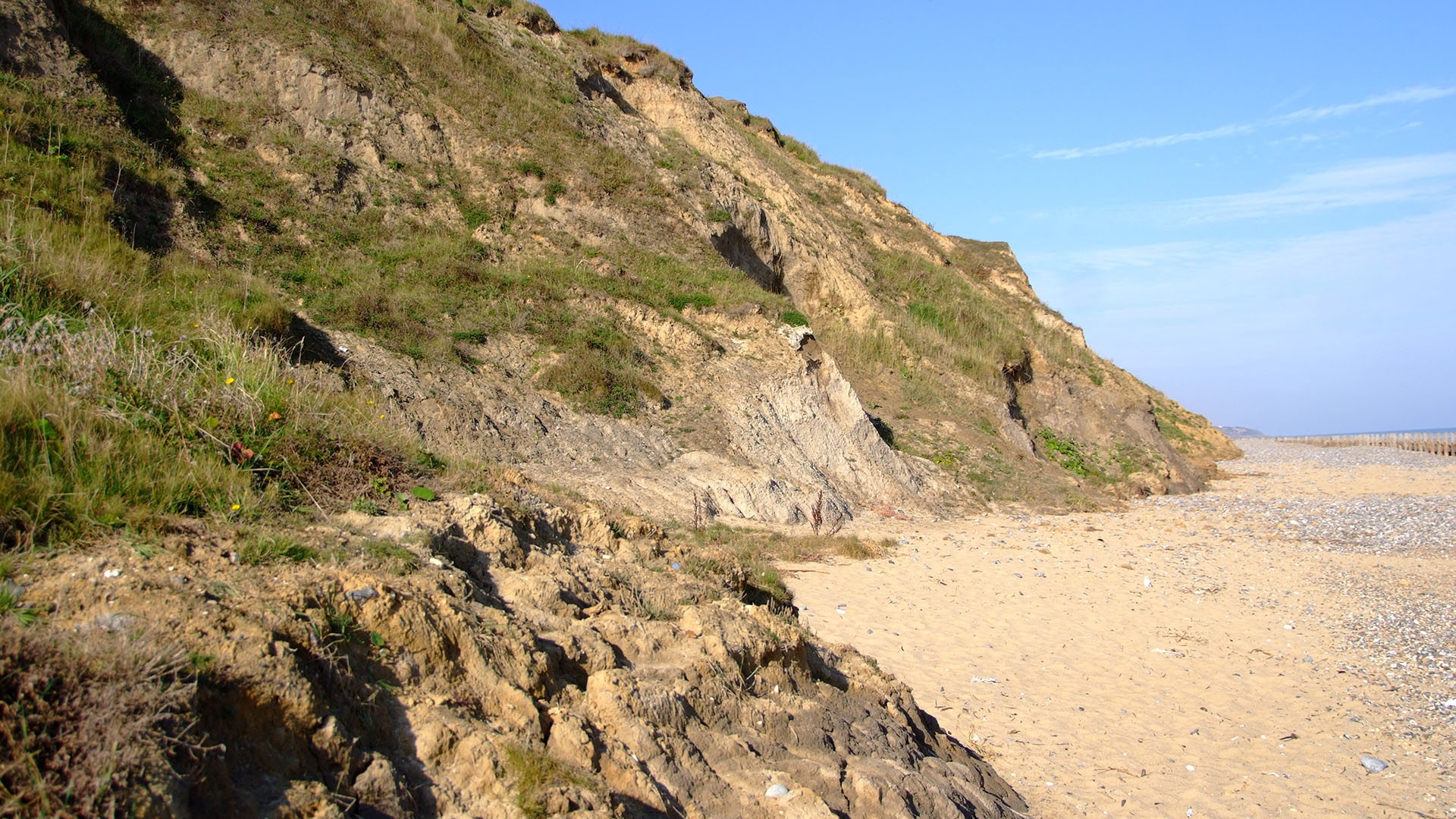
Overview
Directions
- For the Sidestrand exposures, use an established beach access at Overstrand and walk east only when a safe low-tide route is available. The council car park on Pauls Lane, Overstrand, is listed at NR27 0PE. The Clifton Way beach ramp provides the eastern Overstrand approach, but it is reached on foot and must not be obstructed by parking.
- Access checked October 2026: Overstrand’s coastal works affect sections of the promenade and access slopes. The council’s September notice states that the Clifton Way ramp is to remain open, but visitors must check the latest scheme information and follow local diversions. Do not walk through construction areas or climb rock armour to bypass a closure.
- The collecting coast has no convenient escape up its unstable cliffs. Older directions from Trimingham describe long beach approaches and cliff descents that should not be followed without current local confirmation. Do not drive down an unverified track or attempt to reach the shore by scrambling down a landslip. If the beach route is obstructed, postpone the visit.
- What3Words collecting area: ///suspect.creatures.pops
Location photographs
Swipe to browse · Select a photograph to enlarge


Fossil Hunting
Loose Chalk fossils and erratics. Search washed pebbles well out from the cliff base for belemnites, echinoids, brachiopods and sponge-bearing flints. Cretaceous fossils can come from the displaced chalk masses; fossils in other rock types may have travelled with glacial or older river deposits before reaching the beach. A Jurassic fossil in a loose pebble does not establish a Jurassic bed exposed at Sidestrand.
The Sidestrand chalk masses contain the local Sidestrand Chalk Member and parts of the Trimingham Sponge Beds Member. Scientific collections include belemnites such as Belemnella obtusa, thick-tested Echinocorys, smaller Galerites, solitary corals recorded as Desmophyllum, and the brachiopods Cretirhynchia magna and Cretirhynchia retracta. These records come from particular chalk intervals; they do not mean that all six are common or identifiable in worn beach material.
Marine Crag fossils. The older shelly Crag has a particularly rich small-mammal record. Modern research identifies Mimomys pliocaenicus, Mimomys reidi, Mimomys tigliensis, Mimomys hordijki, Borsodia newtoni, Pitymimomys pitymyoides, Ungaromys dehmi and Lemmus kowalskii among the Sidestrand assemblage. These are mainly tiny teeth recovered through controlled research sampling. Keep the Crag fauna separate from mammals belonging to younger freshwater deposits.
The freshwater record. Mussels gave the Unio-bed its traditional name. The Sidestrand Hall Member also contains a water vole of the genus Arvicola and a characteristic freshwater molluscan assemblage including Bithynia tentaculata and Valvata naticina. This is a later temperate episode than the West Runton Freshwater Bed, not another exposure of the same bed. Separate preglacial sediments preserve cold-climate beetles, while the high-level Sidestrand Organic Bed records a still later, postglacial environment.
Do not excavate, bulk-sample or climb to an organic band during an ordinary visit. A fossil’s exact sedimentary context is essential here because ice has moved pieces of older beds into younger positions. Record the location, attached matrix and whether the find was loose; photograph any significant embedded material and seek specialist advice.
Fossil photographs
Swipe to browse · Select a photograph to enlarge


Discoveries and milestones
A chronological record of fossil discoveries, geological research and conservation milestones at Sidestrand.
1882 – Preglacial beds described
Clement Reid documented the Sidestrand sequence and the freshwater shell-bearing horizons that became known as the Unio-bed. His work provided the starting framework for subsequent geological investigation.
1961 – Sidestrand chalk masses compared
Norman Peake and Jake Hancock distinguished western, central and eastern chalk masses at Sidestrand, helping establish their relationship to the wider north Norfolk Chalk succession.
1983–1990 – High-level Organic Bed investigated
Jane Hart discovered the high-level organic deposit in 1983 and described it in her doctoral work. Subsequent work with Sylvia Peglar used its pollen and stratigraphic position to investigate the timing of glaciation.
1993 – Cliffs re-notified as an SSSI
Sidestrand and Trimingham Cliffs was notified under modern conservation legislation, recognising its Pleistocene sequence, fossil vertebrates, Chalk exposures, mass movement and associated habitats.
2001 – Freshwater molluscs separate temperate episodes
Richard Preece’s work showed why the Sidestrand freshwater molluscan assemblage should not be treated as the same interglacial fauna as the West Runton Freshwater Bed.
2001 onwards – Landslide monitoring
The British Geological Survey began collecting data at the Sidestrand landslide site. Repeated surveys, including terrestrial laser scanning, documented rotational slides, mudflows and changing cliff profiles, linking geological structure with coastal erosion.
2009 – Unio-bed defined as Sidestrand Hall Member
A detailed fossil and amino-acid study formalised the Sidestrand Hall Member and strengthened the evidence that it predates the overlying glaciation but postdates the West Runton Freshwater Bed.
2009 – Reworked freshwater beds recognised
Jonathan Lee demonstrated that glacial deformation had carried pieces of Unio-bed sediment into higher positions. The finding made it essential to distinguish undisturbed beds from transported fragments when dating the sequence.
2014 – Arctic beetle assemblage published
Nigel Larkin and colleagues described 59 beetle taxa from preglacial freshwater sediments sampled during work in 2007 and 2010. The assemblage provided unusually detailed evidence for severe cold before deposition of the basal till.
2020 – Small mammals and Crag age revised
New Sidestrand material helped establish a revised age and correlation for the Weybourne Crag. The work documented the first British Pleistocene records of Mimomys hordijki and Ungaromys dehmi.
Geology
Ancient chalk inside younger cliffs. The conspicuous white masses are slabs of Upper Cretaceous chalk that were displaced by ice. Their flint bands, marls and fossils preserve details of the original marine succession despite later movement. Parts of the Sidestrand Chalk Member and the lower Trimingham Sponge Beds Member occur in the local masses; the higher chalk beds at Trimingham should not all be transferred to this locality.
Several preglacial environments. The Wroxham Crag Formation contains marine and estuarine sands, silts and shelly gravels. Its older “Weybourne Crag” fauna has been correlated with an interval around 2.2–2.1 million years ago. Much later freshwater sediments of the Cromer Forest-bed Formation include the Sidestrand Hall Member, traditionally the Unio-bed. These record a warm river environment and belong to a younger temperate episode than the West Runton type Cromerian.
Later cold-stage freshwater sediments and glacial tills record the approach of severe conditions. Ice deformed the preglacial deposits, transported rafts and folded the laminated glacial-lake sediments. Even a recognisable Unio-bed fragment can have been moved up through the sequence, so its height in a cliff is not a reliable guide to its age.
The Organic Bed is a different deposit. The Sidestrand Organic Bed, also called the Trimingham lake bed in the literature, occupies a high-level hollow above glacial outwash. Fossils and amino-acid evidence support a post-Anglian, probably early Hoxnian age, around Marine Isotope Stage 11. It must not be confused with the preglacial Unio-bed below the glacial sequence. Their contrasting positions and ages help constrain the intervening glaciation.

Detailed geology and bed-by-bed succession
Detailed geology and stratigraphy of Sidestrand.
Several independent logs and horizons
The Sidestrand coast contains displaced Chalk, older marine Crag, later freshwater and tidal sediments, glacial deposits and a still younger lake fill. The numbered subdivisions below retain the scheme of the source that describes them. They must not be combined into one unbroken present-day cliff column.
Chalk Group
The white rock masses are Late Cretaceous slabs displaced during the Pleistocene. The age of the chalk and the age of its later structural emplacement are different.
White Chalk Subgroup
The local masses preserve mainly Lower Maastrichtian chalk. Their internal original succession overlaps, but is not identical to, the intervals at Overstrand and Trimingham.
Sidestrand Chalk Member
The Western Mass includes the Sidestrand Marl low in one of its component slabs and large paramoudra flints above. The wider Porosphaera Beds interval contains corals, brachiopods, echinoids and belemnites. Historic central and eastern masses have been reduced by erosion, so their former logs are not current exposure maps.
Basal thrust of the Western Chalk Mass
A glaciotectonic thrust places the older chalk against Quaternary sediment. This is a structural base, not the original depositional base of the member.
Sidestrand Marl
This local marl lies low in the displaced chalk slab and provides a correlation with Overstrand.
Lower paramoudra-bearing chalk
Successive large cylindrical flint levels occur above the marl in the Western Mass log.
Lower Zoophycos horizon and bedding joint
A trace-fossil horizon lies beneath a conspicuous bedding joint, separating parts of the flinty succession.
Giant-paramoudra interval
Very large paramoudra flints characterise the next interval in the published log. These flints are lithological markers, not separate formal members.
Upper bedding joint
A higher bedding joint marks the top of the most conspicuous giant-paramoudra interval.
Scattered-flint chalk
The overlying chalk contains more dispersed flints, contrasting with the larger flints below.
Big carious flints
A higher interval contains large, irregularly cavernous flints.
Upper Zoophycos horizon
The published log records another trace-fossil horizon above the carious flints.
Upper Chalk surface and Crag cap
Crag caps the preserved chalk across a major depositional gap. The diagram is a historical local log, not a guarantee of current exposure or an exact measurement of every bed.
Trimingham Sponge Beds Member: lower part at Sidestrand
The higher local chalk includes hardgrounds and sponge-bearing indurated beds. Historic collections from the eastern mass record Belemnella obtusa and Galerites. This is not the full younger grey-chalk succession described at Trimingham.
Crag Group
Marine sediments occur both on displaced chalk and in lower-level preglacial exposures. The local marine record includes more than one age and facies.
Wroxham Crag Formation: older shelly interval
The older Weybourne Crag contains shelly sand, gravel and silt. Modern dating and faunal comparisons place its characteristic assemblage much earlier than the Unio-bed; identical locality names do not make the fossil assemblages contemporaneous.
Sidestrand Member: older marine correlation
BGS uses this member for the older marine laminated clay, silt, sand and shelly gravel at Sidestrand. It differs from the Cretaceous Sidestrand Chalk Member and the freshwater Sidestrand Hall Member.
Basal stone bed and shelly sand
A flint-rich lag is overlain by shelly sand with silt partings in documented lower exposures. The marine shells and small-mammal teeth are associated with this older Crag interval.
Lee’s measured preglacial sequence
Units A–N below belong to Lee’s eight-section investigation, not the older Weybourne Crag log. Measurements are local; some units occupy channels or deformation zones.
Wroxham Crag Formation
Lee’s locally logged marine sequence belongs to this formation.
Mundesley Member: lower local sedimentary succession
Lee assigns A–B and the original sedimentary material of D–L to the Mundesley Member. This local correlation must not be extended to every marine bed at Sidestrand.
Unit A
Iron-stained, flint-rich gravel; base concealed.
Unit B
Gravelly sand,0.20–0.40 m; scoured base, shell debris.
Dunwich Group
Freshwater river deposits interrupt the marine sequence rather than constituting another marine Crag member.
Cromer Forest-bed Formation
The freshwater part of the preglacial succession includes the Sidestrand Unio-bed, formally described as the Sidestrand Hall Member.
Sidestrand Hall Member — Unio-bed
The temperate freshwater fauna includes Arvicola and differs from West Runton’s fauna. Fossil and amino-acid evidence indicates a younger interglacial, commonly correlated with MIS 13. Its presence in a moved sediment slice is not evidence for a younger depositional repetition.
Unit C — undisturbed channel occurrence
Gravel-bottomed channel clay contains Unio pictorum and Unio crassus; channels are about 2.3 m wide and reach 0.4 m deep.
Crag Group — renewed tidal deposition
The sequence above the undisturbed freshwater channel returns to marine or estuarine sedimentation in the logged sections.
Wroxham Crag Formation
The following lettered units retain Lee’s local labels. Unit K is a deformed slice, not a separate sea-level cycle.
Mundesley Member: upper local sedimentary succession
The named member provides the depositional interpretation for the tidal sands and silts. The bed letters are informal field subdivisions, not additional formal members.
Unit D
Laminated sandy silt, up to 0.25 m; locally contorted.
Unit E
Clayey silt,0.20–0.35 m; drying cracks record temporary exposure.
Unit F
Sand–silt channel fills cut E; channels 1.3–3.1 m wide and 0.3–0.5 m deep.
Unit G
Cross-bedded fine sand,0.20–0.40 m; local channel-side faults.
Unit H
Rippled and storm-structured sand with silt; locally up to 0.5 m.
Unit I
Pebbly sand cuts H into G; foresets reach 0.4 m.
Unit J
Interbedded sand and clayey silt,0.8–1.7 m; later thrusts cross-cut bedding.
Unit K — remobilised slice
Folded silty-sand lens,0.5 m thick and more than 6 m long; its inclined base truncates J.
Unit L
Ripple-laminated sand and sandy silt, up to 0.3 m; deformation varies.
Albion Glacigenic Group
The logged sequence ends with deformation and till emplacement. Younger glacial units occur elsewhere in the cliff, separated by structures and changing exposure.
Happisburgh Glacigenic Formation
The basal local till is associated with the first major ice incursion represented in this section. Its shear zone incorporated older sediment rather than leaving a simple depositional contact.
Unit M — displaced Unio-bearing material
Mixed shell-bearing sediment,0.20–0.40 m; shearing moved older freshwater material upwards.
Happisburgh Till Member — Unit N
Consolidated sandy-clay diamicton, locally up to 3 m, caps Lee’s section and incorporates fragments of M.
Lower till at the separate BGS monitoring site
BGS reports 3–6 m of Happisburgh Till at its monitored section. This separately scoped range must not replace or be added to Lee’s Unit N maximum of 3 m.
Ostend Clay Member: overlying glacial-lake interval
At the separate BGS landslide-monitoring section, the Ostend clay interval overlies the lower till and is commonly obscured by slips. It is not represented by an invented letter O in Lee’s A–N log.
Lowestoft Formation — BGS framework
The monitored cliff includes Walcott Till above the lower glacial deposits. Exposure and modern landsliding obscure much of the middle section.
Walcott Till Member
BGS describes a stiff, blue-grey chalky and flinty till at the monitoring site. It differs lithologically from the darker sandy lower till; no constant thickness for the full Sidestrand coast is assumed.
Sheringham Cliffs Formation — BGS framework
Sorted sediments and younger tills occupy much of the higher cliff. This section uses the current Lexicon grouping and notes later alternative parentage separately.
Mundesley Sand Member
The monitored section includes the lower sandy part of the Sheringham Cliffs Formation. BGS describes stratified silty sand with chalk debris and ripple or cross-bedding; its regional thickness and type-section measurements are not Sidestrand values.
Ivy Farm Laminated Silt Member
Dark clay and pale silt rhythms pass upwards towards pale laminated marl; a second facies is rippled fine sand. The contact below is abrupt but described as conformable, while the upper surface can be cut by till. The type section is at Sidestrand; more than 22 m is reported, but shear truncation prevents a simple true-thickness calculation.
Bacton Green Till Member
Stony diamicton alternates with sorted laminae and beds. Its presence at the monitored section is documented, but the regional thickness range should not be treated as a Sidestrand measurement.
Trimingham Clay Member
The BGS monitoring section records this clay above the Bacton Green Till. Fine sedimentation contrasts with the stony diamicton below; later deformation and slips complicate the local boundaries.
Weybourne Town Till Member
A highly chalk-rich diamicton forms part of the upper monitored succession. It can incorporate stretched remnants of older till; its apparent layering may therefore be tectonic rather than depositional.
Briton’s Lane Formation
The upper outwash includes the Stow Hill Sand and Gravel Member in the monitored Sidestrand section. Glacial thrusting affects much of this succession, and some visible shear surfaces belong instead to modern mudslides.
Stow Hill Sand and Gravel Member
This is the outwash member identified at the top of the BGS monitoring section. Its contact with the deformed glacial sequence is distinct from the much younger lake fill; no layer-by-layer gravel log is invented.
Later alternative glacial framework
The 2017 research scheme places the equivalent Ivy Farm Silt Member within a Mundesley Formation and reorganises parts of the tills and mélange. It is a separate structural interpretation, not extra strata to stack between the BGS members above.
Postglacial Sidestrand Organic Bed
The high-level lake-hollow fill is separate from the preglacial Unio-bed. Fossil and amino-acid evidence supports a probably Hoxnian/MIS 11 age. The literature also calls it the Trimingham lake bed or Sidestrand Cliff Formation.
Lower inorganic lake deposit
The hollow’s basal fill is relatively inorganic. Its irregular lower surface records a local depression above the glacial sequence, rather than a continuous regional bed.
Upper organic lake deposit
A sharp contact introduces the organic horizon. Pollen includes grasses, sedges and early woodland elements; the deposit has little or no deformation compared with the glacial beds below.
References
Lee (2009). Patterns of preglacial sedimentation and glaciotectonic deformation at Sidestrand, PGA120,34–48; units A–N.
Preece and colleagues (2009). Sidestrand Hall Member and glacial chronology.
Preece and colleagues (2020). Weybourne Crag fossil assemblages and dating.
BGS. Sidestrand landslide case study and monitored cliff succession.
BGS Lexicon. Ivy Farm Laminated Silt Member.
BGS Lexicon. Bacton Green Till Member.
Mortimore, Wood and Gallois (2001). Overstrand to Trimingham Cliffs, GCR23.
Hart and Peglar(1990) and later field-guide synthesis of the Organic Bed.
Safety
Sidestrand is a remote tidal shore beneath actively collapsing cliffs. Revetments and groynes do not prevent tidal cut-off; damaged structures may instead obstruct the return route. Visit on a falling tide, know the tide times and leave a substantial return margin. There is no safe assumption that the cliff can be climbed if the beach disappears.
Keep well away from fresh slips, chalk masses and the cliff foot. Soft mud may be deep beneath a deceptively firm crust, while wet clay, seaweed and exposed flints make the shore slippery. Never climb to fossil-bearing bands near the top of the cliff. Do not enter construction areas at the Overstrand approach. This is unsuitable for unsupervised children or visitors expecting a short, easy-access family outing.
Equipment
Take tide and route information, suitable footwear, a charged phone, a companion where possible, a camera, hand lens and padded specimen boxes. Do not rely on phone reception for navigation or an exit plan. Hammers and trowels are unnecessary for the recommended surface search; research sampling needs permissions and a properly assessed safe method.
Cleaning And Treating
Keep different rock types and horizons separately labelled. Sound flint fossils usually need little beyond a soft brush and, if stable, gentle fresh-water cleaning. Soft chalk, freshwater shells and fossil bone can be damaged by scrubbing, soaking or drying too quickly; support fragile finds with matrix and let ordinary stable material dry gradually.
Do not wash an organic sample merely to reveal seeds or insects: it can destroy small fossils and their associations. Waterlogged plant material requires conservation advice before drying. Leave pyritised sponges and scientifically important material minimally prepared, dry and protected from damp once properly assessed. Avoid acids, bleach, varnish and attempts to split flint around an enclosed fossil.
Identify your finds
Need help identifying a fossil? Share clear photos, where you found it and its size with the community.
Further Reading
Deposits Magazine: fossil voles as stratigraphic aids
JNCC: the Sidestrand and adjoining Chalk masses
Sidestrand freshwater beds and the age of glaciation
BGS: deformation of the Sidestrand preglacial deposits
Weybourne Crag fossils and dating: Sidestrand research
Field guide: Sidestrand to Trimingham
Council: current Overstrand access works
Norfolk Museums and council: responsible collecting
Access Rights
Sidestrand lies within the Sidestrand and Trimingham Cliffs SSSI, which protects geology, fossils and soft-cliff habitats. Follow local access notices and ownership requirements. Ordinary visits should concentrate on permitted loose beach finds; excavating a face, removing protected bed material or bulk-sampling an organic horizon requires the appropriate permissions. The scientific importance of the coast makes accurate find records especially valuable.
It is important to follow our ‘Code of Conduct’ when collecting fossils or visiting any site. Please also read our ‘Terms and Conditions‘
Links
♦ Fossil Discussions
♦ Fossil Articles
♦ Buy Fossils, Tools and Equipment
♦ Buy Crystals, Meteorites, and Artefacts
♦ Join Fossil Hunts
♦ UK Fossils Network


