

The thin flagstones of Achanarras Quarry preserve a remarkable community of Middle Devonian freshwater fishes. This disused Caithness quarry offers the chance to examine finely layered lake sediments and search loose spoil for scales, armour and, with patience, more complete fish. NatureScot welcomes visitors and allows limited collecting under its published site rules.


FIND FREQUENCY: ♦♦♦♦ – Fish remains occur in the fine laminites, although recognisable complete specimens demand patience.
CHILDREN: ♦♦♦ – Sharp spoil and flooded workings make this unsuitable for young children; older children need close supervision.
ACCESS: ♦♦♦ – A signposted approach leads to parking below the quarry, followed by a walk of about 1 km.
TYPE: A disused flagstone quarry and SSSI, owned and managed by NatureScot.
DIRECTIONS
♦ From the A9 at Mybster, follow the B870 west for about 1 km. Look for the brown Achanarras Quarry sign and turn onto the track beside the forestry plantation.
♦ Follow the track to the car park. Leave vehicles here and continue on foot along the farm track for about 1 km to the quarry; leave gates as found.
♦ The quarry has a shelter and interpretation panels. National Grid reference: ND 149 544. NatureScot gives KW1 5XU as the nearest postcode; use the signed track for the final approach.
♦ Original guide location: 58.47058°N, 3.45965°W. These coordinates identify the quarry area, not a parking bay.
FOSSIL HUNTING
Search the loose quarry spoil for fine, closely layered flagstone rather than treating every slab as equally promising. Fish-bearing rock is concentrated within the lower part of the Achanarras Fish Bed Member. Smooth dark laminites, more carbonate-rich layers and rougher dolomitic slabs record different parts of that interval, so a change in texture can be as useful as colour. Weathering alters colour, and an isolated spoil slab cannot normally be assigned to a precise faunal division simply by looking at its surface.
Begin with exposed bedding surfaces and already split edges. Look for a dark outline, a patch of overlapping scales, a fin spine or the edges of bony armour interrupting the fine sedimentary lines. Where a suitable loose slab has a natural parting, work along it carefully rather than smashing across the layers. Examine both faces after each split: a fossil may be divided between the part and counterpart. Keep associated pieces together and record that they came from loose spoil; this is more useful scientifically than inventing an exact bed number.
The lungfish Dipterus valenciennesi is among the characteristic finds. Its head, tooth plates and scaled body help distinguish it from the armoured fishes. Coccosteus cuspidatus is an arthrodire placoderm with substantial head and trunk plates; isolated armour fragments are worth examining as well as complete outlines. The antiarch Pterichthyodes milleri has a conspicuous box-like trunk armour and jointed, armoured pectoral appendages. All three are documented at the quarry, but preservation and abundance vary between the original layers.
Small fishes can be easy to overlook on a large slab. The slender, spiny fish now called Orcadacanthus pusillus appears under Mesacanthus in older accounts. Other spiny fishes recorded here include Diplacanthus crassisimus, D. tenuistriatus, Rhadinacanthus longispinus and Cheiracanthus grandispinus. The last name is important: older site lists used C. murchisoni, but modern revision identifies the Caithness material differently. A hand lens helps with fine spines and scale patches; these alone do not always permit a species identification.
The tiny Palaeospondylus gunni is another distinctive quarry fossil. Its mineralised internal skeleton has prompted very different interpretations of its relationships, and it should still be described as an enigmatic vertebrate. Recent research has not established a single agreed answer. Scarcer finds include the early ray-finned fish Cheirolepis trailli, the lobe-finned Osteolepis macrolepidotus and Glyptolepis. The large armoured Homosteus milleri and the ptyctodont Rhamphodopsis threiplandi are rare recorded members of the fauna, rather than likely finds on every visit.
The quarry has also yielded exceptionally rare material: Actinolepis sp., the jawless vertebrates Achanarella trewini and Cornovichthys blaauweni, and the chasmataspid arthropod Achanarraspis reedi. These records show why unusual fragments deserve care rather than forceful preparation. Delicate fish-swimming traces have been reported on a loose slab as Undichna britannica and a tentative second Undichna trace. A faint impression or trail can therefore be important even without a complete fish skeleton.


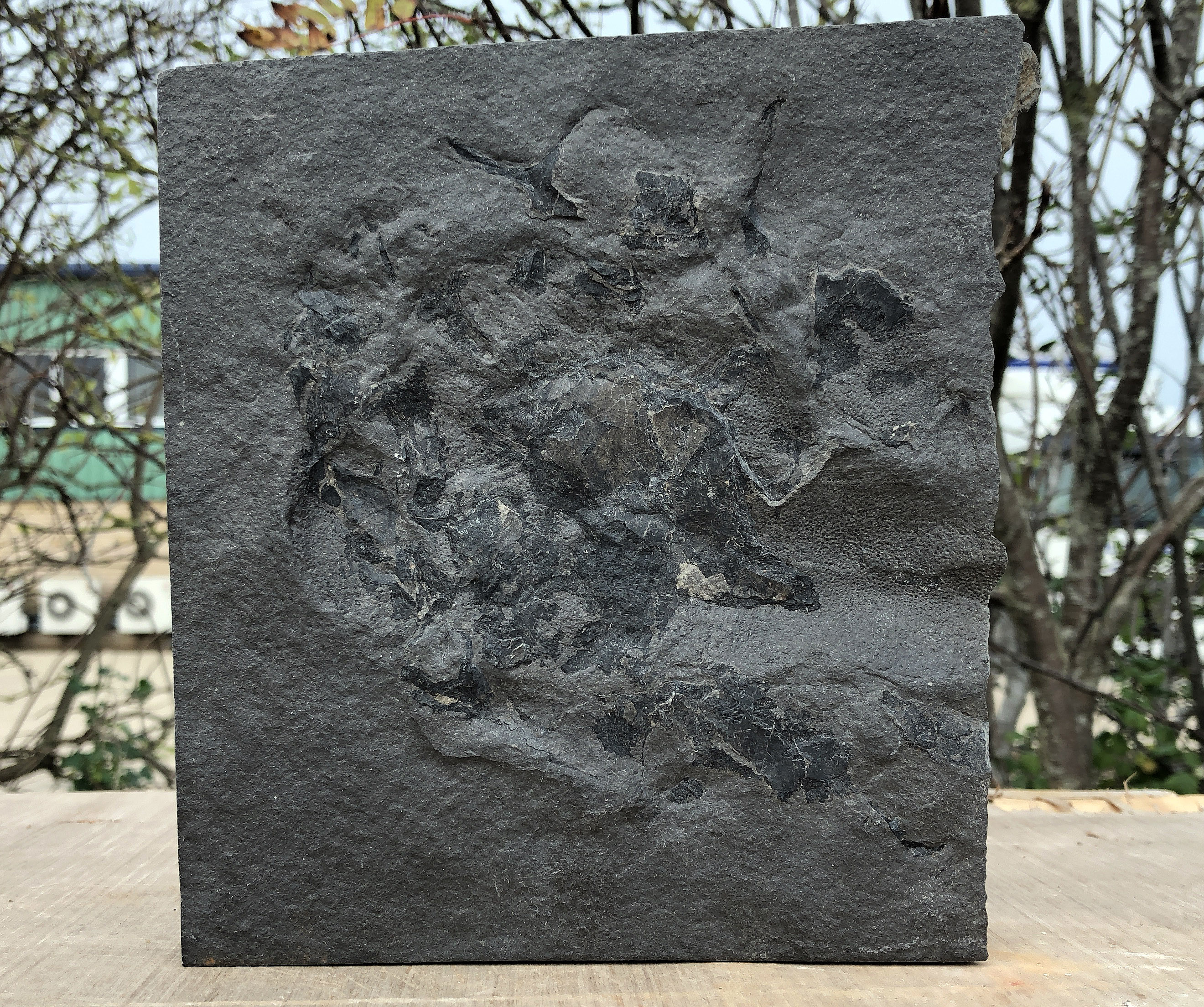
A chronological record of discoveries and research at Achanarras Quarry
c.1870 – The quarry opens
Achanarras began as a small farm quarry. Its thinly splitting flagstones were worked for building and roofing, exposing the laminated rocks that would make the locality internationally important.
1890 – Palaeospondylus enters the scientific record
Ramsay Heatley Traquair published an account of the Achanarras fishes and named Palaeospondylus gunni. Its unusual skeleton would remain the subject of competing interpretations for more than a century.
1937 – A major study of the quarry fishes
Clive Forster-Cooper published a detailed study of the Middle Devonian fishes of Achanarras, adding to the anatomical knowledge of this exceptionally preserved fauna.
1938 – Rhamphodopsis threiplandi is described
D. M. S. Watson described Rhamphodopsis threiplandi, a rare ptyctodont armoured fish for which Achanarras is the type locality.
1963 – The fine lamination is investigated
Dorothy Rayner examined the laminated sedimentary rocks, helping develop the interpretation of their fine layering as a record of repeated, potentially annual changes in the lake.
1980 – Drainage enables a measured study
The quarry was drained, allowing a measured rock column to be collected and studied. Matching fossil-bearing slabs to the fine lamination helped relate different fish assemblages to successive stages of lake development.
1981 – The quarry enters conservation ownership
The site came into the ownership of the national nature-conservation body. Its later management combined protection of the scientific resource with controlled opportunities for collecting and public interpretation.
1986 – Six faunal divisions reveal a changing lake
Nigel Trewin’s sedimentological and palaeoecological study distinguished six successive fish assemblages. Their distribution linked the famous fossils to deepening, maximum lake development and subsequent shallowing.
2000 – A rare arthropod is named
Achanarraspis reedi was described from Achanarras. This rare chasmataspid chelicerate was reported as the quarry’s first arthropod body fossil, extending its significance beyond fishes.
2001 – Cornovichthys blaauweni is named
Michael Newman and Nigel Trewin described Cornovichthys blaauweni, an exceptionally rare jawless vertebrate from the quarry.
2002 – Achanarella trewini is named
Michael Newman described Achanarella trewini, another jawless vertebrate from Achanarras. Its delicate remains can be preserved as dark films rather than the obvious bony armour of the better-known fishes.
2008 – Scotland’s first Actinolepis is reported
A single Achanarras specimen, recorded as having been found in 1998, was scientifically reported as Actinolepis sp. It was the first Scottish record of this arthrodire genus.
2008 – New interpretation helps visitors explore the site
A visitor shelter and interpretation were added, helping explain the quarry’s fossils and the long geological history recorded by its rocks.
2016 – The diplacanthid fishes are revised
A detailed revision, including Achanarras specimens, clarified the identities of several spiny fishes. It supported the use of Diplacanthus crassisimus rather than the later name D. striatus, and treated Rhadinacanthus longispinus as a separate genus.
2017 – A proposed merger of the jawless fishes
A study proposed that Achanarella and Cornovichthys belonged together under Euphanerops cf. longaevus. This remained disputed: a later study in 2025 supported keeping the two Achanarras forms distinct.
2020 – The Caithness Cheiracanthus is clarified
A revision of Scottish Cheiracanthus identified the Caithness Achanarras-horizon material as C. grandispinus. It reported C. murchisoni and C. latus as unknown in Caithness, correcting names repeated in older quarry lists.
2021 – Fish-swimming traces reveal temporary bottom-water oxygenation
A loose slab collected in May 2019 was described with two fish-swimming traces, one assigned to Undichna britannica and another tentatively to Undichna. The traces showed that living fish could reach the sediment surface during at least brief oxygenated episodes.
2021 – Possible arthropod traces add another line of evidence
A separate study reported putative arthropod scratch traces from Achanarras. Their cautious identification adds to discussion of activity on the lake floor without establishing a particular trackmaker.
2022 – A stem-tetrapod interpretation of Palaeospondylus
Synchrotron imaging of Palaeospondylus gunni led researchers to propose a position close to the ancestry of tetrapods. The interpretation attracted scientific criticism and should not be presented as a settled identification.
2023 – Orcadacanthus replaces familiar older names
A revision introduced Orcadacanthus pusillus for small Scottish spiny fishes previously separated as Mesacanthus pusillus and M. peachi. The study included museum specimens explicitly recorded from Achanarras.
2023 – The Palaeospondylus debate continues
A published critique challenged the tetrapod interpretation; a reply defended it with further analysis. The exchange confirmed that the affinity of this characteristic Achanarras fossil remained an active research question.
2024–2025 – Australian material challenges the tetrapod hypothesis
A study published online in December 2024 and in a 2025 journal issue compared Scottish Palaeospondylus gunni with older Australian P. australis. It argued against a tetrapodomorph interpretation and explored a position among early jawed vertebrates, potentially close to cartilaginous fishes. The newly described species came from Australia, providing comparative evidence for the Scottish fossil.
2025 – New evidence supports two distinct jawless fishes
Newman, den Blaauwen and Jones reported further information on Achanarella trewini and Cornovichthys blaauweni. Their study supported their distinction, challenging the proposed 2017 merger.
2026 – The evolutionary position remains open
A further scientific letter discussed Palaeospondylus as a potentially distinctive early jawed-vertebrate lineage. Its relationship to other vertebrates remains unresolved.
GEOLOGY
Achanarras records a deep-lake episode in the Orcadian Basin during the late Eifelian stage of the Middle Devonian. Rivers and lakes occupied this continental basin within the Old Red Sandstone landscape. The familiar flagstones are sedimentary rocks that split readily along bedding, rather than metamorphic slate. At the quarry, finely laminated muds and silts captured both changing lake conditions and the remains of an unusually diverse fish community.
Current BGS terminology places the Achanarras Fish Bed Member in the Lybster Flagstone Formation, within the Lower Caithness Flagstone Subgroup and Caithness Flagstone Group. Older accounts call it the Achanarras Limestone Member and use different group or formation boundaries. The distinction matters here: the published complete laminite unit is about 3.6 m thick, while the principal fossil-rich interval occupies approximately its lower 1.95 m. Those figures refer to different parts of one succession, not two beds to be added together.
Below the member, rippled siltstones and thin sand lenses record shallower water. The basal dark, organic-rich laminites formed as the lake deepened; carbonate-rich and then more dolomitic layers followed before increasingly silty sediment marked regression. Fine organic, carbonate and clastic laminae have been interpreted in terms of seasonal sedimentation, although annual-layer counting involves assumptions and does not provide an exact calendar for every bed. The fish assemblage also changes upward. Six published faunal divisions describe those changes without constituting six separately named members.
The preservation of articulated fish is associated with quiet deposition and poorly oxygenated bottom conditions, which limited scavenging and disturbance. Concentrations on particular bedding surfaces record episodes of mortality and burial, rather than a uniform rain of identical fish throughout the section. The discovery of swimming traces adds an important qualification: the sediment surface was at least occasionally oxygenated enough for living fishes to approach it. Permanently lifeless bottom water is too simple an explanation for the whole deposit.
Above the main fish interval, laminites continue with relatively few fish, small sedimentary pull-aparts and microfaults. Higher beds include alternating fine laminites and sharp-based sandstone or siltstone event layers, assigned in the modern framework to the Spital Flagstone Formation of the Upper Caithness Flagstone Subgroup. Some flows tore pieces from underlying laminated sediment. The beds dip gently eastward, but flooding and spoil obscure much of the section; loose blocks are consequently easier to inspect than the full bed-by-bed sequence.


A closer look at the rocks and fossil-bearing beds at Achanarras Quarry
The succession is described from oldest to youngest. The fish-bearing rocks belong to the late Eifelian, near the end of the first stage of the Middle Devonian. They accumulated in the Orcadian lake basin. The quarry records a lake-deepening and shallowing cycle, rather than a marine shoreline.
CAITHNESS FLAGSTONE GROUP
The Caithness Flagstone Group forms part of the Old Red Sandstone Supergroup. At Achanarras, its lake deposits include the fish-bearing member and the beds immediately below and above it.
LOWER CAITHNESS FLAGSTONE SUBGROUP
Lybster Flagstone Formation
Beds below the fish-bed member
Dark, flaggy siltstones contain pale silty laminae, isolated ripple structures and fine sand lenses, with occasional plant debris and pyrite replacement recorded in the log. These record relatively shallow water before the lake deepened. No separate formal member name or reliable quarry thickness is assigned here.
Achanarras Fish Bed Member — 3.6 m in the measured section
The complete laminated member is about 3.6 m thick in the published measured section; most fish fossils occur in its lower approximately 1.95 m. These are measured stratigraphic thicknesses, not the amount currently exposed to visitors. The lower boundary is placed above the rippled silty beds and the upper boundary at the first non-laminated bed. Older accounts call this the Achanarras Limestone Member.
The principal fish-bearing interval was divided into six faunal divisions. They describe changes in the fossil assemblages within a continuous succession, not six separately named formations or six beds of known equal thickness. The published distribution chart records a studied sample, not the chances of finding each fish today.
Faunal division 1: basal, dark laminites
Dark grey to black, thinly laminated silt-rich and organic-rich rocks contain relatively little carbonate. They record the initial deepening of the lake. Smooth, thin-splitting slabs from this lower interval yielded particularly well-preserved Dipterus; Pterichthyodes and other fish also occur.
Faunal division 2: central carbonate-rich laminites
The succession passes into mixed calcareous and dolomitic laminites, with carbonate–organic bundles and less silt. The published fish distribution shows concentrations of Palaeospondylus, the small spiny fish now called Orcadacanthus, and Osteolepis. Pterichthyodes is also present.
Faunal division 3: continued diverse fish assemblages
Within the same central laminated facies, Palaeospondylus, Orcadacanthus and Pterichthyodes remain conspicuous. Glyptolepis and Coccosteus occur, and the soft-bodied jawless fish Achanarella is recorded on the distribution diagram. A distinct thickness or unique rock type cannot be assigned to this division from the available log.
Faunal division 4: larger spiny fishes
The diverse central interval includes a conspicuous concentration of Diplacanthus and Cheiracanthus, with Rhamphodopsis and other fishes. Its upper part approaches the end of the more calcareous phase. The carbonate-rich central rocks are interpreted as deposits of the deepest part of the lake cycle.
Faunal division 5: the main Coccosteus interval
Rougher, finely nodular, dolomite-rich laminites contain more silt and frequent organic laminae. Coccosteus is especially prominent in the studied assemblage. These deposits mark the beginning of the lake-shallowing phase.
Faunal division 6: upper Dipterus concentration
Coarser dolomitic rocks contain a second concentration of Dipterus, generally less well preserved than in the basal interval. The assemblage is Dipterus-dominated; the published distribution diagram also records rare Glyptolepis, so it should not be described as containing only lungfish.
Upper laminites above the main fish-rich interval
Smoother clastic–dolomitic laminites with fewer organic laminae continue above the principal fish-bearing interval, within the same member. Pull-apart structures and small faults record disturbance of soft sediment. Fish are much less frequent as the lake continued to shallow.
UPPER CAITHNESS FLAGSTONE SUBGROUP
Spital Flagstone Formation
Above the laminated fish-bed member, the measured quarry succession includes two repeatedly interbedded lithologies. The letters X and Y below are descriptive codes used in the published logs, not formal bed names. The quarry does not expose the full thickness of the formation.
Lithology X: fine silt–dolomite laminites
Thin quartz-rich silt and dolomicrite layers form comparatively even pairs, reported as 0.5–1.5 mm thick, averaging about 0.7 mm.
Lithology Y: sediment-flow beds
Greenish-grey, relatively massive fine sandstone and siltstone beds reach up to 45 cm thick. They have sharp bases and may show grading, muddy tops, or torn-up flakes and folded sheets of laminite. Dolomite alteration gives weathered surfaces a brown colour. These beds are interpreted as deposits of low-density sediment flows entering the lake, alternating with the quieter-water laminites.
Changing names and boundaries
The current BGS Lexicon places the Achanarras Fish Bed Member in the Lybster Flagstone Formation, within the Lower Caithness Flagstone Subgroup. Older publications use different group and formation boundaries and the names Robbery Head, Achanarras Limestone and Spittal Beds. Some BGS boundary descriptions retain legacy wording. This guide follows the current member–formation parentage and uses the older measured logs for the detailed quarry succession, without treating historical names as extra layers.
Preservation and life on the lake floor
Fine sediment, limited disturbance and episodes of oxygen-poor bottom water helped preserve articulated fish. Algal activity and associated rises in water pH helped promote carbonate precipitation. Seasonal deposition has been proposed for the lamination, but a precise duration depends on how those layers are interpreted. Fish-swimming traces described from a loose quarry slab show that the sediment–water interface was oxygenated at least temporarily. They cannot be assigned to a particular faunal division, and the lake floor was not necessarily lifeless throughout deposition.
References
- Barclay, W. J., Browne, M. A. E., McMillan, A. A., Pickett, E. A., Stone, P. and Wilby, P. R. (2005). The Old Red Sandstone of Great Britain. Geological Conservation Review Series 31. Joint Nature Conservation Committee, Peterborough. Achanarras Quarry account, pp. 90–93. Source.
- Dineley, D. L. and Metcalf, S. J. (1999). Fossil Fishes of Great Britain. Geological Conservation Review Series 16. Joint Nature Conservation Committee, Peterborough. Achanarras Quarry site account. Source.
- Newman, M. J. and Dean, M. T. (2005). A biostratigraphical framework for geological correlation of the Middle Devonian strata in the Moray-Ness Basin Project area. British Geological Survey Internal Report IR/05/160. Source.
- Trewin, N. H. (1986). Palaeoecology and sedimentology of the Achanarras fish bed of the Middle Old Red Sandstone, Scotland. Transactions of the Royal Society of Edinburgh: Earth Sciences, 77, 21–46. Source.
- Trewin, N. H. (2009). Excursion 5: The Old Red Sandstone of Caithness. In Trewin, N. H. and Hurst, A. (eds), Excursion Guide to the Geology of East Sutherland and Caithness. Dunedin Academic Press, Edinburgh. Locality 3; Figures 5.4 and 5.7. Source.
- Tindal, B. H., Shillito, A. P. and Davies, N. S. (2021). First report of fish trace fossils (Undichna) from the Middle Devonian Achanarras Limestone, Caithness Flagstone Group. Scottish Journal of Geology. Source.
- British Geological Survey (accessed 12 October 2026). The BGS Lexicon of Named Rock Units: Achanarras Fish Bed Member and linked parent units. Source.
SAFETY
Avoid the flooded workings, water’s edge and unstable slopes, and obey fences and warning signs. Sharp, shifting flagstone makes footing awkward; keep children close. The quarry is exposed, so dress for cold rain and wind. When splitting rock, leave space around other visitors and wear the head and eye protection required by the site notice.
EQUIPMENT
Bring sturdy boots, gloves, warm waterproof clothing, a hand lens and wrapping with a rigid box for fragile specimens. Purpose-made rock hammers and chisels are permitted for loose material; power tools, sledgehammers and crowbars are prohibited. Goggles and head protection are required when hammering.
CLEANING AND TREATING
Keep matching halves together and support thin slabs on a rigid backing during transport. Let damp pieces dry gradually, then remove loose dirt with a soft dry brush. Fine bone, scales and carbonaceous impressions can be lifted away with the sediment, so avoid vigorous scrubbing, soaking or trying to peel off every overlying layer.
Leave delicate or unusual finds unprepared for expert assessment. Household acids and bleach can damage the fossil or its carbonate-rich matrix; varnish also obscures surfaces needed for study. Consolidation should be limited to genuinely unstable material and chosen with specialist advice, particularly for a specimen that may be offered to a museum.
IDENTIFY YOUR FINDS
Need help identifying a fossil? Share clear photos, where you found it and its size with the community.
FURTHER READING
Fossil fishes of the Old Red Sandstone — Deposits (2016; some names and interpretations have since changed)
NatureScot: current Achanarras collecting and access notice
NatureScot: visiting Achanarras Quarry Nature Reserve
Trewin’s field guide: Achanarras is Locality 3
Geological Conservation Review: Achanarras fossil-fish account
Orcadacanthus: the 2023 revision of small Scottish spiny fishes
ACCESS RIGHTS

NatureScot, the landowner, permits collecting from loose material only: at most 10 fossil-bearing rock pieces per day, for a maximum of 7 days. Longer collecting needs a separate application supported by research and museum or university donation evidence. Do not excavate bedrock on the floor or faces. Fossils may be sold only with written NatureScot permission. Report rare or particularly fine finds.
Read the current collecting and access notice before visiting and follow the Scottish Fossil Code. The published scheme is specific to Achanarras Quarry SSSI; do not assume it applies at other Scottish sites.
It is important to follow our ‘Code of Conduct’ when collecting fossils or visiting any site. Please also read our ‘Terms and Conditions‘
LINKS
♦ Fossil Discussions
♦ Fossil Articles
♦ Buy Fossils, Tools and Equipment
♦ Buy Crystals, Meteorites, and Artefacts
♦ Join Fossil Hunts
♦ UK Fossils Network


