Watton Cliff is one of Britain’s most important Middle Jurassic microfossil localities, exposing the fossil-rich Forest Marble Formation above the Frome Clay. While larger fossils such as brachiopods, crinoids, sharks’ teeth and reptile remains can be found, the site is best known for its remarkable microvertebrate fauna, including rare Middle Jurassic mammal teeth. Careful collection and processing of samples can reveal an extraordinary range of tiny fossils hidden within the sediments.


FIND FREQUENCY: ♦♦♦♦ – Watton Cliff is one of the richest microfossil localities in Britain, yielding an exceptionally diverse range of fossil types and species. Processed samples from the Forest Marble can produce mammal teeth, fish remains, shark teeth, crocodile material, amphibians, reptiles, ostracods and much more. Larger fossils are less common, although brachiopods from the Frome Clay and shelly fossils from the Forest Marble are regularly found.
CHILDREN: ♦♦♦ – Suitable for older children, particularly when accessed from Eype. Although the site is best known for microfossils, children can often find brachiopods and shell material amongst loose material on the open foreshore, well away from cliffs and slips without the need for specialist equipment.
ACCESS: ♦♦♦ – The easiest access is from Eype, walking eastwards along the beach to the cliff. The route is relatively straightforward and not excessively long. Access from West Bay is not recommended due to the difficult descent over rocks and the increased risk of slips and falls.
TYPE: Cliff and foreshore locality. Most collecting involves searching fallen blocks and taking small samples from detached, stable Forest Marble blocks on the open foreshore for later processing. The cliffs are high and unstable, particularly after wet weather, so keep well away from their base and from landslips.
DIRECTIONS
♦ The easiest way to reach Eype is via a narrow turning off the A35 just west of Bridport. Follow New Street Lane, which becomes Mount Lane, and continue down through the village of Lower Eype until you reach the beach car park at Eype’s Mouth. The road is very narrow in places and is not suitable for large vehicles, motorhomes or caravans.
♦ There is a small car park at Eype’s Mouth (postcode DT6 6AL) close to the beach. Parking charges now apply all year round, so be prepared to pay on arrival. Parking spaces can be limited during busy periods, particularly in summer.
♦ From Eype Beach, walk east along the foreshore towards Watton Cliff. The walk is straightforward and provides the safest and easiest access to the locality.
♦ Watton Cliff is reached after a relatively short walk along the beach. Search only detached material on the open foreshore, keeping well clear of the cliff base and landslips.
♦ Access from West Bay is not recommended. The descent onto the beach at the western end involves crossing large rocks, and several people have suffered injuries attempting this route. Access via Eype is considerably safer and is the route we recommend.
♦ Car parking: DT6 6AL, Google Maps
♦ What3Words location: ///tagging.dimension.option
VIDEO FILM
FOSSIL HUNTING
Watton Cliff is one of Dorset’s most important microvertebrate localities and has produced an extraordinary range of fossils from the Middle Jurassic. Unlike many Dorset sites where large fossils are the main attraction, the greatest rewards here often come from collecting and processing samples from the fallen Forest Marble beds.
Most of the cliff consists of the relatively unfossiliferous Frome Clay Formation, although occasional brachiopods, bivalves and corals can be found. More productive material is usually derived from the overlying Forest Marble Formation, which occurs near the top of the cliff and reaches the beach as fallen blocks and slipped debris.
The Forest Marble yields a diverse fauna of small vertebrates and invertebrates. Processed samples include shark teeth, fish scales, crocodilian and other reptile fragments, amphibian remains, ostracods, bryozoans and crinoid columnals. Published Watton samples include Egertonodus duffini, Planohybodus grossiconus and Parvodus pattersoni. Older accounts and specimen captions use historical names: crushing teeth called Asteracanthus are now distinguished as Strophodus, and the crinoid is listed as Apiocrinus in the GCR log. These are research identifications, not names to assign to every worn tooth or stem fragment.
The site is internationally important for tiny mammal teeth. Records include Eleutherodon oxfordensis, Borealestes serendipitus, Amphilestes cf. A. broderipii and indeterminate trechnotherians. Watton also supplied the type teeth of Morganucodon tardus, Stylidens hookeri and Phascolotherium simpsoni, described in 2016. The tritylodont Stereognathus is a mammal relative, not another mammal genus. Such finds are rare and need specialist identification; retain each tooth and its labelled sample residue rather than attempting to clean away every trace of matrix.
Small brachiopods are common in suitable samples and include Goniorhynchia boueti, Avonothyris langtonensis and Ornithella digona. Bivalves include Chlamys vagans, Camptonectes, Plagiostoma and Praeexogyra. Small oysters are often abundant within the shelly Forest Marble blocks found on the foreshore.
Towards the western end of the section lies Faults Corner, where movement on the Eypes Mouth Fault has brought older Jurassic rocks into contact with the Forest Marble succession. Fallen blocks of Beacon Limestone Formation can sometimes be found on the beach and may yield additional fossils not normally associated with Watton Cliff.


The key microvertebrate source is the Mammal Bed: impersistent sheets and lenses of shell-rich, locally cross-bedded limestone with marly partings, wood fragments and broken shells. It is not simply any orange-brown, crumbly sand. Rounded shiny teeth and scales can be minute, and the mixed marine and land-animal remains reflect transport into a shallow-water shell bank. Keep samples from recognisably different blocks separate and record uncertain provenance honestly.
Forest Marble material reaches the shore from high in the cliff. Search only detached, stable blocks on the open beach, well away from the cliff base and landslips; do not climb to the beds or enter fresh fallen debris.
Samples should be collected in strong bags and labelled carefully with the bed or horizon from which they were taken. Keeping accurate notes is important, particularly if several samples are collected from different parts of the cliff.
Begin with a small, labelled test sample of soft marl that has no visible fragile fossil. Gentle water disaggregation may separate a soft matrix, but the hard Mammal Bed limestone will not necessarily break down by soaking. Do not repeatedly crush a sample to force it apart: tiny teeth can be damaged. Research collections used controlled laboratory preparation, including acid treatment; that is not a general home-cleaning recipe. Seek specialist advice for cemented blocks or significant finds.
The resulting sediment can then be wet-sieved through a range of mesh sizes. Many collectors use sieves of approximately 500, 250 and 150 microns. Once dried, the residues can be examined under a binocular microscope.
Patience is essential. A seemingly unremarkable sample may contain shark teeth, fish remains, mammal teeth, ostracods, tiny brachiopods and numerous other fossils invisible to the naked eye.


Key fossil discoveries, geological records and site-history milestones from Watton Cliff, Dorset.
1836 – early geological attention
The Watton Cliff coast, between Eype Mouth and West Bay, had entered formal geological study by the 1830s. This early recognition helped establish the cliff as an important Middle Jurassic section rather than just a local stretch of unstable coast.
1894–1898 – first detailed cliff descriptions
Late 19th-century geological survey work gave the first detailed descriptions of the Watton Cliff succession. These accounts recorded the relationship between the clays, limestones and shelly beds that are now placed in the Frome Clay and Forest Marble formations.
1916–1922 – Watton Cliff name and Junction-Bed study
S.S. Buckman investigated the cliffs after finding fossiliferous material at Fault Corner in 1916, returning in later years before publishing his account in 1922. He used the name Watton Cliff from Watton Farm behind the coast, helping fix the geological name for a section also known locally around West Cliff, Ware Cliff, Clay Knapp and Fourfoot Hill.
1933 – near-complete Forest Marble succession recognised
The former presence of a small Cornbrash remnant on the cliff top showed that the Forest Marble succession at Watton Cliff was probably almost complete. This made the locality especially useful for understanding the upper Bathonian rocks of west Dorset.
1936–1941 – Wattonensis Beds established
The brachiopods Rhynchonelloidella wattonensis and Wattonithyris wattonensis became central to defining the Wattonensis Beds, a fossil-rich marker horizon at the base of the Frome Clay. Watton Cliff is the type locality for these beds, making the site important for regional Bathonian correlation.
1957–1959 – microfossils and ammonites expanded the record
Microscopic fossils from Watton Cliff, including holothurian sclerites and foraminifera, were described during the late 1950s. In the same period, ammonite work included the holotype of Procerites wattonensis from the Wattonensis Beds, adding useful dating evidence to the brachiopod-rich marker horizon.
1969 – bed-by-bed framework refined
A modern bed-numbered framework was set out for the Forest Marble and underlying beds at Watton Cliff. This made it easier to place fossils, including material from the Boueti Bed and Mammal Bed, into a precise position within the cliff succession.
spring 1970 – fossiliferous shore blocks found
Blocks from the Forest Marble were found on the shore below Watton Cliff and proved to contain a varied fossil assemblage, including crinoid material, shark teeth and rare crocodilian remains. These finds drew attention to the vertebrate potential of the fallen and slipped Forest Marble blocks.
1970 – trace fossils interpreted
Trace fossils from the upper Forest Marble at Watton Cliff, including Gyrochorte and Imbrichnus wattonensis, were used to interpret the shallow-marine environment. The work showed that the ripple-marked and burrowed sandstone tiles were evidence of changing water energy and seafloor activity, not just decorative markings in fallen blocks.
1976–1977 – first mammal and tritylodont records
Mammalian teeth were recorded from the Watton Cliff Mammal Bed, followed by a single tritylodont tooth identified as Stereognathus. These discoveries established Watton Cliff as one of the few British Middle Jurassic localities to yield important small mammal and mammal-relative remains.
1977 – Liassic palaeofault recognised
Work on the older beds faulted against the Watton Cliff section showed evidence for Jurassic movement on a palaeofault, including abrupt thickness changes and mineral-filled fissures with Toarcian ammonites. This added structural importance to the locality as well as its better-known Bathonian fossil record.
late 1970s – Mammal Bed bulk sampling
A University College London team excavated and processed material from the Mammal Bed as part of work on Middle Jurassic tetrapod assemblages. Bulk sieving and acid preparation recovered small sharks, bony fish, amphibians, reptiles and mammals, turning Watton Cliff into a key microvertebrate locality.
1981–1983 – Mammal Bed environment explained
Detailed sedimentological work interpreted the Mammal Bed as a shell-rich, high-energy deposit with channels and storm-washed debris. This explained why Watton Cliff preserves a mixed assemblage of marine fossils, plant material and transported land vertebrate remains in the same Forest Marble horizon.
1985 – Lissodus sharks described
Two small hybodont sharks, Lissodus wardi and Lissodus pattersoni, were described from Mammal Bed material, with the holotype of Lissodus wardi from Watton Cliff. The historical names need qualification: L. wardi was later synonymised with L. leiodus, and L. pattersoni is now placed in Parvodus. These teeth strengthened the site’s importance for tiny shark faunas as well as for mammals and amphibians.
1992–1994 – transported tetrapod assemblage clarified
Studies of the Forest Marble microvertebrates showed that Watton Cliff contains a marine fish component together with water-worn amphibian, reptile and mammal remains transported from land or freshwater settings. This helped explain the unusual mixture of fossils found in the Mammal Bed.
1995 – ammonite dating and lithostratigraphy refined
The Watton Cliff Frome Clay succession was reinterpreted within a modern stratigraphic framework, and ammonites from the Wattonensis Beds were used to recognise the Upper Bathonian Quercinus Subzone. The holotype of Procerites wattonensis was also reassessed in relation to Procerites quercinus, tightening the dating of the section.
1998 – Eleutherodon oxfordensis added to the mammal record
Allotherian mammal teeth from Watton Cliff were included in the record of Eleutherodon oxfordensis. Although based on tiny isolated teeth, the material added to the site’s importance for early mammal evolution in the British Middle Jurassic.
1999–2005 – national site importance documented
Watton Cliff was recognised as a nationally important site for fossil fishes, mammals and Middle Jurassic stratigraphy. Its value rests on the best Bathonian exposure in Dorset, the type locality of the Wattonensis Beds, the Boueti Bed marker horizon and the Mammal Bed microvertebrate fauna.
2003 – docodont and trechnotherian mammals recorded
The Watton Cliff mammal fauna was expanded with records including Borealestes serendipitus and indeterminate trechnotherian material. These rare teeth added further diversity to the Mammal Bed and linked Watton Cliff with other important British Middle Jurassic microvertebrate sites.
2005 – further allotherian teeth described
Additional allotherian mammal teeth from the Forest Marble were described, including Watton Cliff specimens from the Mammal Bed. The work helped clarify the early record of multituberculate-like mammals and showed that Watton Cliff continued to provide evidence from very small, easily overlooked fossils.
2011 – Wattonensis Beds formalised in modern usage
The Wattonensis Beds were treated as a formal local unit with Watton Cliff as the stratotype. This reinforced the site’s role as the reference point for a distinctive brachiopod-rich Bathonian marker bed within the Frome Clay.
2016 – new triconodont mammals named
Triconodont mammal teeth from Watton Cliff and related Forest Marble sites were revised, with Watton Cliff providing type material for Morganucodon tardus, Stylidens hookeri and Phascolotherium simpsoni. These tiny teeth made the locality especially important for understanding Middle Jurassic mammal diversity.
2024 – ornithischian dinosaur teeth reviewed
Five isolated ornithischian dinosaur teeth from Watton Cliff were included in a wider study of British Bathonian microvertebrate faunas. The record shows that small dinosaur remains were also washed into the Forest Marble depositional system, adding another terrestrial element to the Mammal Bed story.
GEOLOGY
Watton Cliff exposes one of the most complete sections of the Forest Marble Formation in Dorset and is an important Middle Jurassic locality of Bathonian age.
The lower part of the cliff consists of the Frome Clay Formation, a sequence of grey calcareous mudstones and clays deposited in a relatively quiet marine environment. Although generally less fossiliferous than the beds above, occasional brachiopods, corals and shell beds occur within the succession.
The boundary between the Frome Clay and the overlying Forest Marble is marked by the distinctive Boueti Bed, named after the brachiopod Goniorhynchia boueti. This horizon forms the basal bed of the Forest Marble Formation but is often difficult to access directly.
Above the Boueti Bed lies the Forest Marble Formation itself. Despite its name, the formation is not dominated by marble-like limestone at Watton Cliff. Instead, it consists largely of grey calcareous mudstones, shelly sandstones and cross-bedded ferruginous limestones deposited in shallow marine conditions influenced by strong currents and shifting sandbanks.
Published sections expose more than 25 metres of Forest Marble at Watton Cliff, although the formation top is not seen in the BGS reference-section account. The site preserves an important Bathonian succession. Several beds contain concentrations of shell debris and vertebrate remains, while a small number of horizons are particularly rich in microfossils.
At the western end of the cliff, the major Eypes Mouth Fault creates the feature known as Faults Corner. Here, fault movement has juxtaposed older Jurassic rocks against the Forest Marble succession, and blocks of the Beacon Limestone Formation can often be found on the foreshore.
Together, the Frome Clay, Boueti Bed and Forest Marble Formation provide an exceptional record of Middle Jurassic marine environments and have made Watton Cliff one of Britain’s most important Bathonian fossil localities.

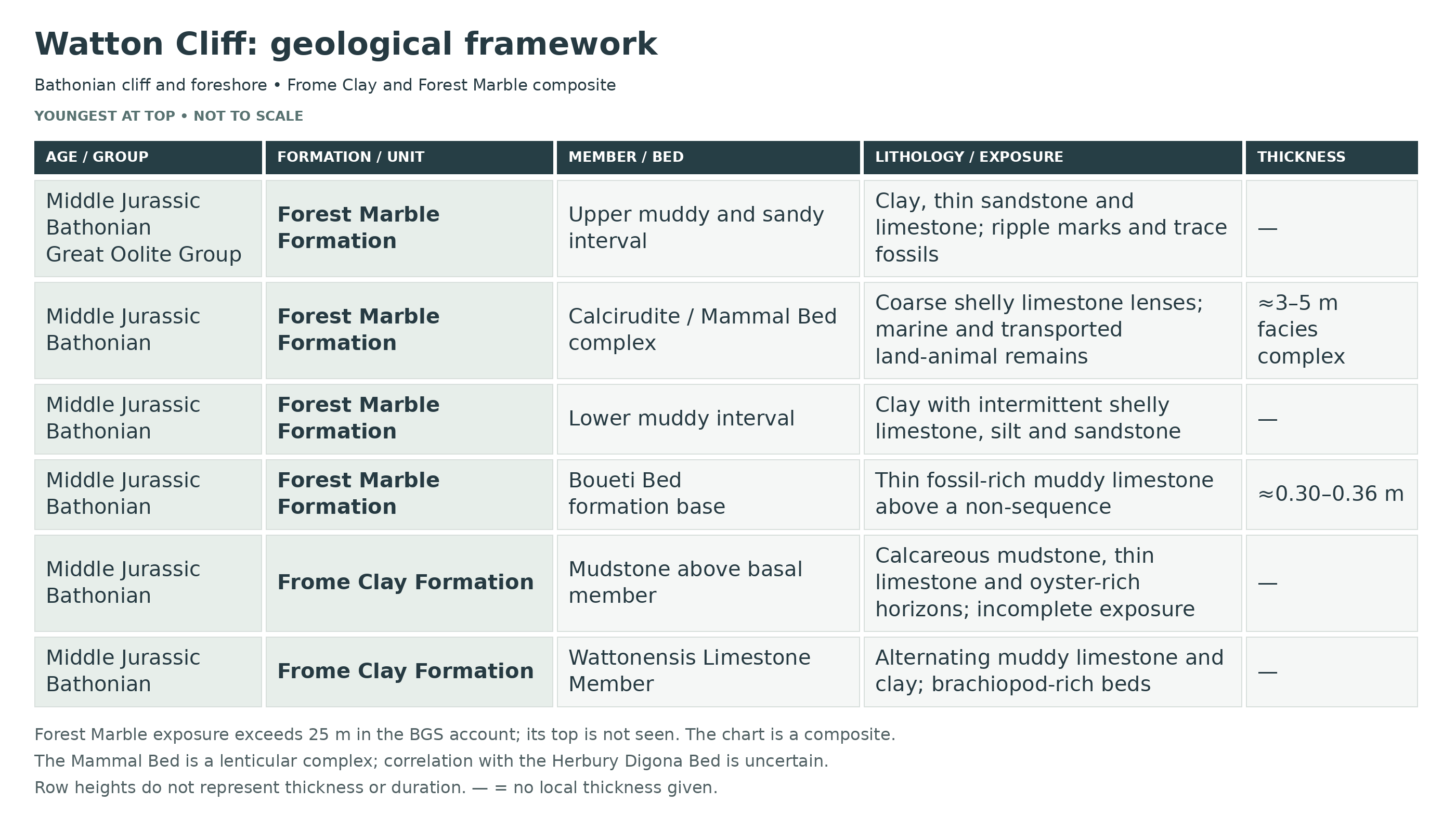
This is a detailed stratigraphic breakdown of Watton Cliff, the best Bathonian cliff-and-foreshore section in Dorset, where the Frome Clay Formation and the overlying Forest Marble Formation are exposed between Eype Mouth and the River Brit. The locality is especially important for the Wattonensis Beds and Boueti Bed marker horizons, and for the vertebrate-rich calcirudites of the Forest Marble Mammal Bed.
The sixteen WC labels below are editorial cross-references. Their measurements and published bed numbering follow Cox’s GCR account (2002, printed pages 43–44), adapted there from Callomon and Cope, Wilson and Torrens, with Holloway and Hallam observations. The Frome Clay and Forest Marble each have their own numbered series. These are historical local composite observations, not sixteen newly measured beds or a complete modern cliff traverse.
Section Architecture
Watton Cliff is not a single simple vertical cliff log. The section extends for about 750 m between Eype Mouth and the River Brit and is affected by landslip, beach masking and faulting at both ends, so some parts are only intermittently visible. The Bathonian succession, comprising the Frome Clay Formation overlain by the Forest Marble Formation, is faulted against older Lias Group rocks to east and west, and the type locality of the Wattonensis Beds is now exposed only in restricted places near the Eype Mouth Fault and within the West Cliff Fault shatter belt.
Stratigraphic Note
Published bed numbers exist for this section. The Frome Clay and Forest Marble bed numbers used below are those of Torrens and later summaries based on Wilson, Holloway and Callomon & Cope. The older Woodward log uses a different numbering system, and the famous Mammal Bed calcirudites of Woodward’s Bed 8 correspond broadly to the middle shell-bank complex of the modern Forest Marble scheme. The succession is upper Bathonian throughout, with the Frome Clay placed in the Quercinus Subzone and the Forest Marble correlated more broadly by its marker beds and lithological position within the late Bathonian succession.
GREAT OOLITE GROUP
Frome Clay Formation (Upper Bathonian)
Wattonensis Limestone Member
Bed WC1 — Wattonensis Beds In The Historical Local Log (Seen To c. 8 m); Published Formal-Member Thickness Accounts Differ, So No Fixed Thickness Is Assigned In The Chart
The Wattonensis Beds form the basal and most famous part of the Frome Clay succession at Watton Cliff. They consist of alternating clays and thin muddy limestones, richly fossiliferous and dominated by brachiopods, especially Acanthothiris powerstockensis, Rhynchonelloidella, Rugitela, Tubithyris and Wattonithyris, together with bivalves such as Catinula knorri, Modiolus anatinus, Parallelodon and Trigonia elongata. Sparse ammonites include the specimen originally named Procerites wattonensis, later regarded as close to P. quercinus, and this is why the Watton Cliff Frome Clay is assigned to the Quercinus Subzone. Watton Cliff is the type locality of the Wattonensis Beds but is now only intermittently visible because of shingle cover, landslip and fault disruption. Depositional environment: quiet offshore calcareous mud accumulation with recurring shelly, bioturbated limestone interbeds on a low-energy shelf.
Frome Clay Formation — Undivided Above The Wattonensis Limestone Member
Bed WC2 — Oyster Bed / Torrens Bed 2 (0.75 m)
A clay bed rich in small or broken Praeexogyra hebridica. This is one of the two oyster-rich levels recognised in the Dorset Frome Clay above the Wattonensis member and provides a useful marker within the lower part of the formation. The abundance of disarticulated small oysters indicates a quiet muddy sea floor that was periodically colonized by dense oyster populations and then disturbed or reworked just enough to break and concentrate shells without converting the bed into a true shell gravel.
Bed WC3 — Covered Gap / Torrens Bed 3 (Historically Estimated c. 12 m; Later Authors Considered This An Underestimate)
A substantial covered interval occurs above the Oyster Bed. Buckman estimated this missing thickness at about 12 m, but later workers regarded that as probably an underestimate. Because this interval is not honestly visible in modern exposure, it should remain a documented gap rather than be turned into a spurious detailed local log. It represents a large part of the lower to middle Frome Clay succession.
Bed WC4 — Torrens Bed 4, Marly Clay To Beach Level (6.0 m)
Grey to blue-grey marly clay forms a thick, rather featureless middle part of the exposed Frome Clay. Although not as conspicuously fossiliferous as the Wattonensis Beds below, it belongs to the same broad offshore mudstone regime and records continued deposition below fair-weather wave base. Fossils are comparatively sparse and exposure quality is usually poor, but the bed is important because it shows that the Frome Clay at Watton Cliff is not merely a thin brachiopod bed below the Forest Marble, but a substantial clay formation in its own right.
Bed WC5 — Torrens Bed 5, Alternating Pale Fine-Grained Limestones And Marl (0.45 m)
A thin but distinctive alternation of pale argillaceous fine-grained limestone and marl interrupts the more monotonous clays below and above. It represents a brief phase of more calcareous sedimentation within the Frome Clay sea and may reflect slower mud input, enhanced carbonate production or both. The bed is significant mainly as an internal marker in the upper part of the formation.
Bed WC6 — Torrens Bed 6, Main Blue-Grey Marl (16.4 m)
This thick blue-grey marl is the dominant upper unit of the exposed Frome Clay at Watton Cliff. It is calcareous, predominantly fine-grained and relatively uniform, though locally fossiliferous and bioturbated. The great thickness of this interval is one reason the Watton section is so valuable, because the Frome Clay is much less well exposed in its inland type area and commonly known there only from boreholes. Depositional environment: prolonged offshore mud accumulation in a quiet shelf sea, with only subordinate limestone development and no sign yet of the sandy, shell-bank conditions of the Forest Marble above.
Bed WC7 — Torrens Bed 7, Laminated White Argillaceous Limestone (1.5 m)
A conspicuous white, fine-grained, laminated argillaceous limestone near the top of the Frome Clay. The bed is more indurated and laterally obvious than much of the formation below and marks a short-lived calcareous phase close to the transition into the Forest Marble. Its lamination and pale colour contrast with the darker marls beneath.
Bed WC8 — Torrens Bed 8, Upper Shaly Blue Marl (1.5 m)
Blue shaly marl forms the highest exposed Frome Clay directly beneath the Boueti Bed. The top of this unit may contain burrows, and the Boueti Bed above rests non-sequentially on it. This final marl interval records the last offshore-mud phase before the abrupt late Bathonian facies change into the mixed shell-bank, sandstone and limestone environment of the Forest Marble.
Composite Frome Clay Scale: Roughly 47 Metres If The Historical 12-Metre Gap Estimate Is Used; This Is An Approximate Calculation, Not A Continuously Measured Total
Forest Marble Formation (Upper Bathonian)
Historical Cornbrash And The Missing Digona Marker
The GCR records that a small Cornbrash remnant formerly occurred on the summit but was subsequently eroded away; this historical observation does not make the present Forest Marble top visible. The characteristic Digona Bed of Herbury cannot be recognised at Watton, so it is not inserted as a named local bed or used to import a Weymouth fauna.
Forest Marble Note
The Forest Marble at Watton Cliff is the most complete section of the formation in west Dorset and can be divided into three broad lithological packages: a lower muddy and sandy shell-bearing unit, a middle coarse shell-bank and calcirudite complex, and an upper muddy sandstone-and-clay unit with exceptionally varied trace fossils. Direct ammonite evidence in the Forest Marble at Watton itself is sparse, so detailed age control relies mainly on correlation by the Boueti Bed and the higher calcirudite interval with the better-dated east Dorset succession.
Bed WC9 — Boueti Bed (unnumbered basal Forest Marble marker; 0.35 m)
The Boueti Bed forms the base of the Forest Marble Formation and is one of the two great marker horizons of Watton Cliff. It is a hard, whitish to reddish-brown weathering shelly calcareous marl or argillaceous micrite rich in brachiopods, especially Goniorhynchia boueti, together with terebratulids, bivalves such as Camptonectes laminatus, Chlamys vagans, Praeexogyra hebridica, Trigonia costata and Vaugonia impressa, gastropods including Pleurotomaria burtonensis and Turbo burtonensis, crinoid debris of Apiocrinus elegans, serpulids, bryozoans and rare corals. Large Thalassinoides burrow networks occur at the base. The bed is a widespread late Bathonian datum that can be traced northwards into Somerset and the southern Mendips, and it rests non-sequentially on the Frome Clay below. Depositional environment: very slow shell-rich sedimentation on a shallow marine shelf floor with firmground development and strong benthic colonization.
Boueti Bed: Full Published GCR 26 Faunal Record
The local list also includes the bivalves Arcomytilus asper, Catinula ancliffensis, Gervillella acuta, Nicaniella (Trautscholdia) cordata, Pholadomya and Placunopsis socialis, alongside Camptonectes laminatus, Chlamys (Radulopecten) vagans, Praeexogyra hebridica, Trigonia costata and Vaugonia impressa. The gastropods are Pleurotomaria burtonensis and Turbo burtonensis; brachiopods include Goniorhynchia boueti and terebratulids; echinoderms include Apiocrinus elegans and material listed as “Cidaris”. Serpulids, bryozoans and occasional Montlivaltia corals complete the published macrofaunal list. These are the source’s historical identifications rather than a newly revised taxonomy.
Bed WC10 — Torrens Bed 1, Lower Forest Marble Blue-Grey Shale With Calcirudite And Calcarenite Lenses (12.0 m)
The lowermost major unit of the Forest Marble is a thick blue-grey shale and clay interval containing lenses of brownish-grey fissile calcirudite and calcarenite. One especially notable body occurs about 6.6 m above the base, where a wedge-shaped lens about 200 m long thins and fines laterally from coarse 0.35 m-thick calcirudite to 0.10 m-thick calcarenite. This unit is the muddy lower part of the Forest Marble and shows that the formation did not begin as a uniform limestone shelf. Instead, shell-detrital sand bodies and thin channelised banks were emplaced intermittently within a mainly muddy shelf setting. Depositional environment: shallow-marine muddy shelf receiving episodic shell-bank and calcarenitic storm deposits.
Bed WC11 — Torrens Bed 2, Calcarenitic Laminated Shale With Silt Streaks (1.8 m)
A thinner but distinctive interval of laminated calcarenitic shale with silt streaks. It records continued mixed mud, fine shell-debris and very fine clastic input. The lamination and silt wisps suggest fluctuating low-energy conditions, but the calcarenitic character shows that shell detritus was still being supplied to the site from nearby shoal or shell-bank accumulations.
Bed WC12 — Torrens Bed 3, Hard Argillaceous Fine-Grained Limestone (0.3 m)
A hard cream-weathering argillaceous limestone forming a prominent marker bed. This bed likely represents a short phase of sea-floor stabilization and carbonate lithification between muddier Forest Marble intervals. Its persistence and hardness make it one of the more useful small-scale markers in the lower part of the formation.
Bed WC13 — Torrens Bed 4, Blue Clay With Silt Streaks (0.5 m)
A relatively thin return to blue clay with silt streaks, lying immediately below the main calcirudite complex. The bed is important because it separates the lower muddy Forest Marble from the central coarse shell-bank facies above and shows that the onset of the Mammal Bed shell-bank complex was abrupt rather than gradual.
Bed WC14 — Torrens Bed 5, Main Calcirudite / Mammal Bed (c. 2.0 m In The Simplified Torrens Log; Part Of A Broader 3–5 m Calcirudite Facies In Other Treatments)
This is the most important single bed-package in the whole Watton Cliff section. It consists of massive shell-fragmental and locally ooidal limestone, flat-bedded and cross-bedded in places, with irregular clay seams, ochreous galls, lignite, bored pebbles of grey micrite and sparsely ooidal micrite, abundant broken or disarticulated pectinids and oysters, common crinoid columnals, shark teeth and large logs of carbonized wood up to about 1 m long. This is the classic Mammal Bed calcirudite of the Watton Cliff literature. Microvertebrate bulk sampling from these impersistent sheets and lenses recovered a mixed fauna of marine fishes and reworked terrestrial or marginal-terrestrial tetrapods. The GCR fossil-fish account records the following historical identifications from the Mammal Bed assemblage, rather than from every limestone lens individually: Asteracanthus, Hybodus, Polyacrodus, Lissodus wardi, L. pattersoni, Spathobatis, Protospinax, Heterodontus, an orectolobid, ?Palaeocarcharias, Scyliorhinus, Lepidotes and pycnodontids. Amphibians include Eodiscoglossus oxoniensis, Marmorerpeton and albanerpetontids; reptiles are diverse but usually fragmentary; the GCR mammal account lists Eleutherodon oxfordensis, Amphilestes broderipii, Borealestes serendipitus, trechnotherian material alongside the separately recorded non-mammalian tritylodont material referred to Stereognathus. These are source-attributed historical identifications; the list is not a claim that all names have undergone a new taxonomic revision. The tetrapod remains are commonly abraded, showing transport into a high-energy offshore shell-bank complex. Depositional environment: unstable shallow-marine shell shoals and channels repeatedly reworked by storms, with terrestrial debris and vertebrate material flushed seaward through storm-breach channels in an offshore bank system.
Bed WC15 — Torrens Bed 6, Clay And Shale With Shelly Limestone Lenses And Ripple-Marked Sandstone (6.0 m)
Above the calcirudite complex the Forest Marble returns to a dominantly muddy and shaly facies. Shelly limestone lenses occur throughout, and laminated sandstone leaves preserve ripple marks. Ferruginous staining is common in places. This unit forms the lower part of the upper muddy Forest Marble and records waning energy after the main shell-bank phase, though sand and shell pulses still repeatedly crossed the area.
Quartz Sand And Silt: A Published Terminological Difference
Cox notes that Callomon and Cope replaced older sandy descriptors with calcarenite terminology, whereas Holloway demonstrated quartz silt and sand in streaks and lenses, especially in the higher Forest Marble. Both the carbonate shell debris and the siliciclastic component are therefore retained in these descriptions.
Bed WC16 — Torrens Bed 7, Upper Tile Bed With Spectacular Trace Fossils (2.5 m)
The highest Forest Marble unit in the published log reproduced here is a clay bed with laminated sandstone lenses that split into tile-like slabs and preserve one of the richest trace-fossil assemblages in the Bathonian of southern England. Characteristic traces include Gyrochorte comosa, Imbrichnus wattonensis, Monocraterion, Neonereites, Pelecypodichnus, Planolites, Rhizocorallium, Teichichnus, Thalassinoides and Tibikoia. Rippled sandy laminae and the abundance of shallow-tier traces indicate a soft, intermittently colonized sea floor in shallow marginal-marine water. Hallam interpreted these beds as a slightly brackish coastal-lagoon or nearshore shelf setting influenced by freshwater influx from nearby rivers, and that interpretation remains broadly consistent with the sedimentology and trace-fossil suite.
Gyrochorte Interpretation And The Local Imbrichnus Type
The GCR describes Gyrochorte as low winding ridges with a plaited bedding-surface structure. Its producer was debated: worm or crustacean tunnelling and an alternative bivalve interpretation were discussed, so no single maker is asserted here. Imbrichnus wattonensis has its type specimen from Watton Cliff.
Forest Marble Thickness At Watton Cliff: About 25 Metres In The Composite Log Summarised Here; The BGS Reference Account Records More Than 25 Metres Exposed, With The Formation Top Not Seen
Separate Historical Comparison: The Older Woodward-Based Log
GCR 32 Table 2.3 and GCR 16 reproduce an older local scheme with Beds 1–10. These numbers and measurements are independent of the Torrens series above. The basal beds were labelled “Fuller’s Earth” historically; they are not a new local log of the modern Fuller’s Earth Formation. No one-to-one crosswalk or total combining the two schemes is imposed.
Frome Clay Formation Context — Historical “Fuller’s Earth” Entries
Historical Bed 1: Grey Marls — 25 m Seen
The bottom of the old exposed log is grey marl; the quoted value is an observed minimum.
Historical Bed 2: Hard White Marl — 0.84 m
Hard, fissile, white marl forms a separate thin interval.
Historical Bed 3: Bluish-Yellow Marl — 2.74 m
This marl includes an impersistent harder white band.
Forest Marble Formation — Older Numbered Comparison
Historical Bed 4: Boueti Bed — 0.30 m In GCR 32
Hard sandy marl, reddish-brown weathering, with Goniorhynchia boueti, Avonothyris langtonensis, Ornithella digona, Chlamys vagans, crinoid debris and serpulids. GCR 16 prints 0.36 m; the Torrens-based log above gives 0.35 m. These differing published values are not silently standardised.
Historical Bed 5: Flaggy Limestone And Clay — 9.15 m
Blue muddy limestones alternate with blue and yellow clays and thin calcareous grit.
Historical Bed 6: Hard Pale Marl — 0.15 m
White or grey marl contains thin bluish shelly limestone seams.
Historical Bed 7: Impersistent Grey Clay — 0–0.90 m
The old log expressly permits this clay to thin out.
Historical Bed 8: Calcirudite Or Mammal Bed — 3.00–4.60 m
Cross-bedded shelly limestone has local sand and ooids, clay seams, ochreous galls and lignite, with Camptonectes, Plagiostoma, Praeexogyra and Apiocrinus debris. Its old proposed Digona correlation remains questioned; it does not establish a recognisable local Digona bed.
Historical Bed 9: Clay-Dominated Upper Beds — 6.10 m
Clay with carbonate “race”, shaly and shelly limestone, and thin sandy limestone leaves is locally iron-stained.
Historical Bed 10: Limestone-Dominated Upper Beds — 3.04 m
Blue flaggy ripple-marked limestone alternates with clays or shales and carbonate “race”.
Historical Cornbrash Record — Unnumbered, No Thickness Assigned
GCR 16 places Cornbrash above the older log in parentheses, while GCR 26 explains that the summit remnant was subsequently eroded. This additional historical context is not an eleventh measured bed in Table 2.3.
Depositional Environment
The Watton Cliff succession records the late Bathonian evolution of a shallow marine shelf in the Wessex Basin. The Frome Clay Formation represents prolonged offshore muddy deposition with only subordinate fine limestones and local shell concentrations, including the brachiopod-rich Wattonensis Beds at its base. The Boueti Bed marks a widespread late Bathonian transgressive or condensed shell-rich datum resting non-sequentially on the Frome Clay. Above it, the Forest Marble records increasingly mixed carbonate–siliciclastic sedimentation on a shallowing shelf: muddy lower beds with thin calcarenite bodies pass upward into a central shell-bank and calcirudite complex reworked by storms, followed by upper muddy and sandy beds with ripple lamination and a diverse trace-fossil suite. The Mammal Bed in particular shows that shell banks were breached and reworked during storms, allowing carbonized wood and reworked terrestrial vertebrate debris to be introduced into a dominantly marine setting.
Approximate Combined Scale Of The Torrens-Based Frome Clay And Forest Marble Succession: Roughly 72 Metres Using The Historical Gap Estimate; The Separate Older Comparison Is Excluded From This Sum. The Unknown Gap, Differing Wattonensis Accounts And Unseen Formation Top Prevent A Precise Complete Local Total
References
British Geological Survey Lexicon: Frome Clay Formation, Wattonensis Limestone Member, and Forest Marble Formation.
Cox, B.M. & Sumbler, M.G. (2002). Geological Conservation Review account for Watton Cliff in British Middle Jurassic Stratigraphy.
Dineley, D.L. & Metcalf, S.J. (1999). Geological Conservation Review account for Watton Cliff in Fossil Fishes of Great Britain.
Benton, M.J., Cook, E. & Hooker, J.J. (2005). Geological Conservation Review account for Watton Cliff in Mesozoic and Tertiary Fossil Mammals and Birds of Great Britain.
Arkell, W.J. (1933, 1947) on the Bathonian and Forest Marble successions of Dorset and regional correlation.
Torrens, H.S. (1969) on the Bathonian rocks of Watton Cliff and the bed numbering used here.
Holloway, S. (1981, 1983, 1985) on Forest Marble sedimentology, calcirudites, trace fossils and storm-breach channel interpretation at Watton Cliff.
Callomon, J.H. & Cope, J.C.W. (1995) on Bathonian ammonite correlation and the Quercinus Subzone assignment of the Frome Clay at Watton Cliff.
Freeman, E.F. (1976, 1979), Kermack et al. (1987, 1998), Evans (1992), Evans & Milner (1994), and Duffin (1985) on the mammal, amphibian, reptile and fish faunas of the Watton Cliff Mammal Bed.
Cox (2002), GCR 26, Watton Cliff, pages 41–45: local bed log, named horizons, trace fossils and source differences. GCR 16 Watton Cliff: historical microvertebrate identifications and distinct older log. GCR 32 Watton Cliff: historical mammal records.
SAFETY
Common sense should always be used when collecting, and checking tide times before visiting is essential. At Watton Cliff, the sea frequently reaches the base of the cliff at high tide, making it easy to become cut off. Always visit on a falling tide and allow plenty of time for a safe return.
Use the Eype beach approach described above. Do not treat the difficult rock descent from the West Bay promenade as a required part of the route. Beach access still depends on the tide, waves and current ground conditions.
The cliffs are unstable and prone to landslips and rockfalls, especially after prolonged rainfall. Avoid standing directly beneath the cliff face and keep clear of any areas showing signs of recent movement or fresh falls.
Because much of the collecting involves searching fallen blocks and loose cliff material, sturdy footwear is strongly recommended.
EQUIPMENT
Watton Cliff is best known for its microfossils, so most collectors will need to take samples home for processing. Strong sample bags are essential, and it is advisable to label each sample with its location and bed information, particularly if collecting from several horizons.
Small hand tools and safety glasses may help with appropriate small, loose samples on the open beach. Use them sparingly and stop if a fossil is exposed. Do not break up large boulders indiscriminately, damage ledges or dig into the cliff. A small trowel can help collect loose soft sediment without crushing the tiny fossils it may contain.
For soft sample sediment, test gentle water disaggregation on a small labelled portion before sieving. Cemented shell-rich limestone may need specialist preparation; repeated crushing or prolonged soaking is not a reliable substitute. Keep residues and labels together for examination under a binocular microscope.
Small specimen tubes, containers or compartment trays are useful for storing and organising the recovered fossils, which may include mammal teeth, fish remains, shark teeth, ostracods and other microfossils.
CLEANING AND TREATING
Begin by removing any loose sediment very carefully using a soft toothbrush. Take your time, as many fossils are fragile and easily damaged. Do not soak bones as this can make them fragile and crack, if bones are already wet, slowly dry out slightly using a wet cloth on top to keep moisture in and clean carefully using a small brush and needle.
Sound specimens do not need routine coating. Where a fragile fossil needs consolidation, seek advice on selective consolidation with Paraloid B-72. It is soluble in suitable solvents, but complete removal from porous fossils or matrix cannot be guaranteed. A consolidant is not a cure for active pyrite decay, and treatment should preserve diagnostic surfaces and any useful adhering matrix.
IDENTIFY YOUR FINDS
Need help identifying a fossil? Share clear photos, where you found it and its size with the community.
FURTHER READING
Watton Cliff — GCR fossil fishes
Bridport: West Cliff to Eype Mouth — Ian West
Geology of south Dorset and south-east Devon and its World Heritage Coast — BGS
Machine learning confirms new records of maniraptoran theropods in Middle Jurassic UK microvertebrate faunas
ACCESS RIGHTS
This site is an SSSI and forms part of the UNESCO World Heritage Jurassic Coast. Follow the West Dorset Fossil Collecting Code and local landowner restrictions. Search loose beach material responsibly, leave rock ledges intact, and do not dig into cliffs or climb landslips. Important or unusual finds should be recorded and referred to the Charmouth Heritage Coast Centre for advice. For full information about the reasons for the status of the site and restrictions please download the PDF from Natural England – SSSI Information – West Dorset
It is important to follow our ‘Code of Conduct’ when collecting fossils or visiting any site. Please also read our ‘Terms and Conditions‘
LINKS
♦ Fossil Discussions
♦ Fossil Articles
♦ Buy Fossils, Tools and Equipment
♦ Buy Crystals, Meteorites, and Artefacts
♦ Join Fossil Hunts
♦ UK Fossils Network