The striking red and white cliffs at Aust, on the Severn Estuary, expose the Rhaetian Penarth Group, home to one of the most famous bone beds in the UK. This thin but highly productive layer is packed with teeth, fish remains and reptile material, making Aust the richest Triassic fossil site in Britain. Under the right conditions, the foreshore can yield a wide variety of microfossils, rewarding careful searching and sieving.


FIND FREQUENCY: ♦♦♦♦♦ – Fossils are regularly found at Aust and just a small amount of the famous bone bed can yield a high number of teeth, coprolites and bone fragments. And, even if you cannot find any of these blocks, there are plenty of Carboniferous molluscs to search for. The blocks of Aust bone bed are highly collected, so are usually quickly broken down by collectors. However, the broken down smaller pieces of bone bed can usually be broken down further.
CHILDREN: ♦♦♦♦ – Aust is suitable for children, provided they are supervised by an adult. Keep to the southern side of the bridge and do not walk round to the northern side. And keep away from the cliffs and mudflats.
ACCESS: ♦♦♦♦ – Aust is easy to access, providing that you stick to the southern side of the bridge. The northern side is much more difficult to access and should only be visited by experienced collectors, wearing appropriate footwear. There are no toilets near Aust.
TYPE: – Fossils at Aust are found on the foreshore from the beds at the top of the cliff. The lower red mudstones are generally poor in fossils; search fallen fossil-bearing blocks and shingle on the foreshore.
DIRECTIONS
♦ Aust is located on the eastern side of the Severn estuary, close to the eastern end of the Severn Bridge.
♦ Access to the cliffs from Junction 1 of the M48 is through a steel gate, over a stile onto a concrete causeway. Parking is on the B4461 Aust Wharf Road at Old Passage.
♦ Walk along Passage Road towards the bridge, until you get to the beach.
♦ Parking area: BS35 4BG (see Google Maps)
♦ What3Words: South side of bridge: ///obstruct.vets.outsiders
♦ What3Words: North side of bridge: ///wing.umbrellas.tame
VIDEO FILM
FOSSIL HUNTING
There are cliffs at Aust both on the north and south side of the bridge. When you reach the foreshore, you are on the southern side, which is currently being washed out more than the northern side. To access the northern side, you will need to wait until the tide is low enough to walk around the concrete bridge support. Take extreme care if accessing this area, as it can be slippery with mudflats. Return before the tide turns to avoid being cut off.
Look out for shells, and loose bones, teeth and bone fragments in the areas of shingle. Occasionally, you can come across large lumps of the bone bed, although lumps of the bone bed are usually quite small because collectors have already split them down. You only need a small amount of the bed to get some finds. Common fossils are shark and fish teeth, fish scales and coprolites. Under a hand lens, the low crushing crowns of Lissodus minimus contrast with the taller central cusp and smaller side cusps of Rhomphaiodon minor. Many teeth are broken, so keep fragments and attached matrix rather than forcing an identification from a single worn point. Fragments of bone are also very common and often are from ichthyosaurs and plesiosaurs, but identifiable bones are less common. You can also find fossil clams and oysters. However, it is a very popular location for collecting fossils, so competition means that the bone bed blocks are becoming harder to find. However, in recent times, the south side of the bridge is regularly washing out, with fresh cliff falls, giving rise to a good amount of material to search through.
The lower red mudstones are generally poor in fossils. The principal Aust Bone Bed lies at the base of the Westbury Formation in the Penarth Group, above the Blue Anchor Formation. It is Late Triassic (Rhaetian), below the younger Blue Lias succession. Search only fallen material already on the foreshore, keeping clear of the cliff.


Some of the most significant fossil discoveries and scientific milestones from Aust Cliff include the first description of the famous Rhaetian bone bed, classic fish and reptile discoveries from the 19th century, important fossil insect work, and modern studies that have revised the significance of some of the largest bones from the site.
1824 – William Buckland and William Conybeare first described the Aust Cliff section and noted the fossil bone bed
Aust Cliff entered the scientific literature in 1824 when Buckland and Conybeare described the local succession and noted the fossil-rich bone bed near the top of the cliff. This is one of the earliest published accounts of the famous Aust bone bed and marks the beginning of the site’s scientific importance.
1830s – Louis Agassiz named 17 fish taxa from Aust Cliff material
In the 1830s, Louis Agassiz described a large fish fauna from Aust Cliff, naming 17 taxa from the site. Although not all remain valid today, several still do, and this work helped establish Aust Cliff as one of the classic British localities for Late Triassic fish remains.
1845 – Peter Bellinger Brodie documented Aust Cliff fossil insects
Peter Bellinger Brodie included Aust Cliff in his classic work on fossil insects in 1845. Aust later became recognised as the most productive British site for Rhaetian to earliest Hettangian insects, with important remains including beetles, scorpionflies and other insect groups.
19th century onwards – Aust Cliff became Britain’s most prolific site for Rhaetian fossil reptiles
Continued collecting during the nineteenth century showed that Aust Cliff was exceptionally rich in reptile remains from the bone bed, especially ichthyosaurs and plesiosaurs, with rarer large archosaur and dinosaur material also reported. This long tradition of collecting is one of the reasons Aust became such a classic British Triassic locality.
1990s – detailed modern work clarified the Aust Bone Bed and its vertebrate concentration
Modern sedimentological and palaeontological work in the 1990s helped explain how the Aust Bone Bed formed as a transgressive lag deposit packed with reworked vertebrate debris, fish remains and phosphatic material. This confirmed Aust as one of the most diverse Late Triassic vertebrate assemblages in Europe.
2018 – first modern detailed study of Aust Cliff microvertebrates
A major 2018 study provided the first modern detailed account of the microvertebrates from the Aust Cliff basal Rhaetian bone bed. It showed that the site preserves a much richer assemblage of sharks, bony fish and small vertebrate remains than had often been appreciated from the larger fossils alone.
2018 – some of the famous large “dinosaurian” bones were reinterpreted as giant ichthyosaur jaw material
Another important modern development came in 2018, when large cylindrical bones from Aust Cliff that had previously been interpreted as dinosaur or large archosaur remains were reinterpreted as jaw fragments of giant ichthyosaurs. This significantly changed how some of the most spectacular Aust fossils are understood.
GEOLOGY
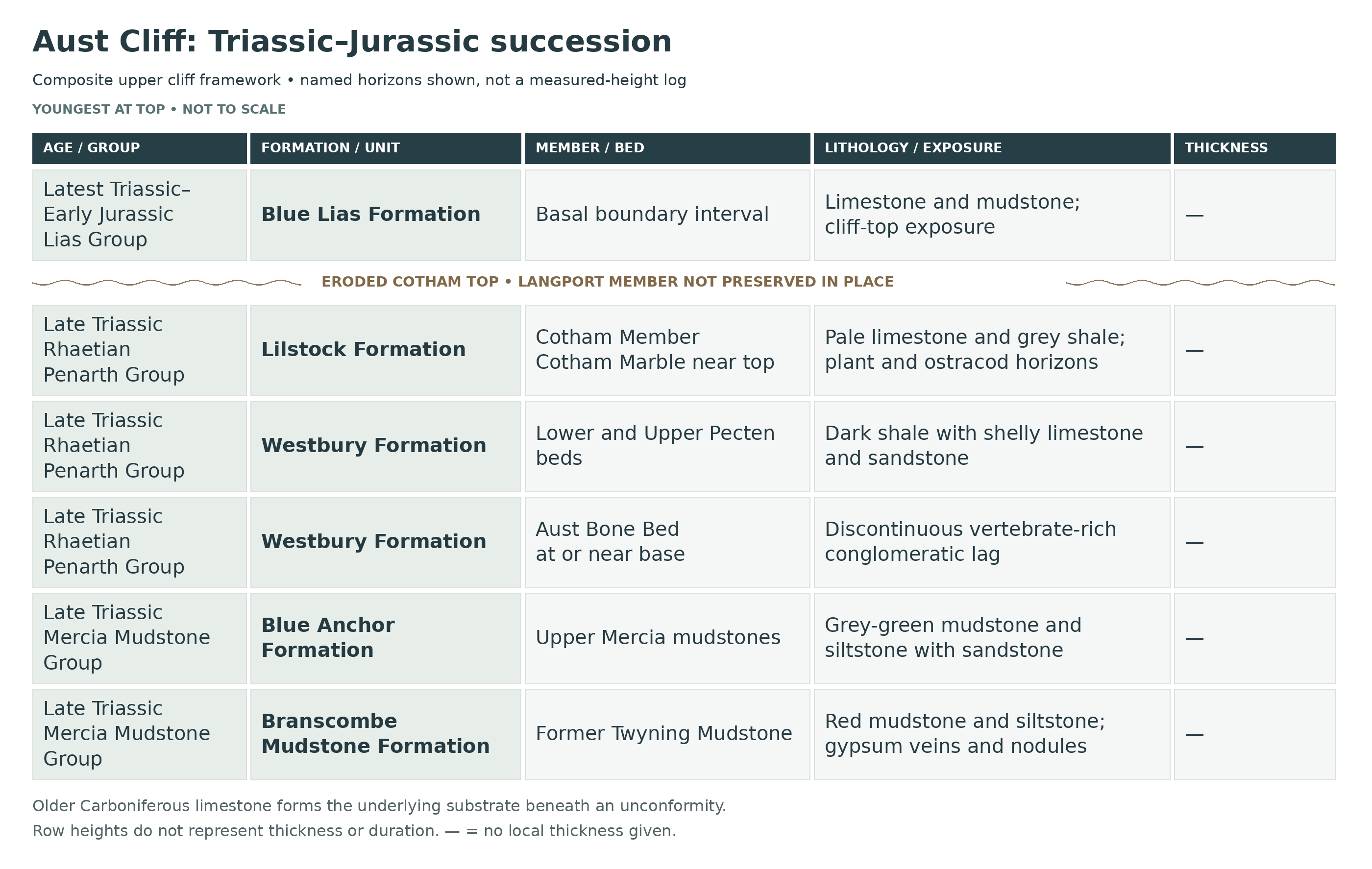
This Late Triassic and Early Jurassic coastal section lies downstream (south) of the Severn Bridge and is instantly recognisable for its bold colour contrast: red-brown mudstones low on the cliff, passing up into pale green-grey beds and then darker grey strata, before finishing with lighter, more limestone-rich beds at the top. Together, these layers capture a major environmental shift from arid continental mudflats, through marginal marine conditions, into fully marine seas at the start of the Jurassic.
At the base of the cliffs, the Mercia Mudstone Group is represented by the Branscombe Mudstone Formation (Late Triassic). These are typically brick-red to reddish-brown mudstones and siltstones, often weathering into steep faces and producing abundant slumped debris. The red colour reflects oxidation during deposition in hot, generally dry conditions on broad coastal plains and sabkha-like mudflats. In the field, the Branscombe Mudstone is usually massive and blocky, with subtle banding, occasional green mottling, and a tendency to break down into sticky mud after rain. Because this unit is comparatively weak and impermeable, it often forms the unstable foundation for the higher, more fractured beds above.
Up-section, the colour shifts into greenish-grey and grey mudstones of the Blue Anchor Formation (Late Triassic). This change is one of the most useful field markers at the site: it reflects a move away from the most arid conditions into wetter coastal flats and increasingly brackish, marginal-marine settings. The Blue Anchor beds can show a more obviously striped appearance than the Branscombe Mudstone, with repeated alternations of green-grey and paler bands. Thin, harder ribs may locally stand out as small ledges, and the unit often weathers into a stepped profile where those firmer layers resist erosion slightly more than the surrounding mudstones. Gypsum can occur within this interval, consistent with evaporation and fluctuating salinity on coastal flats.
Above the Blue Anchor Formation, the cliff section enters the Penarth Group (latest Triassic / Rhaetian), where the exposure becomes more distinctly grey and commonly more bedded. The Penarth Group here includes the Westbury Formation and the Cotham Member of the Lilstock Formation. In practical field terms, this interval marks the transition into conditions dominated by shallow seas, with repeated changes in oxygenation and energy levels. The Westbury beds are typically darker grey at the base of the group, while higher parts can become paler and more thinly bedded, giving the “white-and-grey” banding that makes the upper cliff so striking compared with the red beds below. This part of the sequence tends to fracture into more tabular blocks, so it often produces a distinctive style of cliff fall compared with the softer mudstones beneath.
At the top of the cliff, the section passes into the Blue Lias Formation across the Triassic–Jurassic boundary interval. Here the rocks typically become more regularly bedded, with a stronger limestone–mudstone rhythm than the units below, and they often weather into a series of small ledges and steps. In the landscape, these beds help form the lighter, tougher cap to the cliff profile and can shed blocks that accumulate on the slope and foreshore.

This is a detailed stratigraphic breakdown of the Upper Triassic to Lower Jurassic succession at Aust Cliff, Gloucestershire. The section is one of the most important Rhaetian localities in Britain, exposing red Mercia mudstones, the Blue Anchor Formation, the famous Aust Bone Bed at the base of the Penarth Group, the Cotham beds above, and the basal Blue Lias boundary interval at the cliff top.
The succession below retains the published local lithological horizons. Earlier guide labels AC1–AC18 were editorial labels, not the numbering used in the cited measured sections, and are omitted to avoid confusion. The older name Twyning Mudstone is replaced by the current Branscombe Mudstone Formation. Individual thicknesses are included only where their Aust Cliff scope is established.
MERCIA MUDSTONE GROUP
Branscombe Mudstone Formation (Upper Triassic)
Upper Branscombe Red Mudstone Cycles
Red Dolomitic And Calcareous Mudstones And Siltstones
The lower part of Aust Cliff is formed by red, dominantly argillaceous mudstones and siltstones with a strong dolomitic component. These beds were deposited in dominantly terrestrial sabkha, playa and saline mudflat conditions and represent the final stage of long-lived red-bed deposition before the marine Rhaetian transgression. At Aust they form the lower two-thirds of the cliff and are one of the best visible red Mercia Mudstone successions in southern Britain.
Gypsum-Nodule Cycles, Alabaster Veins And Halite-Pseudomorph Beds
Within the upper Branscombe Mudstone are repeated sedimentary cycles in which red mudstones with gypsum nodules and vertically oriented gypsum stringers are followed by more variegated mudstones and then by laminated greenish silts and mudstones. Long V-shaped fissures filled with gypsum may extend downward from horizontal gypsum beds, and the laminated units may show halite pseudomorphs and ripple marks on bedding planes. These cycles record alternating arid evaporation, groundwater sulphate growth, occasional flooding and shallow ephemeral water bodies on a coastal plain.
Total Visible Thickness Of Upper Branscombe Mudstone Formation At Aust Cliff: Approximately 30–35 Metres
Blue Anchor Formation (Upper Triassic)
Grey-Green Transitional Marine Beds
Grey-Green Gypsiferous And Dolomitic Clays With Sandstone
The Blue Anchor Formation at Aust forms a lighter-coloured unit between the red Mercia mudstones below and the dark Penarth shales above. It consists mainly of green and grey mudstones, siltstones and minor sandstones, with gypsum and local dolomitic cement still present. The formation records increasing marine influence but is not yet fully open marine; it represents tidal-flat, shallow-lagoon and marginal-marine environments preceding the main Rhaetian transgression. Marine fossils are sporadic, and pale blue celestite may occur on joint planes.
Upper Blue Anchor Erosion Surface
The top of the Blue Anchor Formation is an uneven, locally burrowed and eroded surface on which the Aust Bone Bed rests. Blue Anchor mudstone clasts within the bone bed show that the uppermost sediment was reworked while still soft, emphasizing the erosive nature of the transgressive contact. This surface is one of the most important stratigraphic breaks in the Aust succession.
Thickness Note: The Approximately 3 m Blue Anchor Section At Manor Farm Is A Separate Inland Exposure, Not An Aust Cliff Measurement
PENARTH GROUP
Westbury Formation (Upper Triassic — Rhaetian)
Basal Bone-Bed And Black-Shale Interval
Aust Bone Bed
The Aust Bone Bed forms the base of the Westbury Formation and is the single most famous bed in the section. The basal bone bed is the principal vertebrate concentration, but minor bone-rich horizons are also recorded within the Westbury succession. It is a discontinuous coarse-grained transgressive lag made up of grit and breccio-conglomerate with quartz grains, potassium feldspar, phosphate nodules, vertebrate material, a fine shelly matrix and calcitic plus pyritic cement. Large clasts are commonly derived from the underlying Blue Anchor Formation and show signs of soft-sediment deformation before final burial. Grading within the bed suggests an arrested turbulent sediment flow, with dense apatite concentrated near the base and larger but less dense mudstone rip-up clasts toward the top.
Basal Phosphatic Lag
The lowest part of the bone bed is a coarse phosphatic lag rich in durable vertebrate material, quartz grains and coprolites. Many elements are abraded, rounded and polished, indicating strong reworking during marine flooding of the Blue Anchor surface.
Main Vertebrate Conglomerate
Teeth, scales, denticles and small bones occur within the conglomeratic bone bed. The descriptive subdivisions here refer to compositional grading within the bed, not separately numbered or laterally continuous formal beds.
Upper Rip-Up Clast And Shelly Matrix Layer
The top of the bone bed is richer in soft Blue Anchor mudstone clasts and finer shelly matrix. It marks the waning stage of the initial transgressive event, when reworking remained active but fine marine sediment was beginning to accumulate more continuously.
Fossil Content
The Aust Bone Bed has yielded one of the most diverse Late Triassic vertebrate assemblages in Europe. Dominant microvertebrates include the sharks Lissodus minimus and Rhomphaiodon minor, together with osteichthyans such as Gyrolepis albertii and Severnichthys acuminatus. Scarcer taxa include Pseudodalatias barnstonensis, Pseudocetorhinus pickfordi, Hybodus cloacinus, Parascylloides turnerae, Sargodon tomicus and unidentified lepidotids. Larger fossils include ichthyosaur and plesiosaur bones, Pachystropheus, shark fin spines and coprolites. Some historically reported dinosaur bones have subsequently been reinterpreted as ichthyosaur jaw material. Classic nineteenth-century accounts also listed Acrodus, Nemacanthus and other fish remains from the bone bed fauna.
Interpretation
The bone bed is a high-energy marine transgressive lag laid down on the flooded top of the Blue Anchor Formation. It concentrated vertebrate material derived from multiple shallow-marine and nearshore environments into a single condensed horizon. In the assemblage analysed by Cross and colleagues, shark teeth dominate and bony-fish teeth are less numerous.
Basal Sandstone
A sandstone directly above the Aust Bone Bed, marking the start of more sustained marine sedimentation in the Westbury Formation. It is less fossil-rich than the bone bed itself but still contains transported shell and vertebrate debris and provides the first true clastic marine cover above the condensed lag.
Shales With Isolated Sandstone Ripples And Trace Fossils
Dark shales above the basal sandstone with isolated sandstone ripple beds and trace fossils. These beds record a quieter but still shallow marine setting, with intermittent traction-current events on an otherwise muddy sea floor. They form the lower black-shale phase of the Westbury Formation at Aust.
Black Fissile Shales With Blue Anchor Pellets
Black fissile shale with pellets of Blue Anchor Formation mudstone, calcareous sandstone pellets and rare vertebrate fossils at the base. Selenite rosettes are common. These beds indicate continued low-energy deposition under relatively low oxygen, but still with some reworked material derived from the substrate below.
Lower Pecten Bed
A dark grey, shelly, sandy biosparite with quartz pebbles at the base. This is the lower of the two named Pecten beds in the Aust Westbury Formation and represents a higher-energy shell-rich pulse within the otherwise shale-dominated succession. It is a useful internal marker and a key invertebrate-bearing bed.
Dark Shale With Sand Lenticles
Dark shale with lenticular sand bodies in the lower part, lying between the two Pecten limestones. These beds indicate fluctuating energy conditions and repeated minor scouring or sand influx into a muddy shallow-marine shelf setting.
Upper Pecten Bed
A dark grey hard shelly limestone, generally more indurated than the Lower Pecten Bed. It marks another shell-rich event and is one of the strongest upper Westbury markers at Aust. The combined Pecten-bed interval is important because it preserves the main invertebrate fauna of the Westbury Formation above the transgressive bone bed.
Upper Dark Greenish Shales
Dark greenish shales forming the top of the Westbury Formation. These beds are less spectacular than the bone bed and Pecten limestones below but complete the marine black-shale succession before the switch into the paler, more argillaceous limestones and shales of the Cotham Member above.
Typical Westbury Invertebrates
Rhaetavicula contorta, Pleurophorus elongatus, Chlamys valoniensis, ophiuroids and the inarticulate brachiopod Orbicula townshendi. Vertebrate fossils are commonly concentrated in the harder beds and are much rarer in the intervening shales.
Thickness Note: The Approximately 3.5 m Westbury Section At Manor Farm Must Not Be Transferred To Aust Cliff
Lilstock Formation (Upper Triassic — Rhaetian)
Cotham Member
Basal Cotham Limestone
The basal limestone in the Hamilton-based GCR succession is recorded as unfossiliferous. It marks the change from the upper Westbury dark greenish shale into the paler Cotham succession.
Lower Grey Shale
Grey shale, also recorded as unfossiliferous, overlies the basal limestone. It separates that carbonate bed from the fossil-bearing limestone above.
Plant-, Ostracod- And Insect-Bearing Limestone
The next limestone contains occasional plant remains, ostracods and insects. The Cotham Member at Aust also preserves the liverwort Naiadita lanceolata and the branchiopod Euestheria minuta; these member-level records should not be assigned automatically to every limestone bed.
Middle Grey Shale
A further grey shale separates the plant-bearing limestone below from the ostracod-bearing limestone above. This is a distinct entry in the published local succession, although no individual thickness is assigned here.
Upper Ostracod Limestone
An ostracod-bearing limestone lies above the middle shale. The limestone–shale alternation records repeated changes in carbonate and fine-clastic sediment accumulation in the shallow, restricted Cotham environment.
Upper Grey Shale
Grey shale above the ostracod limestone underlies the topmost Cotham limestone. Keeping it separate makes the position of the Cotham Marble clear.
Cotham Marble
The top limestone of the Cotham Member, often used historically as an ornamental stone. At Aust it occurs in two classic forms: Landscape Marble, in which microbial or algal growth creates the appearance of hedges, trees and sky in section, and Crazy Marble, in which angular flakes of limestone are set in a finer matrix. These two facies formed in different ways, the first reflecting algal-mat development in very shallow intertidal conditions and the second representing channel or runnel infill by brecciated sediment.
Thickness Note: No Single Cotham Member Thickness Is Assigned Here
Absent Langport Member: Correlation Note
Langport Member / White Lias (Not Recognised At Aust Cliff)
Unlike Blue Anchor and many west Somerset sections, the Langport Member is not recognised at Aust Cliff. The top of the Cotham Member is eroded and separated from the overlying Jurassic by a disconformity. This means Aust does not preserve the full White Lias limestone development seen farther south and west, making the Aust Triassic–Jurassic boundary section notably condensed compared with Blue Anchor or St Audrie’s Bay.
LIAS GROUP
Blue Lias Formation (Triassic–Jurassic Boundary Interval)
Pre-planorbis Beds
Basal Lias Conglomerate
The base of the Lias Group at Aust is marked by a discontinuous conglomerate containing reworked Langport limestone clasts in a dark matrix. This rests disconformably on the eroded top of the Cotham Member and records another break in sedimentation at the Triassic–Jurassic boundary interval. It is the local boundary bed below the Pre-planorbis limestones.
Brown Flaggy Pre-planorbis Limestones
Brown, flaggy limestones forming the lowest Lias beds visible at Aust Cliff, near the vegetation line at the top of the cliff. These are the Pre-planorbis Beds of older usage. That name denotes the interval below the first Psiloceras planorbis, rather than demonstrating an exclusively Jurassic age. They are the highest beds usually visible at Aust and are only thinly exposed, but they demonstrate that fully marine Lias deposition was established immediately above the condensed Penarth Group succession.
Ammonite Significance
The Psiloceras planorbis interval is listed above the Pre-planorbis Beds in the published Aust succession. The base of the Blue Lias Formation is a lithostratigraphical boundary and must not be treated automatically as the Triassic–Jurassic time boundary; the exact time boundary is not pinned to a numbered Aust bed here.
Depositional Environment
Aust Cliff records a late Triassic to earliest Jurassic environmental transition interrupted by erosional breaks. The Branscombe Mudstone Formation represents arid sabkha and playa conditions on a saline coastal plain; the Blue Anchor Formation reflects increasingly shallow marine and tidal-flat influence; the Aust Bone Bed marks the main Rhaetian marine transgression as a coarse vertebrate lag; the Westbury Formation above records shallow marine black-shale and shell-bed deposition; the Cotham Member represents a return to very shallow restricted lagoonal or intertidal carbonate-mud conditions; and the Pre-planorbis Blue Lias at the top records marine deposition around the Triassic–Jurassic transition.
Exposure Note: This Is A Composite Succession, Not A Measurement Of The Present Cliff Height
Historical Measured Section: Reynolds Scheme
The GCR fossil-reptile account preserves a separate numbered Westbury log based on Reynolds and later work. These are published historical bed numbers, unlike the removed AC labels. They are not forced into a one-to-one match with the more finely described Hamilton lithological inventory above.
Bed 3 — Bone Bed (0.02–0.15 m)
The discontinuous vertebrate-bearing basal concentration varies markedly in thickness.
Bed 4 — Black Shale (1.2 m)
Black shale becomes hard, fissile paper shale higher in this interval.
Bed 5 — Lower Pecten Bed (0.18 m)
Hard pyritous grey limestone forms the lower named shell-bed marker.
Bed 6 — Black Shales (2.4 m)
The thick shale interval separates the two principal Pecten limestones.
Bed 7 — Upper Pecten Bed (0.13 m)
Hard grey limestone forms the upper Pecten marker.
Bed 8 — Greenish-Black Shale (0.3 m)
The final shale interval completes this historical Westbury log.
The same historical GCR summary gives approximately 7 m for the Blue Anchor Formation, 4.3 m for the Westbury Formation and 3.4 m for the Lilstock Formation at Aust Cliff. These are local published estimates, distinct from the Manor Farm values. Differences between historical measurements and bed schemes are retained rather than hidden in a single supposedly exact modern total.
References
Hamilton, D. (1977). Aust Cliff. In Savage, R.J.G. (ed.), Geological excursions in the Bristol district, University of Bristol, pp. 111–118.
Curtis, C.D. (1982). Cyclic sedimentation in the Mercia Mudstone Group at Aust Cliff.
Storrs, G.W. (1993, 1994) on the Aust Bone Bed and Rhaetian vertebrates.
Cross, S.R.R. et al. (2018). Microvertebrates from the basal Rhaetian Bone Bed at Aust Cliff.
British Geological Survey Lexicon: Branscombe Mudstone Formation, Blue Anchor Formation, Westbury Formation, Cotham Member and Blue Lias Formation.
Geological Conservation Review account for Aust Cliff.
Benton, Cook & Turner (2002), Aust Cliff, GCR 24
Cross et al. (2018), Aust Cliff microvertebrates
Howard et al. (2008), BGS Mercia Mudstone framework
Benton & Spencer (1995), Aust Cliff, GCR 10
ACID PREP
The Aust bone bed (often referred to as part of the Rhaetian bone-bed horizon within the Westbury Formation) is typically a thin, locally patchy layer formed as a high-energy lag deposit when the sea advanced over older Triassic mudstones. Rather than preserving fossils neatly “in place,” it commonly concentrates tough, durable material: vertebrate teeth and bone fragments, fish debris (scales, denticles), phosphatic pebbles, small clasts ripped up from underlying mudstones, and occasional shell or limestone fragments.
That mix is exactly why acid-based preparation can be useful for this bed: the cement and matrix are often carbonate-rich, while many of the collectible microfossils (especially the smaller vertebrate elements) are more phosphate-rich and can survive careful, controlled chemical prep better than the surrounding carbonate.
What acid prep is best for (and what it isn’t)
Acid prep is usually most effective here when your aim is bulk recovery—freeing lots of small, isolated fossils for sorting—rather than producing a single “display specimen.” Bone-bed material is commonly reworked and fragmentary, so the payoff is often in the microfossils you can’t easily extract by hand.
A practical, non-technical workflow overview
It helps to frame acid prep as “lab-style processing” rather than a quick trick.
- Start by understanding your matrix. A small test on non-valuable matrix can tell you whether the rock is likely to respond (carbonate-rich material reacts readily; clay-rich material may not).
- Work in controlled cycles. Short exposures with long rinses between them are generally safer than prolonged soaking, because they reduce the chance of softening or etching fossil surfaces.
- Rinsing matters as much as the acid. Bone-bed residues can trap dissolved salts; if those salts crystallise during drying they can crack or flake delicate pieces. Thorough rinsing and patience reduces this risk.
- Expect a lot of “non-fossil” residue. Because the bed is a lag deposit, you’ll often process plenty of pebbles and mudstone clasts along with the fossils. The real results come from sieving and careful picking under magnification.
- Fragile pieces may need stabilising. Small bones and teeth can be porous or fractured; some collectors use suitable consolidants (applied sparingly) to help pieces survive handling and drying.
Common pitfalls with Aust bone-bed material
- Over-prepping: Rushing the process can leave fossils chalky, etched, or weakened—even if they don’t fully dissolve.
- Hidden weak spots: Some fossils look solid until they dry, then split along old cracks. Gentle handling and slow drying help.
- Iron sulphides (pyrite): Dark, organic-rich horizons can contain minerals that cause long-term deterioration if stored damp or sealed without care. Keeping material dry and well-ventilated after proper rinsing is important.
Safety note
Even “mild” acids are hazardous. If you choose to do chemical preparation, treat it like proper chemical handling: use appropriate eye/skin protection, good ventilation, acid-safe containers, and follow local rules for neutralisation and disposal. If you’re not set up for safe chemical work, stick to mechanical preparation and selective collecting.
SAFETY
Common sense when collecting at all locations should be used and knowledge of tide times is essential. There are several dangers at Aust and these become more apparent if you plan to collect from the northern side of the bridge. To get there, you will need to walk round a pillar of the bridge when the tide is retreating. However, this is slippery and often has dangerous mudflats. You can also easily get cut off by the tide if you do not return before the tide starts to come in.
Keep away from the cliff as this can fall or crumble at any time, and keep away from the mud on the foreshore which can be dangerous. And beware of the Severn Bore (a large wave that happens several times a month and is created as the tide flows up the river into an increasingly narrow space). Times for this are advertised at: www.severn-bore.co.uk.
EQUIPMENT
Fossils can only be collected from the foreshore, especially along the tide line. However, any large lumps of the bone bed will require strong tools to split them up. A good eye is often all you need, but a geological hammer, chisels and eye protection may be necessary for the larger lumps.
CLEANING AND TREATING
Begin by removing any loose sediment very carefully using a soft toothbrush. Take your time, as many fossils—particularly pyritic specimens—are fragile and easily damaged. Fragile bone-bed fossils and pyritic specimens need individual assessment before wet cleaning; do not apply a fixed soaking time to every specimen. Keep delicate finds supported in their matrix. After any appropriate wet cleaning, allow specimens to dry naturally at room temperature. Do not dry them on radiators or other heat sources, as rapid drying can cause cracking or long-term damage.
Where consolidation is needed, Paraloid B-72 is a well-established conservation resin. It can often be re-dissolved, but removal from a porous fossil may be incomplete. Use it selectively after assessing the specimen and matrix; it is not a moisture-proof seal or a cure for pyrite decay.
IDENTIFY YOUR FINDS
Need help identifying a fossil? Share clear photos, where you found it and its size with the community.
FURTHER READING
Classic fossil site re-explored in undergraduate project
Microvertebrates from the basal Rhaetian Bone Bed (latest Triassic) at Aust Cliff, S.W. England
Aust Cliff, Avon — GCR fossil reptiles
ACCESS RIGHTS
Although not an official right of way to the beach, the council and National Grid allow the use of the raised road, for walking but not for vehicles. An information board explaining this is at the end of this raised road.
This site is a site of special scientific interest (SSSI). This means you can visit the site, but hammering the bedrock is not permitted. For full information about the reasons for the status of the site and restrictions, download the PDF from Natural England.
It is important to follow our ‘Code of Conduct’ when collecting fossils or visiting any site. Please also read our ‘Terms and Conditions‘
LINKS
♦ Fossil Discussions
♦ Fossil Articles
♦ Buy Fossils, Tools and Equipment
♦ Buy Crystals, Meteorites, and Artefacts
♦ Join Fossil Hunts
♦ UK Fossils Network