

Overview
Directions
- Head to North Cliff Country Park on Church Cliff Drive, north of Filey. The council Country Park car park is at YO14 9ET; read current signs for seasonal charges.
- Follow the signed public cliff paths and beach access. The established route includes steps, but obey any closure rather than assuming a particular stair descent is open.
- Plan any visit to either side of the Brigg around the tide and sea conditions, keeping a safe route back. Car-park opening hours do not establish shore access.
- Original Brigg approach reference: TA 12523 81575. This is a locality reference, not the car-park entrance.
Location photographs
Swipe to browse · Select a photograph to enlarge


Fossil Hunting
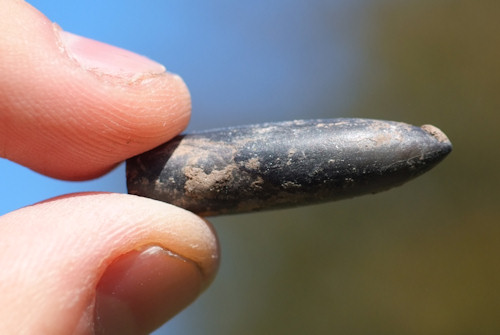
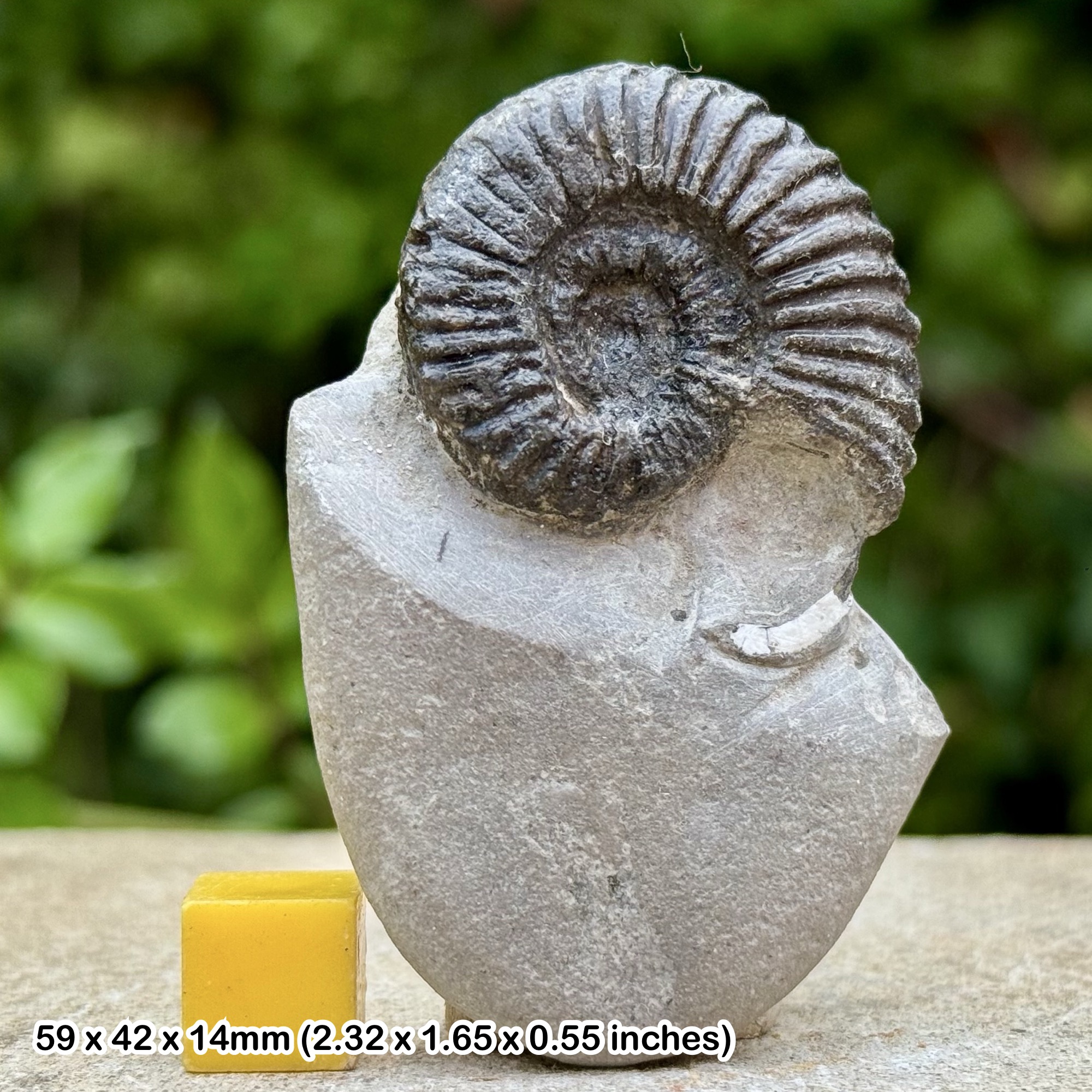
Look closely at weathered loose stones and already exposed surfaces for bivalves, brachiopods and ammonites. Sandy shell limestone can retain recognisable shells, while sandstone commonly shows casts and burrows. Photograph the extensive Thalassinoides burrow networks without damaging the rock.
The upper leaf of the Hambleton Oolite on the south side of the Brigg is particularly fossiliferous. Cardioceras and Perisphinctes are both ammonites; they are not an ammonite–bivalve pair. The north-side sandstone and lower beds often provide especially clear trace fossils.
The Saintoft Member’s conspicuous rounded “Ball Beds” concretions are geological features rather than dependable ammonite nodules. Leave fixed blocks and in-situ beds intact. Keep a record of the locality and rock type with permitted loose finds.
The old guide records fossil-bearing glacial material south of the Brigg. Such reworked fossils are distinct from the in-situ Jurassic succession and cannot be given a local source-bed label merely from their beach position. Old plant reports likewise do not establish a Gristhorpe-style plant bed here.
Fossil photographs
Swipe to browse · Select a photograph to enlarge
Discoveries and milestones
A chronological record of fossil research, geological interpretation and conservation at Filey Brigg.
1829 – Oxfordian strata recorded
John Phillips recorded the rocks at Filey Brigg, establishing an early published framework for the locality’s Jurassic succession.
1876–1892 – The coastal section documented
Work by Hudleston, Blake and Hudleston, and the Geological Survey’s Fox-Strangways progressively described the section and supplied the basis for later stratigraphic comparisons.
1933–1945 – Corallian stratigraphy reassessed
W. J. Arkell contributed to interpretation of the Filey succession during his wider investigations of British Jurassic strata.
1949 – Wilson’s detailed measured section published
After more than thirty years of investigation, V. Wilson presented a 34-bed subdivision of the Coralline Oolite at Filey, with bed-specific fossil lists and discussion of the ancient environments.
1972–1983 – Sandstone correlations revised
J. K. Wright revised the Filey succession and subsequently corrected the correlation of its main sandstone interval. The rock previously taken as Middle Calcareous Grit was recognised as Birdsall Calcareous Grit between two leaves of the Hambleton Oolite.
1985 – Filey Brigg designated as an SSSI
Formal protection recognised both the geological section and the importance of the rocky shore for wintering purple sandpipers.
1995 – Older bed schemes correlated
A. L. Coe compared the Oxfordian sections and related Wilson’s detailed bed numbering to Wright’s later scheme, helping fossil records from different studies to be compared.
Geology
Filey Brigg exposes the upper part of the Lower Calcareous Grit Formation and a sandy coastal expression of the Coralline Oolite Formation. These Oxfordian marine rocks alternate between sandstone and shell-rich or oolitic limestone, reflecting changing sediment supply and shallow-sea conditions.
The Tenants’ Cliff and Saintoft members belong to the Lower Calcareous Grit. The latter contains the rounded concretions known as the Ball Beds. Above an erosion surface, the Yedmandale Member, historically called the Passage Beds, begins with strongly burrowed sandstone and passes into shelly limestone.
The lower Hambleton Oolite leaf contains conspicuous Thalassinoides networks. The intervening Birdsall Calcareous Grit forms much of the resistant promontory and is a sandy interval between the Hambleton leaves, not a separate Middle Calcareous Grit bed. The upper Hambleton leaf is well seen on the south side, where limestone-filled burrows descend into the underlying sandstone.
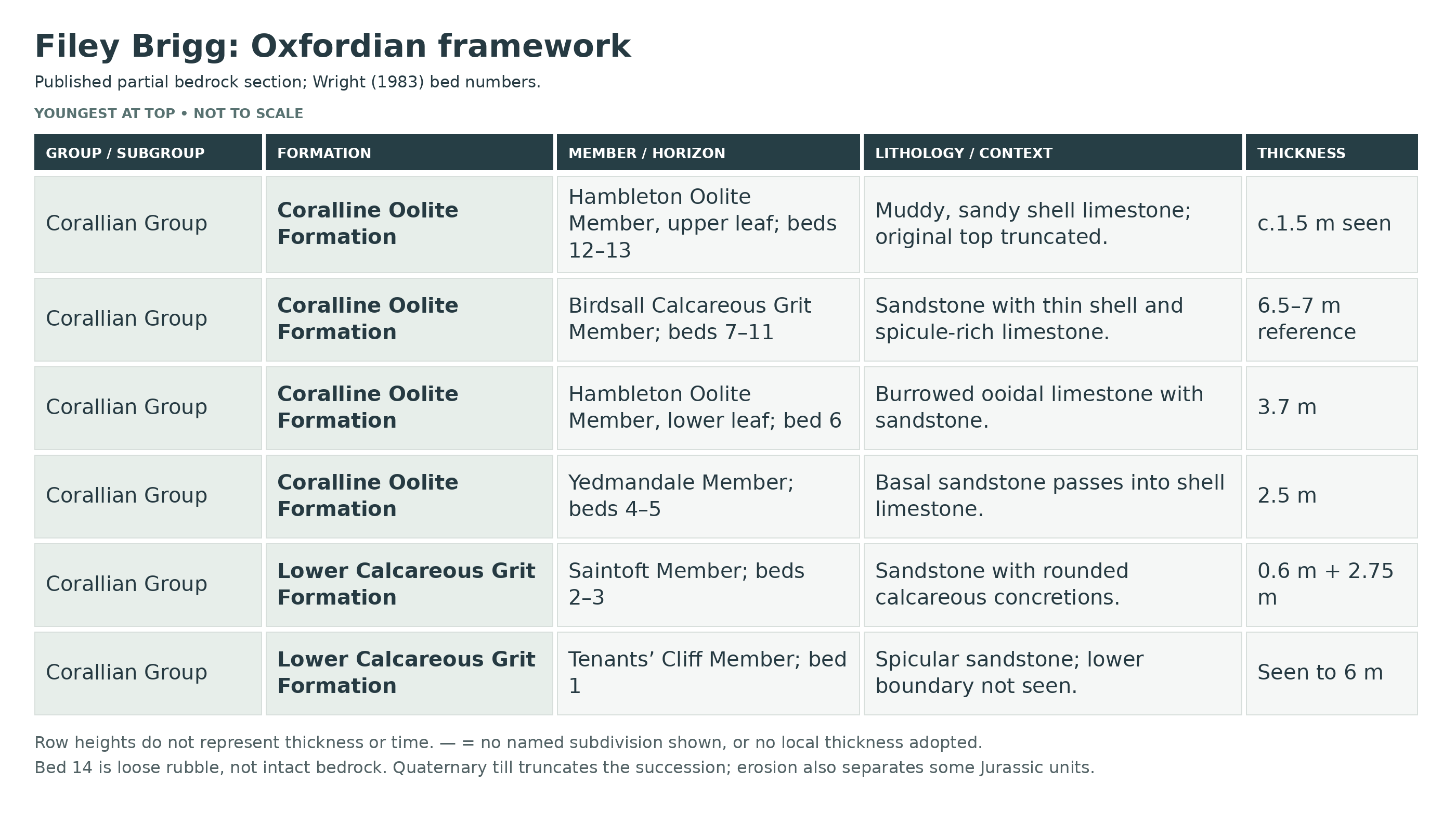
Glacial erosion truncates the upper succession beneath superficial deposits. The expandable account preserves the published 14-number local framework and its contacts, keeping it separate from an older alternative numbering scheme.

Detailed geology and bed-by-bed succession
Detailed geology and fossil-bearing horizons at Filey Brigg.
Reading the Filey section
The bed numbers below follow the published Filey Brigg log of Wright (1983), reproduced in the Geological Conservation Review. They are local numbered beds, not additional formal members. The exposed sequence passes from the Lower to Middle Oxfordian; Quaternary till truncates its top. Measurements describe the published exposure, whose accessibility and beach cover vary.
CORALLIAN GROUP
Lower Calcareous Grit Formation
The Brigg exposes the upper part of this formation. Fine sandstone and sponge-spicule-rich rock can look much coarser than they are; the word “grit” is a traditional name. The locality is a type section for the formation but does not display its complete thickness.
Tenants’ Cliff Member
The oldest bed visible in the published Filey log is exposed towards the base of the high cliffs and is covered by the sea except around low water. It is not the famous fossiliferous concretion section at Tenants’ Cliff in Cayton Bay.
Bed 1 — spicular sandstone, seen to 6 m
Yellow, sponge-spicule-bearing sandstone contains intermittent grey sandy-limestone beds. “Seen to” denotes exposed thickness, not a complete member measurement. The lower boundary is not included in this Filey log.
Saintoft Member
These are the traditional Ball Beds. At Filey their rounded calcareous concretions are a conspicuous weathering feature, but are not especially fossil-rich; richer inland Saintoft Quarry assemblages must not be promised here.
Bed 2 — resistant basal sandstone, 0.6 m
A strongly cemented, fine-grained calcareous sandstone makes a persistent rocky projection. Its resistance contrasts with softer parts of the succession.
Bed 3 — Ball Beds sandstone, 2.75 m
Three approximately equal massive sandstone layers each contain two rows of large calcareous concretions. The host ranges from fine to fine–medium sandstone. These rounded masses are sedimentary concretions, not rolled boulders or a separate formal unit.
Coralline Oolite Formation
The lower part of the formation is preserved here. An erosion surface separates it from the Saintoft Member. The succession includes sandy and muddy limestones as well as ooidal rock; the formation name does not imply that every bed is an oolite.
Yedmandale Member (formerly Passage Beds Member)
The 2.5 m Filey interval is thinner than its inland equivalents. It begins with sandstone and passes into shell-rich limestone. The modern name replaces the old Passage Beds label without adding a new layer to the succession.
Bed 4 — basal bioturbated sandstone, 0.6 m
Relatively soft fine–medium sandstone lies on the eroded Saintoft surface. Large shells recorded include Nanogyra nana and Chlamys fibrosus; burrowing has extensively disturbed the sediment.
Bed 5 — shelly limestone, 1.9 m
Six grey-weathering beds make up the main limestone interval. The rock is variably sandy and locally ooidal, with bivalves and brachiopods. Oyster clusters and Gervillella valves are notable; some of the latter remain in life position in the upper beds. Small scours and southward cross-bedding record intermittent movement of shell-rich sediment.
Erosion surface below the Hambleton Oolite
A marked bedding surface separates the Yedmandale Member from the next limestone interval. Its regional correlation provides evidence of a pause and erosion, rather than uninterrupted accumulation. Reworked coral fragments in the Passage Beds do not make Filey an in-situ coral reef.
Hambleton Oolite Member — lower leaf
“Lower leaf” is a local subdivision of the Hambleton Oolite Member, not a separately ranked member. The sandy Birdsall facies intervenes before the upper leaf appears.
Bed 6 — burrowed ooidal limestone, 3.7 m
Two limestone packages are separated by calcareous sandstone with scattered ooids. Shells include bivalves and brachiopods; branching Thalassinoides burrows form conspicuous networks in weathered blocks. The relatively delicate fauna and extensive burrowing indicate intervals of quiet deposition and sediment stability.
Birdsall Calcareous Grit Member
At Filey this sandstone member is enclosed between the two leaves of Hambleton Oolite. Historical identification as Middle Calcareous Grit was revised in 1983; the two names must not be drawn as separate Filey units. The BGS reference-section thickness is 6.5–7 m.
Bed 7 — main cross-bedded sandstone, 4.6 m
Brown-weathering fine sandstone is shelly, locally cross-bedded and varies from well bedded to massive. A tough calcareous layer occurs towards its base. Loose ammonites reported from the interval include Cardioceras cordatum and related forms; a loose specimen is not proof of an exact bed position.
Bed 8 — lenticular shell limestone, 0.25 m
A discontinuous sandy limestone contains shells and sponge spicules. Together with Bed 10 it makes one of the harder layers near the upper part of the Birdsall interval.
Bed 9 — softer sandstone, 0.45 m
Fine-grained sandstone weathers more readily than the adjacent calcareous layers. It separates the thin Bed 8 limestone from the thicker Bed 10.
Bed 10 — spicule-rich sandy limestone, 0.9 m
This resistant bed commonly has a sandy parting near its middle and is only intermittently shelly. Abundant Rhaxella spicules accompany ammonites recorded as Cardioceras and Peltoceras. It is a sandy limestone within the Birdsall Calcareous Grit Member, not another formation.
Bed 11 — laminated sandstone, 0.6 m
Soft-weathering fine sandstone caps the Birdsall interval. Burrows descend into it from the overlying limestone and are filled with that younger calcareous sediment. This contact is particularly clear on the Brigg’s south side.
Hambleton Oolite Member — upper leaf
The upper leaf reintroduces muddy, shelly and sandy limestone above the Birdsall sandstone. About 1.5 m is recorded in the Filey reference section; the original top is lost beneath the glacial erosion surface.
Bed 12 — basal upper-leaf limestone, 0.75 m
Argillaceous, sandy shell limestone carries Cardioceras densiplicatum and Perisphinctes. Both are ammonites. Limestone-filled Thalassinoides extends down into Bed 11 at its base.
Bed 13 — flaggy shell limestone, seen to 0.75 m
The overlying limestone is flaggy, muddy, sandy and shelly. The published fauna includes Cardioceras excavatum, Goliathiceras and Perisphinctes. The stated thickness is the amount seen, not a complete original bed.
Bed 14 — loose limestone rubble
The published log ends with loose rubble and supplies no measured thickness. It is not a new member and should not be converted into a precisely measured intact rock layer.
Glacial cover and reworked fossils
Till overlies the eroded Jurassic succession. Fossils loose in this glacial material can be older than the enclosing deposit and need to be labelled as reworked finds. They do not extend the in-situ Brigg succession into the Speeton Clay or other distant fossil beds.
References
Wright & Cox (2001), Filey Brigg, Geological Conservation Review 21
BGS Lexicon: Yedmandale Member
BGS Lexicon: Birdsall Calcareous Grit Member
BGS Lexicon: Hambleton Oolite Member
BGS Lexicon: Lower Calcareous Grit Formation
BGS Lexicon: Coralline Oolite Formation
Safety
The outer Brigg and shore beneath the cliffs are tidal, wave-exposed and slippery. Start with a falling tide and a generous return margin, having checked the escape route; turn back before water or swell threatens it.
Stay clear of cliff bases, recent falls, undercut edges and unstable scree. Do not cross wet, weed-covered gullies. Facilities and lifeguards on the town beach do not imply supervision of fossil exposures.
Equipment
Take sturdy grippy footwear, tide information, a hand lens, camera or notebook and padded rigid containers. Fixed scientific exposures are best observed and photographed; use no damaging collection method without applicable permission.
Cleaning And Treating
Gently dry-brush stable loose fossils. Do not force shells out of hard calcareous sandstone or limestone, and avoid acids that can dissolve both shells and cement. Preserve the relationship between burrows and their matrix.
Support friable muddy specimens, dry them slowly and avoid repeated wetting. Do not routinely varnish fossils. Important or unstable material is best left unprepared for specialist assessment.
Identify Your Finds
Need help identifying a fossil? Share clear photos, where you found it and its size with the community.
Further Reading
Wright & Cox (2001), Filey Brigg, Geological Conservation Review 21
BGS Lexicon: Yedmandale Member
BGS Lexicon: Birdsall Calcareous Grit Member
BGS Lexicon: Hambleton Oolite Member
Natural England: Filey Brigg SSSI citation
Access Rights
Filey Brigg SSSI protects this geological section; see the original linked citation. Follow current signs, landowner rules and management guidance, avoiding damage to beds and fixed blocks. A proposal to amalgamate or extend protected sites is not evidence that a new designation has been completed; protected status itself is not collecting permission.
It is important to follow our ‘Code of Conduct’ when collecting fossils or visiting any site. Please also read our ‘Terms and Conditions’.
Links
♦ Fossil Discussions
♦ Fossil Articles
♦ Buy Fossils, Tools and Equipment
♦ Buy Crystals, Meteorites, and Artefacts
♦ Join Fossil Hunts
♦ UK Fossils Network


