

Beltinge, near Herne Bay, is one of the UK’s premier locations for collecting fossil shark teeth, attracting collectors from across Britain and Europe. The foreshore exposes the famous Beltinge Fish Beds, which can yield a wide variety of shark, ray and fish remains. While fossils can be found year-round, the site is most productive during very low spring tides, when the richest layers are exposed and large numbers of teeth can be collected under the right conditions.


FIND FREQUENCY: ♦♦♦♦♦ – Herne Bay is a highly productive location, particularly during very low spring tides when the main fossil-bearing beds are exposed. However, fossils can be found on most low tides, either washed up on the foreshore or within the shingle. For best results, aim to visit one to two hours before low tide, giving maximum time to search.
CHILDREN: ♦♦♦ – Suitable for children, although supervision is essential. During very low tides, large areas of sand and shingle are exposed, and the sea can return quickly, potentially cutting off access routes and leaving collectors stranded on isolated patches.
ACCESS: ♦♦♦♦♦ – Easy to access, with parking available close to the beach. The town centre is nearby, providing toilets, food and facilities within walking distance.
TYPE: – Foreshore collecting site. Fossils are found loose amongst sand and shingle, within exposed clay, and amongst the cockle beds and pebble patches that appear across the beach during low tide.
DIRECTIONS
♦ From the A299, head towards Herne Bay and follow signs for Beltinge and Reculver. As you approach the seafront, follow the road as it bends inland away from the coast.
♦ Turn left onto Reculver Drive and follow it to the end, where you will find a cliff-top car park. From here, a footpath and steps lead directly down to the foreshore.
♦ Parking charges apply at certain times of the year, particularly during the summer months, so be prepared to pay. Spaces can be limited during busy periods.
♦ Once on the beach, head east towards Reculver. The most productive area is typically found just before the cockle beds and pebble patches, especially during very low tides when more of the foreshore is exposed.
♦ Postcode to Parking area: CT6 6QE, Google Maps
♦ What3Words collecting area: ///reseller.begun.headings
DOWNLOAD THE UKF BOOKLET TO FOSSIL HUNTING AT BELTINGE

A FIELD GUIDE TO COLLECTING BRITISH CENOZOIC FOSSILS
by Steve Snowball & Alister Cruickshanks
£21.99 (PAPERBACK)
FULL COLOUR – 190 PAGES
Available worldwide exclusively through Amazon
- Fossil identification plates
- Stunning locality and fossil photos
- Up-to-date geological & site information
- Best fossil-bearing sites in southern and eastern Britain described in detail
- Illustrations of life in deep time by Andreas Kurpisz
VIDEO FILM
FOSSIL HUNTING
Fossil collecting at Herne Bay, particularly around Beltinge and towards Reculver, is one of the best opportunities in the UK to find Palaeocene and early Eocene marine fossils, especially shark teeth. This stretch of coastline can be extremely productive under the right conditions, although success is highly dependent on tide, weather and recent beach activity. On a good low tide, it is not uncommon to find dozens of teeth in a single visit, and even when many collectors are present, there is often plenty to go around.
The key to collecting here is to head out as far as the tide will allow. The further the sea retreats, the greater the area of exposed foreshore and the higher the chances of finding fossils. The main collecting zone lies between the groynes either side of the concrete steps at Beltinge. At low tide, a visible “stream” or channel often runs out towards the sea—this marks an important boundary between the clay beds to the west and the shingle and pebble deposits to the east, and is one of the most productive areas to search.
When conditions are ideal, a small “island” of pebbles may appear further out along this line. This area is often less visited and can produce excellent finds, as teeth and other fossils accumulate among the pebbles over time. To the west lies a large shingle spit known locally as “the Rand”, which historically yielded many fossils, although its productivity has reduced in recent years due to disturbance and mussel colonisation.
Most fossils originate from the Beltinge Fish Bed, a glauconitic sandy clay horizon within the Upnor Formation, dating to around 54 million years ago. This bed is relatively thin but dips gently, meaning only a small section is exposed at any one time. As erosion continues, the exposed area gradually shifts, continually releasing new fossil material onto the foreshore. The greenish colour of the sediment is due to the presence of glauconite, indicating deposition in a shallow marine environment.
A wide range of fossils can be found, but the site is particularly famous for its shark teeth, with around two dozen species recorded. By far the most common is Striatolamia macrota, a sand shark whose teeth typically make up the majority of finds. These are easily recognised by the fine vertical striations along the blade. The next most common species is Carcharias hopei, which differs in having a smoother blade and more slender form.

Closely related forms such as Odontaspis winkleri can also be found and may be confused with other sand tiger sharks, although subtle differences in shape and structure can help distinguish them. Another distinctive and highly sought-after species is Palaeohypotodus rutoti, a striking sand tiger shark tooth characterised by multiple lateral cusps along the blade. Complete examples are rare, as the delicate cusps are often broken, but well-preserved specimens are particularly prized by collectors.
Larger and more impressive teeth can occasionally be found from Otodus obliquus, a large extinct mackerel shark that could reach lengths of up to 10 metres. These teeth are triangular, robust and may include small side cusps. While complete specimens are uncommon, fragments are regularly encountered. Members of the cow shark family, particularly Notidanodon, are also present but are extremely fragile and are usually found as broken pieces.
In addition to sharks, a wide variety of ray and fish remains can be found. The eagle ray Myliobatis dixoni is relatively common, although usually found as broken plates or fragments rather than complete crushing surfaces. Other ray and fish species include Squatina prima (angel shark), Heterodontus vincenti (Port Jackson-type shark), Ardiodus marriottiand Eutrichurides winkleri. Teeth from monkfish and other teleost fish are also occasionally found.
Chimaeroid (rat fish) remains are another notable feature of the site, with species such as Callorhinchus regulbiensis, Ischyodus dolloi, Edaphodon bucklandi and Elasmodus hunteri represented. These often occur as distinctive dental plates or fragments and are relatively common compared to many other sites.
Vertebrate material is also present, including shark and fish vertebrae, fin spines and occasional reptile remains. Turtle fragments and crocodilian material have been recorded, although these are much less common than fish remains. Fossil wood is frequently found but is often poorly preserved and tends to disintegrate quickly once removed from the sediment, particularly if pyrite is present. Fossil pinecones are occasionally discovered but require careful preservation, often needing to be kept wet until stabilised.
Collecting is typically carried out by carefully scanning the ground while walking slowly across the foreshore. Many of the teeth are small, so kneeling down and searching closely is often the most effective method. A pair of tweezers is highly recommended, as some specimens are extremely small and difficult to pick up by hand. A small container or pot is essential for storing finds safely during collecting.
For those willing to put in extra effort, sieving can be very productive. Using a fine mesh sieve (around 2mm), sediment from the pebble beds can be collected, washed and then dried for later examination. This method can reveal a wide range of smaller fossils that would otherwise be missed, including rare species and delicate material. Once dried, the residue can be carefully sorted at home, often yielding surprising results.
As with all collecting sites, it is advisable to keep all finds initially, even fragments, as pieces that appear insignificant in the field can sometimes prove to be rare or important upon closer inspection. With patience, good conditions and careful searching, Herne Bay and Beltinge remain among the most rewarding locations in Britain for collecting early Cenozoic marine fossils.


Some of the most significant fossil discoveries and scientific milestones from Herne Bay and Beltinge include classic early work on the Thanet and Woolwich beds, the discovery of the exceptionally rich Beltinge Fish Bed fauna, and important fossil plant finds from the London Clay.
1850–1854 – Joseph Prestwich described the Herne Bay section and helped establish its importance
Joseph Prestwich published some of the earliest classic accounts of the Herne Bay cliffs and foreshore, helping establish the locality as one of the most important lower Palaeogene coastal sections in Britain. His work laid the foundation for later fossil and stratigraphic study of the site.
1866–1872 – William Whitaker further documented the Herne Bay succession
William Whitaker’s work built on the earlier studies and helped clarify the geology and fossil-bearing beds exposed between Herne Bay and Reculver. These early descriptions were important in establishing the long-term scientific value of the section.
1901 – first report of fossil fruits and seeds from the Herne Bay London Clay
Johnson was the first to report fossil fruits and seeds from the Herne Bay London Clay. This marked the beginning of recognition that Herne Bay was important not only for fish and marine fossils, but also for a very significant fossil flora.
1933 – Reid and Chandler highlighted the diversity of the London Clay flora
The work of Reid and Chandler drew wider attention to the extraordinary diversity of the London Clay flora, including Herne Bay material. Their studies helped establish the Kent coast as one of the major British localities for early Eocene plant fossils.
1959 – the Woolwich Bottom Bed was found exposed on the foreshore and its rich fish fauna recognised
While working on the vertebrate faunas of the Herne Bay cliff section, E. I. White found the Woolwich Bottom Bed exposed on the foreshore for the first time in 1959. This bed, now widely known as the Beltinge Fish Bed, proved to contain an exceptionally rich fish fauna and became one of the most important fossil horizons at the site.
1962 – E. I. White described the new fish fauna of the Woolwich Bottom Bed
White formally described the fossil fish fauna from the Woolwich Bottom Bed in 1962. The bed yielded well-preserved chimaeroid toothplates, sharks and other fish remains, and remains especially important because several species are only known from Herne Bay.
1961–1964 – Marjorie Chandler studied the Herne Bay fossil flora in detail
Marjorie Chandler’s work on the Herne Bay and Walton-on-the-Naze floras provided the first detailed records of the Herne Bay London Clay fruits and seeds. Herne Bay went on to be recognised as having one of the most diverse fruit and seed floras from the Eocene London Clay, with more than 130 species recorded and several genera unique to the locality.
1977–1978 – the London Clay fauna of the Herne Bay area was comprehensively reviewed
Later twentieth-century work brought together museum collections, published records and recent collecting to produce a fuller picture of the Herne Bay London Clay fauna. This confirmed Herne Bay as one of the most important coastal London Clay fossil localities in Britain, especially for fish remains.
Modern understanding – the Beltinge Fish Bed remains the key fossil horizon at Herne Bay
Modern reviews continue to recognise the Beltinge Fish Bed as the most important single fossil bed at Herne Bay, with an exceptionally rich fish fauna including sharks, rays, chimaeroids and bony fish. The site is also important for the London Clay flora, making Herne Bay notable for both vertebrate and plant fossils.
GEOLOGY
The geology at Herne Bay and Beltinge represents a sequence of late Paleocene to early Eocene marine deposits, laid down approximately 56–54 million years ago in a warm, shallow sea. At this time, southern Britain lay much further south and experienced a subtropical climate, with conditions often compared to a modern Caribbean-type environment. These sediments form part of the Lower London Tertiary sequence, one of the most important early Cenozoic successions in south-east England.
At the base of the exposed sequence, particularly visible on the foreshore towards Reculver during favourable low tides, is the Thanet Formation. This unit consists mainly of fine sands and sandy clays deposited in relatively shallow marine conditions during the late Paleocene. The Thanet Formation represents one of the earliest marine transgressions into the London Basin and forms the foundation of the coastal exposures in this area. However, it is often obscured by beach sand and is only intermittently visible depending on tidal and beach conditions.
Overlying the Thanet Formation is the Upnor Formation, also of Paleocene age. This unit represents a continuation of shallow marine deposition, with increasing influence from currents and nearshore processes. At Beltinge, the Upnor Formation is particularly important because it is brought down to beach level by the gentle dip of the strata, exposing the well-known Beltinge Fish Bed on the foreshore. This horizon reflects a period of concentrated sedimentation and marine activity within the basin.
Above this lies the Harwich Formation (formerly known as the Oldhaven Beds), which consists of sands, pebble beds and clay layers deposited in higher energy marine conditions. These sediments indicate a shift to more dynamic coastal or nearshore environments, with stronger currents capable of transporting coarser material. The Harwich Formation can be seen dipping towards beach level in places west of Beltinge, contributing to the complex and variable exposures along the coastline.
The upper part of the sequence is formed by the London Clay Formation of early Eocene age. This unit consists mainly of soft, blue-grey clays deposited in a deeper, quieter marine environment. These clays form much of the cliff material along this stretch of coast and are highly prone to erosion and slumping. The continual breakdown of these soft sediments is a key factor in exposing fresh material onto the foreshore.
The strata along the Herne Bay and Beltinge coastline dip gently, bringing different formations down to beach level over relatively short distances. This allows a wide range of geological units to be accessed across the foreshore, particularly during very low tides. The combination of marine deposition, gentle structural tilting and ongoing coastal erosion makes this one of the most important and accessible Paleogene sections in the UK.


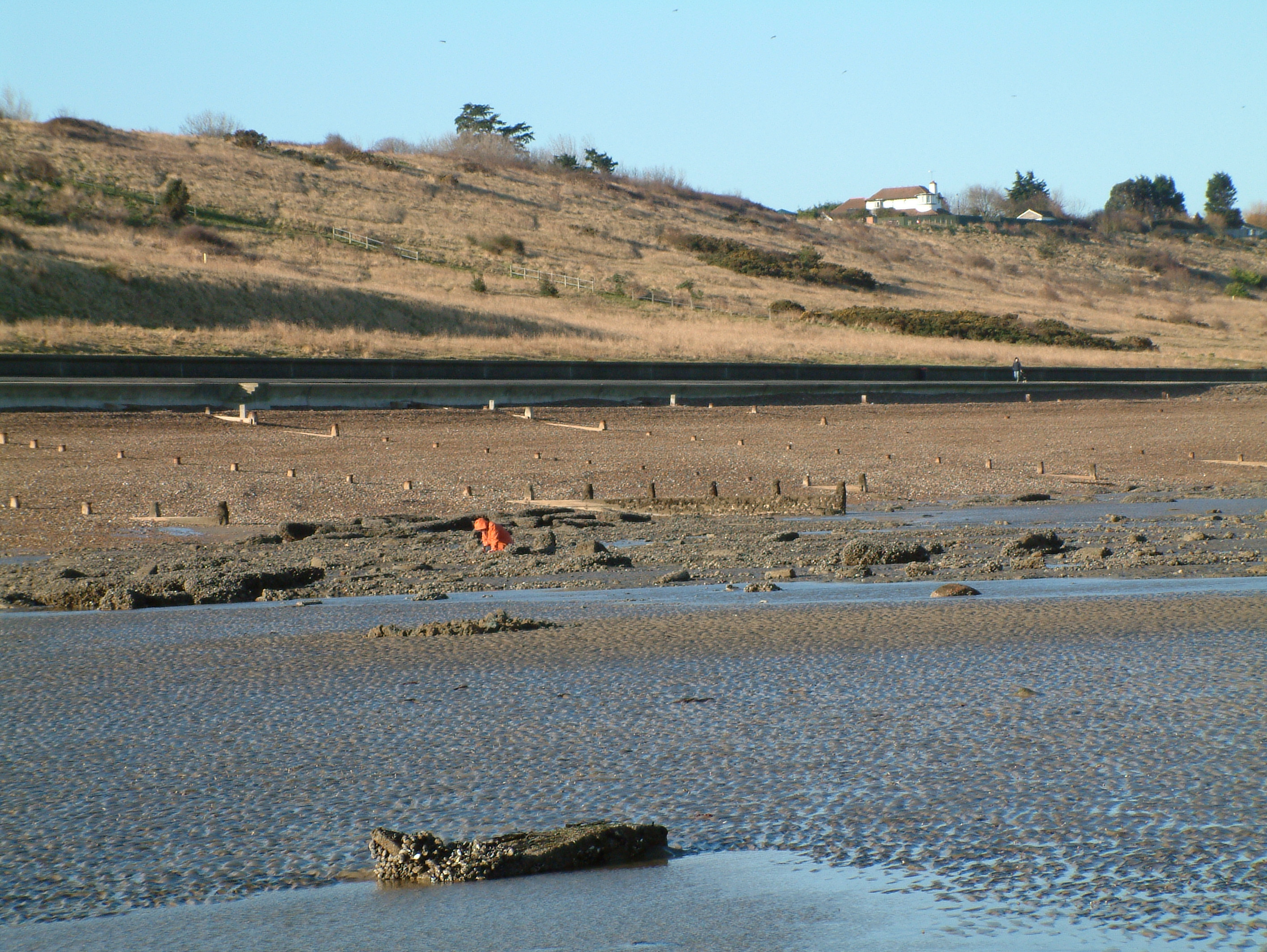
London Clay from Divisions B1 and B2 is exposed at the extreme west end of the bay. The exposures are not very good, although there are some excellent exposures further west at Seasalter. The deposits run from the youngest in the east to the oldest in the west.
To the west of the car park, the Oldhaven Beds are well exposed on the foreshore, which are marked by a pebble bed at their base. This contains black flint pebbles in a buff yellow sandy matrix, which cuts down into the underlying Woolwich Beds. The Woolwich and Reading Beds are below the Oldhaven Beds, but are rarely exposed.

This is a detailed stratigraphic breakdown of the Palaeocene to Lower Eocene succession at Herne Bay, Kent. The section is one of the most important lower Palaeogene coastal sections in Britain, exposing the upper Thanet Formation, the Beltinge Fish Bed and associated Woolwich beds, the Oldhaven sands and pebbles, and the basal London Clay.
PALAEOGENE SUCCESSION
Thanet Formation (Palaeocene — Thanetian)
Upper Thanet Beds
Bed HB1 — Unit A, Eutylus cuneatus Bed (c. 7.75 m)
Stiff silty grey clay forming the lowest exposed part of Ward’s upper Thanet succession at Herne Bay. Individuals of Eutylus cuneatus occur frequently, commonly in life position, especially in the lower part of the bed. Arctica morrisi is the commonest associated mollusc and occurs as scattered shells and thin compressed drifts. Other bivalves are uncommon and fish remains are rare. Impersistent stone bands occur within the uppermost two metres.
Bed HB2 — Unit B, Reculver Tabular Band (c. 0.20 m)
Light grey silty sand that, where calcite-cemented, forms a persistent series of large tabular nodules weathering into conspicuous blocks on the foreshore. Where uncemented it weathers more rapidly than the adjacent units and forms a notch in the cliff. The base of the cemented blocks is cut by prominent burrows penetrating the underlying silt. This is an important marker bed in tracing the Thanet section at Herne Bay. No clearly indigenous molluscs are recorded from the cemented band itself.
Bed HB3 — Unit C, Arctica morrisi Bed (c. 2.10 m)
Grey silty clay with abundant individuals and closely packed drifts of Arctica morrisi, many with both valves intact and in life position. Apart from Arctica, the fauna is comparatively restricted, with Nucula spp., Corbula regulbiensis and occasional oysters; gastropods are uncommon. Near the top is a pyritised fossil horizon. Fish remains are infrequent except where concentrated in shell drifts. Fossil driftwood is often bored by teredinids, usually unabraded and sometimes silicified.
Bed HB4 — Unit D, Panopea remensis Bed (c. 3.20 m)
Grey-green silty clay with a much more diverse molluscan fauna than the underlying Arctica Bed, the fauna occurring as scattered individuals rather than dense drifts. Corbula regulbiensis and Arctica morrisi remain the dominant bivalves. Oysters, commonly attached to driftwood, together with Garum edvardsi and Thracia aff. oblata, are commonest near the base. Panopea remensis is abundant near the top, where Cyrtodaria rutupiensis and gastropods are also most frequent. A distinctive level of irregular, spiky pyrite concretions occurs near the middle and often encloses calcareous fossils or wood.
Bed HB5 — Unit E, Astarte tenera Bed (c. 1.00 m)
Grey silty clay speckled with large glauconite grains. Corbula regulbiensis is the most abundant mollusc and occurs in loose drifts with other bivalves. Very large, often articulated examples of Arctica scutellaria are common, but the bed is most readily recognised by the abundance of Astarte tenera, commonly preserved articulated. Gastropods are less common than in the bed below. Vertebrate remains are at their most frequent here within the Thanet section, though still uncommon overall. Rolled wood is abundant and seeds and pine cones are commoner here than in any other Thanet unit.
Bed HB6 — Unit F, Tornatellaea parisiensis Bed (c. 0.60 m)
Glauconitic silty sand with abundant and evenly distributed Corbula regulbiensis. Other molluscs are generally scarce except where concentrated within large tabular masses of silicified matrix. These silicified bodies yield a diverse and often beautifully preserved fauna, especially rich in small forms. The bryozoan Membranipora eocena occurs both loose and attached to bivalves. Otoliths, barnacles and vertebrate remains also occur. Rolled wood is less common than in the Astarte Bed.
Bed HB7 — Unit G, Corbula regulbiensis Bed (c. 1.20 m)
Glauconitic silty sand very similar to the underlying bed in matrix and in the abundance of Corbula, but characterised by richly glauconitic, usually silicified clusters or “nests” of Corbula regulbiensis. The shells are commonly rolled but usually remain articulated. Other molluscs are relatively uncommon and poorly preserved outside these nests, but include Cucullaea decussata, Arctica morrisi, Aporrhais dispar and Siphonalia mariae. At the base is the informal “scutellaria horizon”, a brown glauconitic phosphatic level yielding large internal moulds of Arctica scutellaria and rare crustaceans such as Hoploparia gammaroides.
Bed HB8 — Unit H, Woody Nodule Bed (c. 0.25 m)
Glauconitic sandy silt characterised by large pyrite concretions that commonly enclose large twigs or small unabraded branches of wood. No calcareous fossils are recorded. The bed is distinctive because of its woody pyritic nodules and marks one of the highest clearly fossiliferous units of the Thanet succession at Herne Bay.
Bed HB9 — Unit I, Unfossiliferous Sandy Silts (c. 1.25 m)
Glauconitic sandy silt with no recorded macrofossils. Trace fossils occur, chiefly short unlined vertical burrows. This bed is commonly regarded as the uppermost unit within the Thanet Formation in Ward’s scheme and forms the transitional top of the shelly upper Thanet succession.
Total Thickness Of Upper Thanet Formation At Herne Bay: Approximately 17.5 Metres
Woolwich And Reading Formation (Latest Palaeocene To Earliest Eocene)
Woolwich And Reading Bottom Bed Member
Bed HB10 — Unit J, Beltinge Fish Bed (c. 0.40 m)
Dark olive-grey silty clay with frequent rounded black flint pebbles and large green-coated sand grains. Some pebbles are very large, and fine gravel and quartz grit may be incorporated into pyrite concretions. Pyritised burrow linings and lignite are common. Calcareous fossils are absent, though pyritic internal casts of molluscs may occur and are probably derived. This is the famous Beltinge Fish Bed, one of the richest vertebrate horizons in the British lower Palaeogene.
Fossil Content
Abundant shark teeth and vertebrae, chimaeroid plates, teleost teeth and bones, crocodile bones, turtle bones and scutes. The fauna includes Notidanodon loozi, Scyliorhinus gilberti, Synechodus eocaenus, Synodontaspis striatus, S. teretidens, S. hopei, Hypolophodon sylvestris, Callorhinchus regulbiensis, Chimaera eophantasma, Edaphodon bucklandi, E. minor, Elasmodus hunteri and Ischyodus dolloi.
Bed HB11 — Unit K, Woolwich Marine Bed (c. 5.20 m)
Dark grey-green, intensely burrowed silty sands weathering yellow-grey. Fragments of abraded wood are common, but vertebrate remains are rare compared with the Beltinge Fish Bed below. This unit records a more fully marine sandy phase following the concentrated basal vertebrate lag.
Oldhaven Formation (Early Eocene — Ypresian)
Blackheath Pebbles Member
Bed HB12 — Unit L, Basal Pebble Bed (0–0.60 m)
Rounded black and brown flint pebbles, sometimes absent, usually set in a soft sand or silty sand matrix but locally cemented into limonitic ironstone. Rolled shark teeth and fragments of turtle are common. This erosive basal pebble bed marks the base of the Oldhaven Formation and a fresh pulse of marine reworking.
Oldhaven Sands Member
Bed HB13 — Unit M, Glauconitic Silty Sand (c. 0.75 m)
Where the basal pebble bed is absent, this glauconitic silty sand rests directly on the eroded top of the Woolwich and Reading Formation. No cross-bedding is apparent. Shell lenticles are less common than in the unit above, but those in the cliff are often well preserved. This unit is equivalent to the Silt Bed at Shelford Sand Pit.
Bed HB14 — Unit N, Glauconitic Cross-Bedded Sands (up to c. 6 m)
Glauconitic cross-bedded sands with lenticular drifts of disarticulated bivalves throughout. Arctica morrisi is the most abundant mollusc and commonly lies convex-upward. Fish and turtle remains, and occasionally wood and seeds, are concentrated within the shell drifts. Large tabular blocks of calcareous sandstone weather from this unit and may enclose well-preserved molluscs and occasionally ophiuroids. The upper half is decalcified in the cliff, yielding selenite sand roses and soft manganiferous concretions.
Total Thickness Of Oldhaven Formation At Herne Bay: Approximately 6–7 Metres, Though The Formation May Reach Up To About 10 Metres Regionally
London Clay Formation (Early Eocene — Ypresian)
Basal London Clay
Bed HB15 — Unit O, London Clay Basement Bed sensu stricto (0–0.30 m; locally thicker in generalized foreshore logs)
Glauconitic silty clay with occasional ovoid black flint pebbles, silt streaks and patches of pyritised wood. Casts of molluscs occur occasionally, mainly Arctica and “Natica”, and vertebrate remains are common. This is the true London Clay Basement Bed at Herne Bay and forms a low pholad-bored outcrop on the foreshore where well exposed.
Fossil Content
Squatina prima, Otodus obliquus, Palaeohypotodus rutoti, Synodontaspis macrotus, S. teretidens, S. hopei, Hypolophodon sylvestris, Amylodon eocenica, together with undifferentiated bony fish remains.
Bed HB16 — Lower London Clay / Division B In The Holmes Generalized Foreshore Section (c. 0.23–0.46 m In The Foreshore Log; Much Thicker In Cliff)
Pale bluish-grey shaly clay, roughly laminated, passing into grey or faintly mauve sandy clay with lignite, iron pyrite, pyritised wood and selenite concentrated at the base; locally interbedded with sand. In the classic Holmes generalized foreshore section this is the only London Clay division resolved above the Basement Bed. Historically, however, the cliffs at Herne Bay preserved much thicker London Clay sections, once reported as up to about 30 metres.
Fossil Content
Sharks and other fishes including Notorhynchus serratissimus, Isistius trituratus, Carcharias hopei, Isurolamna affinis, Jaekelotodus trigonalis, Palaeohypotodus rutoti, Synodontaspis macrotus, S. teretidens, S. hopei, Elasmodus hunteri, Ardiodus marriotti and Cylindracanthus rectus.
Total Thickness Covered Here: Approximately 30–40 Metres In The Composite Herne Bay Collector Breakdown, Excluding The Full Historically Thicker London Clay Cliff Development
Depositional Environment
The Herne Bay succession records a transition from open-marine Thanet silts and shelly sands into a vertebrate-rich condensed transgressive sand and clay interval at the base of the Woolwich beds, followed by sandy nearshore Oldhaven facies and finally the more fully marine silty clays of the basal London Clay transgression. Facies change, erosion and local discontinuity are a major part of the significance of the section.
References
Ward, D.J. (1978). The Lower London Tertiary (Palaeocene) succession at Herne Bay, Kent. Report of the Institute of Geological Sciences, 78/10.
Holmes, S.C.A. (1981). The Geology of the Country Around Faversham.
King, C. (1981). The stratigraphy of the London Clay and associated deposits.
Daley, B. in Geological Conservation Review accounts for Herne Bay.
British Geological Survey Lexicon and London Basin lithostratigraphic framework sources.
SAFETY
Common sense when collecting at all locations should be used and prior knowledge of tide times is essential. It is very easy to get cut off by the tide as the water can come in, around and behind you, if you are not looking. This is especially the case if collecting on the islands of pebbles and the Oldhaven clay. The tide also comes in very quickly.
EQUIPMENT
Most fossils at Herne Bay are found directly on the foreshore, often within soft clay or amongst shingle and pebble deposits. As a result, specialist tools are not always required, but having the right equipment can significantly improve your success rate.
A small trowel is highly recommended for gently working through the clay, particularly in areas where the Beltinge Fish Bed is exposed. A pointed tool, such as a wood chisel, small file or even a sturdy pick, can be useful for carefully extracting fossils that are partially embedded in the clay without damaging them. Many of the best finds are delicate and require a controlled approach rather than force.
Because collecting is often carried out at ground level, knee pads are extremely useful and will make long sessions far more comfortable, especially when searching slowly across the foreshore. Fossil hunting here is very much a case of patience and close inspection rather than heavy digging.
Most shark teeth are black or dark brown in colour and are found within similarly coloured clay, which makes them surprisingly difficult to spot. Often only the tip or crown of the tooth is visible, so it is important to search carefully and methodically. A good eye is by far your most important tool at this location.
A pair of fine tweezers is highly recommended, as many teeth are very small and can be difficult to pick up by hand, especially in wet or muddy conditions. Bringing small containers or pots will help keep your finds safe, and it is advisable to include tissue or padding to protect more fragile specimens during transport.
For those planning to sieve material, a fine mesh sieve (around 2mm) and a container for collecting sediment can greatly increase the number of smaller fossils recovered. This method is particularly effective in pebble-rich areas where tiny teeth and fragments can easily be missed.
Finally, waterproof boots or wellingtons are strongly recommended, as you will often need to walk through mud, shallow water or soft sediment to reach the most productive areas. The foreshore can be wet, slippery and uneven, so suitable footwear will make collecting both safer and more comfortable.
CLEANING AND TREATING
Begin by removing any loose sediment very carefully using a soft toothbrush. Once cleaned, fossils should be desalinated by soaking them in fresh water for at least 24 hours to remove residual salt. After soaking, allow specimens to dry naturally at room temperature. Do not dry them on radiators or other heat sources, as rapid drying can cause cracking or long-term damage.
Once fully dry, we recommend sealing fossils with Paraloid B-72, dissolved in acetone. This is a museum-grade consolidant that is widely available in pre-mixed bottles. Paraloid B-72 is stable, long-lasting, and does not yellow or react chemically over time. Importantly, it is also fully reversible, making it suitable for scientifically important or display-quality specimens.
DISCUSSIONS
Beltinge micro molluscs or coral?
Hi all, very much a novice here but picked this up on Beltinge beach. It's stone/heavy but has very unusual pitting that looks like...
Rare cow shark tooth found in Beltinge
Xampylodon tooth found on Saturday in Beltinge on my first hunt down there. Shame its not complete but its in great shape. Thought others...
Herne Bay fossil
The attached photos show two views of a conical fossil found on the beach at Herne Bay. It's 3.5cm high with a base 3.2cm...
Herne Bay help
Hi everyone, my family (wife, me and two kids) and I are heading to Herne Bay next week on holiday and were wondering if...
Possible fossil Herne Bay
Hi there, would be very grateful if someone could tell me if this is a fossil that my daughter found on Herne Bay beach...
Identification help needed. Beltinge, Kent finds.
My son found these two at Beltinge, Kent at the weekend. Any ideas on what we have found? 📷 📷 📷 ...
Beltinge unknown!
📷 📷 📷 📷 First timer here. Travelled to Beltinge today to look for Sharks teeth with the kids and...
How old is this wood from Beltinge?
Hi, This wood was found at Beltinge on a previous visit, in late 2019. There was a lot more of it when I first...
Beltinge Fossil
Hi, I was looking through the bits I brought back from belting and this caught my eye as looking quite different to the others. ...
Fossils from Beltinge beach, Herne Bay today
Hi, I found this today at Beltinge beach fossil beds, Herne Bay area. Would anyone know what this could be? I think it looks...
ARTICLES
- Thanet anticline’s shifting shorelines: Two millennia of change
- Collecting sharks’ teeth at Herne Bay, Kent
- Fossil beetles of Bognor Regis, West Sussex
- Fossil arachnids
ACCESS RIGHTS
This site is a site of special scientific interest (SSSI). This means you can visit the site, but hammering the bedrock is not permitted. For full information about the reasons for the status of the site and restrictions, download the PDF from Natural England.
It is important to follow our ‘Code of Conduct’ when collecting fossils or visiting any site. Please also read our ‘Terms and Conditions‘
LINKS
♦ Fossil Discussions
♦ Fossil Articles
♦ Buy Fossils, Tools and Equipment
♦ Buy Crystals, Meteorites, and Artefacts
♦ Join Fossil Hunts
♦ UK Fossils Network


