The latest Eocene to early Oligocene beds along the coast at Bouldnor Cliff yield mammal, crocodile, turtle and fish remains, together with molluscs and fossil plants. Loose fossils can be found on the foreshore, providing a window into freshwater wetlands and coastal lagoons across the Eocene–Oligocene transition.


FIND FREQUENCY: ♦♦♦♦♦ – The beds at this location are highly fossiliferous and rich in many types of fossils. These are also of very good quality, with superb preservation. This is a fantastic location to visit and the best on the island.
CHILDREN: ♦♦♦ – This location would be a perfect location for families, but access may be difficult down to the shore. It can also be a fair walk. If taking children, we recommend focusing only on the Bouldnor Cliff, in the area where the coastal footpath crosses through a small bay.
ACCESS: ♦♦♦ – Parking is via the Bouldnor viewpoint car park, please note the roads leading to the coastal path are private and no parking is permitted. It’s an easy walk to the foreshore, but a bit of a trek with young children.
TYPE: – All of the fossils are found on the foreshore. You just pick them up.
DIRECTIONS
♦ You will need to park at the Bouldnor Viewpoint car park, since all the roads that lead down to the main coastal footpath are private and parking there is not permitted. Do not attempt to gain access by parking in the private roads, as this can block access for large vehicles.
♦ From here, you will need to return to the main road and walk east until you reach the stony track, Victoria Road. Use a pavement or footway where one is provided. Do not assume that a grass verge guarantees safe pedestrian access; turn back if there is no safe route.
♦ At the end of Victoria Road, you will meet the main coastal path; follow this to the east (right).
♦ The path will follow the cliff until you reach a small bay. The footpath crosses the bay via a boardwalk. Here, the foreshore is easy to access. Fossils can be found to the east or west, though the best beds are on the east side.
♦ Postcode to Car Park: PO41 0UR, Google Maps.
♦ What3Words to the main collecting area: ///autumn.windmill.neck
DOWNLOAD THE UKF BOOKLET TO FOSSIL HUNTING AT BOULDNOR TO HAMSTEAD

A FIELD GUIDE TO COLLECTING BRITISH CENOZOIC FOSSILS
by Steve Snowball & Alister Cruickshanks
£21.99 (PAPERBACK)
FULL COLOUR – 190 PAGES
Available worldwide exclusively through Amazon
- Fossil identification plates
- Stunning locality and fossil photos
- Up-to-date geological & site information
- Best fossil-bearing sites in southern and eastern Britain described in detail
- Illustrations of life in deep time by Andreas Kurpisz
VIDEO FILM
FOSSIL HUNTING
The coastline from Bouldnor Cliff is one of the most important late Eocene to early Oligocene fossil sites in the UK, renowned for its exceptional preservation of mammals, reptiles, fish, molluscs and plant remains. Unlike many coastal locations, this site represents a freshwater to estuarine environment, rather than a fully marine one, preserving life on land and in coastal lagoons across the Eocene–Oligocene transition.
Fossil collecting is best carried out along the foreshore, where material is continually washed out from the cliffs. The most common finds include crocodile and turtle remains, particularly teeth, scutes and shell fragments. The dominant crocodile is Diplocynodon, a small to medium-sized freshwater crocodilian, whose teeth are frequently found scattered amongst the shingle. Turtle remains are also common and include both soft-shelled turtles such as Trionyx and hard-shelled forms such as Emys. These are usually found as fragments of shell or plate, although more complete pieces are occasionally discovered.
Fish remains are abundant and include teeth, vertebrae and scales from a variety of species. These are often small and require careful searching, particularly in fine sediment or shingle patches. Crustacean remains can also be found, although these are less common and often fragmentary.


The Hamstead Member of the Bouldnor Formation is notable for fossil seeds and plant material, including the water-soldier Stratiotes websteri. Important plant assemblages are documented from the White Band and Water-Lily Bed. The flora also includes conifer remains and other aquatic plants; many specimens are carbonaceous or pyritised, which makes their preservation and careful storage important.
The Bembridge Marls are best documented near Hamstead Ledge, at the eastern end of the wider Bouldnor–Hamstead tract, rather than beneath every Bouldnor cliff exposure. Their shell bands are particularly rich in molluscs. These include bivalves such as Corbicula, Polymesoda, Mytilopsis and Ostrea, which can sometimes be found compacted within thin layers. Gastropods are also common and include species such as Potamides, Melanoides, Viviparus and Hydrobia. These assemblages reflect a mixture of freshwater and brackish conditions, typical of estuarine environments.
Within the Hamstead Member, freshwater molluscs are especially abundant. Species such as Viviparus (a freshwater gastropod) and Unio (a freshwater bivalve) are commonly found, often in large numbers. These fossils can occur loose on the foreshore or within soft marl deposits and are often well preserved.
Mammal teeth and bones are scientifically important, but the faunas differ through the succession. Palaeotherium and Anoplotherium characterise older, pre-Grande Coupure levels; higher Hamstead beds contain anthracotheres such as Bothriodon and Elomeryx. A loose beach fossil may have lost its precise bed provenance. Record the finding place and retain adhering matrix rather than assigning every specimen to one age or horizon.
For collectors, the most productive method is to search slowly along the foreshore, particularly in loose shingle and along the tideline, keeping well clear of cliff bases, landslips and soft mud. Many of the best finds, especially small teeth and bone fragments, are discovered by getting low to the ground and carefully scanning the surface.
Sieving is particularly effective at this location. By collecting sediment from the Hamstead Member and processing it through a fine sieve (around 1–2mm mesh), it is possible to recover a wide range of small fossils, including seeds, teeth and micro-remains that would otherwise be missed. Taking samples home to dry and sort can greatly increase the number and variety of finds.
The stretch between Hamstead Bay and Bouldnor Cliff is especially productive for larger material, including crocodile and turtle fragments, as well as occasional mammal remains. Walking this section of beach can yield a wide range of fossils, often without needing to move far, as productive patches tend to occur where material has recently been eroded from the cliffs.
Some of the most significant fossil discoveries from Bouldnor and Hamstead Cliffs include classic Oligocene mammal finds, important reptile and bird records, type specimens of mammals, and one of the most important late Palaeogene plant floras in Britain.
1856 – Edward Forbes described the Bembridge Oyster Bed and the fossil-rich Bouldnor–Hamstead succession
Edward Forbes was one of the earliest workers to document the fossil-bearing beds at Bouldnor and Hamstead. His work helped establish the importance of the succession, including the oyster-rich horizons and the fossiliferous marls and clays that later became famous for mammals, reptiles and plants.
1925 – Cooper’s classic work on anthracotheres confirmed Bouldnor as a major site for large Oligocene mammals
By the early twentieth century, Bouldnor Cliff had already become known as a classic British site for larger Paleogene mammals, especially anthracotheres. Cooper’s 1925 work is one of the key landmarks in that history and helped establish the site’s reputation for important mammal remains.
1927 – Dyspterna woodi named from Bouldnor Cliff
Bouldnor Cliff provided the type specimen of Dyspterna woodi, named by Hopwood in 1927. This makes the site the type locality for one of its characteristic fossil mammals and adds to its importance in British Palaeogene mammal studies.
1963–1978 – Chandler described the important Hamstead Member plant flora from Bouldnor material collected by G.W. Colenutt and R.L.E. Ford
The fossil flora of Bouldnor Cliff was described in a series of works by Marjorie Chandler, based largely on material collected by G.W. Colenutt and R.L.E. Ford. These studies helped show that Bouldnor preserves the youngest known Palaeogene plant macrofossils in southern Britain, including important conifers, aquatic plants and pyritised plant remains.
1972 – Butselia biveri recorded from the site
The presence of the insectivore Butselia biveri at Bouldnor/Hamstead was noted by Butler in 1972. This was one of the important smaller mammal records from the site and later became significant in discussion of faunal change across the Eocene–Oligocene transition.
1974 – Bosma described the rodent fauna from the Hamstead Member
Bosma’s work on the rodent fauna showed how important Bouldnor and Hamstead are for small mammal assemblages as well as large mammals. These faunas became central to later biostratigraphic work on the late Eocene to early Oligocene of the Isle of Wight.
1979 – Glamys fordi named from a Bouldnor Cliff type specimen
Bouldnor Cliff also provided the type specimen of Glamys fordi, described by Bosma and de Bruijn in 1979. This is one of the locality’s key named mammal species and confirms the site’s importance for Oligocene rodent evolution and biostratigraphy.
1979 – fossil birds from the vicinity of Bouldnor Cliff were described by Harrison and Walker
Bird fossils from the Bouldnor area were described by Harrison and Walker in 1979, adding avian remains to the already important record of mammals, reptiles and plants. This helped underline how diverse the Bouldnor/Hamstead fauna really is.
1980 – Hooker and Ward summarised the reptile fauna, and Moody detailed the turtles
By 1980 the reptile fauna of Bouldnor and Hamstead had been recognised as the best British Oligocene reptile assemblage, including turtles, snakes and crocodilians. Hooker and Ward summarised the fauna, while Moody provided further detail on the turtles, helping establish the site as internationally important for Oligocene reptiles.
1980s–1990s – plant macrofossil work showed Bouldnor to be the youngest Palaeogene flora in Britain
Further work by Collinson and others on the plant-bearing horizons demonstrated that Bouldnor Cliff preserves the youngest known Palaeogene plant macroflora in Britain. The site is also the type locality for Sequoia couttsiae and is especially important for aquatic plants, conifers, seeds, leaves and pyritised logs from the Hamstead Member.
2004 – Hooker and colleagues showed the Bouldnor succession documents the ‘Grande Coupure’ within the Hamstead Member
Intensive collecting and screenwashing demonstrated that the famous mammalian turnover known as the ‘Grande Coupure’ occurs within the Hamstead Member rather than at its base. This made Bouldnor Cliff uniquely important in Europe for showing a superposed succession of mammal faunas across that major faunal change.
GEOLOGY
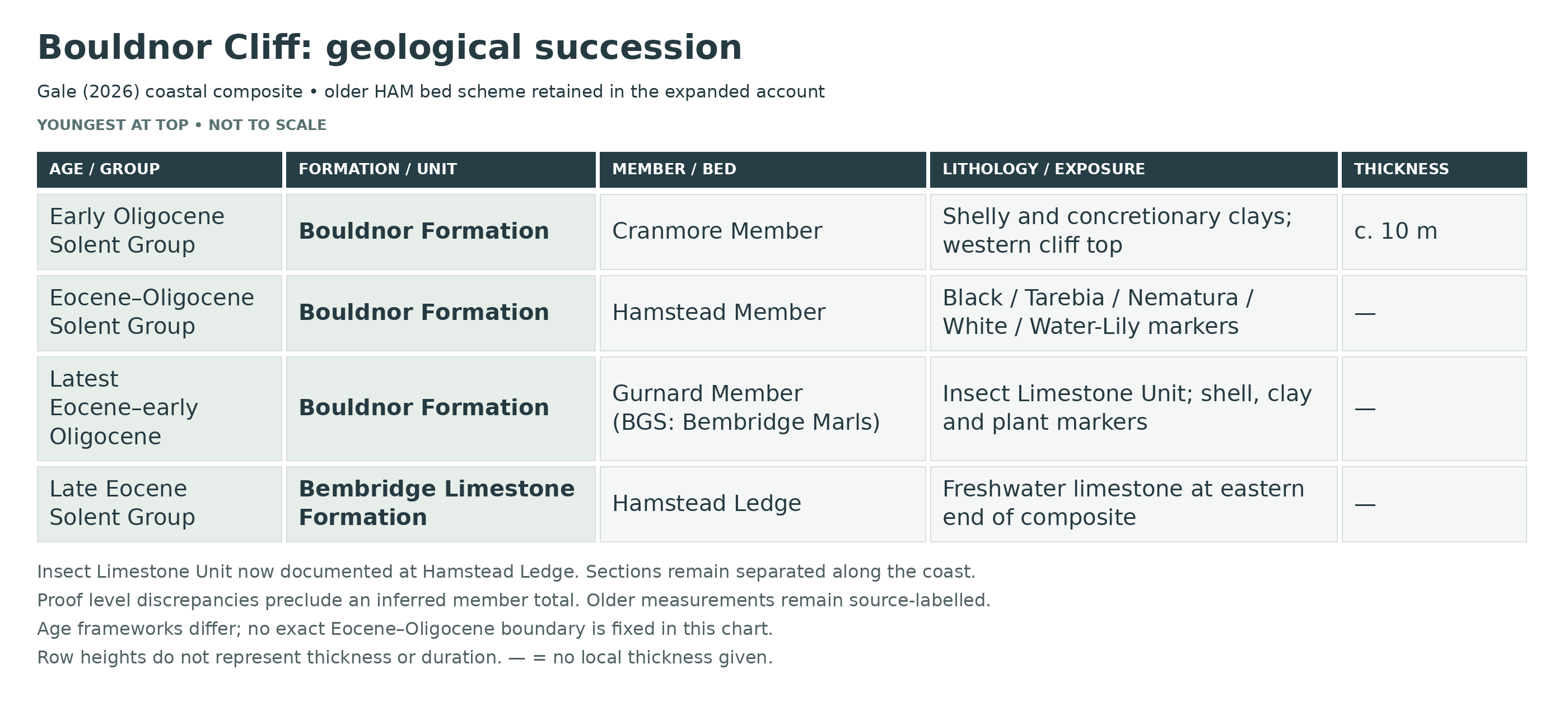
Bouldnor Cliff belongs to the Bouldnor–Hamstead coastal succession of the Solent Group, spanning the latest Eocene and early Oligocene. Its principal units are the Bembridge Limestone Formation and the overlying Bouldnor Formation, whose members are the Gurnard (traditionally Bembridge Marls), Hamstead and Cranmore in Gale’s 2026 terminology.
The Bembridge Limestone and Bembridge Marls are best documented towards Hamstead Ledge at the eastern end of the tract. The marls comprise fine muddy sediments, shell seams and plant-bearing horizons deposited in quiet fresh to brackish water. Their basal oyster layer is thin. Gale (2026) documents an Insect Limestone Unit with micritic limestone lenses at Hamstead Ledge, updating older accounts that regarded it as absent here.
The Hamstead Member forms much of the cliff succession. Black Band, Nematura Bed, White Band and Water-Lily Bed are key markers within clay, silt, lignitic and shelly intervals. The mammal change associated with the Grande Coupure lies within this member; it is not simply the boundary between Bembridge Marls and Hamstead beds.
The younger Cranmore Member is documented at the cliff top near Cranmore Avenue, farther west. Its Cerithium and Corbula beds record renewed brackish and marine influence. It should not be described as merely late Eocene river sediment or assumed to overlie every currently accessible exposure.
The section follows a shallow synclinal structure and is repeatedly obscured or displaced by landslips. The detailed account retains the published bed framework, distinguishes Hamstead foreshore from the western cliff-top exposures, and identifies differing source measurements instead of presenting a single permanently exposed vertical log.

This is a detailed stratigraphic breakdown of the latest Eocene to early Oligocene succession across the Bouldnor–Hamstead tract, Isle of Wight. The section exposes the underlying Bembridge Limestone Formation and the full Bouldnor Formation in synclinal structure, recording a transition from freshwater limestones into brackish, lagoonal, floodplain and finally more marine beds, with rich fossil assemblages including mammals, crocodiles, turtles, plants and molluscs.
New measured-section account: Gale (2026)
Gale (2026), following King (2016), uses the name Gurnard Member for the interval called Bembridge Marls Member in BGS (2015), here written as Gurnard Member. These are alternative names for the same part of the Bouldnor Formation, not two superposed units. The survey below uses Gale’s terminology and measured-section framework. The separately labelled older account retains the useful HAM bed numbers, fossils and historical measurements; its numerical divisions must not be spliced into the new survey.
The lower section is the Hamstead Ledge and adjacent foreshore succession; the middle and upper units include the Bouldnor landslip and western cliff-top exposures. These are correlated coastal sections, not all beds visible in one face. The following individual markers follow Figures 4–7 and the associated text.
SOLENT GROUP
Bouldnor Formation
Gurnard Member (Bembridge Marls Member in BGS 2015)
Basal oyster shell bed and eroded limestone contact
At Hamstead Ledge, the Gurnard Member rests on an eroded surface of the Bembridge Limestone. Its basal shell bed includes material reworked from that limestone and marks renewed transgression. This is a local shell-bearing horizon, not the thickness or sandy facies of the Oyster Bed at Whitecliff.
Insect Limestone Unit at Hamstead Ledge
Gale’s Figure 4 places this unit between 0.3 and 0.7 m in the Hamstead log. Dark laminated clays contain syneresis cracks, rare halite pseudomorphs and lenses of concretionary micritic limestone; Figure 6C shows the limestone lenses in place. This direct observation updates older statements that the Insect Limestone is absent from the Bouldnor–Hamstead tract. It does not demonstrate the same productive insect assemblage as at Gurnard or Saltmead.
T/P marker
Figure 4 distinguishes the T/P marker above the Insect Limestone Unit, within the lower succession of shell beds, silts and clays. The published abbreviated label is retained without expanding it into an unverified taxonomic or formal bed name.
Serpulid marker
A separate serpulid-bearing horizon lies above the T/P marker in Figure 4. It is one of several faunal markers used to correlate the lower Gurnard Member; it is not merged with the basal Oyster Bed.
Pc marker
The separately labelled Pc marker follows the serpulid horizon in Figure 4. Its published abbreviation is retained, and no independent thickness or unverified species identification is assigned.
Lower green marker
The lower conspicuously green clay marker is distinguished in Figure 4 and the Hamstead foreshore photograph, Figure 6A. It belongs to the lower rhythmic succession with shell-rich cycle bases and pedogenically modified clay tops.
Dark clay marker
The dark clay marker forms a distinct level between the lower green marker and the overlying green-clay interval. It is useful for local correlation rather than evidence for one uninterrupted dark bed throughout the member.
Middle green-clay marker
The separately illustrated green interval above the dark clay marker lies below the Potamomya marker. Across the lower member, mottling, local decalcification, desiccation cracks and rooted or slickensided cycle tops record repeated emergence and soil development.
Potamomya marker
This bivalve marker is individually labelled between the middle and upper green markers in Figure 4. Shell-bearing layers within this part of the member record short brackish-water incursions into the muddy coastal plain.
Upper green marker
The upper green marker in Figure 4 and Figure 6A is distinct from the lower and middle green intervals. Its separation preserves the published sequence of coloured-clay and shell-bed markers without treating every green clay as one correlatable bed.
Polymesoda obovata marker
A brackish shell bed rests on an omission surface penetrated by Thalassinoides burrows. This sharply based marker caps the lower marker-rich succession and is traced between northwestern sections and the more silty Howgate–Whitecliff succession.
Upper rooted clay cycles and organic-rich cycle bases
Above the lower markers, grey clays alternate with thin dark laminated organic-rich beds at cycle bases. Densely rooted cycle tops, siderite concretions and mineralised root traces are characteristic; local channel cutting is shown in Figure 4. These repeatedly soil-modified beds are not one homogeneous marl interval.
Nystia Bed
Gale describes a 2 cm brackish mollusc layer at 24.9 m in the Hamstead log. This is a distinct upper Gurnard Member marker, below the Black Band, and must not be confused with the separate Nystia-named horizons of older formations elsewhere on the island.
Silt marker immediately below the Black Band
Figure 4 distinguishes a silt horizon near the top of the Gurnard Member below the basal Hamstead Black Band. It is separate from the more conspicuous indurated silt higher in the lower Hamstead Member.
Hamstead Member
Black Band and basal rooted surface
The basal Hamstead marker is 0.7 m of dark grey laminated freshwater clay in Gale’s account, directly above a palaeosol with sideritic concretions. Older accounts give a thinner Black Band estimate; the new measurement is not silently substituted into the older HAM/GCR log.
Lower Hamstead scoured clays and Viviparus lenses
Clays above the Black Band contain silt-filled scours and lenses of Viviparus. Gale contrasts their lack of palaeosols with the repeatedly rooted clay cycles below the member boundary.
Indurated silt marker
A prominent indurated silt lies above the lower scoured clays and below the Tarebia Bed. Figure 6D shows its foreshore exposure, and Figure 15 correlates this marker northeastwards. Conflicting printed level ranges are not used to manufacture an exact thickness.
Tarebia Bed and desiccated upper surface
Small brackish gastropods pack this shell bed. Shell-filled Thalassinoides burrows extend 35 cm down into the underlying clay, while a desiccation-polygon surface immediately above records a subsequent exposed phase.
Rooted pale grey clay below the Log Bed
About 1 m of pale grey clay separates the Tarebia interval from the Log Bed. A sharp upper surface bears dense fine rootlets descending about 0.4 m into the clay.
Log Bed at Hamstead–Bouldnor
The log-bearing clay occupies 37.1–37.4 m in Gale’s Figure 4 and is laminated at its base. Large conifer trunks characterise this bed immediately below the Nematura Bed. Gale restricts this particular Log Bed to the Hamstead–Bouldnor section; logs also occur within the Nematura Bed, so wood alone does not identify a unique level.
Nematura Bed
Dark shelly clays above the Log Bed contain densely packed lenses of the brackish bivalve Polymesoda convexa, often in convex-up orientation, and additional logs. The bed passes upward into laminated silt with partly decalcified bivalves and increasingly strong soil mottling. The new survey therefore preserves more than the older description as a gastropod-rich lignite.
Decalcified palaeosol cycles below the White Band
Between 43 and 47.4 m in the Hamstead log, rhythmic silts and clays are extensively decalcified. Yellow-brown mottling, slickensides and thin separating grey clay layers mark individual soil-modified cycles; concretions are absent from this particular interval.
White Band in the new Hamstead log
Gale places the White Band at 47.4–53.1 m. Green-grey clays contain mollusc-rich lenses and siderite concretions. Brackish shell lags, including bivalves in life position, pass up into freshwater-gastropod-bearing clay and rooted, slickensided palaeosols. This broader logged interval is distinguished from the 1.8 m White Band entry of the older GCR table.
Post-White Band silts, clays and red palaeosol
Approximately 4 m of soil-modified silts and clays above the White Band end in a conspicuous brick-red palaeosol, shown at 56.3 m in Figure 4. Gale correlates this marker towards Thorness, where the intervening succession is thinner.
Bouldnor slip interval formerly poorly exposed
The interval between the White Band and Water-Lily Bed includes red-mottled palaeosols, silt beds and green or partly laminated silty clays exposed in the Bouldnor slip. The nineteenth-century gap of about 18 m reflects poor exposure in the older account, not demonstrated absence of strata.
Fish-otolith-bearing silty clays
Gale records fish otoliths in the sublaminated silty clays at 65.7–67 m in the Bouldnor upper-succession log. This is a separately documented fossil-bearing interval below the leaf bed.
Water-Lily or leaf bed
At 73.8 m in Figure 5, the leaf bed is only 5–7 cm of dark laminated carbonaceous clay. It overlies pale grey clay with vertical roots, itself above pale blue-green clay with siderite nodules. The bed was found on the third landslip tier; this new thin-bed measurement is distinct from the older 0.6 m table entry.
Mottled clays above the leaf bed
About 8.5 m of brown-grey clay with palaeosol mottling overlies the Water-Lily Bed. It is retained as a distinct post-leaf-bed interval rather than being collapsed into an undifferentiated upper clay summary.
Pyritic clay and rooted silt interval
At 82.7 m in Figure 5, dark grey pyritic clay contains rooted silt beds and passes upward into pale grey clay rich in siderite nodules.
Pale blue unionid-bearing clays
The 87.7–89.6 m interval consists of bright pale blue clays with siderite nodules and abundant unionid bivalves, recording freshwater conditions high in the Hamstead Member.
Upper red palaeosol and turquoise clay
A conspicuous upper red palaeosol lies about 1.4 m below the Cranmore base. Bright turquoise clay immediately below that boundary provides a further lithological marker; neither colour should be confused with the older red marker above the White Band.
Cranmore Member
Sharp Cranmore basal contact
Gale gives approximately 10 m of Cranmore Member in the western Bouldnor cliff-top section. Its base, at about 95.2 m in Figure 5, rests sharply on turquoise clay. This is a western coastal composite observation, not a unit exposed above every Hamstead collecting spot.
Lower shelly and rooted clays: Cerithium interval
The lower Cranmore alternates grey-brown shelly clays with pale blue-grey rooted clays. Figure 5 identifies the Cerithium interval within this lower part, reflecting the renewed influence of saline water.
Lentidium horizon
Figure 5 separately identifies a Lentidium-bearing level below the prominent middle-member silt. It is retained as a named faunal horizon without inventing an individual bed thickness.
Cranmore silt at 98.8 m
A distinct silt at 98.8 m in the Bouldnor log separates the lower alternations from the overlying thicker grey-clay succession.
Cuma horizon
The Cuma label in Figure 5 lies above the silt marker, within the upper clay succession. It is kept as Gale’s faunal horizon label, without treating it as a formal member.
Upper concretionary clays and Corbula interval
Above the silt, about 5.5 m of grey clay contains spheroidal and septarian carbonate concretions. Figure 5 places the Lentidium and Cuma faunal zones within the broader Corbula Bed. In the uppermost metres aragonitic shells are absent, although occasional large oysters remain; loss of aragonitic fossils is not evidence that those beds were originally unfossiliferous.
Erosional top and younger cover
The preserved Palaeogene succession is truncated. Figure 5 shows younger gravel above the Cranmore; the contact is an unconformity, not a continuation of the Palaeogene member sequence.
Measurement and interpretation limits
The printed proof gives inconsistent numerical levels for the Gurnard–Hamstead boundary and some lower Hamstead markers. Their order is secure in the illustrated sections, but a corrected member total or precise height for an ambiguous marker is not inferred here. Metre levels below refer only to the explicitly named published log, not height above today’s beach.
The mammal turnover is placed within about 4 m above the Nematura base in Gale’s discussion. His interpretation questions a large hiatus associated with the Log Bed, while older mammal-based work proposed a substantial break. That disagreement is retained rather than converting either interpretation into a proven erosional gap. Gale also retracts his earlier C13n assignment for the basal normal-polarity interval in favour of King’s C15n interpretation.
Older GCR/HAM reference account
This is a published composite framework for the Bouldnor–Hamstead coastal tract, not a single upright cliff log. The Bembridge Limestone and HAM-numbered marl beds belong to the eastern Hamstead Ledge/foreshore part; Hamstead beds occur in scattered cliff sections, and Cranmore beds are documented near Cranmore Avenue farther west. These geographical limits are retained for each part rather than assigning the entire succession to every collecting spot. The BC labels below belong to the older reference account and are editorial guide divisions. Numerical bed estimates below follow GCR Table 3.6 (2005); older GCR 10 values differ and are not combined with them.
SOLENT GROUP
Bembridge Limestone Formation (Upper Eocene / Priabonian)
Hamstead Ledge Freshwater Limestones
Bed BC1 — Freshwater Limestones Of Hamstead Ledge
Three freshwater limestone beds are developed at the eastern end of the Bouldnor–Hamstead coastal section, where the Bembridge Limestone crops out at Hamstead Ledge. These limestones are hard, pale, pond-limestone facies deposited in shallow freshwater to slightly brackish lakes and marshes. They commonly contain freshwater gastropods and associated lime-mudstone partings, and they form the resistant ledge that makes Hamstead Ledge such a prominent foreshore feature beneath the younger Bouldnor beds.
Bouldnor Formation (Upper Eocene To Lower Oligocene)
Bembridge Marls Member
Bed BC2 — HAM I–IV, including the basal oyster bed (whole interval c. 0.9 m in the older table)
Grey and black clays with shelly partings and a thin oyster shell bed at the base. The thin basal shell layer represents the local Bembridge Oyster Bed, resting on the Bembridge Limestone and marking the main transgressive phase at the base of the Bembridge Marls Member. The bed contains abundant shell debris and a restricted brackish-water fauna, and is interpreted as an estuarine or strongly lagoonal deposit with appreciable water movement.
Bed BC3 — HAM V (c. 0.3 m)
Greenish-grey clay with fossil bands containing Melanoides acuta, Serpula sp. and Viviparus lentus. This thin but distinctive bed records fluctuating salinity and a mixed brackish to freshwater fauna, with quieter lagoonal conditions than the oyster bed below.
Bed BC4 — HAM VI–X (c. 2.7 m)
Grey and blue-green laminated clays with brackish-water bivalves and gastropods. Fine lamination and locally varve-like bedding indicate low-energy deposition in a quiet lagoon or estuarine backwater. This eastern Hamstead-foreshore interval illustrates the laminated clay facies of the lower Bouldnor Formation within the wider coastal composite.
Bed BC5 — HAM XI–XIV (3.6 m in GCR Table 3.6)
Mudstones and siltstones with a bivalve band. These beds continue the generally low-energy lagoonal succession but show slightly more silt input than the lower laminated clays. Molluscs are more conspicuous at particular levels, and the unit represents fluctuating salinity in shallow standing water.
Bed BC6 — HAM XV–XIX (2.3 m combined in GCR Table 3.6)
This interval includes black clay with gastropods, green mudstone with a lignite band, and green clays and white marls with bivalves. It marks a transition from darker organic-rich lagoon-floor muds upward into somewhat fresher-water marls and clays. These beds show repeated alternation between organic accumulation, quiet standing-water sedimentation and more oxygenated shallow-water deposition.
HAM XV — Gastropod-bearing black clay (0.2 m)
This thin dark clay begins the grouped interval in Table 3.6. It is followed by the greener muddy and lignitic beds.
HAM XVI–XVIII — Green muds and lignitic band (1.8 m)
These muddy beds include the organic-rich band within the middle member. The GCR plant-bed diagram marks a lignitic P2 horizon in this part of the succession.
HAM XIX — Bivalve-bearing green clay and white marl (0.3 m)
The upper part of the group contains bivalves and a pale marly component; Figure 5.40 identifies a corbiculid shell marker in the corresponding middle succession.
Bed BC7 — HAM XX–XXII (2.0 m in GCR Table 3.6)
Freshwater clays and silts, indicating that salinity had dropped markedly relative to the lower Bembridge Marls. These beds represent quieter lacustrine or upper-lagoon conditions and contain a less marine and more freshwater molluscan assemblage.
Bed BC8 — HAM XXIII–XXV (c. 2.0 m)
Lignite and clay rich in water-plant seeds, leaf fragments and gastropods. This is one of the distinctive plant-bearing intervals in the Hamstead-foreshore part of the coastal composite. Seeds of aquatic plants such as Brasenia and Stratiotes occur with Viviparus and other freshwater molluscs, indicating very shallow, plant-rich water on a lagoon margin or floodplain lake.
Bed BC9 — HAM XXVI–XXIX (5.7 m in GCR Table 3.6)
Clays with seeds and molluscs, continuing the upper freshwater trend of the Bembridge Marls Member. These beds are less lignitic than the plant-rich interval below, but still yield abundant seeds, freshwater molluscs and comminuted plant matter. They represent quiet lacustrine to floodplain-waterbody deposition.
Bed BC10 — HAM XXX (0.1 m in GCR Table 3.6)
A thin lignite with seeds and molluscs. This bed forms a compact organic-rich marker in the upper Bembridge Marls and records a short interval of peat or highly plant-rich mud accumulation in standing freshwater.
Bed BC11 — HAM XXXI–XXXIV (1.8 m in GCR Table 3.6)
Green, red and mottled clays forming the highest Bembridge Marls beds in the eastern Hamstead-foreshore reference section. These beds reflect increasingly terrestrial, floodplain and upper-lagoon conditions with fluctuating water tables and periodic oxidation. Vertebrate remains become more important near the top of the member, and large mammal remains from this level include Anoplotherium, Palaeotherium medium suevicum and Plagiolophus major, characteristic of the MP20 fauna below the main faunal turnover.
Published Bembridge Marls Thickness: About 21.5 Metres At Hamstead Foreshore
Individual horizons in the older GCR Figure 5.40 scheme
The following numbered levels and P labels belong specifically to that graphical Hamstead-foreshore log. They supplement the older bed prose above and are not presented as a precise numerical crosswalk to either GCR Table 3.6 or Gale (2026).
P1 plant horizon in GCR Figure 5.40
The first labelled plant horizon lies at the shell-bearing level numbered 15, above the rooted top of the preceding clay. It is separate from the lignitic mud band higher in the log.
P2 lignitic mud band
P2 is the conspicuous dark lignitic mud band at level 17 in Figure 5.40. It lies between the lower plant horizon and the overlying Corbicula-bearing interval.
Corbicula Bed in the older graphical log
Figure 5.40 identifies the Corbicula shell marker at level 19. The historical fossil label is retained as printed; an automatic equivalence with Gale’s separately named marker beds is not asserted.
P3 plant horizon
P3 is separately labelled in the interval numbered 20, above the Corbicula Bed and below the shell-bearing level 21 in Figure 5.40. No independent thickness or exclusive species assemblage is supplied by that figure.
P4 plant horizon
P4 is distinguished immediately above P3 around the transition to level 21. It is retained as a separate plant concentration, without inventing a diagnostic lithology not given by the source.
P5 plant horizon
P5 occurs in the interval numbered 22, below the laminated upper part of that package and beneath the rooted level 23. Its position separates it from both P4 below and P6 above.
P6 rooted plant horizon
P6 is placed at level 23, where Figure 5.40 shows roots above the laminated interval. This adds the rooted contact detail lost when the older middle marls are described only as one clay unit.
P7 plant horizon
P7 is separately marked in the lower part of the level-25 package above the level-24 interval. The figure does not support assigning it a distinct modern Gale bed number or a unique flora.
P8 plant horizon
P8 is the upper separately marked plant concentration in the same level-25 part of the old log, below the higher clays numbered 26–27. P7 and P8 are not one undivided plant bed.
Ironstone Band in the older graphical log
The Ironstone Band is shown individually at level 28, above the thick clay package numbered 26–27 and below the Nystia Band.
Nystia Band in the older graphical log
The shell marker labelled Nystia Band occupies level 30 in Figure 5.40, above interval 29. The figure’s numbered horizons are retained in their own scheme rather than forced into the differing tabulated HAM subdivisions.
Rooted upper contact and P9 context
The older graphical log shows a laminated level near 32 and rooted upper clay at 33. The associated plant-bed discussion places P9 in the basal Hamstead Black Band, above the Bembridge Marls plant horizons. These contacts are retained without turning all P labels into independently measured beds.
Hamstead Member
Bed BC12 — Black Band (c. 0.5 m in the older GCR table)
A carbonaceous mud or lignitic horizon full of freshwater gastropods such as Viviparus and the bivalve Unio. Autochthonous root systems penetrate the bed below at its base. This distinctive horizon marks the base of the Hamstead Member and records a widespread pause and organic accumulation on a low-energy lagoon or floodplain surface.
Bed BC13 — Lower Hamstead Green And Black Clays (c. 8.1 m)
Green and black clays with bivalves and gastropods forming the lower Hamstead Member beneath the Nematura Bed. These beds represent quiet lagoonal to low-salinity estuarine deposition and yield the lower Hamstead mammal fauna, including Anoplotherium commune, Xiphodon gracilis, Palaeotherium, Plagiolophus and the theridomyid rodent Theridomys bonduelli. They are important because they still preserve the pre-Grande Coupure endemic European mammal assemblage.
Bed BC14 — Log Bed (Within The Lower Hamstead Member)
The older BGS account, summarising Hooker and co-authors, describes thin clayey sand below the Nematura Bed with water-escape structures and large conifer logs. The inherited description includes ball-and-pillow and convolute deformation, consistent with soft, water-saturated sediment disturbed soon after deposition. Plant seeds and leaves are recorded from the associated lower Hamstead beds. Gale (2026) describes the local Log Bed as a 0.3 m clay interval, laminated at its base, with large conifer trunks; the differing descriptions are retained as source-specific observations, not asserted to be identical measured lithologies or proof of a large hiatus.
Bed BC15 — Nematura Bed (c. 0.9 m in the older GCR table)
Black lignitic clay full of gastropods, especially the mollusc for which the bed is named. Dinoflagellates, ostracods, rootlets and reworked wood fragments indicate brackish-water conditions. This bed is the classic divider between the lower and upper Hamstead Member successions and is a key marker in the Bouldnor Cliff section.
Bed BC16 — Lower Upper-Hamstead Green Clays And Ironstone Nodule Band (c. 10.8 m)
Green clay with an ironstone nodule band and associated silts and clays above the Nematura Bed. The basal few metres of the upper Hamstead include alternating greenish to greyish clays and silts with decalcified Polymesoda shells. These beds mark the beginning of the post-Grande Coupure part of the section, with a distinctly changed mammal fauna and continued fluctuating salinity.
Bed BC17 — Eomys Bed
Bosma, de Bruijn and Wessels (2023) identify the informal Eomys Bed as Hooker’s UHB10 in the upper Hamstead Member. Richard Ford collected its rodent teeth in the 1980s from a fossiliferous layer only a few centimetres thick, consisting of bone-rich lenses within green to green-grey muds. Their studied material is Eomys antiquus, of post-Grande Coupure, earliest Oligocene age. This source verifies the named horizon but does not establish the former guide’s precise claim of 10 m above the upper-Hamstead base.
Bed BC18 — White Band (c. 1.8 m in the older GCR table)
Green clays with pale white shell marls, a conspicuous light-coloured horizon within the upper Hamstead Member. Decalcified Polymesoda and other shell material occur here, and the bed marks one of the clearest internal lithological changes in the upper part of the cliff.
Green and red marls above the White Band (20.7 m in Table 3.6)
The composite table places this largely obscured muddy interval between the White Band and Water-Lily Bed. Red and green colours and mottling reflect variable oxidation and waterlogging. It must not be omitted when describing the spacing between these two marker beds. Crocodilian remains are discussed separately below at the supported member-level scope.
BC19 — Crocodilian remains: member-level context
Crocodilian remains, including records assigned to Diplocynodon hantoniensis and Diplocynodon sp., are documented from the Bouldnor–Hamstead succession in the reptile GCR account. Fish, turtles, crocodiles and mammals occur at several levels. The earlier guide’s specific placement of a rich “Crocodile Bed” above the White Band is not established by the checked primary bed logs, so that fixed position and a bed-specific species assemblage are not used here.
Bed BC20 — Water-Lily Bed (c. 0.6 m in the older GCR table)
Laminated lignite with seeds, palm leaves, water-lily leaves and molluscs. This is one of the most distinctive plant-rich beds in the upper Hamstead Member and records a low-energy waterbody with abundant floating and emergent vegetation. It is particularly important for palaeobotanical work on the subtropical Oligocene flora of the Isle of Wight.
Bed BC21 — Upper Green And Mottled Clays With Lignite Beds And Shell Beds (up to c. 25 m)
The highest part of the Hamstead Member consists of green and mottled clays with lignite beds, shell beds and locally red or brown laminated clays.
Upper Hamstead mammal fauna: member-level context
The upper Hamstead Member as a whole yields a mammal fauna, including anthracotheres such as Bothriodon, Elomeryx and Anthracotherium, the beaver Asteneofiber, the hamster Atavocricetodon, the rodent Eomys, the hedgehog Tetracus, the last adapid primate Leptadapis and the first British true rhinoceros Ronzotherium. This member-level fauna records the post-Grande Coupure mammal turnover and are of exceptional European importance.
Hamstead Member Thickness: Published Composite Estimates Differ
Cranmore Member
Bed BC22 — Cerithium Beds (c. 3.4 m)
The lower part of the Cranmore Member, comprising fossiliferous grey, blue and black clays of mainly non-marine to brackish aspect. These beds preserve the remains of the mollusc traditionally referred to as Cerithium and indicate renewed marginal, shallow-water conditions after the more varied lagoonal-floodplain deposition of the Hamstead Member below.
Bed BC23 — Corbula Beds (c. 5.8 m)
The upper and more marine part of the Cranmore Member, consisting of fossiliferous clays with Corbula and other brackish to marine molluscs. These beds show that salinity increased upward again near the end of Bouldnor Formation deposition. Shark remains have been reported from the Cerithium and Corbula beds, although mammal remains are not known from this uppermost member.
Cranmore Member: About 9.2 Metres Preserved In The Cranmore Cliff-Top Section
Depositional Environment
The Bouldnor Cliff succession records a complex low-energy lagoonal, lacustrine, estuarine and marginal-marine system. The Bembridge Limestone formed in shallow freshwater lakes and marshes; the Bembridge Marls record estuarine to lagoonal conditions passing upward into more freshwater lake and floodplain settings; the Hamstead Member records alternating brackish, freshwater and floodplain conditions with major organic beds, log-bearing horizons and the famous faunal turnover across the Grande Coupure; and the Cranmore Member marks a return to more brackish and marine conditions at the top of the succession. The whole section is heavily slipped, so fresh exposures are intermittent but often very productive.
Composite Thickness And Exposure Limits
References
Insole, A. & Daley, B. (1985). Revision of the late Eocene and early Oligocene lithostratigraphy of the Hampshire Basin.
Daley, B. (1972, 1973) on the Bembridge Marls and Bouldnor succession of the Isle of Wight.
Hooker, J.J. and co-authors on the Bouldnor Cliff mammal faunas and the Grande Coupure.
British Geological Survey Lexicon: Bembridge Marls Member, Hamstead Member, Bembridge Limestone Formation.
Geological Conservation Review accounts for Bouldnor Cliff and Bouldnor–Hamstead Cliffs.
Thickness provenance and research limits
GCR 15 gives about 21.5m for the Bembridge Marls, about 78m for the Hamstead Member and about 9.2m preserved for Cranmore across the full coastal composite. BGS 2015 instead gives 58–69m for the Hamstead Member in its broader formation account, and the individually tabulated 2005 intervals are not identical to the 1999 estimate. These are differing published estimates and definitions, not a range of cliff heights or a complete section exposed at every point. The full Bouldnor Formation composite was estimated at nearly 110m by GCR 15; no new summed total is asserted here.
The named plant-bearing horizons P1–P8 in GCR Figure 5.40 lie within the Bembridge Marls at Hamstead foreshore, and P9 is the Black Band at the base of the Hamstead Member. They document multiple separate plant concentrations rather than one continuous plant bed. They are retained as that publication’s horizon scheme; the figure does not justify assigning a unique flora or independent thickness to every P label.
Checked sources: Hopson and Farrant (2015), Isle of Wight, Bouldnor Formation and members; Daley and Balson (1999), GCR 15: Bouldnor and Hamstead cliffs, Figures 5.39–5.40; Benton, Cook and Hooker (2005), GCR 32: Bouldnor Cliff, Table 3.6; Benton and Spencer (1995), GCR 10, chapter9: Bouldnor and Hamstead Cliffs; Cleal and colleagues (2001), GCR22: Bouldnor Cliff.
Additional source: Gale (2026), Bouldnor Formation stratigraphy, sections 2 and 6–8, Figures 4–7, 14–16 and 18.
Mammal-horizon source: Bosma, de Bruijn and Wessels (2023), Eomys antiquus from Bouldnor Cliff, locality description.
EQUIPMENT
Fossil collecting between Bouldnor Cliff is largely carried out on the foreshore, where most fossils can be found loose within the shingle, clay or along the tideline. As a result, no heavy tools are required, and a good eye and patience are often all you need to make successful finds.
However, bringing a few basic tools can be helpful. A small trowel, pick or sturdy screwdriver can be useful for gently working through soft clay or marl where fossils may be partially embedded. Many of the best finds, particularly small teeth and seeds, are easily missed without careful searching at ground level.
Because much of the collecting involves kneeling or crouching, knee pads are highly recommended for comfort during longer sessions. A pair of tweezers is also very useful, especially for picking up small fossils such as seeds or tiny teeth that can be difficult to handle with fingers.
For those planning to sieve material, a fine mesh sieve (around 1–2mm) and a container for collecting sediment can significantly increase the number of finds, particularly from the Hamstead Member which is rich in small fossils.
It is also important to bring wrapping materials such as tissue, newspaper or small containers, as many fossils—especially shells and fragile bone fragments—can be easily damaged. A bag or backpack will help carry your finds safely along the beach.
As the foreshore can be uneven, muddy and slippery in places, sturdy waterproof footwear is strongly recommended. Overall, this is a location where careful searching is far more important than heavy tools, but a few simple items can greatly improve both comfort and success.
SAFETY
Common sense should always be used when collecting at this location, and checking tide times is essential. The tidal conditions here can be unpredictable, with double tides sometimes affecting the coast. It is very easy to become cut off, so always plan to return before the tide turns.
The cliffs are prone to slumping, and the foreshore can be difficult to navigate. In places, soft mud and clay can be very deep and “sinky”, with a risk of becoming stuck, especially after wet weather. Care should be taken when walking across these areas.
Fallen trees and debris along the foreshore can also create trip hazards, particularly when moving between access points. Take care when stepping over obstacles and avoid climbing on unstable ground or landslips.
CLEANING AND TREATING
Support delicate bone and plant fossils in their matrix and keep associated pieces together. Begin with minimal dry cleaning; do not routinely soak the clay-rich, carbonaceous or pyritised material from these beds. Seek preparation advice for fragile finds.
Use Paraloid B-72 only if a specimen needs consolidation, after testing and preferably with specialist advice. It can be re-dissolved in suitable solvents, but removing a treatment from porous fossils is not always straightforward. Record any treatment; a surface coating does not prevent pyrite decay.
IDENTIFY YOUR FINDS
Need help identifying a fossil? Share clear photos, where you found it and its size with the community.
FURTHER READING
Deposits Magazine – Locations on the Isle of Wight: A personal view
Bouldnor and Hamstead Cliffs and foreshore — GCR stratigraphy
Bouldnor Cliff — GCR fossil mammals
Bouldnor Cliff — GCR fossil birds
ACCESS RIGHTS
This coast forms part of Bouldnor and Hamstead Cliffs SSSI. Respect landowner access conditions and local notices. Keep casual collecting to loose beach material; do not hammer the bedrock or dig into the cliffs. The Natural England citation for Bouldnor and Hamstead Cliffs SSSI explains the protected scientific interest.
It is important to follow our ‘Code of Conduct’ when collecting fossils or visiting any site. Please also read our ‘Terms and Conditions‘
LINKS
♦ Fossil Discussions
♦ Fossil Articles
♦ Buy Fossils, Tools and Equipment
♦ Buy Crystals, Meteorites, and Artefacts
♦ Join Fossil Hunts
♦ UK Fossils Network