Black Ven is one of the most iconic and geologically dynamic fossil locations on the Jurassic Coast. Located west of Charmouth, its constantly shifting cliffs and large landslips make it one of the most important sites for fossil discovery in the UK. Renowned for marine reptiles, ammonites and exceptional flatstone fossils, Black Ven continues to produce remarkable finds year after year.


FIND FREQUENCY: ♦♦♦♦♦ – Extremely productive due to constant landslips, regularly yielding ammonites, flatstones and marine reptile remains.
CHILDREN: ♦♦♦ – Less suitable for younger children due to unstable cliffs, uneven terrain and increased hazards.
ACCESS: ♦♦♦ – Access is more difficult, with a longer walk and very uneven ground, including boulders and soft clay in places although it may be easier to walk from Lyme Regis.
TYPE: – Fossils are found on the foreshore and in detached material on the open beach, well away from landslips. Follow the West Dorset Fossil Collecting Code: collect responsibly from loose beach material and do not dig into cliffs or in-situ beds.
DIRECTIONS
♦ ACCESS 1: The beach at Charmouth is easy to access. Just head into Charmouth and then down Lower Sea Lane, where there is a large car park next to the sea.
♦ There are also toilets, an information centre, and a cafe/food outlets nearby.
♦ Walk west, behind the Charmouth Heritage Centre along the seawall, which will lead to some wooden steps to the beach. walk right to the end of the Beach where the landslides of Black Ven begin.
♦ ACCESS 2: You can also access from Lyme Regis via the steps at Church Cliffs, it’s a longer walk but avoids the large boulders. There is a large car park at Charmouth Road, Lyme Regis.
♦ Access 1, Lower Sea Lane Car Park, Charmouth: DT6 6LR, Google Maps
♦ Access 2, Parking at Lyme Regis: DT7 3DW, Google Maps
♦ What3Words collecting area: ///pots.stand.chuckling
DOWNLOAD THE UKF BOOKLET TO FOSSIL HUNTING AT CHARMOUTH
VIDEO FILM
FOSSIL HUNTING
Black Ven is one of the most dynamic and productive fossil locations on the Dorset coast, characterised by its constantly shifting cliffs and large-scale landslips. This continual movement exposes fresh material on a regular basis, making it one of the best places to find a wide variety of fossils, from ammonites to marine reptiles. Most fossils are found on the foreshore and in detached material washed clear of the cliffs; keep away from fresh falls and landslips.
Ammonites occur loose and within nodules at Black Ven. Their matrix helps distinguish sources: Microderoceras birchi is recorded from concretions in the upper Shales-with-Beef, while Asteroceras, Promicroceras and Xipheroceras occur in the younger Bed 83 nodule suite. Higher pyritic beds yield forms such as Echioceras and Oxynoticeras. Goldstones is a traditional name for one of the limestone-nodule horizons; it does not mean that every golden pyritic nodule belongs to that bed. Collectors also use “goldstone nodule” informally for other nodules, including Arnioceras-bearing examples; that usage does not identify the named Bed 83 horizon. Coiling, ribbing and sutures are more useful than colour alone for recognising an ammonite.
Yellowstones form another named limestone-nodule horizon in the Bed 83 succession at Black Ven. They belong to the same broad fossil-rich interval as the Flatstones, but are a separate marker. Weathering colour alone cannot reliably distinguish these levels in loose beach material. Record an uncertain nodule as loose material of uncertain horizon rather than forcing a bed name from its appearance.
Black Ven is especially known for Flatstones: laminated limestone concretions within the dark Bed 83 shales. Their fine layers can preserve ammonites, fish and rare insects, sometimes with exceptional detail. They should not be confused with ordinary thin shale slabs. Check naturally exposed loose fragments for fossil outlines and keep matching pieces together; a small insect wing or fish fragment may be scientifically useful. Pentacrinites fossilis is also recorded locally, especially in the separate Pentacrinite interval (Bed 84b), where jointed stems and branching arms may be associated with fossil wood.


Stellare Nodules are rounded, commonly septarian concretions from Bed 88f of the Black Ven succession. Published records include Asteroceras stellare, but rings or calcite-filled cracks on a nodule are not themselves ammonite whorls. Look for an actual shell outline, ribs or sutures before interpreting a weathered surface. Keep potentially fossil-bearing examples intact for assessment rather than testing them by repeated hammer blows.
Marine reptiles are important parts of Black Ven’s fossil record, but a visitor should not expect a skeleton. Isolated vertebrae, ribs, jaw fragments and limb bones may occur in loose material. The wider Lyme–Charmouth fauna includes Ichthyosaurus communis and species of Temnodontosaurus, as well as plesiosaurs; Temnodontosaurus is a genus, not a second species name. Most isolated fragments cannot be named that precisely. Preserve attached matrix and matching pieces, record the find position and show unusual bones to the Heritage Coast Centre or museum.
Shark remains include teeth and dorsal fin spines. A spine may retain longitudinal ridges or small projections along its edge, but a pointed pebble or isolated fragment needs expert assessment. Keep suspected shark material and its adhering matrix intact, record the find position and show it to the Heritage Coast Centre or museum.
Erosion continually releases new material, but fresh landslips are dangerous places to search. Collect only from the open foreshore in settled conditions, well away from cliff bases, fresh falls and soft mud. Look through wave-washed shingle and stable detached blocks rather than entering landslip debris.
If you find something that may be scientifically significant, consider reporting it to the Charmouth Heritage Coast Centre or the Lyme Regis Museum. They can help identify your find and offer expert advice. Proper documentation ensures that important specimens are recorded and remain available for scientific research.
This is a longer dated log of some of the most significant fossil discoveries from Charmouth, Black Ven, and the immediate Charmouth–Lyme stretch. It includes the classic early marine reptile finds, the first recognised coprolites, the famous Scelidosaurus discoveries, the marine crocodylomorph Turnersuchus hingleyae, and notable recent ichthyosaur finds.
1811–1812 – Joseph and Mary Anning’s first major ichthyosaur discovery
Joseph Anning found the skull in 1811, and Mary Anning returned to the same site and excavated the rest of the skeleton in 1812. By early 1813 it had become the first largely complete ichthyosaur to be uncovered and scientifically studied, helping transform understanding of extinction and ancient life.
1814 – Mary Anning’s ichthyosaur entered the scientific literature
After its excavation, the specimen was studied by Sir Everard Home and became one of the fossil discoveries that brought ichthyosaurs to the attention of the scientific world. This was one of the most important early scientific milestones for the Charmouth–Lyme coast.
1820 – the Anning ichthyosaur was recognised as an extinct marine reptile
By 1820 the strange animal found by the Annings had been recognised as an extinct marine reptile rather than a crocodile or fish. This was a major change in interpretation and part of the wider scientific impact of the Charmouth coast discoveries.
1823 – Mary Anning discovered the first complete Plesiosaurus skeleton
In December 1823, Mary Anning discovered the first complete Plesiosaurus skeleton from the Lower Jurassic coast. It became one of the most celebrated fossil finds of the nineteenth century and helped establish the Charmouth–Lyme coast as one of the world’s great marine reptile localities.
1828 – Mary Anning discovered Britain’s first pterosaur
In December 1828, Mary Anning uncovered the remains of the first pterosaur found outside Germany, the fossil later known as Dimorphodon. This added flying reptiles to the already remarkable fossil record of the area.
1829 – coprolites were recognised as fossilised dung
Work by William Buckland on material from the Lyme Regis and Charmouth coast led to the recognition that certain curious stony objects were fossilised dung, or coprolites. This was another major scientific breakthrough linked to the fossil discoveries of this coast.
1858–1859 – Scelidosaurus discovered at Black Ven near Charmouth by James Harrison
Fossils found by James Harrison while working the Black Ven cliffs near Charmouth were sent to Richard Owen, who recognised their importance. This discovery made Charmouth one of the classic British dinosaur localities.
1861 – Scelidosaurus harrisonii formally described by Richard Owen
Owen formally described Scelidosaurus harrisonii in 1861. It became one of the most important early ornithischian dinosaurs ever discovered and remains central to discussions of armoured dinosaur evolution.
June 1955 – the museum acquired J. F. Jackson’s juvenile Scelidosaurus
The British Museum (Natural History) bought a fossil-bearing marlstone nodule found by J. F. Jackson on the beach beneath Black Ven. It contained a small, incomplete articulated skeleton. Its exact source bed is uncertain; Norman’s later study considered the Topstones Bed the likely source.
1968 – preparation of Jackson’s partial Scelidosaurus skeleton published
Arthur Rixon published an account of preparing the juvenile specimen now numbered NHMUK R6704. The work freed its delicate bones from the enclosing nodule and provided material for later anatomical comparisons. The discovery was on the Black Ven shore, within the wider Charmouth–Lyme area covered by this timeline.
1984–1985 – another important Scelidosaurus specimen recovered
Norman records the Bristol specimen, BRSMG Ce12785, as collected from the Topstones Bed by Simon Barnsley and Chris Moore in 1984–1985. It preserves a partial, disarticulated skull and skeleton together with patches of skin impressions and armour, supplementing the earlier discoveries.
December 2000 – David Sole found the most complete Charmouth Scelidosaurus specimen yet discovered
The first parts of this specimen were found in December 2000 by local collector David Sole. Over the following months and years, more pieces were recovered by David and fellow collectors Peter Langham, Jo Anderson, Andrew Sole, Christine Endecott, Rick Taylor and Bernie Abbott. The specimen proved to be over 85% complete, with exceptional preservation including skin and apparent stomach contents.
2000s–2010s – the David Sole Scelidosaurus became recognised as Britain’s most complete and best-preserved dinosaur
The Black Ven Scelidosaurus found by David Sole came to be regarded as Britain’s most complete and best-preserved dinosaur found to date. The specimen also showed that major dinosaur discoveries were still being made on the Charmouth coast in modern times.
2017–2018 – the future Turnersuchus specimen recovered
Paul Turner found the initial block and Lizzie Hingley recovered additional material and prepared the specimen. Its five main blocks emerged between May 2017 and July 2018 from eroded material about one kilometre west of Charmouth Heritage Coast Centre. The fossil comes from the lower Pliensbachian Belemnite Marl Member and includes parts of the skull, jaws, backbone and limbs.
2023 – Turnersuchus hingleyae formally described
The 2017 Charmouth specimen was formally described in 2023 as Turnersuchus hingleyae. The genus name honours Paul Turner, while the species name honours Lizzie Hingley. It is one of the oldest diagnostic thalattosuchians known and one of the most important recent discoveries from the Charmouth coast.
February 2024 – “Gonzo”, the mummified ichthyosaur, found by Chris Moore
In February 2024, local collector Chris Moore found an exceptionally preserved ichthyosaur nicknamed “Gonzo”. Charmouth Heritage Coast Centre reports associated shark teeth interpreted as a possible new hexanchiform species and an exceptionally early record of the group. The proposed shark identification remains provisional pending formal scientific description.
September 2024 – “Enzo”, a complete ichthyosaur, discovered by Chris Moore
Chris Moore discovered and excavated this complete ichthyosaur in September 2024, with special permission from the landowners to remove the specimen. The fossil is thought to represent an undescribed new species, with several unusual skeletal features including a pronounced overbite and an unusual hind paddle.
March–May 2025 – Enzo scanned and publicly presented as a likely new ichthyosaur species
In March 2025 the unusual skull was digitally scanned, and in May 2025 the specimen was publicly named “Enzo” in a Charmouth Heritage Coast Centre competition. Although not yet formally described in the scientific literature, it has been presented as a probable new species-level find from Charmouth.
GEOLOGY
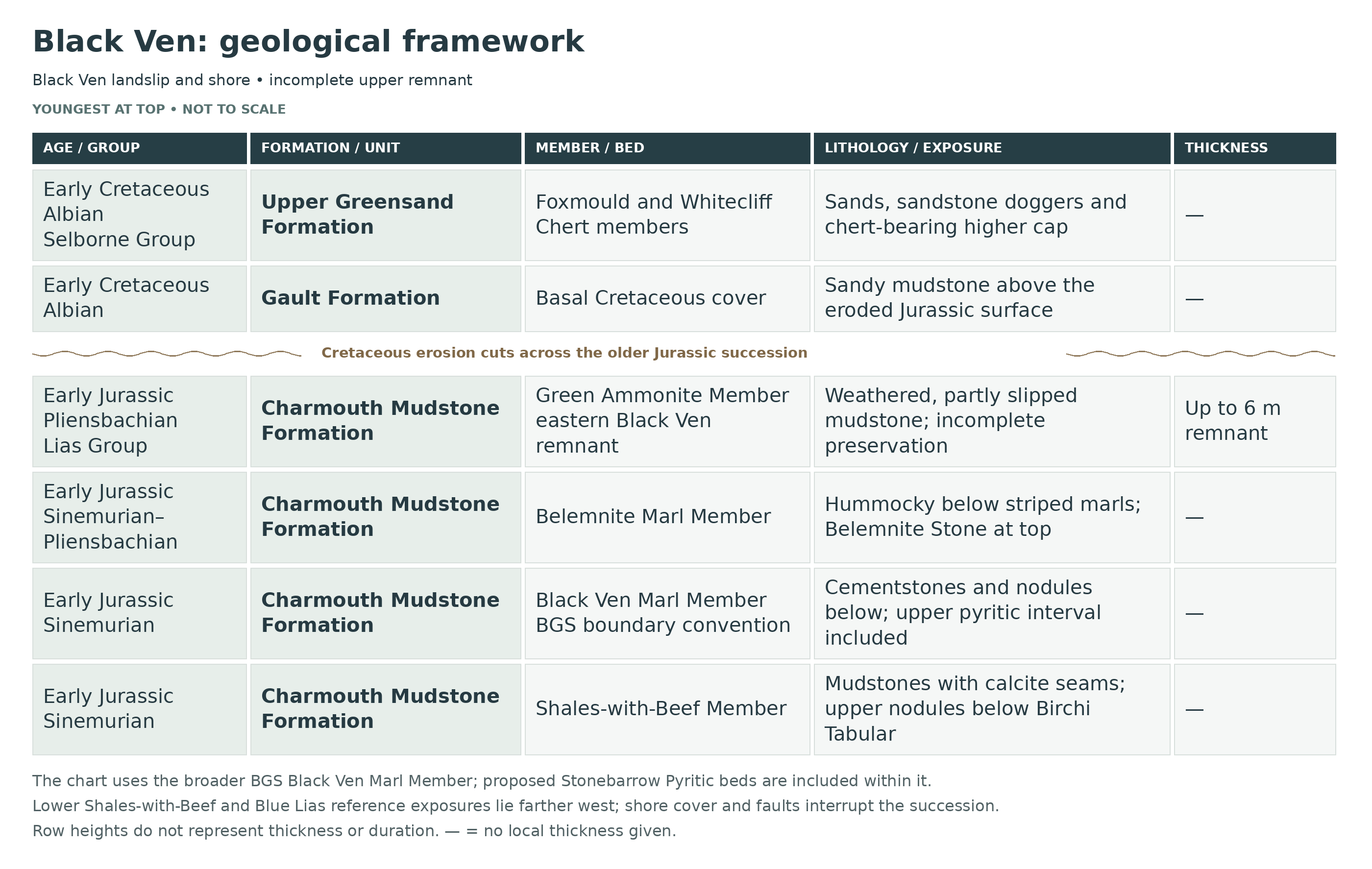
Black Ven is dominated by the Charmouth Mudstone Formation of the Lower Jurassic, deposited during the Early Jurassic in a shallow marine environment. The cliffs here are composed largely of soft, clay-rich sediments, making them some of the most unstable along the Dorset coast and forming one of the largest active landslip complexes in Europe.
The majority of the cliff is made up of the Black Ven Marl Member, which forms the bulk of the slope. These dark grey mudstones are highly prone to water saturation and movement, leading to frequent slumping and rotational landslides. This constant instability is key to fossil collecting at Black Ven, as it continually exposes fresh fossil-bearing material that is then washed onto the foreshore.
The Shales-with-Beef Member contains dark mudstones, fibrous calcite seams and local nodular horizons. Its middle and upper beds reach the cliff and foreshore between Black Ven and the River Char. The classic Stonebarrow Flatstones, however, belong to the younger Black Ven Marl Member and should not be assigned indiscriminately to the Shales-with-Beef.
The Black Ven Marl Member overlies the Shales-with-Beef and includes the cementstones, Flatstones and upper pyritic beds. Higher still are the Belemnite Marl Member beds. These form more resistant layers within the sequence and are rich in belemnites and ammonites. As these beds weather out, they contribute nodules and fossil-bearing blocks to the foreshore, adding to the diversity of material found along the beach.
Higher up the cliff, the Jurassic sequence is capped by younger Early Cretaceous deposits, including the Gault Formation and Upper Greensand Formation. These overlying layers add weight and allow water to percolate into the softer Jurassic clays below, significantly contributing to the large-scale landslips that characterise Black Ven today.

Detailed Black Ven–Spittles succession, with nearby western basal exposures distinguished from the main landslip and the incomplete Green Ammonite remnant.
Published bed numbers are retained, with source-specific corrections. The BGS member boundaries are used for the coloured hierarchy. The proposed Stonebarrow Pyritic subdivision is described within the broader BGS Black Ven Marl Member, so the same beds are not counted twice. Outcrop shifts, faults, cover and landslip mean this is a composite framework rather than a single continuously visible cliff log.
LIAS GROUP
Blue Lias Formation (Uppermost Part Only)
Western Basal Reference: Top Blue Lias
Grey Ledge
Grey Ledge (Lang Bed 49) is the highest persistent Blue Lias limestone in the western reference exposures. Its burrowed top marks the base of the Shales-with-Beef. Gallois places the exposed Blue Lias junction in the Church/East Cliff–Spittles sector west of the Black Ven fault zone; it is not assumed to be exposed beside the River Char on West Beach.
Charmouth Mudstone Formation (Lower Jurassic — Sinemurian to Pliensbachian)
Shales-with-Beef Member
The Shales-with-Beef Member forms the lowermost part of the Charmouth Mudstone Formation at Black Ven and is about 28–30 metres thick in the Lyme Regis–Charmouth area. It consists of thinly interbedded medium- to dark-grey mudstones, paler blocky calcareous mudstones and darker organic-rich laminated mudstones, with numerous bedding-parallel fibrous calcite seams or “beef”. The member contains several persistent limestones and concretion horizons that provide the real field framework for the Black Ven lower cliff.
Basal Erosion Surface And Lower Shales-With-Beef
At the western reference junction, basal laminated and interbedded mudstones overlie the burrowed top of Grey Ledge. Gallois’s SB 1 is the lower Fish Bed Shales interval, locally pyritic and containing crushed Arnioceras. This basal outcrop lies west of the immediate Charmouth shore; middle and upper member beds are exposed between Bar Ledges and the River Char.
Fish Bed Shales And Fish Bed — Western Reference Markers
The Fish Bed interval comprises lower fissile shales, then the Fish Bed itself as a strikingly laminated calcareous siltstone, followed by more dark shales and in places an “upper” Fish Bed siltstone. These beds are some of the most useful markers in the lower member and record episodic silt influx into otherwise muddy, organic-rich marine sedimentation. Fossils include fish debris, shell fragments and ammonites in adjacent shales.
Fish Bed (SB 2) — Western Reference
The lower marker is a tabular calcareous siltstone with conspicuous lamination in Gallois’s western reference framework. It is kept separate from the shale above and the younger upper Fish Bed.
Gallois gives 0.15–0.20 m for this marker in his coastal study framework. These are source-specific coastal study ranges, not a newly measured continuous Charmouth column.
Intervening Fish Bed Shales (SB 3)
Thinly bedded grey and organic-rich mudstones separate the two siltstone markers. This intervening muddy package is a distinct recorded unit, not part of one solid Fish Bed.
The published study-area range is 1.00–1.30 m. These are source-specific coastal study ranges, not a newly measured continuous Charmouth column.
Upper Fish Bed (SB 4) — Western Reference
The higher marker is a tabular calcareous siltstone with bioturbation, contrasting with the striking lamination of the lower Fish Bed. These lower-member markers are not promised at the River Char shore where the middle and upper member are exposed.
The study-area range is 0.10–0.15 m. These are source-specific coastal study ranges, not a newly measured continuous Charmouth column.
Saurian Shales (SB 5)
The interval below Table Ledge comprises thinly bedded grey and organic-rich mudstones. Its traditional name is retained as a stratigraphic label, without implying that vertebrate fossils are abundant in every exposure.
Gallois’s study-area range is 2.50–3.80 m. These are source-specific coastal study ranges, not a newly measured continuous Charmouth column.
Table Ledge
Table Ledge (Lang Bed 53; within Gallois’s SB 6) consists of pale muddy limestone lenses with rhynchonellid brachiopod clusters. It is a useful lower-member marker in the Spittles and more western reference sections; its position should not be inferred simply from a loose block on Charmouth West Beach.
Intervening Mudstones (SB 7) Above Table Ledge
Mainly thinly interbedded medium and dark grey mudstones with organic-rich brownish-grey laminated mudstones and numerous thin seams of beef. This interval is one of the thickest parts of the member and records persistent low-energy, oxygen-poor marine deposition punctuated by early diagenetic calcite growth.
The published range across the study area is 2.10–4.40 m, with individual thin beef seams generally below 10 mm. These are source-specific coastal study ranges, not a newly measured continuous Charmouth column.
Alcinoë Bed (Within SB 8)
Pale calcareous mudstone locally contains sparse concretions and crushed Pararnioceras alcinoë. This supplementary marker is less persistent than the main limestone framework.
Gallois gives the whole SB 8 package as 0.90–2.00 m across the study area; the fossiliferous concretion level is within it, not a limestone of that full thickness. These are source-specific coastal study ranges, not a newly measured continuous Charmouth column.
Devonshire Head Limestone
The Devonshire Head Limestone is a strong marker below the Spittles west of the Black Ven fault zone. Gallois explicitly found that this limestone, as such, is absent at Charmouth; Lang’s indurated marl (Bed 71a) may be its equivalent. The named western marker is retained here as correlation context, with that uncertainty rather than a claim of an identical local limestone.
Pale Calcareous Mudstone Above The Devonshire Head Level (SB 10)
This thin package contains small pale concretions; local phosphatic nodules indicate condensation. It is distinguished from the much thicker, organic-rich mudstones above.
The package is 0.50–0.70 m in the study framework, with local pale phosphatic material in its upper part. These are source-specific coastal study ranges, not a newly measured continuous Charmouth column.
Middle Shales-With-Beef
Dark grey mudstones, laminated brownish-grey bituminous mudstones and numerous thin seams of beef, with septarian concretions in places. This interval contains many of the classic fossil mudstones and contributes greatly to the instability of the lower Black Ven cliff.
Brookei Horizon Within Organic-Rich Mudstones (SB 11)
The thick fissile mudstone package includes a beef seam and sparse small septarian nodules at the traditional Brookei level in the eastern outcrop. Its basal lithological change may mark an erosional break.
Gallois gives 5.00–6.50 m for the whole SB 11 package; the upper nodules can be about 0.1 m across, whereas the distinct fissile interval at the base is about 0.4 m. These are source-specific coastal study ranges, not a newly measured continuous Charmouth column.
Black Arnioceras Bed (Base Of SB 12)
Discontinuous limestone lenses are locally crowded with jumbled ammonites. Gallois interpreted the photographed Spittles material as a storm-transported assemblage; the horizon is a supplementary marker, not a laterally continuous layer or an exposure guarantee.
The SB 12 package ranges from 2.30–2.50 m in the study framework; its discontinuous basal limestone lenses are up to about 0.12 m thick and 0.6 m long. These are source-specific coastal study ranges, not a newly measured continuous Charmouth column.
Spittles Limestone
The Spittles Limestone (SB 13) is tabular in its named western exposure but passes laterally into nodules with beef coatings or a multiple beef seam. Gallois found that a discrete Spittles limestone is absent at the Charmouth type section. That lateral change is important when matching West Beach mudstones to the western cliff log.
The named western marker is 0.20–0.35 m in Gallois’s framework, but a discrete limestone is absent at Charmouth; that dimension is therefore not asserted for West Beach. These are source-specific coastal study ranges, not a newly measured continuous Charmouth column.
Upper Beef-Bearing And Pyritic Mudstones (SB 14)
Thin grey and organic-rich mudstones contain several fine beef seams and pyritised layers below the terminal nodular interval. They form a separate intervening package above the Spittles marker level.
Gallois gives 3.30–4.30 m across the study area, with several beef seams and pyritised layers generally less than 10 mm thick. These are source-specific coastal study ranges, not a newly measured continuous Charmouth column.
Little Ledge (Lang Bed 74) — Charmouth Reference Marker
The GCR identifies Little Ledge as a sharp change into organic-rich paper shales higher in the Shales-with-Beef succession. It describes little benthic fauna in those shales, with chiefly ammonites and other swimming or drifting organisms, including the bivalve traditionally called Avicula and rare Pentacrinites. The historical Lang marker is retained without forcing an unsupported one-to-one correlation to a Gallois SB bed number.
Upper Shales-With-Beef And Birchi Nodules (SB 15)
Thinly interbedded grey mudstones and organic-rich mudstones with several thin beds of beef and one or two lines of septarian nodules. The Birchi Nodules are especially characteristic and may enclose Microderoceras birchi. These beds form the fossil-rich upper part of the member immediately beneath the Birchi Tabular boundary bed.
The terminal SB 15 package is 0.30–1.10 m in the study framework. Individual nodules may reach about 0.3 m across and 0.2 m thick; these nodule dimensions are not a bed thickness. These are source-specific coastal study ranges, not a newly measured continuous Charmouth column.
Total Thickness Of Shales-with-Beef Member At Black Ven: Approximately 28–30 Metres
Black Ven Marl Member
Birchi Tabular Bed (Lang Bed 76) — Base Of Black Ven Marl
The Birchi Tabular is a dense muddy limestone, commonly 0.15–0.30 m in the published coastal framework. The current BGS boundary is at its base, assigning the bed to Black Ven Marl rather than Shales-with-Beef. The underlying Birchi Nodules are a separate horizon in the upper Shales-with-Beef.
In the current BGS Lexicon the Black Ven Marl Member runs from the base of Birchi Tabular (Bed 76) to the base of Hummocky (Bed 103). The GCR also discusses a proposed narrower Black Ven/Stonebarrow Pyritic division near the Coinstone. Both conventions occur in the literature; the descriptive pyritic subdivision below does not create an extra thickness above the full BGS member.
Lower Black Ven Mudstones (Lang Beds 77–79)
Mudstones between Birchi Tabular and the Lower Cement Bed form the basal member interval. Callomon’s reassessment identifies a printing error in the 1926 account: the description of black conchoidal marl with indurated bands belongs to Bed 79, while the Lower Cement Bed is Bed 80. Keeping the numbers separate avoids turning the whole intervening marl into a cementstone.
Bed 80 — Lower Cement Bed / Lower Cementstone
The Lower Cement Bed is a laterally variable carbonate marker, about 0.3 m in the cited coastal log. Its limestone and dolomitic development contrasts with the adjacent mudstones. The classic printed description of conchoidal marl with indurated bands conflates Bed 79 with Bed 80 and should not be treated as the entire definition of this limestone marker.
Bed 81 — Inter-Cement Mudstones
Dark fissile mudstones and paper shales between the Lower Cement Bed and the Pavior. These beds continue the organic-rich, pyrite-prone sedimentation of the lower member and yield pyritised ammonites and other fossils where freshly exposed.
Under Pavior — Informal Comparative Name
West describes a concretionary carbonate below the Pavior in the Stonebarrow reference section and explicitly introduces “Under Pavior” as an informal convenience. It is not a formal member or a new established Lang bed number; its nearby example helps explain lateral cementation.
Bed 82 — Pavior / Upper Cement Bed
A second important cementstone horizon above Bed 80. It forms a useful datum bed and, together with the Lower Cement Bed, brackets one of the main lower fossil intervals in the Black Ven Marls.
Bed 83 — Obtusus Shales / Stonebarrow Flatstones
Bituminous paper shales with the classic flatstone nodules. This is one of the most famous horizons in the Black Ven succession, notable for uncrushed ammonites such as Asteroceras obtusum, insects in nodules and, regionally, vertebrate remains. It forms a strongly recessive but palaeontologically important interval.
Named Flatstone Horizons Within Bed 83
The GCR comparative log distinguishes Yellowstones, Woodstones, lower Flatstones, Goldstones and upper Flatstones, with a fissile interval above. These are individual nodule or shale horizons within the wider package, not separate formations. Their lateral persistence differs: Callomon notes that Woodstone is weak or absent and Lower Flatstones absent in much of the Stonebarrow outcrop, so the full Black Ven suite cannot be transferred unchanged eastwards.
Yellowstones — Lower Bed 83 Reference Horizon
The GCR Black Ven–Stonebarrow comparative figure identifies Yellowstones as the lowest of this named nodule-horizon series within Bed 83. No distinct mineral composition or thickness is inferred from the traditional name.
Lower Flatstones — Bed 83 Reference Horizon
Callomon’s explicit Black Ven lettered account identifies the Lower Flatstones as Bed 83d, below Woodstone (83f). Lower Flatstones are absent through much of the Stonebarrow section, so this is a retained Black Ven reference horizon rather than a universally exposed local layer.
Woodstones — Bed 83 Reference Horizon
Woodstone is Bed 83f in Callomon’s Black Ven lettered account, above the Lower Flatstones (83d) and below Upper Flatstones (83h). It is weak or absent through much of Stonebarrow and remains a lateral comparison here.
Goldstones — Bed 83 Reference Horizon
Goldstones are independently named in the GCR’s Bed 83 nodule suite. No new precise lettered crosswalk or local thickness is forced from its compressed graphic labels. It is kept distinct from the explicitly correlated Lower Flatstones, Woodstone and Upper Flatstones.
Upper Flatstones — Stonebarrow Flatstone Horizon
Callomon distinguishes Upper Flatstones numbered 83h in the Black Ven log from the correlated Stonebarrow Flatstones numbered 83e. Those western and eastern subdivisions are not interchangeable bed numbers. The GCR describes laminated lenticular limestone nodules with well-preserved fossils. They remain distinct from the lower reference horizons, which are not all developed east of the river.
Fissile Interval Above The Flatstones
The comparative log separately identifies a fissile muddy interval above the upper Flatstones. This preserves the top part of the Bed 83 package instead of treating every named horizon as one nodule bed.
Beds 84–86 — Middle Black Ven Marls
Dark mudstones and shales with nodular limestone development in parts, forming the less easily subdivided middle of the member. These beds continue the ammonite-bearing, organic-rich marl deposition and have yielded pyritised fossils, marine reptiles and dinosaur material in the broader Black Ven–Charmouth area.
Pentacrinite Bed (Lang Bed 84b)
The BGS memoir names the Pentacrinite Bed as Bed 84b. The fuller GCR description makes clear that it is an interval exceeding 2 m of organic-rich mudstone, with scattered groups of Pentacrinites fossilis, often associated with driftwood, rather than one continuous crinoid sheet. Its detailed development and correlatability vary between Black Ven and Stonebarrow.
Topstones (Lang Bed 85)
This named nodular marker, also associated with the “Mudstone” terminology of the older log, is separately identified in the GCR section between Bed 84 mudstones and the higher Bed 86 interval. The broader Black Ven record includes important vertebrate material at this level.
The GCR’s provenance discussion specifically assigns important Scelidosaurus specimens to this Topstones interval. The broader history of vertebrate discoveries must not make every Flatstone horizon an identical dinosaur-bearing bed.
Bed 87 — Limestone With Brachiopods
A thin limestone marker bed with brachiopods and shell debris. This is one of the best marker bands high in the Black Ven Marl Member and helps place the upper part of the member on the cliff face.
Bed 88 — Upper Black Ven Pyritic Marls And Stellare Nodules
Dark mudstones contain the septarian Stellare Nodules (Bed 88f), which sometimes preserve Asteroceras stellare. Pyritised ammonites below the Coinstone are relatively uncommon and may occur as coatings on crushed shells. The more abundant uncrushed pyritic ammonites are associated with the younger beds above the Coinstone, particularly Beds 90–102; these intervals should not be confused.
Bed 89 — Coinstone
The Coinstone (Bed 89) comprises reworked, bored and encrusted nodules. On Stonebarrow the hiatus coincides with this nodular surface; the GCR explicitly places the equivalent hiatus more than 1 m above the nodules on Black Ven, at a thin bored-belemnite horizon. The position must not be assumed identical at both cliffs. It is an internal break within the broader BGS Black Ven Marl Member.
Black Ven Marl Thickness Conventions: BGS Lexicon 43 m; BGS 2011 Coastal Account 48 m; GCR Alternative Lower Approximately 27 m And Upper Approximately 16.8 m
Historical Pyrite Working — Member-Level Provenance
The BGS Sidmouth account records a pyrite-rich “Metal Bed” in the Black Ven Marl succession worked for sulphuric-acid manufacture. This retains the useful industrial history at member level; it is not assigned without evidence to the Lymense Bed or another exact Lang number.
In the GCR’s alternative subdivision, approximately 27 m extends from Birchi Tabular (76) to the Coinstone-area hiatus, with about 16.8 m of upper pyritic beds above. These are that source’s measured subdivisions, not extra units to add to the separate 43 m Lexicon or 48 m memoir estimates.
Upper Pyritic Interval — Proposed Stonebarrow Pyritic Member In The GCR Scheme
The upper pyritic beds above the Coinstone-area hiatus are retained here as a useful descriptive interval within the current BGS member. The GCR discusses a proposed Stonebarrow Pyritic Member for this approximately 16.8 m succession. It is rich in pyritised ammonites and has fewer large nodules than the underlying part, but contains distinct marker horizons that must retain their correct bed numbers.
Beds 90–94 — Lower Pyritic Marls
The lower pyritic mudstones above the hiatus include the Lymense horizon. The GCR restricts Oxynoticeras lymense to the basal Densinodulum interval, Lang Beds 90–92, rather than placing it in Beds 95–98. The wider pyritic succession contains Crucilobiceras, Eoderoceras and Echioceras; these are not a claim that every genus occurs in each bed.
Lymense Bed — Within The Lower Beds 90–92 Interval
The characteristic smooth pyritised ammonites belong to the lower part of the pyritic succession. The exact source-defined horizon is kept below the younger middle beds rather than grouped with them.
Beds 95–98 — Middle Pyritic Marls
These middle mudstones contain pyrite and locally thin beef seams, continuing above the lower Lymense interval. They lead upwards towards the Watch Ammonite Stone. The name Lymense is not assigned to this younger group.
Bed 99 — Watch Ammonite Stone
The GCR identifies the Watch Ammonite Stone as Lang Bed 99, a lenticular limestone up to about 0.3 m in the coastal reference. It contains abundant Echioceras of the aeneum group and a richer benthic fauna than the surrounding mudstones. It is below Beds 100–102, not itself Bed 102.
Beds 100–102 — Upper Pyritic Marls
These mudstones lie above the Watch Ammonite Stone and below the Hummocky boundary limestone. The GCR notes a faunal and lithological change about 1.6 m below Hummocky, from laminated towards more homogeneous mudstone; it is a separate upper-interval feature.
Upper Pyritic Interval: Approximately 16–17 m In The GCR Proposed Subdivision; Included Within The Broader BGS Black Ven Marl Member
Belemnite Marl Member
The bed framework below combines directly observed Stonebarrow beds with explicitly identified reference measurements farther east. Hesselbo and Jenkyns (1995) measured Beds 103–109 below Stonebarrow, reconstructed Bed 110 from cliff photographs there, measured Beds 111–115 east of Westhay Water, and measured Beds 116–121 between The Corner and Seatown. The upper dimensions are not transferred to every Stonebarrow or Black Ven exposure. Every main bed is retained, together with subdivisions independently recorded by Bolton (1982); unsupported historical inch values are not presented as modern measurements.
Bed 103 — Hummocky Limestone
The irregular nodular limestone marks the lithostratigraphic base of the member. Its bioclastic fabric includes burrows, reworked limestone fragments and worn skeletal material. Hesselbo and Jenkyns discuss mixing and erosion through this basal interval rather than an undisturbed, instant boundary. BGS gives approximately 0.10–0.15 m for the thin basal and terminal limestones in its coastal summary; the GCR describes local merging of Beds 103–105 into a thicker complex bed below Black Ven.
Bed 104 — Clays Above Hummocky
The thin muddy interval above the basal limestone includes small nodules and reworked clasts. The GCR describes approximately 0.10 m in its coastal account. Published interpretations place the earliest Pliensbachian either at Hummocky or above parts of this mixed interval; the secure lithological order is kept separate from that disputed time boundary.
Bed 105 — Apoderoceras Or Armatus Limestone
A pale bioclastic limestone with distinctive burrowing and large ammonites forms the next resistant marker. The GCR coastal account gives approximately 0.30–0.40 m. It was included in the directly measured Stonebarrow part of the 1995 composite; this range is not inferred from its drawing scale.
Bed 106 — Lower Pale Marl Rhythms
The lower pale interval continues above the Armatus Limestone with alternations of calcareous mud and harder carbonate-rich layers. Bolton’s log retains subdivisions 106a, 106b and 106c. Their identities are retained without assigning unverified individual inch measurements.
Subdivisions 106a–c
These three retained log subdivisions belong within Bed 106. Their separate identification is supported by Bolton’s figure; the old thickness assigned to each is held in the historical comparison rather than inferred anew.
Bed 107 — Lower Pale Indurated Band
A separately numbered thin, harder pale interval lies between Beds 106 and 108 in the published lithological framework. The lower Taylori assemblage includes Apoderoceras and Phricodoceras in the BGS account, but an exact bed-specific faunal name is not imposed here without its original evidence.
Bed 108 — Marl Rhythms With Two Bituminous Horizons
Bolton records two organic-rich shale horizons in this interval: one at the base and a second approximately 0.3 m below Bed 109. The latter yielded documented vertebrate material in that field study. These are useful lithological subdivisions within the marl package, not a reason to promise fossils in every exposure. The particular old faunal bed label is not required for identifying the supported rock succession.
Lower Bituminous Shale In Bed 108
The basal organic-rich horizon is distinguished from the upper shale in Bolton’s direct field description.
Upper Bituminous Shale In Bed 108
Bolton describes this second horizon about 0.3 m below Bed 109; it is not simply another name for all of Bed 108.
Bed 109 — Upper Indurated Band Of The Lower Pale Interval
A harder pale band closes the lower marl package below the thick Bed 110 succession. It remains a separately numbered horizon in the 1995 measured framework; no exact local thickness is assigned from the graphical scale.
Bed 110 — Lower Darker Marl Succession
The thick lower dark interval contains subtle carbonate-rich and carbonate-poor alternations, with organic-rich shale towards its base. The 1995 reconstruction of this bed was made from photographs of Stonebarrow cliff. Bolton distinguishes the principal historical subdivisions 110a and 110b and, separately, five study units I–V based on belemnite assemblages. The latter are research subdivisions, not new formal members.
Bed 110a
The lower historical division contains faint marl rhythms and basal organic-rich levels. Bolton’s Dorset account describes about 8.5 m, while the 1995 presentation reconstructs the local cycle pattern photographically. The source-specific estimate is not a precision measurement derived from the figure.
Bed 110b
The upper historical division participates with Bed 111 in the more clearly expressed rhythmic succession. Its separate identity is retained, but no independent modern individual thickness is asserted.
Bed 111 — Lower Pale Band
This conspicuous light-coloured package includes three harder pale components separated by softer marls. Bolton retains the five subdivisions 111a, 111b, 111c, 111d and 111e. His discussion associates this interval and Bed 113 with brachiopods including Cincta. The 1995 section for these beds was measured east of Westhay Water, not at the same face used for Bed 110.
Retained Subdivisions 111a, 111b, 111c, 111d, 111e
These lettered subbeds are independently recorded in Bolton’s lithological framework. The description preserves the full subdivision sequence while withholding unverified historical inch-level dimensions; the contrasting marls and harder pale intervals are described at the supported package level above.
Bed 112 — Lower Darker Band
Darker, less carbonate-rich alternations follow the lower pale package; Bolton notes an organic-rich shale towards the top. The six recorded subdivisions, 112a through 112f, are preserved in the framework, without presenting the old individual inch values as newly verified dimensions.
Retained Subdivisions 112a, 112b, 112c, 112d, 112e, 112f
These lettered subbeds are independently recorded in Bolton’s lithological framework. The description preserves the full subdivision sequence while withholding unverified historical inch-level dimensions; the contrasting marls and harder pale intervals are described at the supported package level above.
Bed 113 — Middle Pale Band
The next pale rhythmic package is separately identified in the GCR and 1995 figures. Bolton retains subdivisions 113a, 113b, 113c, 113d and 113e and records ammonites and brachiopods in this part of the succession. Its repeated pale and darker components remain important field detail even where no individual numerical thickness is assigned.
Retained Subdivisions 113a, 113b, 113c, 113d, 113e
These lettered subbeds are independently recorded in Bolton’s lithological framework. The description preserves the full subdivision sequence while withholding unverified historical inch-level dimensions; the contrasting marls and harder pale intervals are described at the supported package level above.
Bed 114 — Middle Dark Band
This darker marl interval separates the middle and upper pale packages. Bolton describes the fauna of Beds 113–114 as chiefly ammonites and brachiopods, with belemnites less prolific than in much of the surrounding member. It is not presented as uniformly rich in all fossil groups.
Bed 115 — Upper Pale Band
Numerous finer pale–dark rhythms make this a distinctive package. Bolton explicitly attributes Lang’s 8 ft (about 2.4 m) to Westhay Water and records thinning to about 1.5 m at Ridgewater. These two named-locality values are retained as variation, not merged into a universal Stonebarrow measurement. The historical narrow taxon “zone” is not used as the modern zonal definition.
Bed 116 — Upper Dark Band
This dark calcareous clay lies above the upper pale package. Bolton reports a marked lack of belemnites in this bed in his study, despite otherwise broadly similar marine fauna. In the 1995 composite, this and higher beds were measured in the low cliffs towards Seatown.
Bed 117 — Upper Paler Marls
The succeeding lighter marl interval restores a more visibly calcareous component. Bolton records belemnites here. Lang’s earlier 1913 account gives 2 ft, but that historical figure is not silently treated as a new 1995 local measurement.
Bed 118 — Upper Darker Marls
The upper dark succession retains four historical subdivisions. Bed 118a is the lower marl interval with relatively abundant belemnites in Bolton’s study. Bed 118b is the thin historical one-inch horizon directly corroborated by Bolton, but he found it lithologically indistinguishable from 118c; its former Coeloceras pettos “zone” is obsolete. Bed 118c and Bed 118d continue the muddy rhythmic succession towards the Belemnite Shales. Modern measured values from different studies are not silently substituted for the old whole-bed dimensions.
Bed 118a
Lower marl subdivision; its fossil abundance is described in the main entry.
Bed 118b
Thin historical horizon, one inch in the account explicitly cited by Bolton; not a separate modern ammonite zone.
Bed 118c
Marl rhythms above the thin historical 118b horizon; the two are not readily separated by lithology in Bolton’s account.
Bed 118d
Upper marl subdivision below the Belemnite Shales, retained separately in the primary log. Lang’s 1928 plate explanation records the holotype of the belemnite he named Angeloteuthis uriel, B.M. C28985, from Bed 118d at Black Ven. This supplies an exact historical specimen-to-bed link; the name is quoted in its original usage and does not identify every belemnite from this interval.
Bed 119 — Belemnite Shales And Inferior Belemnite Horizon
The sediment changes from the stronger calcilutite–clay rhythms to alternating more and less calcareous shale. Hesselbo and Jenkyns separately identify an Inferior Belemnite Bed approximately 60 cm below the main Belemnite Bed in their upper Corner–Seatown measured section. That relative position is reported directly, without inventing an exact lettered subbed or transferring its distance to every cliff.
Bed 120 — Upper Pyritic Interval And Belemnite Bed
The historical subdivisions remain distinct. Beds 120a–b comprise dark organic-rich pyritic shale with scattered nodules and a concentration at the top, as independently described by Bolton. Bed 120c is the main condensed belemnite-rich horizon identified by BGS. Beds 120d and 120e have broadly similar muddy lithology but fewer pyrite nodules in Bolton’s account. The highest thin subdivision must not be conflated with the main belemnite concentration.
Beds 120a–b — Pyritic Marls
The lower pyritic package and its upper nodule concentration are retained together as in Bolton’s description; their unverified old one-foot aggregate is not treated as a modern measured value.
Bed 120c — Main Belemnite Bed
Hesselbo and Jenkyns describe the named Belemnite Bed as about 7–8 cm thick and 34 cm below Belemnite Stone in their upper measured section. It is a diffuse dark pyritic, organic-rich mudstone rich in belemnites and bivalves. These are Corner–Seatown source values, not exact dimensions of all Stonebarrow or Black Ven occurrences.
Bed 120d
This intervening upper muddy subdivision is retained separately from the main Belemnite Bed and the highest crumbly horizon. Bolton reports lithology broadly similar to the lower pyritic package, with fewer nodules; no exact thickness is supplied here.
Bed 120e — Uppermost Retained Subdivision
Bolton retains the highest subdivision within the upper muddy interval. Lang’s 1928 detailed sequence describes Bed 120e as the uppermost half-inch of the Crumbly Bed, composed of greyish-black friable marl. That is a historical coastal reference-section value, not a newly measured thickness at this cliff. Lang used Crumbly Bed for subdivisions 120c–e, whereas the GCR Blockley comparison specifically correlates with Dorset Bed 120e. The broader historical name must therefore not be confused with either the single uppermost subdivision or the main belemnite concentration at 120c.
Bed 121 — Belemnite Stone
This terminal pale concretionary limestone is highly condensed and rich in belemnites and other skeletal material. Hesselbo and Jenkyns explicitly record 4–5 cm in their upper Corner–Seatown section. The BGS memoir uses a broader approximately 0.10–0.15 m description for the member’s boundary limestones, and other published local accounts differ. These are attributed source/locality values, not a fabricated single agreed thickness. The stone forms the top of the member below Green Ammonite mudstones.
Belemnite Marl Member Thickness And Exposure Scope
BGS 2011 describes approximately 25 m in the Stonebarrow cliffs. Other sources give approximately 23 m for the coastal framework and 22–25 m at Black Ven. These source-scoped totals are not added together or imposed on a single currently visible face. The thin upper-marker measurements above derive from the specifically stated reference exposures.
Green Ammonite Member — Incomplete Eastern Remnant
Lower Green Ammonite Mudstones Above Belemnite Stone
BGS records up to 6 m of deeply weathered, partly slipped grey mudstone with ironstone nodules beneath the Cretaceous unconformity at eastern Black Ven. The GCR gives about 5 m. These are remnant estimates, not a complete measured Green Ammonite succession; higher Lower Limestone–Red Band–Upper Limestone logs from Stonebarrow and Golden Cap are not imported here.
SELBORNE GROUP
Gault Formation (Lower Cretaceous)
Basal Pebble Bed On Burrowed Jurassic Mudstone
The BGS Sidmouth explanation reproduces Reid’s historical eastern Black Ven section, with a basal pebble bed resting on a burrowed Lias surface. This is a locally recorded transgressive contact, not an invented continuous bed across every landslip.
Gault Clay And Sandy Clay — Historical Eastern Black Ven Section
Reid’s recorded local succession contained 5.3 m of fossiliferous clay and sandy clay at eastern Black Ven [SY 358 932], as quoted by BGS. Its historical measurement is retained with that provenance; it is not a present-day cliff-height promise or a value transferred to Stonebarrow.
Basal Cretaceous Unconformity
The Jurassic succession at Black Ven is cut by a marked erosional unconformity and overlain by dark grey Gault clay. At the eastern end of Black Ven, the Belemnite Stone and a limited thickness of weathered grey mudstone remain beneath this unconformity. The Green Ammonite Member is therefore not preserved here as a full cliff section.
Upper Greensand Formation (Lower Cretaceous)
Foxmould And Chert Beds
The cliff top above Black Ven is capped by Upper Greensand sands and cherts, which drive much of the modern landslip behaviour by feeding debris onto the Gault and Jurassic benches below. These Cretaceous units are not part of the Lower Jurassic fossil section but are an essential part of the Black Ven cliff profile.
Foxmould Member
Sand And Sandstone Dogger Levels
The lower Upper Greensand includes sandy beds and resistant concretions in the Black Ven cap. Weathering removes carbonate cement and produces softer yellow-brown sand. Historical “Cowstone” terminology describes harder dogger horizons; it is not a new formation. Whole-member thickness estimates differ between published accounts and are not added to a local measured cliff total.
Whitecliff Chert Member
Chert-Bearing Upper Beds
Higher Upper Greensand beds contain chert horizons. Decalcification leaves angular chert within weakened sandy debris, contributing material to the slope. The named member is recorded in the Black Ven setting, but transported chert on West Beach alone cannot identify an in-situ bed beneath the observer.
Superficial Cover Outside The Whitecliff Chert Member — Residual Clay-With-Flints
Gallois describes the Clay-with-flints plateau associated with the upper Black Ven–Spittles setting. Residual and reworked cover is kept separate from the in-situ Cretaceous member succession; landslip can mix it with sand and chert on the slope. No layer thickness is assigned from transported debris.
Depositional Environment
The Black Ven succession records a long transition from carbonate-mud shelf deposition in the top Blue Lias, into organic-rich oxygen-poor mudstones with frequent early diagenetic calcite seams in the Shales-with-Beef Member, then into darker ammonite-rich marls and cementstones of the Black Ven Marl Member, including the pyrite-rich upper Sinemurian interval termed the proposed Stonebarrow Pyritic Member in the GCR scheme, followed by the paler belemnite-rich marls of the lower Pliensbachian Belemnite Marl Member. The whole Jurassic section is finally cut by a major Early Cretaceous erosional surface.
Composite Coastal Framework: No Summed Total Assigned Across Different Exposure And Boundary Conventions
References
Gallois, R.W. (2008). The lithostratigraphy of the Shales-with-Beef Member of the Charmouth Mudstone Formation, Lower Jurassic.
Lang, W.D. & Spath, L.F. (1926). The Black Marl of Black Ven and Stonebarrow, in the Lias of the Dorset coast.
Lang, W. D., Spath, L. F., Cox, L. R. and Muir-Wood, H. M. (1928), The Belemnite Marls of Charmouth, a Series in the Lias of the Dorset Coast, stratigraphic and belemnite section, pp. 179–222.
British Geological Survey Lexicon: Shales-with-Beef Member, Black Ven Marl Member and Belemnite Marl Member.
British Lower Jurassic Stratigraphy (JNCC GCR volume) and west Dorset coastal field guides.
Gallois (2008), revised Shales-with-Beef framework and exact exposure map. BGS Black Ven Marl definition. BGS Sidmouth district: eastern Black Ven remnant and cover. GCR30, local detailed succession and Figure 2.8.
Hesselbo and Jenkyns (1995), measured sections and exact exposure provenance, pp.115–119. Bolton (1982), independently described beds and retained subdivisions, pp.18–22 and Figure 2. BGS (2011), formal member framework and Figures 11–12.
GCR Blockley comparison: explicit historical Dorset Bed 120e correlation.
HISTORY OF CHARMOUTH & MARY ANNING
The coastline around Charmouth is closely linked to the pioneering work of Mary Anning (1799–1847), who was born in nearby Lyme Regis and collected extensively along this stretch of coast. Despite significant societal barriers in the early 19th century, her discoveries played a crucial role in shaping the science of palaeontology. Among her most famous finds were the early ichthyosaur skeleton recovered by Joseph and Mary Anning in 1811–1812, several nearly complete Plesiosaurus specimens, and the first British pterosaur, Dimorphodon. These discoveries provided important evidence for the emerging idea of extinction and helped transform scientific understanding of prehistoric life.
Today, this legacy continues along the beaches of Charmouth, Black Ven and beyond. Many of the fossils found here are similar to those discovered by Anning herself, particularly marine reptiles and ammonites weathering out of the cliffs. The nearby Lyme Regis Museum, which features a dedicated Mary Anning Wing, celebrates her life and achievements, while Charmouth’s fossil shops, guided walks and heritage centre help keep this rich tradition alive, allowing new generations to explore and discover the Jurassic past for themselves.
SAFETY
Fossil collecting along the Charmouth coastline should always be approached with care, as this is an active and constantly changing environment. Tide awareness is essential. Always plan your visit around tide times and aim to collect on a falling or low tide, allowing plenty of time to return safely. Certain areas can become completely cut off at high tide, and the sea can rise quickly, trapping unwary collectors.
The cliffs at Stonebarrow, West Beach and Black Ven are highly unstable and prone to frequent landslips and rockfalls. Large sections can collapse without warning, particularly after heavy rain or storms. You should never stand directly beneath the cliffs and always keep a safe distance from the cliff base, and from fresh falls or landslips.
The foreshore can be difficult to navigate, with slippery rocks, uneven boulders and soft clay underfoot. In places, the clay can become very sticky, and there is a risk of becoming stuck, especially after wet weather. Take care where you walk and avoid areas of deep mud. Do not attempt to climb landslips or unstable slopes, as these can shift suddenly and are extremely dangerous.
Storms can release fossils, but collecting should wait until the weather and sea have settled. Wave surges can still cross the beach in apparently favourable tide conditions. Do not collect during rough seas or attempt a route where waves prevent a safe distance from the cliffs.
If using tools, such as hammers, always wear appropriate safety protection, including safety goggles, to protect against flying rock fragments. Only ever collect from loose material on the foreshore. Do not dig into cliffs or in-situ beds; prior permission is required for in-situ excavation under the collecting code.
Wearing sturdy footwear with good grip is essential to reduce the risk of slipping or ankle injury, and suitable outdoor clothing, including a waterproof jacket, is recommended as weather conditions can change quickly along the coast.
EQUIPMENT
Black Ven benefits from a combination of approaches used at both Stonebarrow and West Beach. Many fossils can be found loose on the foreshore, but tools can greatly increase your chances of success. A geological hammer and chisel are useful for splitting nodules and flatstones, while a spade, pick or small trowel may help with small, loose pieces on the open beach; do not dig into landslips or the cliff. Searching through partially split flatstones or discarded fragments left by other collectors can also be very productive. Always wear safety goggles when using tools, and bring wrapping materials to protect fragile finds. A sturdy bag or container is essential for carrying specimens across the uneven foreshore.
CLEANING AND TREATING
Begin with gentle dry brushing of loose sediment, stopping if the fossil or matrix crumbles. Do not apply a fixed soaking treatment to every specimen: pyritic ammonites and friable mudstone need assessment before any wet cleaning. Water cleaning is appropriate only where the material is sound and water-safe. Let wet finds dry gradually at room temperature, away from radiators and other heat sources.
Sound specimens do not need routine coating. Where a fragile fossil needs consolidation, seek advice on selective consolidation with Paraloid B-72. It is soluble in suitable solvents, but complete removal from porous fossils or matrix cannot be guaranteed. A consolidant is not a cure for active pyrite decay, and treatment should preserve diagnostic surfaces and any useful adhering matrix.
Avoid decorative varnish on ammonites: a glossy coating can obscure surface detail and complicate later preparation. Leave potentially important specimens uncoated and seek specialist advice before cleaning or treating them.


IDENTIFY YOUR FINDS
Need help identifying a fossil? Share clear photos, where you found it and its size with the community.
FURTHER READING
Deposits Magazine – Plesiosaur vertebrae from Black Venn
Deposits Magazine – Fossils re-united
Deposits Magazine – The Spittles Landslip, Lyme Regis (2008 landslide account)
Lyme Regis to Charmouth – Ian West’s geological field guide
Black Ven, Lyme Regis, Dorset – BGS landslide case study
The Fossil Collecting Code – Charmouth Heritage Coast Centre
ACCESS RIGHTS
This coast forms part of the West Dorset Coast SSSI and UNESCO World Heritage Jurassic Coast. Follow the West Dorset Fossil Collecting Code and local signs. Responsible collecting of loose beach fossils is supported; digging in situ requires prior permission. Report scientifically important finds through Charmouth Heritage Coast Centre, retaining their locality and horizon information where known.
LINKS
♦ Fossil Discussions
♦ Fossil Articles
♦ Buy Fossils, Tools and Equipment
♦ Buy Crystals, Meteorites, and Artefacts
♦ Join Fossil Hunts
♦ UK Fossils Network