

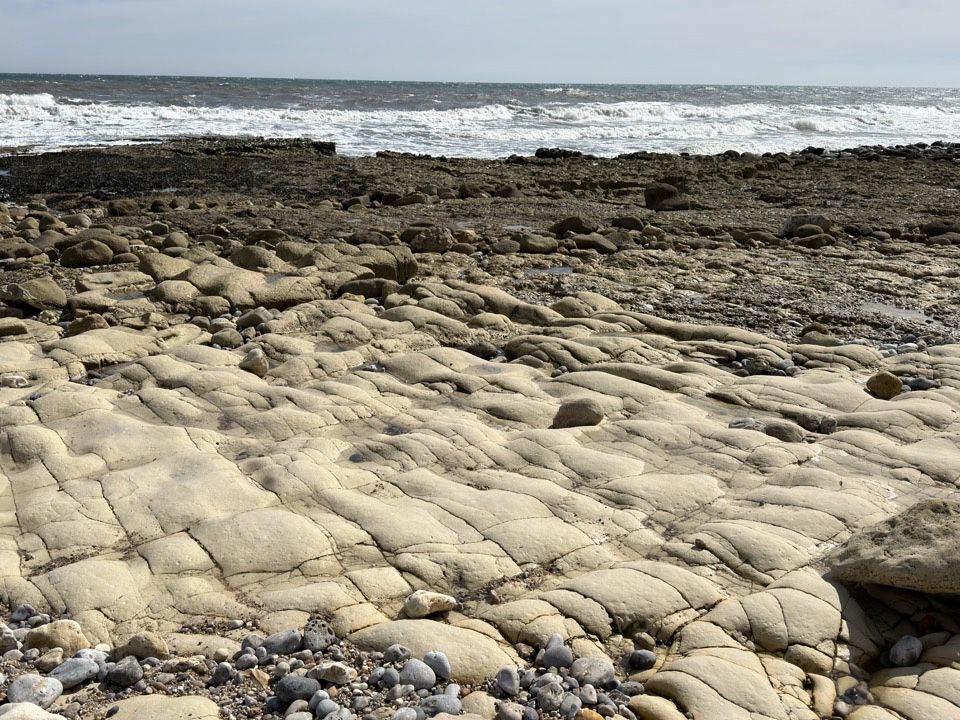
Charton Bay is a remote and rewarding East Devon location, reached via a long walk from Lyme Regis, exposing a mix of Triassic, Jurassic and Cretaceous deposits along a largely undisturbed stretch of coastline. This quiet beach yields a surprising range of fossils, including Blue Lias ammonites, Langport Member bivalves, and Cretaceous echinoids, making it a fascinating spot for collectors willing to make the effort and explore beyond the more popular sites.




FIND FREQUENCY: ♦♦♦ – A varied location where fossils from multiple ages can be found, but success depends heavily on conditions, recent erosion and careful searching. Finds are often scattered rather than concentrated.
CHILDREN: ♦♦ – Not ideal for families due to the very long walk and uneven terrain. Better suited to more experienced collectors.
ACCESS: ♦♦ – Access is difficult, requiring a long walk from Lyme Regis (Monmouth Beach) along a challenging foreshore. No nearby facilities.
TYPE: – Foreshore, fallen blocks and slumped material. Fossils are typically found loose within the shingle or within limestone and chalk debris on the open foreshore, well away from cliffs and landslips.
DIRECTIONS
♦ From Charmouth, follow the A3052 (Charmouth Road) into Lyme Regis. Continue through the town, climbing the steep hill along Pound Road, then bear left as you leave the town centre.
♦ Near the top of the hill, look for the signpost to Monmouth Beach on the left. Turn into Cobb Road and follow it downhill towards the seafront.
♦ Park at the large Monmouth Beach Car Park, operated by Lyme Regis Town Council. From here, walk west across Monmouth Beach and continue past Chippel Bay.
♦ Continue carefully along the foreshore, passing Pinhay Bay, Pinhay Cliff, Humble Rocks and Humble Point before reaching the Charton Bay area. This is a long, tide-dependent walk and should only be attempted on a falling tide with plenty of time to return.
♦ The route becomes increasingly remote and rocky the further west you go, with no facilities beyond Monmouth Beach.
♦ Car park postcode: DT7 3LE: Google Maps
♦ What3Words: Collecting area: ///cubes.wheat.rationed
VIDEO FILM
FOSSIL HUNTING
Charton Bay and Humble Rocks contain fossils in several distinct matrices: pale Langport limestone, darker Blue Lias limestone and shale, and younger Cretaceous debris. Charton is also scientifically important for a basal Westbury bone bed preserved in burrow fills cut into older Blue Anchor mudstone. Research samples yielded tiny shark and fish teeth, including Rhomphaiodon, Duffinselache, Lissodus, Pseudocetorhinus, Severnichthys and Gyrolepis. These minute research finds require careful identification; they are not a promise of conspicuous teeth on an ordinary beach visit, nor a reason to excavate the in-situ contact.
Ammonites occur in detached Blue Lias limestone and shale. The documented Charton sequence includes early psiloceratids, while a historical Humble Point collection contains Psilophyllites hagenowi; rare younger loose blocks have been tentatively identified as containing Metophioceras. These records belong to different levels and displaced material, rather than one ammonite bed. Look for whorl outlines or ribbed fragments already exposed on loose blocks, and keep the matrix and find location with each record.
Older beds of the Langport Member, formerly known as the White Lias, can yield bivalves and other small shells. These are often found in pale limestone blocks or wave-cut surfaces and may occur as isolated shells, broken valves or grouped shell material.
Cretaceous blocks around Humble Rocks and Humble Point must be kept separate from the older pale Langport limestone. Chalk debris can contain echinoid tests or moulds, bivalve shells and sponge fragments; weathering often leaves only parts of a specimen. Humble Point is also a documented source of diverse Cenomanian ammonites in condensed limestone. Record whether a find came from chalk, glauconitic limestone or sandstone rather than assigning every pale block, or every echinoid, to the same horizon.
The best collecting is usually after storms, scouring tides or fresh erosion, when new blocks and debris have been exposed. Because fossils can come from several different formations, it is worth searching carefully through all fallen material, especially stable limestone blocks, chalk rubble and shingle patches on the open foreshore. Wait for calm conditions and keep away from fresh falls and slips.


Significant fossil and stratigraphic records from Charton Bay, Devon, focusing on its late Triassic to earliest Jurassic beds.
1973 – palynomorphs recorded from the Penarth Group
Orbell sampled the Charton Bay outcrop and recorded fossil spores, pollen and marine organic-walled microplankton from the lower Westbury Formation and the overlying Langport Member. This helped show that the bay preserves a useful Rhaetian microfossil record through the marine flooding interval before the Jurassic.
1985 – further microfossil sampling across the boundary beds
Fisher reported additional palynomorphs from the Westbury Formation, Langport Member and basal Lias in the same Charton Bay area. The work strengthened the site’s value for tracing environmental change through the latest Triassic and into the earliest Jurassic.
2007 – detailed Penarth Group section documented
Charton Bay was used as a key East Devon section for the White Lias facies of the Langport Member, including correlation with the nearby Pinhay Bay succession. The work clarified the local order of the late Triassic beds and the setting of their shelly limestones and early marine faunas.
2015 – Rhaetian bone bed in burrow systems described
A basal Rhaetian bone bed at Charton Bay was described from sediment packed into Thalassinoides burrows at the base of the Westbury Formation. The fauna included teeth and remains of sharks and bony fishes, including Rhomphaiodon, Duffinselache, Lissodus, Pseudocetorhinus, Severnichthys and Gyrolepis, making the site important for understanding marine life at the Triassic transgression.
2021 – soft-sediment deformation studied in the Langport Member
Charton Bay was included in a study of soft-sediment deformation across the late Triassic–earliest Jurassic interval, including the late Triassic White Lias at Charton, where folded, slumped and deformed limestones record instability on the sea floor. Although mainly a sedimentological milestone, it matters for fossils because it refines the setting in which the bay’s Langport Member bivalves and associated shallow-marine fossils were preserved.
GEOLOGY
The geology at Charton Bay and the Humble Rocks area is unusually varied, with Triassic, Jurassic and Cretaceous rocks all represented along a remote and difficult stretch of the East Devon coast. This makes the site particularly interesting, as fossils can come from several different formations rather than a single bed.
Within Charton Bay, Blue Anchor Formation mudstones are overlain by the Penarth Group. The basal Westbury bone-bed occupies burrows and hollows in the older mudstone; dark Westbury shales are followed by the Cotham and Langport members of the Lilstock Formation. Pale Langport limestone, traditionally the White Lias, contains the burrowed Sun Bed at its top. Faulting, landslips and beach cover make these exposures discontinuous.
Large slipped blocks west of the Blue Anchor cliff preserve the Langport–Blue Lias Formation contact and beds reaching at least the lower Liasicus Chronozone. Blue Lias alternates limestone with mudstone and shale. The lowest beds span the latest Triassic–earliest Jurassic interval, whereas ammonite-bearing beds lie higher. Neither the Sun Bed contact nor H25 automatically marks the modern global Jurassic boundary.
Around Humble Rocks and towards the eastern end of the bay, younger Cretaceous material becomes important, including Upper Greensand boulders and Chalk debris. These rocks represent a much later marine episode, when warm seas covered the region and deposited calcareous sediments rich in echinoids and other marine fossils.
The coastline is heavily affected by landslips, fallen trees and large slipped blocks, which often obscure the true bedrock sequence but also bring fossil-bearing material down onto the foreshore. As a result, Charton Bay is best understood as a mixed and dynamic locality, where fossils may originate from the Langport Member, Blue Lias or Cretaceous beds depending on where you search.
The younger Sinemurian detached sections sometimes attributed to Humble Rocks in earlier descriptions are documented by Page on Dowlands foreshore, west of Charton. Their bed-level evidence is retained below as a clearly separated comparison. They should not be used to build a continuous local succession at the eastern end of this bay.

This is a composite stratigraphic breakdown of the Humble Rocks–Charton Bay tract, where faulted, landslipped and locally detached coastal exposures show the top of the Blue Anchor Formation, the Penarth Group, and large slipped blocks of basal Blue Lias. The locality is especially important because it combines the classic Charton Bay Rhaetian bone-bed and Langport Member “White Lias” section with a separately identified comparison to the detached lower Sinemurian sections on the nearby Dowlands foreshore. Those western sections must not be relocated to Humble Rocks east of Charton.
Section Architecture
This is not a single simple cliff log. The useful geology is distributed across three linked but different exposure styles: the Blue Anchor cliff and degraded undercliff exposures in Charton Bay itself; large slipped blocks at beach level west of the Blue Anchor cliff that contain the Lilstock Formation–Blue Lias junction and the Triassic–Jurassic boundary interval; and Cretaceous debris around Humble Point. The detailed Sinemurian outcrops described by Page farther west on Dowlands foreshore are treated separately below; their western, central and eastern labels describe those three outcrops, not positions around Humble Rocks. The coast is therefore a genuinely composite locality and should not be forced into a false continuous face.
Numbering Note
The CB numbers below are site-use numbers. Formal published bed numbers are retained exactly where they can be tied securely to the Charton Bay and east Devon lower Jurassic succession, especially the H-bed numbering of Lang and later workers. In the Langport Member and in the separately identified nearby Dowlands blocks, the subdivisions used here are practical lithological units based directly on published composite logs and recent re-interpretation of the section, not invented formal bed names.
MERCIA MUDSTONE GROUP
Blue Anchor Formation (Upper Triassic: latest Norian–Rhaetian)
Bed CB1 – Highest Blue Anchor Formation Beneath The Penarth Erosion Surface
The highest exposed Blue Anchor beds in Charton Bay are pale green-grey to grey dolomitic silty mudstones, muddy siltstones and thin splintery porcellanous or dolomitic limestone beds. Korneisel and colleagues (2015) describe the youngest 20 m in the cliff about 400 m west of their landslipped Penarth section, with the upper contact concealed by landslide debris there. Within the present account the uppermost contact interval remains critical because it is cut by the basal Penarth erosion surface and repeated by faulting and landslip. The top is irregular, strongly burrowed and locally penetrated by shallow scours and burrow systems later filled by basal Westbury bone-bed sediment. No Williton Member is recognized on the Devon coast, and it is generally taken to have been removed by erosion before Westbury deposition. Depositional Environment: restricted marginal-marine to supratidal mudflat and sabkha conditions with increasing marine influence upward, followed by firmground development and erosion at the onset of the Rhaetian transgression.
PENARTH GROUP
Westbury Formation (Rhaetian)
Bed CB2 – Basal Burrow-Fill Bone-Bed And Pebbly Grit Complex
The basal Westbury Formation at Charton Bay has been intermittently exposed as a pebbly calcareous grit and bone-bed resting on an irregular, intensely burrowed erosion surface cut into the top of the Blue Anchor Formation. This is not just a thin lag seam: bone-bed sediment occurs in Thalassinoides burrow systems, burrow fills, desiccation cracks and shallow scour hollows that penetrate the uppermost Blue Anchor mudstone. Gallois (2007) described penetration into the top 0.3 m; Korneisel and colleagues’ specifically sampled network occupied only the top 20–50 mm, with shallow 20–30 mm depressions. These observations concern different scales and must not be treated as a uniform bed thickness. Lithologically it is a pebbly grey mudstone to gritty calcareous bed with angular green mudstone clasts, quartz grains of which many are rounded and frosted, and abundant phosphatic vertebrate debris. The fauna is unusually rich for a basal Rhaetian bone bed and includes sharks and bony fishes in a taphonomically mixed assemblage. Marker-Bed Significance: this is the classic Charton Bay Rhaetian bone bed and one of the most important transgressive horizons on the east Devon coast. Depositional Environment: storm-reworked transgressive lag laid down during abrupt marine flooding of the former Blue Anchor mudflat surface.
Bed CB3 – Main Westbury Black Shales And Thin Limestone Interbeds
Above the basal bone-bed complex, the Westbury Formation continues in dark grey to black shales and mudstones with subordinate thin limestones and fossiliferous layers. Gallois described weathered, creep-disturbed patches and no complete published local measured succession. Korneisel and colleagues later outlined about 7 m of Westbury mudstone in the low cliff, but that overview is not a bed-by-bed log or a current guarantee of visibility. The macrofauna is dominated by thin-shelled bivalves characteristic of quiet-water brackish to marine conditions; ammonites and brachiopods are absent. Compared with the basal lag below, these beds record much lower energy and more sustained muddy deposition, though still within a restricted shallow shelf or embayment. Depositional Environment: quiet-water brackish to shallow-marine mud accumulation after the initial Rhaetian transgression.
Lilstock Formation (Rhaetian)
Cotham Member
Bed CB4 – Degraded Cotham Member Lagoonal Mudstones And Thin Limestones
The Cotham Member is present at Charton Bay, but in the modern locality it is seen mainly in degraded undercliff exposures to the east and is too disturbed for a reliable detailed local bed-by-bed log. It consists of grey and grey-green shales, silty mudstones and thin limestones passing upward towards the better-exposed Langport Member. Korneisel and colleagues’ 2015 outline allows about 2 m for the Cotham interval in its landslide-affected Charton cliff overview; this is an approximate overview thickness, not a newly verified complete bed-by-bed section. In regional terms these beds represent the shallow lagoonal and intermittently emergent phase between the dark marine Westbury shales and the pale micritic “White Lias” facies above. At Charton Bay the member is important as part of the transition, but the literature does not support a finer modern foreshore subdivision here without over-interpreting poor exposure.
Cotham Marble and “Crazy Cotham”
Loose blocks of the algal limestone and its broken, resedimented counterpart have been recorded at Charton Bay. Their occurrence is useful, but a loose block does not locate an intact bed within the disturbed undercliff. The Culverhole numbered Cotham log is not imposed on Charton.
Langport Member
Langport Member Note
The Charton Bay Langport Member is the classical east Devon “White Lias” facies. Gallois (2007) reported the upper 7.2 m exposed. He separately cited Richardson’s 1906 measurement of 5.8 m and estimate of 7.6 m for the complete member. Korneisel and colleagues’ 2015 overview used about 9 m. These differently dated and scoped records are not a measured modern 7.2–7.6 m range. The units below are practical site-use subdivisions based on the published composite Charton Bay section and recent work on soft-sediment deformation; they are not formal bed names. In the added bed descriptions, Gallois’s Figure 6 uses Pinhay-correlative numbers at Charton and prints question marks where the ties are doubtful. Those question marks are retained.
Bed CB5 – Lower Porcellanous And Slumped Limestones With Hardground Surfaces
The lower exposed Langport succession consists of off-white fine-grained limestones, commonly porcellanous and hard, separated by thin marl partings and broken by repeated hardground surfaces. Parallel-bedded limestone alternates with slumped or remobilised units, and some bed tops are stained, corrugated, solution-marked or irregularly channelled. These beds show that the lower Langport sea floor was repeatedly lithified, exposed, bored or burrowed, and then partially reworked. Typical Fossils: fossils are generally sparse. Gallois’s combined Charton–Culverhole–Pinhay assemblage includes bivalves, brachiopods, gastropods, serpulids and rare corals in local shell concentrations; this is not a proven list from the lower Charton beds alone. Depositional Environment: very shallow warm-water marine lagoon or carbonate-flat sedimentation with repeated pauses, firmground development and local gravitational remobilisation.
Lowest unnumbered limestone
Parallel-bedded limestone lies below the slumped package at the bottom of Gallois’s Charton composite. Its presence does not establish that the base of the whole member was exposed.
Correlative Bed 1?
A thick package of slumped limestone is divided by several porcellanous hardground surfaces. The question mark is part of the published correlation; a direct subdivision into Pinhay 1a and 1b is not warranted.
Bed CB6 – Middle Nodular And Wavy-Laminated Limestones With Marl Partings
The Charton composite includes flow-laminated and wavy-laminated micritic limestone, with dewatering and slump structures. Pinhay’s distinct nodular Bed 2 and channel-fill Bed 3 are not copied wholesale into Charton. These beds show load structures, local ripple-like lamination, small slump folds and, in places, fluid-escape structures. Recent work has shown that one of the important Charton Bay liquefaction and slump levels lies within this middle part of the member, where originally bedded micrite has been partially disorganised but not wholly destroyed. Interpretation: shallow subaqueous carbonate deposition repeatedly destabilised by soft-sediment deformation, probably during rapid remobilisation of semi-lithified lagoonal carbonate sheets.
Correlative Bed 2?
Flow-laminated limestone has dewatering structures and shell debris towards its top, between hardgrounds. The proposed correlation remains uncertain.
Correlative Bed 4
Slumped limestone contains abundant angular limestone clasts above the lower hardground.
Correlative Bed 5
Wavy-laminated limestone is associated with load structures, ripples and small slumps.
Correlative Bed 6
A thin wavy-laminated limestone overlies the deformed middle beds.
Bed CB7 – Upper Remobilised Clast-Rich Limestones And Main Slump Bed
Higher in the Langport Member, remobilised limestones with abundant intraclasts, shell debris and bored pebbles rest on a hardground and pass upward into slumped limestones with abundant angular clasts, some very large, concentrated especially toward the base of the unit. This is the main clast-rich slump interval in the modern Charton Bay section and one of the most distinctive deformation levels in the locality. The limestone sheets had clearly already lithified enough to fracture into slabs, pebbles and larger blocks before being redeposited. Depositional Environment: shallow marine carbonate flat or lagoon margin subject to repeated erosion, collapse and redeposition of semi-consolidated carbonate sediment.
Correlative Bed 7
Parallel-bedded remobilised limestone contains common clasts, shells and bored pebbles.
Correlative Bed 8
The hardground capping Bed 7 separates it from the main slump interval.
Correlative Bed 9 and upper Bed 9?
The main slumped limestone contains large clasts, locally up to boulder size and concentrated near its base. A thin overlying interval is marked 9? and has a slumped top; that tentative label must not be silently made certain.
Bed CB8 – Upper Finely Laminated Limestones And Sun Bed
The uppermost Langport Member consists of finer, pale wavy laminated limestones culminating in the Sun Bed, the uppermost persistent pale micritic limestone beneath the Blue Lias. The Sun Bed forms the key local datum at the top of the Penarth Group and is overlain by the basal Blue Lias mudstones on an irregular and locally burrowed surface. The uppermost Langport limestones at Charton Bay are the clearest expression of the east Devon White Lias facies: pale, dense, micritic and strongly laterally variable, yet repeatedly marked by emergence, shallow-water reworking and minor soft-sediment collapse. Depositional Environment: very shallow marine lagoon or carbonate flat with repeated emersion, intermittent drainage and rapid return to shallow subaqueous carbonate precipitation.
Correlative Bed 10
Finely wavy-laminated limestone with marl partings contains small local slumps.
Correlative Bed 11
Finely wavy-laminated limestone includes algal and limestone clasts, a rippled upper part and a hardground.
Correlative Bed 12, Sun Bed
Wavy-laminated limestone forms the top of the Langport succession. Its burrowed top is overlain by Blue Lias, but it is a lithological contact rather than the modern global Jurassic datum.
Langport Thickness: Upper 7.2 m Reported In 2007; Earlier 5.8 m Measurement And 7.6 m Total Estimate; Later Approximate 9 m Outline
Independent modern deformation log: separate numbering
Laborde-Casadaban and colleagues use their own six-unit Charton scheme. It must not be equated numerically with Gallois’s Pinhay-correlative bed labels.
Units 2A–2B
The 1.00 m combined debris-flow interval has an erosive base and a limestone-mud conglomerate. Rare fluid-escape structures occur at the top of 2B; the faults described in the comparison at Pinhay were not observed here.
Unit 4C and overlying 5A
Micritic limestone in 4C was slumped, liquefied and invaded by injections from below. Convolute bedding is strongest at its base, and original structure is partly disrupted above. The study illustrates overlying 5A as unaffected. Directly fault-linked domes like those at Pinhay were not recorded in this Charton interval.
LIAS GROUP
Blue Lias Formation (Latest Triassic–Early Jurassic boundary interval)
Blue Lias Numbering Note
The basal Blue Lias at Charton Bay is best seen in large slipped blocks west of the Blue Anchor cliff, not as a simple upright cliff section. Formal H-bed numbers are retained where the literature supports them, but the units below are grouped into practical packages because the locality is landslipped and discontinuous.
Bed CB9 – Basal Blue Lias Paper Shale And Lower Pre-planorbis Beds (Beds H1–H24, grouped)
The Blue Lias begins sharply above the Sun Bed with the dark laminated Paper Shale, the equivalent of Bed H1, draping the irregular top of the White Lias and in places associated with intraformational conglomeratic material. The Paper Shale is organic-rich, finely laminated and records a rapid environmental change from shallow carbonate-flat conditions below to deeper, muddier marine conditions above. The overlying lower limestones and calcareous mudstones continue the pre-planorbis basal Blue Lias succession and are also well displayed in the large slipped boundary blocks. Wignall’s detailed evidence for basal growth faults, oxygen-poor water and individual H-bed sedimentology comes from Pinhay. It provides comparative context, not a demonstration that identical structures occur in every Charton block. Interpretation: rapid transgression and establishment of laminated offshore mud deposition under a stable, oxygen-poor lower water column, followed by the beginning of the classic limestone–mudstone Blue Lias rhythm.
Bed CB10 – Earliest Ammonite Boundary Interval, Beds H25–H29
These are the earliest locally recorded ammonite-bearing beds at Charton. Page’s 2002 placement of the Jurassic base in H25 predates ratification of the global Kuhjoch boundary, defined by Psiloceras spelae tirolicum. H25 is not assumed to be its exact equivalent. A small non-sequence may underlie the first local ammonites. In the Pinhay–Charton correlation framework, small psiloceratids in H25–H26 may be Neophyllites; Page directly records Charton specimens on the lower surface of H26, and the classic large slipped block at Charton Bay shows the first ammonites immediately below the 11th limestone of the succeeding Blue Lias. In the published wider east Devon framework, about 0.18 m above the base of Bed H29, the plicatulum Biohorizon is represented by forms such as Psiloceras cf. plicatulum and P. ex grp. sampsoni. Stratigraphic Significance: this is one of the best exposed British examples of the practical Triassic–Jurassic boundary interval in large slipped blocks.
Bed CB11 – Higher Hettangian Blue Lias Blocks To The Lower Liasicus Chronozone
Above the earliest psiloceratid boundary beds, the Charton Bay slipped blocks continue upward through more Blue Lias limestone–mudstone couplets to at least the lower Liasicus Chronozone. These higher Hettangian beds are not exposed as a single measurable cliff log, but they show that the Charton Bay boundary block is not restricted to the very lowest Jurassic. The lithology remains typical Blue Lias: thin limestones alternating with calcareous mudstone and shale in a fully marine shelf setting.
Bed CB12 – Detached Higher Blue Lias Blocks In The Humble Point Landslip Complex
Elsewhere in the wider Charton–Humble Point landslip ground, detached Blue Lias blocks and old collections indicate higher Hettangian levels above the main boundary section. These include evidence of the Portlocki Subchronozone, notably Psilophyllites hagenowi from the north side of the road descending from Rousdon to the shore at Humble Point, and rare loose blocks as high as the early Bucklandi Chronozone, including ?Metophioceras. These finds are real but ex situ within the landslip complex and should not be turned into a spurious continuous local cliff log.
Nearby Dowlands foreshore: separate western comparison, not Humble Rocks
CB13–CB16 retain useful information from the former account but correct its location. Page places these detached sections below Dowlands Cliffs, east of the in-situ Blue Lias outcrop towards Charton. They are outside the Charton boundary log and must not be treated as a measured succession at Humble Rocks.
Charmouth Mudstone Formation (Lower Sinemurian)
Shales-with-Beef Member
Bed CB13 – Western Dowlands Detached Outcrop, Sauzeanum Subchronozone (Level Of Bed 70)
East of the in-situ Blue Lias outcrop on Dowlands foreshore, towards Charton, the western detached lower Jurassic outcrop caught up in the landslip complex yields a fauna indicating the Sauzeanum Subchronozone and is correlated with the level of Bed 70. By correlation with the better-known east Devon succession, this level corresponds to the Pararnioceras alcinoeforme bed and adjacent Arnioceras–Euagassiceras-bearing horizons of the Shales-with-Beef Member. Lithologically these detached beds are represented by shale with limestone nodules and septarian concretionary material rather than by the thin limestone–mudstone couplets of the Blue Lias below. Interpretation: a detached lower Sinemurian marine mudstone block preserved within the Cretaceous landslip complex on Dowlands foreshore west of Charton Bay.
Bed CB14 – Central Dowlands Detached Outcrop, ?Brooki Subchronozone
The central detached outcrop on Dowlands foreshore is less securely placed, but the fauna indicates ?Brooki Subchronozone age. Caenisites has been recorded from the comparable central detached Shales-with-Beef outcrop, while the absence of Microderoceras and Promicroceras means that higher placement is not demonstrated. This is therefore best treated conservatively as a probable brooki-level lower Sinemurian block within the landslip complex, not as an in-situ member base or top.
Black Ven Marl Member (separate Dowlands context)
Bed CB15 – Eastern Dowlands Detached Outcrop, Birchi Subchronozone (Level Of Bed 76)
The eastern detached outcrop corresponds to the level of Bed 76 and indicates the Birchi Subchronozone. Loose concretions and nodules from this area have yielded Promicroceras capricornoides and Caenisites subturneri from just above the Birchi Tabular Bed level, indicating the Bed 76 interval in the eastern Dowlands outcrop. In the current BGS hierarchy, the base of the Birchi Tabular Limestone (Bed 76) is the base of the Black Ven Marl Member, above the Shales-with-Beef Member. In the full east Devon–West Dorset sequence this is the interval of the Birchi Nodular and Birchi Tabular beds, but in this Dowlands comparison it is recorded as detached blocks and loose nodular debris among landslipped Cretaceous masses.
Bed CB16 – Loose Early Obtusum-Subchronozone Material
Very fragmentary early Asteroceras recorded loose below Dowlands Cliffs indicates that the lowest part of the Obtusum Chronozone may also be present beneath the local Cretaceous unconformity, but only as beach blocks and not as any continuous exposure. This material probably represents the highest preserved lower Jurassic levels in that nearby Dowlands tract; it is not proof of an exposed Obtusum bed at Charton or Humble Rocks.
Depositional Environment
The Humble Rocks–Charton Bay succession records a major environmental shift across the latest Triassic and earliest Jurassic, later complicated by landslip transport. The highest Blue Anchor Formation represents restricted marginal-marine mudflat and sabkha conditions. The basal Westbury bone-bed records storm-reworked marine flooding across that surface, followed by quiet muddy brackish to shallow-marine Westbury deposition. The Cotham Member marks a shallower lagoonal phase, and the Langport Member records very shallow warm-water carbonate lagoons and flats subject to repeated lithification, hardground development, soft-sediment collapse and short-lived emergence. The basal Blue Lias records abrupt deepening and establishment of organic-rich offshore mud deposition, followed by more normal marine limestone–mudstone couplets through the Hettangian. The separately described Dowlands blocks represent younger Charmouth Mudstone deposition, including Shales-with-Beef and Bed 76-level Black Ven Marl. Their displaced setting and occasional loose younger fossils prevent reconstruction of an uninterrupted local vertical section.
Total Thickness Note
No single measured total can be given for this structurally disturbed locality. Charton has the upper Blue Anchor contact, Westbury and Cotham deposits with uneven visibility, the Langport composite described above, and slipped Blue Lias blocks reaching at least the lower Liasicus Chronozone. Historical thickness observations are kept separate. The younger Sauzeanum, ?Brooki, Birchi and loose Obtusum records discussed for comparison belong to nearby Dowlands foreshore, not the Humble Rocks end of Charton Bay.
References
Gallois (2007), The stratigraphy of the Penarth Group of the east Devon coast
Page (2002), Hettangian and Lower Sinemurian ammonite succession of the east Devon coast
Korneisel et al. (2015), Latest Triassic marine sharks and bony fishes from a bone bed preserved in a burrow system, from Devon
BGS Lexicon: Lilstock Formation
BGS Lexicon: Langport Member
BGS Lexicon: Cotham Member
BGS Lexicon: Westbury Formation
BGS Lexicon: Blue Anchor Formation
BGS Lexicon: Blue Lias Formation
BGS Lexicon: Shales-with-Beef Member
BGS Lexicon: Black Ven Marl Member
International Commission on Stratigraphy, Hettangian GSSP
Laborde-Casadaban et al. (2021), Do soft sediment deformations record seismic activity during the break-up of Pangea?
Wignall (2001), Sedimentology of the Triassic–Jurassic boundary beds in Pinhay Bay
SAFETY
Common sense should always be used when collecting, and checking tide times is essential, as this is a remote stretch of coastline where access can become restricted.
The main hazards at Charton Bay are the unstable cliffs and frequent landslips, with fallen trees and large blocks often present. Rockfalls are a constant risk, so avoid standing directly beneath cliffs or recently slipped areas.
The foreshore can be uneven, rocky and slippery, particularly around algae-covered surfaces or wet limestone. Care should be taken when walking, especially over boulders and along the base of slopes.
Due to the location’s remoteness and the long walk from Lyme Regis, it is important to allow plenty of time to return safely and to be prepared for changing conditions.
EQUIPMENT
A hammer and safety glasses may be useful for small, stable loose pieces: Blue Lias material can contain ammonites and bivalves, whereas the older Langport limestone is searched for shells and trace fossils. Much collecting is visual, with no splitting needed. Follow the Undercliffs Code, leave larger blocks and boulders intact, and do not hammer the ledges or cliff.
It is recommended to bring tissue, specimen bags or containers, as fossils such as echinoids and shells can be fragile and easily damaged.
Due to the long walk and uneven terrain, sturdy footwear is essential, and a backpack is advised to carry finds comfortably over distance.
CLEANING AND TREATING
Begin with gentle dry brushing of loose sediment, stopping if the fossil or matrix crumbles. Do not apply a fixed soaking treatment to every specimen: pyritic fossils, fragile Chalk specimens and friable mudstone need assessment before any wet cleaning. Water cleaning is appropriate only where the material is sound and water-safe. Let wet finds dry gradually at room temperature, away from radiators and other heat sources.
Sound specimens do not need routine coating. Where a fragile fossil needs consolidation, seek advice on selective consolidation with Paraloid B-72. It is soluble in suitable solvents, but complete removal from porous fossils or matrix cannot be guaranteed. A consolidant is not a cure for active pyrite decay, and treatment should preserve diagnostic surfaces and any useful adhering matrix.
Avoid decorative varnish on ammonites: a glossy coating can obscure surface detail and complicate later preparation. Leave potentially important specimens uncoated and seek specialist advice before cleaning or treating them.
IDENTIFY YOUR FINDS
Need help identifying a fossil? Share clear photos, where you found it and its size with the community.
FURTHER READING
Latest Triassic marine sharks and bony fishes from a bone bed preserved in a burrow system, from Devon, UK
Lyme Regis, Westward – Ian West’s geological field guide
Lithostratigraphy of the Penarth Group – R. W. Gallois
Axmouth–Lyme Regis, Devon–Dorset – Geological Conservation Review
The Fossil Collecting Code – Charmouth Heritage Coast Centre
ACCESS RIGHTS
This coast lies within the Axmouth to Lyme Regis Undercliffs SSSI and National Nature Reserve. Follow the Undercliffs Fossil Collecting Code: loose beach material may be collected responsibly, but in-situ excavation normally requires prior permission from Natural England. Leave visible water-worn ammonites in place, including loose examples; do not collect or damage them. Leave rock ledges and fossil pavements intact; refer important or at-risk finds to Natural England or the Charmouth Heritage Coast Centre before attempting recovery.
It is important to follow our ‘Code of Conduct’ when collecting fossils or visiting any site. Please also read our ‘Terms and Conditions‘
LINKS
♦ Fossil Discussions
♦ Fossil Articles
♦ Buy Fossils, Tools and Equipment
♦ Buy Crystals, Meteorites, and Artefacts
♦ Join Fossil Hunts
♦ UK Fossils Network


