Colwell Bay, on the north-west coast of the Isle of Wight, is a rapidly changing and increasingly important fossil collecting location. Although less well known than nearby Totland Bay, it exposes part of the Headon Hill Formation, with soft clays and marls constantly being eroded. This ongoing erosion has made the site more productive in recent years, although access can be affected by slumping and coastal retreat. The area is also notable for its visible coastal erosion, with sections of the nearby holiday park now precariously close to the cliff edge.


FIND FREQUENCY: ♦♦♦ – Colwell Bay is becoming increasingly productive due to rapid coastal erosion, which continually exposes fresh fossil-bearing beds. Fossils can often be found by searching the shingle and clay along the foreshore, particularly after storms or periods of heavy rain.
CHILDREN: ♦♦♦ – Suitable for children with supervision. The beach is relatively accessible, but care should be taken as areas of soft clay, uneven ground and occasional slippery surfaces can make walking difficult.
ACCESS: ♦♦♦ – Good access with parking available close to the beach. From the car park, there is a short walk to the foreshore via the promenade or slipways. Conditions along the beach can vary depending on erosion, with some areas of fallen material and uneven ground to navigate.
TYPE: – Cliffs and foreshore. Search loose fossils in the shingle and other beach material, keeping well clear of cliff bases and slipped ground.
DIRECTIONS
♦ Head to Colwell Bay Car Park (chargeable), located off Colwell Chine Road (B3323), following signs towards Colwell Bay and the seafront.
♦ From the car park, walk down towards the promenade and beach, where access to the foreshore is straightforward via slipways or steps.
♦ The geological section extends north towards Brambles Chine, Linstone Chine and Cliff End. Continue only where the tide, firm ground and local notices allow safe passage.
♦ Search the shingle along the tideline and other loose beach material. Keep well clear of cliff bases and landslips; turn back if the available beach does not leave a safe route.
♦ Take care when navigating the foreshore, as access can vary depending on recent erosion and tidal conditions.
♦ Postcode for parking: PO40 9NP, Google Maps
♦ What3words collecting area: ///cakewalk.deriving.spend
VIDEO FILM
FOSSIL HUNTING
Colwell Bay is a highly fossiliferous location, particularly renowned for its molluscan assemblages from the Headon Hill Formation. The sediments here yield a remarkable diversity of species, with around 100 mollusc species reported from the Venus Bed, making it one of the richest fossil sites of its type on the Isle of Wight.
The gastropods are especially abundant and diverse. Species recorded from different horizons at Colwell Bay include Clithon concavum, Clithon headonense, Clithon cliffendense, Monsneritina aperta, Melanopsis fusiformis, Tarebia acuta, Ptychopotamides vagus, Ptychopotamides trizonatus, Potamides varians, Tympanotonos funatus, Bayania fasciata, Euspira headonensis, Ampullina grossa, Ampullina parisiensis, Colwellia flexuosa and Hippeutis headonensis. These are often found loose within the clay and marl or weathering out onto the foreshore, and while many are well preserved, they can be fragile and require careful handling.
Bivalves are equally well represented and include species such as Nucula headonensis, Mytilus affinis, Striostrea velata, Palindonaia solandri, Divalinga colvellensis, Polymesoda obovata, Geloina pulchra, Sphaerium exiguum, Psammotaea compressa, Gari rudis and Mya angustata. These fossils come from beds of differing salinity. The Venus Bed has a strong marine-affinity fauna, including the characteristic bivalve Sinodia suborbicularis, whereas other horizons contain brackish or freshwater assemblages.
In addition to gastropods and bivalves, other invertebrates are also present, including the chiton Ischnochiton vectensis, along with occasional crustacean remains and trace fossils, although these are less commonly encountered.
Colwell Bay also produces a range of vertebrate remains, which may be found among loose shingle and naturally washed-out beach material, away from cliff bases. Crocodile remains are among the most common vertebrate fossils, particularly teeth and scutes from Diplocynodon. Turtle material is also regularly found, including fragments from both soft-shelled turtles such as Trionyx and hard-shelled forms such as Emys.
Fish remains are recorded from the upper part of the Colwell Bay succession, including the historical shaly beds at Cliff End. Small bones, scales and teeth require careful identification. Keep their matrix and record the exact finding place; worn fragments are not enough on their own to establish a named shark species.
Search along the tideline and loose foreshore deposits, keeping well away from unstable cliffs and mudflows. Fine sediments can be particularly productive, especially when searched carefully at ground level or processed through sieving.
Unlike nearby Totland Bay, fossils at Colwell are rarely found in large hard blocks. Instead, they occur mainly within soft clays and marls, meaning that success depends on careful searching, patience and attention to detail, rather than heavy tools. Under the right conditions, Colwell Bay can produce a wide range of fossils, from abundant shells to occasional vertebrate remains, making it a highly rewarding location for collectors.


Some of the most significant fossil discoveries and scientific milestones from Colwell Bay include the long study of its richly fossiliferous Colwell Bay Member, its role in defining named members of the Headon Hill Formation, and the continued importance of the site for molluscs, microfossils and plant fossils.
1881 – Keeping and Tawney documented the fossils of the Venus Bed at Colwell Bay
One of the earliest major milestones for Colwell Bay was the publication of an old faunal list for the Venus Bed by Keeping and Tawney. This helped establish the bay as an important late Eocene fossil locality, especially for its rich molluscan assemblages.
1889 – Bristow, Reid and Strahan included Colwell Bay in the classic early accounts of the Isle of Wight Tertiary succession
Late nineteenth-century Geological Survey work helped place Colwell Bay firmly into the published geological framework of the Isle of Wight. This was part of the early scientific foundation for the bay’s later importance.
1921 – White described the section in one of the classic Isle of Wight accounts
White’s work became one of the standard early twentieth-century references for Colwell Bay, helping to document the Headon Hill Formation succession and its fossils in more detail.
1963 – Marjorie Chandler described plant macrofossils from the Colwell Bay succession
Chandler’s work showed that Colwell Bay was important not only for shells and stratigraphy, but also for fossil plants, especially water plants. This added an important palaeobotanical dimension to the site.
1967 – Edwards re-described the section in detail
Edwards’ work was one of the important modern re-descriptions of the Colwell Bay succession and helped refine understanding of the beds exposed in the bay. It became part of the key body of literature used in later reviews.
1971–1974 – major work clarified the fossils and environments of the Colwell Bay Member
Studies by Stinton, Insole, Curry and colleagues, Daley and Edwards, and Murray and Wright during the early 1970s greatly improved understanding of the bay. These works documented the rich molluscan faunas, foraminifera and ostracods, and showed that much of the Colwell Bay Member was deposited under hyposaline lagoonal or estuarine conditions rather than fully marine ones.
1978 – the Colwell Bay beds were generally accepted as late Eocene in age
By the late 1970s the Colwell Bay succession was generally being treated as late Eocene rather than Oligocene. This was an important step in placing the bay accurately within the broader Hampshire Basin chronology.
1985 – Colwell Bay became a reference section for named Headon Hill members
The GCR account highlights the Colwell Bay Member and Linstone Chine Member stratotypes designated by Insole and Daley. BGS also attributes the Cliff End Member type section to their 1985 revision, and the Natural England citation lists all three. These complementary descriptions should not be read as a two-member limit to the bay’s stratigraphic importance.
1999 – Daley re-described the section in the Geological Conservation Review
Modern review work confirmed Colwell Bay as a major lithostratigraphic and palaeontological site. The bay was highlighted for its varied environments, from freshwater to almost wholly marine conditions, and for the richness of its molluscs, microfossils and plant fossils.
2010 – the Colwell Bay Member was analysed as a key late Eocene depositional sequence
Later work by Chris King showed that the Colwell Bay Member represents a single depositional sequence divided into several parasequences, with environmentally controlled mollusc assemblages recording changing marginal-marine conditions. This reinforced the wider scientific importance of the bay beyond the Isle of Wight itself.
Modern understanding – Colwell Bay remains one of the Isle of Wight’s key late Eocene fossil localities
Today Colwell Bay is recognised as a major late Eocene site within the Headon Hill Formation, especially for the richly fossiliferous Colwell Bay Member. The bay is best known for molluscs such as Theodoxus, Potamides and Corbicula from the Neritina Bed and Venus Bed, together with important ostracods, foraminifera and plant macrofossils.
GEOLOGY
Colwell Bay exposes a late Eocene, Priabonian succession of the Headon Hill Formation, within the Solent Group. The section runs from Warden Point and Colwell Chine north past Brambles and Linstone chines to Cliff End. It includes upper Totland Bay beds below the Colwell Bay Member and continues into younger Headon Hill members towards the northern end.
The Colwell Bay Member records a major marine incursion into a coastal landscape. Its basal Neritina Bed, fossil-rich Venus Bed and local Oyster Bed preserve differing, mostly reduced-salinity assemblages. The Oyster Bed is a lenticular channel deposit within the Venus interval, rather than a separate sheet extending across the whole bay.
The overlying Linstone Chine Member is a local body of fine- to medium-grained sand with muddy interbeds and plant debris. Its erosive base, restricted geometry and sedimentary structures indicate marginal-marine, intertidal channel deposition. It is not simply a continuation of freshwater clays and marls.
Thin freshwater limestones remain useful markers: How Ledge belongs to the Totland Bay Member, and a thin limestone near Cliff End may represent part of the Hatherwood Limestone Member. The thick Headon Hill limestone development and the Lacey’s Farm Limestone Member are absent here. Younger Cliff End, Fishbourne and Osborne beds record renewed muddy coastal-plain, variable-salinity and fluvial conditions.
The soft cliffs are affected by slipping and variable beach cover. The strata generally dip gently northwards, with a small tight anticline north of Linstone Chine. The detailed account below therefore treats Colwell Bay as a composite succession and distinguishes published member estimates from a single measured cliff thickness.

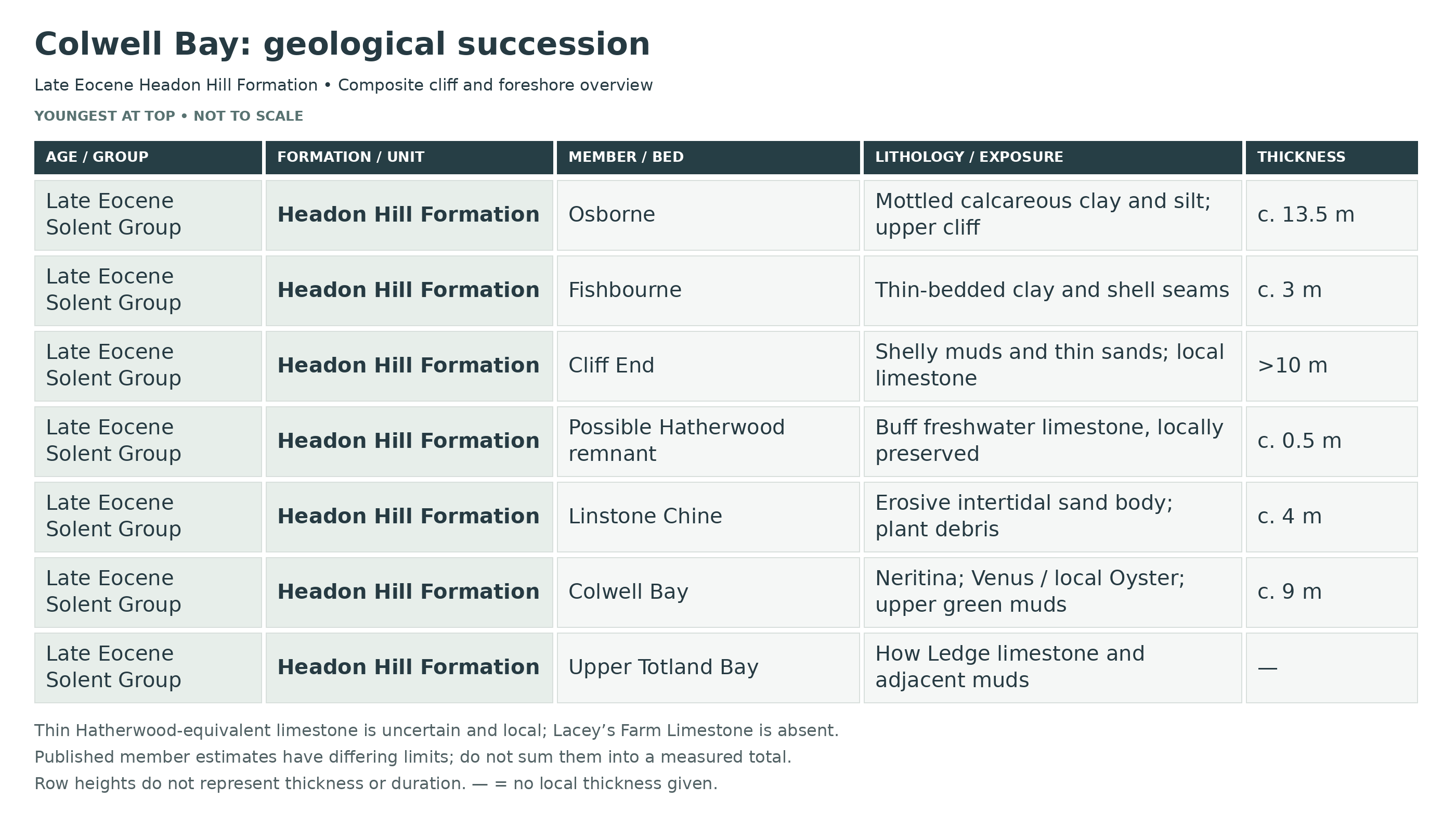
This is a detailed composite breakdown of the Priabonian Headon Hill Formation in Colwell Bay, Isle of Wight, from Warden Point and Colwell Chine north to Cliff End and Fort Albert. The section is important because it contains the type sections of the Colwell Bay, Linstone Chine and Cliff End members, and records the change from freshwater–brackish Totland Bay deposition into the main marine to marginal-marine incursion of the Headon Hill Formation, followed by renewed coastal-plain sedimentation.
Historical Local Sections — Separate From The Modern Succession
Historical upper shelly, lignitic and ferruginous intervals
The original 1889 memoir reproduces a combined Colwell–Totland section measured by Forbes and Bristow around 1852. Its upper and middle divisions are described below, youngest first within each historical division. These are individual lithological entries from that composite log, not a newly measured Colwell-only succession and not extra units added above or below the modern members. No one-to-one modern crosswalk is imposed where it has not been verified. Old fossil names remain attributed historical usage.
Historical Upper Headon 1 — Dark-blue clays and ferruginous/septarian bands
The youngest listed upper-division entry alternates dark-blue clay with ferruginous and septarian bands. The original fauna includes Paludina lenta, P. globuloides, Limnaea longiscata and Potamomya gregaria.
Historical Upper Headon 2 — Red and green marls
A separately listed mottled marl interval follows below the dark-blue clay package. The table supplies no distinct fossil assemblage for this row.
Historical Upper Headon 3 — Sandy beds, greenish clay and grey shale
These beds contain lenticular accumulations of broken shell and wood. The table records Paludina higher in the interval, together with Potamomya, Cyrena and fragments of Unio.
Historical Upper Headon 4 — White, yellowish and dark sands
Sand with clayey streaks contains Melanopsis and Cyrena. Lenticular concentrations of dead shells are separately noted towards the lower part, retaining evidence of local accumulation rather than an evenly fossiliferous bed.
Historical Upper Headon 5 — Thin freshwater limestone
The next distinct row is limestone containing Limnaea longiscata and Planorbis. Its position is retained within the historical sequence without forcing identification with a modern named limestone.
Historical Upper Headon 6 — Shelly greenish clay and sand
This unit is crowded locally with gastropods and bivalves, including the historically named Potamides trizonatum and Cyrena obovata. A ferruginous band is reported 10 inches above its base.
Historical Upper Headon 7 — Argillaceous limestone at Cliff End Fort
The memoir records clay-rich limestone passing southwards into sand, with a carbonaceous basal band and a diverse freshwater molluscan assemblage. It specifically places this bed on the foreshore at Cliff End Fort. The lateral change is retained without identifying it automatically as the entire Hatherwood Member.
Historical Upper Headon 8 — Laminated sands and carbonaceous shales
Bluish-yellow and purplish laminated sand and carbonaceous shale were logged under the southern end of the battery. This is a distinct interval beneath the clay-rich limestone.
Historical Upper Headon 9 — Laminated clay and sand with Potamomya seams
The lowest entry in the historical upper division comprises laminated clay and sand, ferruginous sandy lenses and local lines of Potamomya. No extra formal member is created from this older division.
Historical Middle Headon 1 — Compact pale greenish-yellow sand
The top entry is relatively compact pale sand described as without fossils in the original observations. That absence applies to this logged interval, not to the whole modern Colwell Bay Member.
Historical Middle Headon 2 — Verdigris-green clayey shell beds
Green clayey beds contain abundant Cyrena obovata, oysters, Melania, Cerithium and Natica in the historical account. They are retained as a separate shelly lithological interval.
Historical Middle Headon 3 — Ferruginous concretion band
Ferruginous concretions are described as often calcareous inside. Small gastropods, Cyrena, Modiola and rare oysters were recorded; uncertain historical identifications are not promoted to new accepted taxa.
Historical Middle Headon 4 — Shelly blue-green clay and oyster lenses
The upper part contains Cyrena; local oyster lenses occur lower down where the clay darkens and includes calcareous nodules. This preserves the table’s internal upward and lateral distinctions.
Historical Middle Headon 5 — Lignite and clay with sandy patches
The table distinguishes a lignitic clay interval with local sand and numerous Potamomya bands near its base. Cerithium, Neritina and Melanopsis were also recorded.
Historical Middle Headon 6 — Venus Bed and variable oyster bank
Brownish clay with a diverse marine-affinity shell assemblage includes an oyster bank of changing thickness. The memoir’s locality narrative shows that this oyster-rich body cuts into underlying venerid-rich clay, supporting lateral channel geometry rather than uniform superposition.
Historical Middle Headon 7 — Varied clay and sand below the Venus interval
Blue and red clay alternates with yellow and white sand. Fossils become more abundant towards the base, and a ferruginous band is recorded within the interval. It is kept distinct from the basal Neritina clay.
Historical Middle Headon 8 — Basal Neritina Bed
Dark-blue sandy clay contains two clearly recognised Cyrena bands, with Cerithium, Neritina concava, Melanopsis, Nematura and Chara in the historical list. The multiple shell concentrations are retained without turning them into separate modern formations.
Historical Osborne Beds At Cliff End — 1888 Remeasurement
The 1889 memoir separately records four units at Cliff End in the historical Osborne Series. This older name spans more than the modern Osborne Member and must not be applied to that member alone. The authors re-examined and partly remeasured the section in 1888, explicitly warning that earlier measurements had probably included slipped masses. The entries below are given youngest first in their original scheme; they are not summed into a modern cliff thickness.
Historical Cliff End 1 — Upper bluish sandy and marly clay (about 10 feet)
The highest listed clay contained the historically named Cyrena obovata. The memoir states that this bed was no longer visible at the time of the revised description.
Historical Cliff End 2 — Red and blue marls with nodules (25–30 feet)
Marl contains lines of argillaceous limestone nodules with occasional fossils, preserving a distinct mottled and nodular interval beneath the upper sandy clay.
Historical Cliff End 3 — Dark-grey shale with ironstone (7 feet)
A central ironstone band occurs within dark-grey shale that yielded leaves, insects, fish, Candona, freshwater gastropods and alligator material. The memoir calls this a probable Fish Bed equivalent rather than proving a modern member boundary.
Historical Cliff End 4 — Lower mottled marl with shell-bearing nodules (40 feet)
Reddish and bluish clayey marl contains greenish nodules with shells and turtle remains. Its comparatively large historical thickness was one reason for the 1888 remeasurement and slipped-section caution.
Modern Stratigraphic Succession
The modern Group, Formation and Member account resumes below. Historical entries above are comparative observations and are not additional units within the Colwell Bay Member. Their correlations remain limited to those stated explicitly.
SOLENT GROUP
Headon Hill Formation (Upper Eocene, Priabonian)
Section Character
Colwell Bay is a soft-cliff and foreshore section rather than a single permanently open vertical log. Exposure varies with beach sand, slipped debris and active cliff recession, and the succession is best followed as a composite from Warden Point and Colwell Chine northward past Brambles Chine and Linstone Chine to Cliff End. A small anticlinal flexure near Linstone Chine is important because it brings back a thin local limestone representative above the Linstone Chine sands toward the north end of the bay.
Type-Section Significance
Colwell Bay contains the type section of the Colwell Bay Member beside Brambles Chine, the type section of the Linstone Chine Member between Brambles and Linstone chines, and the type section of the Cliff End Member at the north end of the bay. The CB labels below are editorial navigation labels for this guide, not bed numbers from a published measured log. They organise named beds, member boundaries, erosion surfaces and distinctive lithological packages.
Totland Bay Member
Bed CB1 — Warden Ledge Limestone (local marker within the middle Totland Bay Member)
At the southern approach to Colwell Bay, between Totland Bay and Warden Point, the Warden Ledge Limestone forms a resistant local marker within the otherwise soft Totland Bay Member succession. It is a practical field datum rather than a thick independently mappable limestone body in the Colwell Bay cliffs, but it shows that the lower Headon succession here included repeated calcareous and shell-bearing phases within a dominantly muddy coastal-plain succession. The wider Totland Bay Member in west Wight is chiefly silty mud, calcareous mudstone and thin sand with freshwater limestones, laid down in freshwater to brackish marginal-marine and non-marine settings.
Warden Ledge Limestone is the modern BGS marker name. The 1889 memoir describes the ledge-forming material as calcareous concretionary sandstone and sand, traceable intermittently for about a mile. The historical log likewise records a sandy, partly concretionary bed with lenticular broken-shell masses at Warden Ledge. That lithological variation is retained here rather than presenting the marker as uniformly pure limestone.
Bed CB2 — Upper Totland Bay Member And How Ledge Limestone
The highest Totland Bay beds are exposed in the low cliff north of Colwell Chine and on the foreshore as How Ledge. The How Ledge Limestone is a prominent pale freshwater limestone rich in pulmonate gastropods such as Galba and planorbids, with Viviparus also present. It is the uppermost major freshwater limestone of the lower Headon succession here and should not be confused with the much thicker Hatherwood Limestone higher in the Headon Hill cliff farther south. Muds and marls around and above the How Ledge horizon show increasing brackish influence, with molluscs such as Potamomya, Melanopsis, Potamides, Tarebia and Theodoxus recorded in the upper Totland Bay interval. The top of the member is a sharp interburrowed omission surface penetrated by Thalassinoides, marking abrupt onset of the overlying Colwell Bay marine incursion.
The 1889 memoir describes the How Ledge limestone along the How Ledge–Warden Point coast as 3–5 feet thick, approximately 0.9–1.5 m. The BGS figure of about 2 m concerns the wider western Headon Hill–Totland development. These observations have different section scopes and are not silently combined into one Colwell thickness.
Colwell Bay Member
Bed CB3 — Basal Omission Surface And Neritina Bed
The Colwell Bay Member begins abruptly above the bored omission surface at the top of the Totland Bay Member. At Colwell Bay, the fully marine Brockenhurst Bed developed farther east and on the mainland is not represented as such; instead the lowest Colwell Bay beds are the brackish marginal-marine Neritina Bed, a dark brown clayey sand to sandy silty clay. Fossils include Theodoxus (“Neritina”), Potamides, Corbicula, Batillaria and Melanopsis, together with other molluscs and some drifted freshwater shells. This is the local expression of the basal Colwell Bay transgression, recording estuarine to lagoonal conditions with strong marine influence but lower salinity than the classic fully marine Brockenhurst facies farther north-east in the basin.
Bed CB4 — Venus Bed And Colwell Oyster Bed
The middle and most famous part of the Colwell Bay Member consists of blue-green, grey and brown shelly silty clay and muddy sand known as the Venus Bed. Its characteristic and abundant bivalve is Sinodia suborbicularis, the shell formerly known as “Venus incrassata”, from which the bed takes its traditional name. At Colwell Bay, especially around Brambles Chine, this interval may be replaced laterally or interrupted locally by the Colwell Oyster Bed, a very shelly muddy sand crowded with oysters and developed as a lenticular channel-fill in an erosion hollow cut into the Venus Bed. The Oyster Bed is generally interpreted as a tidal-channel fill. These beds represent the most fossiliferous and most marine part of the bay section, deposited in shallow hyposaline lagoonal to inner-sublittoral conditions with repeated winnowing and local channel scour.
Venus Bed — Shelly silty clay and muddy sand
The local assemblage is dominated by marine-affinity molluscs but includes estuarine and drifted freshwater shells. The GCR records paired valves of Sinodia suborbicularis, some still in life position. The lack of echinoids and corals, together with abundant oysters, corbiculids and cerithiids, supports a muddy, river-influenced inshore environment rather than an unrestricted offshore sea.
Colwell Oyster Bed — Local channel-fill within the Venus interval
The oyster deposit varies laterally and cuts into the underlying Sinodia-rich clay, as already described in the 1889 memoir. The GCR reports an assemblage in which about 90% of shells are oysters, historically named Ostrea velata, accompanied by “Murex” sexdentatus and Nucula headonensis. Shells accumulated as a death assemblage in sandier sediment; this is not a laterally continuous bed superposed everywhere on the Venus Bed.
Bed CB5 — Upper Colwell Bay Member: Green Muddy Beds And Uncertain Batillaria Correlation
Above the Venus Bed, the Colwell Bay Member becomes greener and muddier, with sandy and silty beds and shell seams. The GCR records Theodoxus apertus, Potamides pseudocinctus and Globularia harrisi in this upper interval, with fewer of the marine forms characteristic of the Venus Bed. Its upper green sandy clay also yielded a foraminiferal assemblage interpreted as approaching normal marine salinity. These observations show that salinity did not simply decline steadily upwards. The bed-name correlation is unresolved between the consulted accounts: BGS (2015) calls the uppermost sand–silty-clay interval the Batillaria Bed, whereas the Colwell Bay GCR describes the Headon Hill Batillaria Bed as missing here through erosion, with rolled shells reworked into the overlying unit. The upper green beds are therefore retained without assuming that the complete Headon Hill bed survives at Colwell Bay. BGS gives 9 m for the type-section member as a whole; this is not a thickness for CB5 alone.
Lower and upper foraminiferal faunules
The lower Colwell Bay Member faunule, including the Oyster Bed, indicates very shallow reduced-salinity estuarine or lagoonal water. A higher green sandy-clay assemblage is dominated by large Quinqueloculina impressa and was interpreted as approaching normal marine salinity. These are distinct published faunules rather than evidence of a single steady freshening trend.
Linstone Chine Member
Bed CB6 — Linstone Chine Channel-Fill Sands (c. 4 m)
The Linstone Chine Member is a localized, heterolithic, fine- to medium-grained sand body with plant debris, best developed in the upper cliff between Brambles and Linstone chines. It has an erosive base cut down into the Colwell Bay Member and is interpreted as a marginal-marine channel fill rather than a regionally persistent sheet sand. Its lenticular geometry and restricted development are critical to understanding the Colwell Bay section, because over much of the bay it is this channel-filling sand body, not a continuous laterally uniform bed, that separates the marine Colwell Bay Member below from the more non-marine muds above. The GCR records abundant Potamomya in the basal part and well-preserved sedimentary structures indicating intertidal deposition in reduced-salinity water. Water-plant remains near Linstone Chine include Typha, Azolla and Potamogeton; the GCR regards assignment of the plant-bearing Upper Headon beds to this member as probable rather than certain.
Possible Local Equivalent Of The Hatherwood Limestone Member
Bed CB7 — Thin Local Limestone At Cliff End, Probably A Hatherwood Representative (c. 0.5 m)
Along most of Colwell Bay the Hatherwood Limestone Member is absent. Toward Cliff End, however, a thin buff shelly limestone about 0.5 m thick reappears above the Linstone Chine sands. It is Galba-bearing and its top is truncated by an erosion surface. This bed is generally interpreted as a very attenuated local representative of part of the Hatherwood limestone succession seen much more fully on Headon Hill. It indicates brief renewal of freshwater limestone deposition before further erosion and replacement by the overlying clastic sequence. The bed owes its local reappearance to the structural complications around the Linstone Chine fold area and should not be mistaken for the full Headon Hill limestone development farther south.
The 1889 memoir records a 1 foot 8 inch limestone at Cliff End and regards correlation with the thick Headon Hill limestone as probable, while explicitly stating that the beds could not be connected by mapping. This historical qualification supports treating the local bed as a possible representative, not a proven full equivalent.
Lacey’s Farm Limestone Member — Not Developed At Colwell Bay
The Lacey’s Farm Limestone Member, well developed around Headon Hill and inland, dies out northward and is completely absent at Colwell Bay. This absence is one of the key ways in which the Colwell Bay succession differs from the fuller south-west Headon Hill section.
Cliff End Member
Bed CB8 — Basal Cliff End Erosion Surface And Lower Limestone-Bearing Muds
Over much of the bay, the Cliff End Member rests directly on the eroded top of the Linstone Chine Member; at the extreme north end it overlies the thin local limestone described above. The basal Cliff End beds are grey-green to brown shaly muds and clays with thin shell layers, and a thin brown limestone occurs about 3.5 m above the erosional base at the type site. Fossils are dominated by Potamomya and Viviparus. These beds show that after the localized sand-filled channel and local freshwater limestone phase, sedimentation returned to quiet muddy conditions on a low-energy coastal plain with ponds, marshes and low-salinity water bodies.
Thin brown limestone within the Cliff End Member
BGS records a thin brown limestone about 3.5 m above the member’s erosional base at its Colwell Bay type site. It is a separate marker within the muddy Cliff End succession, not the possible Hatherwood limestone below the member. No thickness or unique fauna is assigned to it without a verified local measurement.
Bed CB9 — Main Cliff End Potamomya–Viviparus Muds And Thin Sands (over 10 m at the type site)
The greater part of the Cliff End Member consists of grey-green and brown mud, shaly in part, with clay carrying thin shell layers and subordinate thin sands. The fauna remains low-diversity and low-salinity in character, with Potamomya and Viviparus especially typical. These beds are increasingly clay-rich northward toward Fort Albert, where modern landslip and slumping commonly obscure parts of the cliff. Overall, the member records non-marine coastal-plain deposition, with broad muddy flats, shallow standing water and only limited clastic channel input.
Trizonatum Bed — Cliff End Member
Symonds (2024) identifies this historically named bed between Colwell Bay and Cliff End as the type horizon of Clithon cliffendense. The small, glossy neritid has a concealed spire and often retains dark wavy colour markings. It belongs to the Cliff End Member, not to the basal Neritina Bed.
Melanopsis Bed and intervening shell horizon
About 1 m above the Trizonatum Bed, a variable sandy interval contains shell lenses rich in Melanopsis and also yields Clithon cliffendense. An intervening bed contains more poorly preserved examples. These are distinct local shell horizons; their thicknesses are not established here. The same study reports only one C. cliffendense from the Venus Bed near Brambles Chine, an exceptionally rare occurrence in that older member.
The freshwater ostracod Candona cliffendensis was described from the Upper Headon beds at Cliff End. The GCR also records brackish ostracod assemblages, including Neocyprideis colwellensis, in the wider Colwell succession. These microfaunas add independent evidence for fluctuating salinity; they are not assigned to every individual shell seam.
Fishbourne Member
Bed CB10 — Fishbourne Thin-Bedded Clays With Shell Seams (c. 3 m at Colwell Bay)
Above the Cliff End Member, the Fishbourne Member is represented in Colwell Bay by only about 3 m of brown and blue-grey thin-bedded clay with thin shell beds. Although much thinner here than in Whitecliff Bay, it is an important upper Headon unit because it records another shift toward marginal-marine to non-marine conditions with thin shelly horizons rather than freshwater limestone. In the Colwell Bay cliffs these beds are not as visually striking as the Venus Bed below, but they help show that the upper part of the local Headon succession remained environmentally variable rather than simply becoming monotonous mottled floodplain clay immediately above the Cliff End Member.
The 1889 Cliff End description records a dark-grey shale interval with an ironstone band and leaves, insects, fish and freshwater shells, identified then as a probable Fish Bed equivalent. This supports retention of the fossiliferous shaly interval but is an older observed section, not proof that the same beds remain exposed today.
Osborne Member
Bed CB11 — Osborne Colour-Mottled Fluviatile Clays And Silts (c. 13.5 m at Colwell Bay)
The uppermost Headon Hill beds represented in Colwell Bay are about 13.5 m of red and green colour-mottled calcareous clay and silt belonging to the Osborne Member. These beds are largely unfossiliferous and represent a non-marine fluviatile to overbank floodplain environment with pedogenic mottling, oxidation and repeated subaerial exposure. In the modern bay they form much of the higher slipped and degraded upper cliff ground rather than clean fossiliferous ledges on the foreshore. Their presence is important because it shows that Colwell Bay does not end with the Cliff End Member alone, but continues upward into the drier, more obviously terrestrial upper Headon succession.
Depositional Environment
Colwell Bay records repeated environmental oscillation across the Priabonian Headon Hill Formation. The Totland Bay Member represents freshwater to brackish coastal-plain lakes, marshes and marginal-marine muds, with shell-rich freshwater limestones such as the How Ledge Limestone. The Colwell Bay Member records the major marine to marginal-marine incursion of the local succession, beginning above a bored omission surface and passing from brackish basal transgressive sands into the fossil-rich Venus Bed and local tidal-channel Oyster Bed before passing into the upper green muddy beds, whose Batillaria Bed correlation differs between the BGS and GCR accounts. The Linstone Chine Member is a localized sand-filled marginal-marine channel cut into those marine beds. Above it, the thin local limestone near Cliff End marks a brief return to freshwater carbonate deposition, and the Cliff End, Fishbourne and Osborne members together record the restoration of mainly non-marine coastal-plain, lagoonal and fluviatile conditions.
Total Thickness Covered Here
The GCR describes approximately 33 m from the How Ledge Limestone to the poorly exposed Osborne beds at Cliff End, with considerably less than half that succession represented south of Cliff End. BGS gives separate local member estimates of 9 m for the Colwell Bay Member, 4 m for Linstone Chine, over 10 m for Cliff End, about 3 m for Fishbourne and about 13.5 m for Osborne. These estimates refer to different accounts and composite exposure limits; they are not added to create a new measured total. The locality is an intermittent cliff-and-foreshore composite, not a continuously open vertical log.
References
Hopson and Farrant (2015), Geology of the Isle of Wight, Solent Group: Headon Hill Formation and constituent members
Daley and Balson (1999), British Tertiary Stratigraphy, GCR 15: Colwell Bay
Additional checked historical reference: Reid and Strahan’s 1889 revision of the Isle of Wight memoir, Colwell–Totland table and locality descriptions.
Symonds, M.F. (2024). Three new species of Clithon from the Solent Group. Cainozoic Research 24(1), 15–24; especially pp. 18–19.
SAFETY
Common sense should always be used, and checking tide times is essential, as it is easy to become cut off along this stretch of coastline. Always ensure you begin your return before the tide turns.
The cliffs at Colwell Bay are highly unstable due to rapid erosion, and landslips occur frequently. Do not stand close to the cliff base, and avoid climbing on slumped material.
The foreshore can be uneven, with areas of soft clay and mud, which may be slippery or difficult to walk on. Care should also be taken when navigating fallen debris from cliff collapses.
With careful planning and awareness, Colwell Bay can be a highly rewarding and productive fossil collecting location.
EQUIPMENT
Fossil collecting at Colwell Bay generally requires minimal tools, as many fossils can be found loose within the shingle or soft sediments.
A small trowel or hand tool can be useful for gently working through clay and marl, particularly when searching for smaller fossils such as teeth or shells. A sieve (around 1–2mm mesh) can also be highly effective for recovering small gastropods, seeds and vertebrate remains.
It is recommended to bring tissue, containers or specimen bags, as many fossils—especially shells—are fragile and easily damaged. A bag or backpack will help carry finds safely along the beach.
Due to soft ground and uneven terrain, sturdy waterproof footwear is strongly advised.
CLEANING AND TREATING
Keep delicate molluscs supported in their clay or marl rather than brushing away all their support. Start with minimal dry cleaning. Water can disrupt friable shells and clay-rich matrix, so a fixed 24-hour soak is not a suitable treatment for every Colwell specimen.
Use Paraloid B-72 only if a specimen needs consolidation, after testing and preferably with specialist advice. It can be re-dissolved in suitable solvents, but removing a treatment from porous fossils is not always straightforward. Record any treatment; a surface coating does not prevent pyrite decay.
IDENTIFY YOUR FINDS
Need help identifying a fossil? Share clear photos, where you found it and its size with the community.
FURTHER READING
Deposits Magazine – Book review: Isle of Wight: Landscape and Geology, by John Downes
Colwell Bay, Isle of Wight — GCR stratigraphy
Colwell Bay, Isle of Wight — Ian West
Geology of the Isle of Wight — British Geological Survey
ACCESS RIGHTS
This coast forms part of Colwell Bay SSSI. Respect landowner access conditions and local notices. Keep casual collecting to loose beach material; do not hammer the bedrock or dig into the cliffs. The Natural England citation for Colwell Bay SSSI explains the protected scientific interest.
It is important to follow our ‘Code of Conduct’ when collecting fossils or visiting any site. Please also read our ‘Terms and Conditions‘
LINKS
♦ Fossil Discussions
♦ Fossil Articles
♦ Buy Fossils, Tools and Equipment
♦ Buy Crystals, Meteorites, and Artefacts
♦ Join Fossil Hunts
♦ UK Fossils Network