Fort Victoria, on the north-west coast of the Isle of Wight, is a family-friendly fossil location exposing the Headon Hill Formation. The foreshore can yield crocodile, turtle, fish and shell remains, often found loose in the shingle or weathering from soft sediments. With easy access from Fort Victoria Country Park and views across the Solent, it is a rewarding site for careful searching rather than heavy collecting.


FIND FREQUENCY: ♦♦♦♦♦ – Fort Victoria is one of the most productive locations on the Isle of Wight, particularly for microfossils and small vertebrate remains, which can be found with careful searching.
CHILDREN: ♦♦♦♦♦ – Suitable for family fossil hunting with close adult supervision, easy access and nearby facilities. The beach is tidal and can be uneven or slippery; keep children away from cliff bases and the water.
ACCESS: ♦♦♦♦♦ – Excellent access with free parking close by and a short walk to the beach. The site also benefits from a café, museum and other amenities within Fort Victoria Country Park.
TYPE: – Foreshore. Fossils are typically found loose within the shingle and can often be picked up without the need for tools.
DIRECTIONS
♦ Head to Fort Victoria Car Park (free), located within Fort Victoria Country Park, just west of Yarmouth. Access is via Westhill Lane, following signs for Fort Victoria.
♦ Park in the main car park, which is close to the café, museum and facilities. From here, follow the clearly marked paths down towards the seafront (towards the South West)
♦ Access to the foreshore is straightforward via slipways and beach paths, making this one of the easiest locations on the island to reach.
♦ Once on the beach, begin searching along the shingle and tideline, where fossils are most commonly found. The park’s fossil guide recommends searching the loose gravel and stones west of the fort. Stay on open foreshore, well clear of cliff bases, fresh falls and slipped ground, and keep a safe tidal return route.
♦ Postcode for parking: PO41 0RR, Google Maps
♦ What3words collecting area: ///burglars.puppets.secret
VIDEO FILM
FOSSIL HUNTING
Fort Victoria is a classic small-fossil site on the north-west coast of the Isle of Wight. It is best known for material derived from the late Eocene Headon Hill Formation and associated Solent Group beds, representing a landscape of lagoons, marshes, rivers, freshwater ponds and brackish coastal waters. Collecting here is usually based on slow, careful searching of the foreshore rather than hammering solid rock. The most productive areas are the shingle, tideline, intertidal gravel patches and soft, recently eroded sediment, after erosion has redistributed material, once sea and ground conditions are safe. The official Fort Victoria fossil guide also notes that fossils are commonly found among the stones and gravel west of the fort, particularly along the high-tide line and intertidal zone. The named lists below include regional Headon Hill Formation comparisons from several beds and localities. They should not be read as a verified inventory of one Fort Victoria bed: the modern exposed section chiefly shows Fishbourne and Osborne strata, and loose finds may have been reworked.
The most sought-after finds are vertebrate remains. Crocodile material is regularly associated with the Headon Hill beds, especially small teeth, scutes, osteoderms and worn bone fragments. Much of this material is usually referred to Diplocynodon, while the well-described species Diplocynodon hantoniensis provides a regional comparison from the Headon Hill Formation at Hordle Cliff. A loose Fort Victoria tooth or scute should not automatically be assigned to that species. Older regional literature has also referred crocodilian material to Crocodilus sp., although isolated teeth and fragments are not always easy to identify with certainty. Turtle fragments are also a feature of the site. Shell pieces may show the ridged or pitted surface of soft-shelled forms, or the scute grooves and internal structure of hard-shelled turtles. Historical regional reports used names such as Trionyx sp. and Emys sp.; Owen’s original Emys crassus material came from Hordwell, and Lydekker later listed that name under Ocadia crassa. These are historical regional records, not separate confirmed turtle species identifiable from every loose Fort Victoria shell fragment.
Fish remains can include small teeth, scales, vertebrae and bone fragments. These are often very small and dark, so a hand lens and patient searching are useful. Shark and ray material is less common than molluscs and reptile fragments, but it is possible in the wider Headon Hill assemblage. Recorded forms include the sand tiger shark Striatolamia macrota, other sharks such as Carcharias acutissima, Carcharias cf. cuspidata, Physogaleus cf. latus, Rhizoprionodon sp. and Abdounia sp., as well as rays such as Aetobatus irregularis, Myliobatis cf. striatus and Dasyatis sp. Freshwater and estuarine fish remains from the Headon beds include Lepisosteus sp., Amia sp. and Acipenser sp. These are not usually obvious beach finds and are more likely to be recovered by close searching or sieving fine sediment.
Molluscs are an important part of the fossil assemblage and are much more common than vertebrate material. Gastropods from the Headon Hill Formation include freshwater, brackish and marginal-marine forms. Regional comparative records include Viviparus angulosus, Viviparus lentus, Monsneritina aperta, Clithon concavum, Clithon planulatum, Clithon headonense, Clithon cliffendense, Bayania fasciata, Melanopsis fusiformis, Melanopsis carinata, Ptychopotamides vagus, Ptychopotamides trizonatus, Potamides varians, Tympanotonos funatus, Potamidopsis duplex and Vicinocerithium concavum. Older books and labels may use slightly different names for some of these shells, especially among the neritids and potamidids, so identifications should be checked carefully.
Bivalves may also be found, particularly from brackish lagoonal and estuarine beds. Regional comparisons include Sinodia suborbicularis, a characteristic shell of the Venus Bed in the nearby Colwell Bay succession, as well as Nucula headonensis, Mytilus affinis, Striostrea velata, Cubitostrea ventilabrum, Corbicula deperdita, Corbicula cf. altirupestris, Geloina pulchra, Polymesoda obovata, Polymesoda ?convexa, Psammotaea compressa, Gari rudis, Abra corbuloides and Caryocorbula cuspidata. Some older references may list Striostrea velata as Ostrea velata, and the name Venus or Cordiopsis may be encountered in older literature for shells now placed in or associated with Sinodia.
Other small fossils can also be found. Plant material, seeds, charophyte gyrogonites and fragments of fossil wood reflect the freshwater and marshy parts of the environment. Recorded plant and freshwater forms from the Headon beds include Gyrogona wrightii, Gyrogona caelata, Nitellopsis helicteres, Chara antennata, Chara subcylindrica, Brasenia ovula, Aldrovanda ovata, Sambucus colwellensis, Potamogeton pygmaeus and Stratiotes headonensis. Ostracods and other microfossils may also occur, including species such as Candona cliffendensis and Neocyprideis colwellensis. Rare crustacean material has been recorded from the wider Headon assemblage, including barnacles such as Vectibalanus unguiformis and crabs or burrowing crustaceans such as Typilobus obscurus and Vecticallichirus abditus.
The best approach at Fort Victoria is to walk the foreshore slowly and look for anything with a different colour, texture or surface pattern from the surrounding gravel. Turtle shell may show a distinctive pitted or honeycomb texture, crocodile scutes may have a sculptured surface, and small fish or shark teeth may appear as tiny glossy black or dark brown points among the shingle. Sieving can be productive for small teeth, seeds, ostracods and other microfossils, but it should be done responsibly and only in loose material. The site rewards patience rather than heavy collecting, and many of the best finds are small fragments that are easily missed.


Scientific milestones for Fort Victoria and Sconce Point, with explicitly identified regional background from the separate Headon Hill type section. A formation or member named in regional research is not proof that every fossil or bed occurs on the present Fort Victoria shore.
19th century – the west Wight Headon Hill succession around Fort Victoria became recognised as an important late Eocene fossil locality
The cliffs and foreshore west of Yarmouth, including the Fort Victoria coast, became important in the nineteenth century as part of the classic Headon Hill late Eocene succession. Early work on the wider west Wight beds established the importance of these strata for mammals, reptiles, shells and plant remains.
1846 – regional context: Prestwich reported mammals from Headon Hill
Prestwich’s stratigraphical account recorded mammal specimens at Headon Hill, the separate west-Wight section used to establish the regional succession. This is background to understanding the rocks around Fort Victoria, not evidence that those specimens were collected on the Fort Victoria shore.
1857 – regional context: Owen described a Headon Hill artiodactyl
Owen’s work concerned an artiodactyl from the Headon Hill succession. It belongs in the history of regional vertebrate research, rather than being presented as a documented Fort Victoria discovery.
Late 19th to 20th century – the Headon Hill and Totland Bay succession was refined bed by bed
As work continued on the west Wight late Eocene sequence, the beds exposed around Fort Victoria became part of one of the best studied Headon Hill successions on the island. This increasingly detailed framework helped place the fossil-bearing limestones, marls and clays of the shore into a much clearer stratigraphic setting.
1985 – Headon Hill was designated the type section for the Headon Hill Formation
This was one of the most important modern milestones for the geology represented at Fort Victoria. The nearby west Wight section was formalised as the type section for the Headon Hill Formation, strengthening the scientific value of the Fort Victoria coast as part of that classic late Eocene succession.
2021 – the Fort Victoria Member name introduced in mammal stratigraphy
Hooker introduced Fort Victoria Member for the restricted lower Cliff End interval of the Headon Hill Formation. The name is useful when comparing modern mammal literature with the BGS framework, but it does not turn the entire Fort Victoria cliff and loose beach assemblage into a single member.
Modern collecting – Fort Victoria remains one of the Isle of Wight’s best known beach-combing sites for vertebrate remains
Today Fort Victoria is especially well known for fossils weathering from the late Eocene beds onto the beach shingle. The shore is noted for turtle shell, crocodile armour and teeth, fish remains, broken white shell debris and occasional mammal material, making it one of the most popular west Wight fossil beaches for surface finds.
Modern understanding – separate the present cliff, slipped blocks and historical Sconce records
BGS identifies Fishbourne and Osborne strata in the mid-cliff and in rotated foreshore blocks. The historical Bembridge Limestone record at Sconce and the uncertain lower cliff beds require separate treatment. Recording the matrix and collecting position of a loose fossil is therefore more useful than assigning it to the Fort Victoria Member from the locality name alone.
GEOLOGY
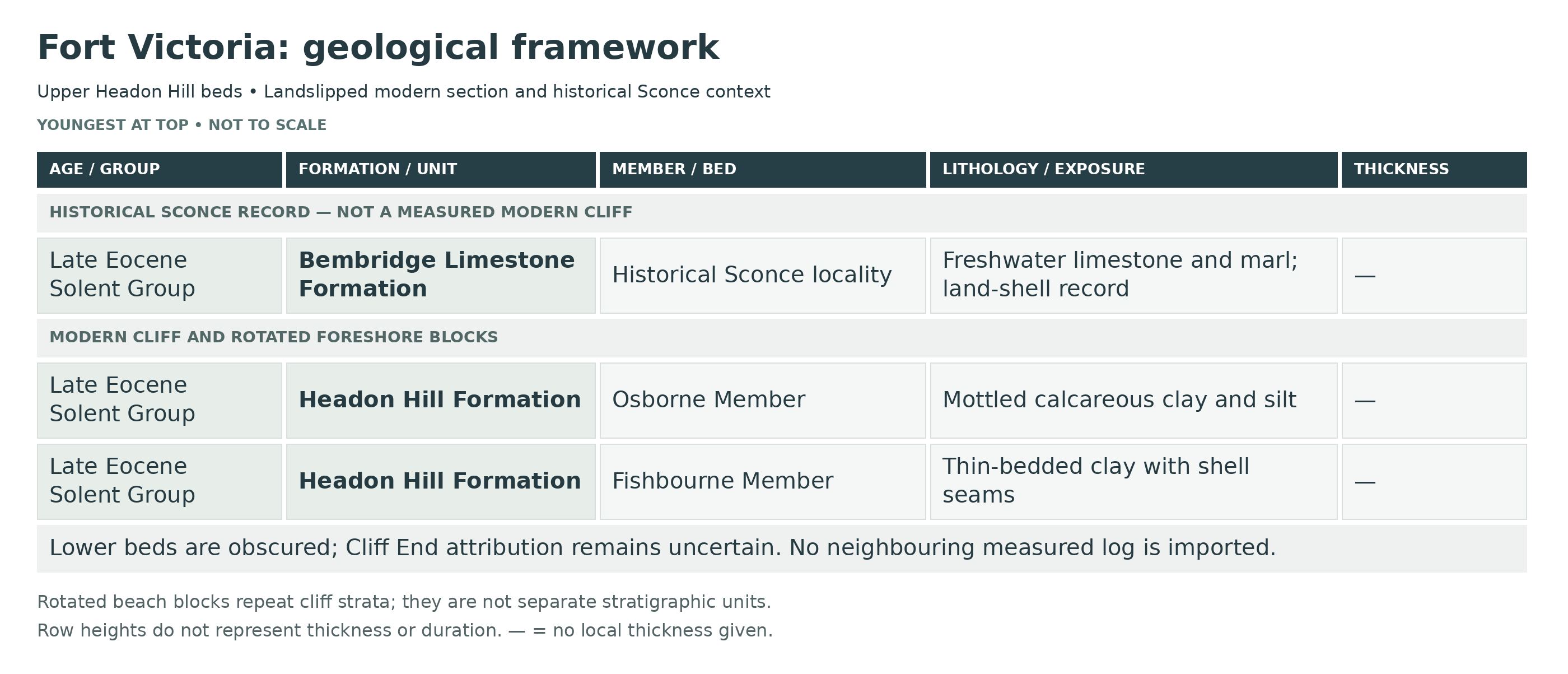
Fort Victoria and Sconce Point lie within the late Eocene Solent Group succession. The modern cliff and foreshore are especially useful for the upper Headon Hill Formation, including Fishbourne and Osborne strata, while Sconce is a historically important Bembridge Limestone locality.
BGS identifies thin-bedded Fishbourne clays and mottled Osborne clays and silts in the mid-cliff. The same units also occur on the beach as steeply tilted, rotated landslide blocks. These are structural repetitions of the succession, not additional younger or older formations.
The lower part of the section is poorly exposed, so a complete Colwell Bay or Headon Hill member sequence must not be transferred here. The name Fort Victoria Member is used in newer mammal literature for the restricted lower Cliff End interval; the detailed account explains that naming distinction without treating every loose fossil as securely attributable to it.
Historical accounts describe cream-coloured Bembridge limestones, marls and land-shell material at Sconce. That historical occurrence is distinguished from a measured modern cliff exposure. Loose beach fossils may have been displaced and reworked, and their precise bed of origin cannot normally be inferred from the collecting spot alone.
Together these sediments record changing non-marine coastal-plain, lagoonal and freshwater carbonate environments. Landslipping and intermittent cover prevent a trustworthy single local thickness from being assigned; the chart is a composite framework with the historical limestone shown separately.

Fort Victoria is a landslipped composite north-coast section where the upper Headon Hill Formation is exposed in degraded cliffs and rotated beach blocks around Sconce Point, and where the historical Sconce Bembridge Limestone locality lay beneath the later fortifications. It is important because it shows the Fishbourne–Osborne part of the Headon succession east of Colwell Bay, and because the inaccessible Bembridge Limestone at Sconce yielded one of the classic Isle of Wight land-shell faunas.
The FV labels are editorial guide divisions, not published measured-bed numbers. Modern BGS observations directly establish Fishbourne and Osborne strata at the cliff and in displaced blocks. The lower Cliff End attribution is less certain, and historical Bembridge Limestone evidence at Sconce is kept distinct from current in-situ exposure.
SOLENT GROUP
Headon Hill Formation (Upper Eocene, Priabonian)
Section Character
At Fort Victoria the soft north-coast cliffs are heavily vegetated and landslipped, so the locality is a composite and seasonally variable section rather than a clean measured cliff. Mid-cliff exposures show in situ upper Headon Hill beds, while the beach platform contains rotated and back-tilted landslide rafts of the same units. The lower part of the cliff is commonly obscured by mudflow and talus, and old military works around Sconce Point have further complicated the original exposures.
By the time the Headon Hill outcrop reaches Fort Victoria, the full limestone-rich west Wight member suite seen at Totland and Colwell bays has already been reduced by lateral change and erosion. The Hatherwood and Lacey’s Farm limestone developments have effectively failed eastward, so Fort Victoria is essentially an upper Headon Hill to Bembridge Limestone locality rather than a full west-Wight Headon log.
Possible Cliff End Member
Bed FV1 — Obscured Lower Fort Victoria Mudstones And Shell Layers
The obscured lower part of the Fort Victoria cliff probably belongs largely to the Cliff End Member, although it is rarely visible as a clean in situ face because of active mudslides and deeper rotational movement. Where preserved on this part of the north coast, the member consists of dominantly grey-green and brown shaly mud, clay with thin shell layers dominated by Potamomya and Viviparus, and a few thin sand beds. These are low-energy non-marine coastal-plain deposits laid down on muddy flats, shallow ponds and very low-salinity waterbodies. At its type section the member exceeds 10 m in thickness, but the true thickness at Fort Victoria cannot be measured reliably because the basal part of the section is degraded and repeatedly slipped. As a regional nomenclatural comparison, newer mammal work uses Fort Victoria Member for the restricted lower Cliff End interval, whereas the BGS 2015 framework retains Cliff End Member. That naming change does not independently establish the identity of the obscured lower beds at this locality.
Fishbourne Member
Bed FV2 — Fishbourne Thin-Bedded Clays And Shell Seams
One of the most dependable in situ parts of the Fort Victoria section is the Fishbourne Member, which forms brown and blue-grey thin-bedded clay with thin shell beds in the mid-cliff. The BGS general description gives about 7 m for the member, though the exact thickness at Fort Victoria is obscured by landslip. It was formerly known as the Fish and Plant Beds. The lithology and fauna indicate marginal-marine to non-marine deposition, probably in shallow lagoon-margin, estuarine-edge and coastal-plain waterbodies subject to intermittent salinity fluctuation. At Fort Victoria these beds commonly form laterally persistent but degraded ledges within the landslip-scarred middle part of the cliff.
Osborne Member
Bed FV3 — Osborne Colour-Mottled Calcareous Clays And Silts
Above the Fishbourne beds lie red and green colour-mottled calcareous clays and silts of the Osborne Member. These beds are generally sparsely fossiliferous or unfossiliferous and represent non-marine fluviatile and overbank sedimentation on a low-relief floodplain. At Fort Victoria they weather into soft hummocky slopes and are one of the main reasons for continuing shallow failure in the upper cliff. Their mottled colouring reflects pedogenic modification, oxidation and repeated subaerial exposure rather than continuous open-water sedimentation. Exact thickness at Fort Victoria is difficult to establish, but the member forms a substantial upper cliff interval on this stretch of coast.
Structural Style And Exposure
Fort Victoria must be treated as a landslipped section, not as a simple upright cliff log. The Fishbourne and Osborne members appear as near-horizontal units in the mid-cliff, but the same beds also occur on the beach platform as steeply dipping, back-tilted rotated blocks, demonstrating a buried slip plane and repeated mass movement. These rafts can expose fresher material than the vegetated cliff, but they are structural repetitions rather than separate stratigraphic units. The present beach and cliff therefore show both the original succession and a landslide-modified duplicate of parts of it.
Bembridge Limestone Formation (Upper Eocene / Priabonian)
Bed FV4 — Historical Sconce Point Bembridge Limestone
The fort itself stands on or very near the classic Sconce Point Bembridge Limestone locality, now largely inaccessible because the old shore exposures were occupied by fortifications and later modified by landslip and sea defences. Historically the unit was described as compact cream-coloured freshwater limestone alternating with shales and marls, corresponding to the Bembridge Limestone Formation. Historical descriptions of the Bembridge Limestone use names such as Limnaea, Planorbis and Paludina orbicularis, together with abundant Chara gyrogonites; Lyell particularly highlights land shells at Sconce and illustrates Helix occlusa and Bulimus ellipticus from the formation. These historical names and the wider formation assemblage should not be interpreted as a modern, bed-by-bed inventory for the present shore. This limestone marks a clear lithological and environmental shift from the clastic upper Headon coastal plain into palustrine to lacustrine carbonate deposition. Regionally the Bembridge Limestone Formation reaches up to about 9 m in thickness, but the actual exposed thickness at Sconce was never straightforward once the site became fortified and subsequently degraded. Historical accounts also note marl above the limestone, including an oyster-rich band a few feet above its top, but those higher beds are not now a dependable modern Fort Victoria in situ section.
Historical Sconce Limestone And Marl Section (16–20 feet)
The 1889 memoir reproduces Forbes’s earlier Sconce account because the exposure was already much overgrown in 1888. It describes 16–20 feet, approximately 4.9–6.1 m, of limestone and marl with rapid lateral variation and concretionary, tufaceous and brecciated textures. This historical total belongs to that Sconce description; it is not a measured thickness of today’s Fort Victoria cliff or beach.
Lower freshwater-shell-rich division
Forbes described freshwater shells as more frequent in the lower part, contrasting with the land-shell-rich upper half. Some intervening strata were described as apparently unfossiliferous, so shell abundance was not uniform.
Upper land-shell-rich and tufaceous bands
Irregular tufaceous concentrations of land shells lay between harder beds containing Limnaea and Planorbis, commonly as well-preserved casts. The memoir independently records historical Sconce names including Helix occlusa, H. vectensis, H. globosa, Bulimus ellipticus and Achatina costellata. These are retained as old identifications, not asserted modern taxonomic combinations.
Thin white Paludina globuloides band
A thin pale band containing the small gastropod historically called Paludina globuloides was observed beneath a belt rich in Limnaea longiscata. Its position is part of Forbes’s Sconce account; no separate thickness is supplied.
Near-top brecciated white band (6 inches–1 foot)
The most conspicuously concretionary and brecciated material formed a white band not far below the top. The original account gives 6 inches to 1 foot, approximately 0.15–0.30 m, and compares it with the capping limestone elsewhere without proving that every locality preserves identical beds.
Hard siliceous or cherty band near the top
A hard, locally nodular band described historically as silex occurred intermittently just below the top. The siliceous development is retained as a separate recorded marker; no continuity or thickness is invented.
Terminal calcareous marl (4–5 inches)
The uppermost recorded unit was soft calcareous marl, 4–5 inches thick, approximately 0.10–0.13 m, containing small limestone pebbles or possible concretions. The original uncertainty between clasts and concretions is retained.
Concretionary surface historically interpreted as turtle eggs
The memoir reports unusual bodies on a surface within the tufaceous/concretionary portion that Edwards regarded as turtle eggs. This is an old, uncertain interpretation, not a confirmed vertebrate occurrence or a newly validated egg horizon.
Typical Fossils
In the cliff-forming Headon beds, identifiable in situ fossils are mostly shell-bed assemblages dominated by Potamomya and Viviparus low in the section and more diffuse shell seams in the Fishbourne beds, while the Osborne Member is much poorer in body fossils. The historically important Sconce limestone fauna is much richer, with abundant freshwater and land snails and plentiful Chara. Modern beach shingle at Fort Victoria commonly contains derived rather than in situ fossils, including broken white shell from the Bembridge Limestone and vertebrate debris such as turtle shell and crocodilian material washed from the soft north-coast Palaeogene succession.
Depositional Environment
The Fort Victoria succession records the late Eocene shift from low-energy non-marine coastal-plain muds of the upper Headon Hill Formation into freshwater limestone deposition of the Bembridge Limestone Formation. The Cliff End equivalent represents muddy coastal-plain lakes, marshes and ponded areas with thin shell layers; the Fishbourne Member records marginal-marine to non-marine clay deposition with fluctuating salinity; the Osborne Member represents oxidized overbank and floodplain sedimentation; and the Bembridge Limestone at Sconce formed in shallow freshwater to locally slightly brackish lacustrine and palustrine settings where molluscs and charophytes flourished and carbonate mud accumulated intermittently with marl.
Total Thickness Covered Here
Fort Victoria exposes a landslipped composite of upper Headon Hill strata, with Fishbourne and Osborne beds specifically identified by BGS in both the mid-cliff and rotated foreshore blocks. The obscured lower beds require more cautious member attribution. Historical Sconce records document the Bembridge Limestone, including Forbes’s 16–20 foot historical estimate, but they do not supply a reliable thickness for the present exposure. Regional and neighbouring member thicknesses quoted above are context only: none is added to infer a local total, and the earlier suggestion of at least 20 m of exposed upper Headon strata is not retained without a verified Fort Victoria measurement.
References
British Geological Survey. Geology of the Isle of Wight, part sheets 300, 331, 344 and 345: brief explanation.
British Geological Survey Lexicon entries: Headon Hill Formation, Cliff End Member, Fishbourne Member, Osborne Member and Bembridge Limestone Formation.
Insole, A. & Daley, B. (1985). Revision of the lithostratigraphy of the Late Eocene and Early Oligocene strata of the Hampshire Basin.
Insole, A., Daley, B. & Gale, A. (1998). The Isle of Wight. Geologists’ Association Guide No. 60.
Daley, B. (1999). Palaeogene sections of the Isle of Wight: revised description and significance.
Gale, A.S. and co-authors (2006) on magnetostratigraphy and correlation of the Headon Hill Formation, Bembridge Limestone Formation and lower Bouldnor Formation.
Hooker, J.J. (2021). The Mammals of the Late Eocene–Early Oligocene Solent Group of the Isle of Wight, southern England, Part 1, for the Fort Victoria Member terminology.
White, H.J.O. (1921). A Short Account of the Geology of the Isle of Wight.
Hughes, J.C. The Geological Story of the Isle of Wight.
Lyell, C. Student’s Elements of Geology, for the classic Sconce Point Bembridge fauna.
Checked source links: BGS Isle of Wight explanation (2015); Lyell, chapter XVI; Hooker and colleagues (2022), terminology discussion.
Additional historical reference: Reid and Strahan’s 1889 revision of the Isle of Wight memoir, Sconce account, pp. 160–162.
SAFETY
Common sense should always be used when collecting, and checking tide times is essential, as parts of the foreshore can become inaccessible at higher tides. Although this is a relatively accessible location, the sea can still reach the base of the cliffs, so always allow plenty of time to return safely. The Isle of Wight Council advises against swimming here because of strong tidal currents; fossil hunting should remain on the shore.
The cliffs are low but can still be unstable in places, with occasional slumping and erosion. Avoid standing directly beneath exposed sections and be cautious of recently fallen material.
The foreshore consists of shingle, soft clay and uneven ground, which can become slippery, especially after rain or in winter months. Care should be taken when walking, particularly near the tideline or on algae-covered surfaces.
EQUIPMENT
Fossil collecting at Fort Victoria generally requires minimal tools, as most finds are located loose within the shingle or weathered out from soft sediments.
A small trowel can help separate permitted loose sediment on firm, open foreshore, well clear of cliffs and slipped ground; do not excavate banks or attached beds. A fine mesh sieve (around 1–2 mm) can help find small teeth and shell fragments in permitted loose samples. Label each sample with its finding position and keep fragile material supported.
It is recommended to bring tissue, specimen bags or small containers, as many fossils—especially shells and delicate bone fragments—are fragile and easily damaged.
As the terrain can be uneven and occasionally soft underfoot, sturdy footwear is advised. A bag or backpack will help carry finds comfortably along the foreshore.
CLEANING AND TREATING
Support fragile turtle shell, teeth and bones in their matrix and remove only loose sediment with a very soft brush. Do not apply a routine 24-hour soak to every specimen: water can soften clay-rich matrix or harm unstable material, while salt removal needs a specimen-specific plan. Avoid heat and rapid drying, and seek preparation advice for important or crumbling finds.
Paraloid B-72 can help selected fragile areas after testing, but sound fossils do not automatically need coating. It is not a waterproof seal, and complete removal from porous bone or matrix cannot be guaranteed. Keep finds supported in stable storage and document any treatment; important specimens should be assessed before adhesive or consolidant is applied.
IDENTIFY YOUR FINDS
Need help identifying a fossil? Share clear photos, where you found it and its size with the community.
FURTHER READING
Fossil Hunting — Fort Victoria Country Park
Geology of the Isle of Wight — British Geological Survey
Exploring Fort Victoria — Visit Isle of Wight
ACCESS RIGHTS
Fort Victoria Country Park is managed by the Isle of Wight Council. Follow park notices and collecting permissions, keep to lawful access and take only permitted loose beach material. Do not dig into cliffs or hammer attached bedrock; ask the park ranger if you are unsure about collecting at a particular spot.
It is important to follow our ‘Code of Conduct’ when collecting fossils or visiting any site. Please also read our ‘Terms and Conditions‘
LINKS
♦ Fossil Discussions
♦ Fossil Articles
♦ Buy Fossils, Tools and Equipment
♦ Buy Crystals, Meteorites, and Artefacts
♦ Join Fossil Hunts
♦ UK Fossils Network