Hayburn Wyke is one of Yorkshire’s most important and rewarding plant fossil localities. This site exposes Middle Jurassic rocks that have yielded an exceptional diversity of fossil flora. The fine-grained sediments here preserve delicate leaf impressions in remarkable detail, offering a rare glimpse into the lush, humid landscapes that bordered the Jurassic sea around 170 million years ago.


FIND FREQUENCY: ♦♦♦ – Hayburn Wyke yields excellent plant remains, but you will have to work for them. Examine loose blocks and their bedding surfaces; use a hammer and chisels only on permitted loose material, never on the cliff or in-situ beds.
CHILDREN: ♦♦ – It is difficult to get to the shore at this location, as there is quite a drop and therefore it is not suitable for children.
ACCESS: ♦♦ – Access to the shore at Hayburn Wick can be difficult due to a large drop by the waterfall. There is also quite a long walk to the shore.
TYPE: Most of the fossils can be found within the boulders on the foreshore, but they can also be seen in the layers within the cliff face.
DIRECTIONS
♦ You will need to head towards the Hayburn Wyke Hotel. From the A171, turn off at Cloughton towards Crowdon.
♦ Park here and follow the footpath to Hayburn Wyke. Take care on the descent: hidden steep drops occur where the woodland meets the cliff slopes. Explore the shore only where tide and ground conditions leave a clear return route.
♦ Postcode to car park: YO13 OAU, Google Maps Link.
♦ What3Words: ///overcomes.corrosive.adapt
VIDEO FILM
FOSSIL HUNTING
Hayburn Wyke is one of the finest plant fossil localities on the Yorkshire coast. Both north and south of the waterfall are productive collecting areas, and careful searching of the boulders, foreshore exposures and fallen cliff material can yield exceptionally well-preserved specimens. Plant remains occur throughout the debris, often preserved as dark carbonised impressions against lighter sandstone or siltstone.
The best strategy is to examine freshly fallen blocks and flat bedding surfaces, particularly after storms or periods of heavy rain, when new material has been washed down from the cliffs. Many specimens are found within loose blocks rather than embedded in solid cliff, making responsible surface collecting both practical and rewarding. Take time to split fine-grained sandstone and siltstone carefully along natural bedding planes, as delicate fronds and leaves are often preserved between layers.
Hayburn Wyke is especially renowned for its diversity of Jurassic fossil plants. Recorded ferns include Coniopteris simplex, Coniopteris hymenophylloides, Coniopteris murrayana, Clathropteris, Phlebopteris woodwardii, Todites princeps and Klukia exilis. Their abundance varies between plant beds and even within a single horizon, so a historical species list is not a promise of equally frequent finds today.
Seed ferns and cycad-like plants are also present. Species such as Nilssonia compta, Nilssonia syllis, Otozamites graphicus, Otozamites gramineus, Otozamites tenuatus, Pachypteris lanceolata and Pterophyllum thomasii represent several distinct seed-plant groups, rather than plants that all shared one palm-like growth form. The large and more frequently encountered Zamites gigas is a striking specimen when found complete.
Recorded conifer foliage includes Brachyphyllum mamillare, Elatocladus setosus, Elatocladus sideriticus, Geinitzia rigida and Lindleycladus lanceolatus. These are historical records from the Hayburn Wyke plant assemblages; the abundance and preservation of conifer shoots vary with the particular bed exposed.
Ginkgoalean and related foliage is rarer but highly desirable, including Ginkgo huttoni, Baiera furcata, Czekanowskia furcula and Sphenobaiera pecten. These plants are related to the modern ginkgo and represent an important component of Jurassic floras.
Horsetails are occasionally found, such as Equisetum columnare, indicating damp ground conditions and river-margin environments. Together, this remarkable floral assemblage paints a picture of a warm, humid Jurassic landscape dominated by ferns, cycads, conifers and early ginkgo relatives.
Hayburn Wyke’s plant fossils are often exceptionally crisp in detail, preserving fine vein structures and leaf segmentation. Patience, careful splitting and close inspection of bedding planes are key to success. As always, avoid working directly beneath unstable cliffs and remain aware of tide times when exploring both sides of the waterfall.


Some of the most significant fossil discoveries and scientific milestones from Hayburn Wyke include the earliest records of its Jurassic plant beds, the later description of several plant species first recognised from the site, and the work that established Hayburn Wyke as one of Yorkshire’s most important Middle Jurassic plant localities.
1829 – John Phillips provided one of the earliest records of fossil plants from Hayburn Wyke
One of the earliest known scientific records of Hayburn Wyke plant fossils was published by John Phillips in 1829. This marks the beginning of the site’s documented history as an important Yorkshire Jurassic plant locality.
1837 – Lindley and Hutton recorded and described plant fossils from Hayburn Wyke
Lindley and Hutton included Hayburn Wyke material in their classic fossil plant work, making this one of the earliest major milestones in the scientific study of the site. Their work helped establish the importance of the locality for well-preserved Jurassic plant remains.
1864 – Leckenby collected important plant material from Hayburn Wyke
Leckenby collected from Hayburn Wyke in the mid nineteenth century, and his specimens later became part of the site’s important historic record. These collections helped build knowledge of the flora and are still significant in the history of research on the locality.
1875 – Phillips referred to Leckenby’s Hayburn Wyke specimens
Phillips later mentioned Leckenby’s Hayburn Wyke collections, helping preserve their place in the developing scientific understanding of the site’s Jurassic flora.
1900 – Seward summarised the nineteenth-century records from Hayburn Wyke
By 1900, the earlier discoveries from Hayburn Wyke had become important enough to be brought together in Seward’s summary of the Yorkshire Jurassic flora. This marked a key step in recognising the site as a major plant fossil locality rather than just a source of scattered finds.
Early 20th century – Hamshaw Thomas collected extensively from Hayburn Wyke
Hamshaw Thomas collected large amounts of plant material from the section in the early twentieth century. Although much of this work was not fully published at the time, it formed an important part of the site’s research history and helped expand the known flora.
1944–1955 – Harris and Bose described important Hayburn Wyke plant species
Through a long series of publications between the 1940s and 1950s, Harris and Bose described various bennettite, ginkgophyte, czekanowskialean and conifer foliage from Hayburn Wyke. This was one of the most important phases in the scientific study of the locality.
1961–1979 – Harris’s monographs revealed the full importance of the Hayburn Wyke flora
The full diversity of the Hayburn Wyke flora only became clear through Harris’s major monographic work on the Yorkshire Jurassic floras, published between 1961 and 1979. This established Hayburn Wyke as one of the key Jurassic plant sites in Britain.
Late 20th century – several species were recognised as first described from Hayburn Wyke
Later synthesis work showed that a number of important plant taxa were first described from Hayburn Wyke, including Cladophlebis haiburnensis, Bucklandia gigas, Otozamites leckenbyi, Otozamites mimetes, Otozamites parallelus, Otozamites tenuatus, Weltrichia sol and Baiera furcata. The liverwort Hepaticites haiburnensis is especially significant because it is known only from this locality.
1999 – van Konijnenburg-van Cittert and Morgans documented the field geology of the plant beds
Modern field work provided a clearer geological framework for the Hayburn Wyke plant beds and helped place the main fossil horizons more accurately within the Saltwick Formation. This was one of the most important modern milestones for understanding exactly where the flora occurs.
2014 – pterosaur footprints were described from Hayburn Wyke
Whyte and Romano reported footprints assigned to Pteraichnus from the Saltwick Formation at Hayburn Wyke. The publication documented the first British record of that footprint type, adding a significant vertebrate trace-fossil record to the locality’s better-known plant flora.
Modern understanding – Hayburn Wyke remains one of Yorkshire’s most important Jurassic plant fossil localities
Today Hayburn Wyke is recognised as a key Aalenian plant site with a rich and well-preserved flora of about 60 species, especially cycads, bennettites, ferns, ginkgophytes and conifers. Its importance lies not only in the number of species present, but also in the fact that several were first described from here and one, Hepaticites haiburnensis, is unique to the site.
GEOLOGY
Hayburn Wyke exposes Middle Jurassic rocks of Aalenian age and is particularly well known for the Hayburn Wyke Plant Bed, which forms part of the upper Saltwick Formation. This unit represents a significant change from the marine-dominated Lower Jurassic strata seen further north, marking a shift toward more terrestrial and deltaic environments.
The Saltwick Formation was deposited in coastal plain, river and delta systems, where sediment washed from nearby land built out into shallow lagoons and estuaries. The Hayburn Wyke Plant Bed formed within these low-lying, waterlogged environments, allowing abundant vegetation to accumulate and become buried in fine sediment. Periodic flooding rapidly covered plant debris, leading to the exceptional preservation of fossil leaves and fronds now found at the site.
The strata at Hayburn Wyke dip gently to the south. This gradual dip brings the overlying marine Eller Beck Formation close to beach level at Iron Scar. The Eller Beck Formation represents a return to more marine conditions, deposited as rising sea levels flooded the earlier delta plain environments. This transition records an important environmental shift during the Middle Jurassic.
Exposures of the Saltwick Formation at Hayburn Wyke are often scattered, as the cliffs are prone to landslip and are frequently vegetated. Fresh material is commonly revealed after heavy rainfall or coastal erosion, with fallen blocks on the foreshore providing the best opportunities to examine the plant-bearing beds. Because much of the cliff consists of weaker sediments, erosion is ongoing, continually renewing exposures but also obscuring sections beneath slumped material.

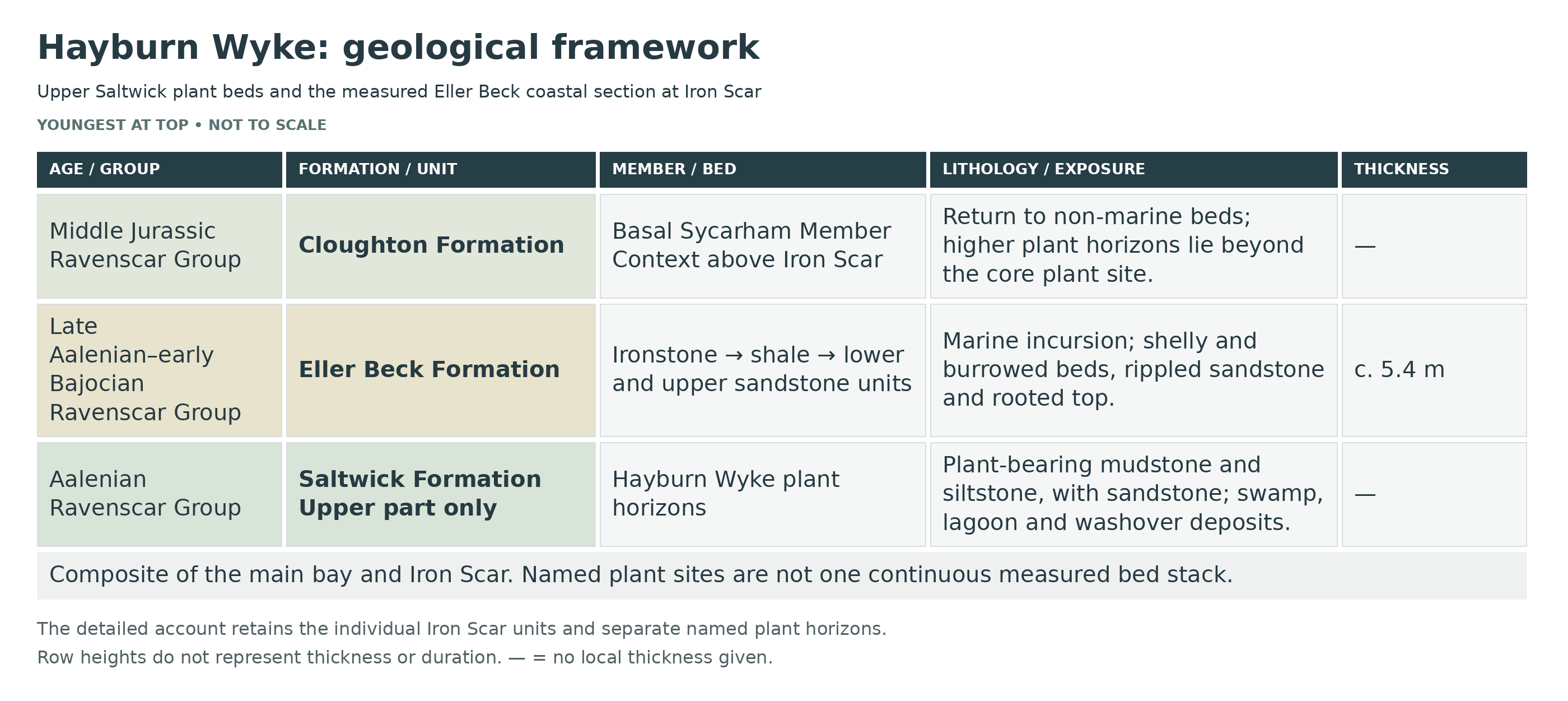
Hayburn Wyke is a composite Middle Jurassic plant locality in which the centre of the bay exposes upper Saltwick Formation floodplain and lagoon-margin beds containing the classic Hayburn Wyke Plant Bed, while the gently south-dipping succession brings the marine Eller Beck Formation to beach level at Iron Scar. It is one of the key Yorkshire Aalenian fossil-plant sites, notable for the rich Zamites flora, the unique liverwort Hepaticites haiburnensis, and the abrupt passage from non-marine delta-plain deposits into a shallow-marine transgressive succession.
At Hayburn Wyke the bedrock section is not a single clean cliff log. Thick glacial boulder clay caps the Middle Jurassic cliffs, the exposure is scattered across the rocky foreshore and the beck-cut waterfall gully, and parts of the section are often obscured by landslip. The main plant-bearing beds lie in fine-grained Saltwick Formation sediments in the centre of the bay, while the overlying Eller Beck Formation comes down to shore level at Iron Scar to the south.
The named plant horizons below follow Harris’s records as summarised in the Geological Conservation Review. They are geographically scattered collecting horizons, not a continuously measured numbered succession. The former HW identifiers were guide-only display labels and are omitted to avoid confusion with published bed numbers. The separately measured Iron Scar units retain their published lithological subdivisions and thicknesses.
Older site citations sometimes referred the Hayburn Wyke Plant Bed broadly to the Cloughton Formation, but modern GCR and BGS lithostratigraphy place the main Hayburn Wyke plant beds in the Saltwick Formation. A few higher Harris plant horizons above Iron Scar belong instead to the basal Sycarham Member of the Cloughton Formation and are included below only as context.
RAVENSCAR GROUP
Saltwick Formation (Aalenian)
Section Character Of The Saltwick Formation At Hayburn Wyke
Only the upper part of the Saltwick Formation is exposed at Hayburn Wyke. The formation here consists of grey mudstones, yellow-grey siltstones and yellow sandstones deposited in fluvial, fluviodeltaic and paralic settings. Published logs show repeated changes from vegetated swamp and floodplain mudstone into washover-fan, lagoonal and barrier-bar style sands and silts. The finer-grained beds yield the best-preserved and most diverse plant fossils, whereas the sandier units commonly contain only fragmentary, often charcoalified plant debris and wood.
Hayburn Beck Bed 1 And Hayburn Beck Bed 2 — Recorded Plant Horizons
Harris recorded Hayburn Beck Bed 1 and Bed 2 as separate plant-bearing localities in the Saltwick Formation. The GCR table locates them along Hayburn Beck rather than assigning a common measured thickness or a demonstrated position beneath every coastal plant bed. The local formation includes fine-grained floodplain and swamp mudstones, siltstones and thin sandstones, with roots, sideritic nodules, fossil wood and leaf material shown in the published Hayburn logs. Those section characteristics should not be read as individual measured descriptions of each of Harris’s two collecting horizons.
Main Hayburn Wyke Plant Bed — Tentative Correlation
The principal Hayburn Wyke Plant Bed probably corresponds to the Hayburn Beck and Zamites beds of Harris, according to the GCR account. This is a tentative historical correlation, not proof that the two geographically separate Zamites collecting localities are one continuous bed. It is intensely localized both vertically and laterally and lies within fine-grained argillaceous floodplain or swamp deposits, probably with nodular siderite and abundant fossil wood. Ferns are particularly common, including Clathropteris obovata, Coniopteris bella, C. hymenophylloides, C. murrayana, C. simplex, Matonidium goeppertii and Phlebopteris woodwardii; the pteridosperm Pachypteris lanceolata is also frequent. In some patches the bed is dominated by great numbers of Zamites gigas leaves with only a few Williamsonia stems, Williamsonia gigas flowers and Weltrichia sol, suggesting concentration of organs from a very local bennettitalean vegetation. This is the key vegetated-swamp horizon at Hayburn Wyke and the source of much of the classic museum material.
Hayburn Beck Zamites Bed
Harris’s locality list records the Hayburn Beck Zamites Bed separately at 54°21′32″ N, 0°26′50″ W. This named Saltwick Formation collecting horizon is retained independently of the Hayburn Wyke Zamites locality. No measured thickness or demonstrated bed-to-bed continuity between them is assigned.
Hayburn Wyke Zamites Bed
Harris’s Hayburn Wyke Zamites Bed is recorded at 54°21′27″ N, 0°26′32″ W, a separate locality in the coastal bay. Its relationship to the principal Plant Bed remains tentative. The plant assemblage described for the rich Zamites horizon is not automatically an independently documented species list for each of the two named collecting sites.
Hayburn Tindall Point Plant Bed
Harris’s Hayburn Tindall Point Plant Bed is another recorded Saltwick Formation plant horizon, east of the principal beck exposures. Its name and locality are retained separately from the main Zamites-bearing beds. The published Hayburn section shows repeated fine-grained vegetated-swamp and lagoonal deposits separated by sandier washover-fan intervals, but the GCR locality list does not securely tie the Tindall Point collecting horizon to one particular sand body or establish a simple bed-by-bed order among all the named plant sites. It is therefore not assigned a thickness or a more precise vertical correlation here.
Hayburn Phlebopteris Bed Below Iron Scar
Harris’s named Phlebopteris collecting horizon is recorded below Iron Scar in the Saltwick Formation. The name and its geographic position are supported, but its identity with a particular bed in Knox’s measured Iron Scar section is not established by the cited accounts.
Upper Saltwick Laminated Siltstone–Shale At Iron Scar — 1.68 m
Immediately below the Eller Beck Formation, Knox’s Iron Scar section records 1.68 m of pale-grey, delicately laminated siltstone-shale. It contains finely divided plant material, very small Rhizocorallium-like burrows and occasional runnels; rare bivalves occur on the undersides of some runnel casts. This is a local measured lithological unit, not an assigned thickness for Harris’s Phlebopteris Bed.
Underlying Upper Saltwick Mudstone At Iron Scar — Thickness Unassigned
The measured section also records underlying poorly laminated mudstone containing some sphaerosiderite. No thickness is given for this mudstone. Its position below the laminated 1.68 m interval is preserved, without identifying it with an unproven named plant horizon. Together these upper Saltwick beds show plant-bearing sediment with some aquatic and marine-influenced features before the overlying Eller Beck flooding.
Eller Beck Formation (Late Aalenian To Earliest Bajocian)
Section Character Of The Eller Beck Formation At Hayburn Wyke And Iron Scar
The overlying Eller Beck Formation is the thin marine incursion that flooded the Saltwick delta plain. At Hayburn Wyke the succession dips gently southward so that the unit reaches beach level at Iron Scar, an important coastal reference section. The Eller Beck here is a classic transgressive–regressive shallow-marine succession, beginning with a thin basal ironstone and passing upward through shelly silty shale into ripple-laminated and flat-bedded sandstone deposited by wave and tidal currents along a prograding strandline. The detailed subdivision below follows Knox’s published Iron Scar section.
Basal Eller Beck Transgressive Ironstone (up to 0.08 m)
The base of the formation is a very thin but highly distinctive ooidal sideritic ironstone or ironstone-rich mudstone resting sharply on the plant-bearing Saltwick beds below. Scattered marine fossils occur within it, and ironstone-filled burrows including Diplocraterion and Rhizocorallium penetrate the base. This is the flooding surface at Hayburn Wyke: a condensed marine transgressive bed marking abrupt replacement of the vegetated delta plain by shallow marine conditions.
Eller Beck Shale Unit (1.22 m)
Above the basal ironstone lies silty shale with shell casts in the lower part and thin laminae of fine sand higher up. This is the lowest substantial marine mudstone interval at Iron Scar. Its fauna is less spectacular than that of some higher Yorkshire marine beds, but shell casts and common bioturbation show definite marine colonization. Sedimentation took place in shallow but protected water on the newly flooded platform, before later sandier strandline facies prograded across the site.
Eller Beck Lower Sandstone Unit, Laminated Lower Division (0.56 m)
This division is a thin-bedded laminated sandstone with interbedded silty shale and ironstone. It marks the first major increase in sand supply after the initial mudstone phase. Ripple and lamination structures show transport by oscillatory and current action in shallow water, and the mixed sandstone–shale character indicates repeated pulses of reworking rather than uninterrupted sheet-sand deposition.
Eller Beck Lower Sandstone Unit, Thin-Bedded Shelly Division (1.83 m)
Thin-bedded sandstone with silty shale intercalations, impersistent beds of silty siderite mudstone and occasional shelly bands forms the main part of the lower sandstone unit. This interval was deposited on a shallow marine platform influenced by wave and tidal currents. Bioturbation is common and indicates that bottom waters were not persistently hostile; published interpretations suggest water depths of only a few metres. The interbedded shelly and sideritic layers record minor fluctuations in energy, salinity and sediment supply across the marine shoreline system.
Eller Beck Upper Sandstone Unit (1.68 m)
The top of the Eller Beck Formation at Iron Scar is a flat-bedded sandstone with some symmetrical ripple-marked surfaces and a top penetrated by rootlets. This is the clearest indication that the marine incursion was followed by renewed non-marine sedimentation. The sandstone has been interpreted as part of a shallow strandline or barrier-bar complex laid down under wave and tidal influence and then colonized subaerially or in very shallow brackish settings as the sea retreated or the shoreline prograded. It forms the uppermost marine to marginal-marine sandstone below the return to coal-measures facies of the Cloughton Formation.
Total Thickness Of The Eller Beck Formation At Iron Scar: About 5.4 Metres
Cloughton Formation (Context Above The Main Hayburn Wyke Section)
Sycarham Member
Basal Sycarham Member Above Iron Scar (context horizon only)
Immediately above the Eller Beck at and south of Iron Scar, the succession returns to cross-bedded, plant-debris-rich sandstone, siltstone and mudstone with rootlets belonging to the Sycarham Member. Harris recorded higher plant horizons here and nearby, including beds about 5 ft and 25 ft above Iron Scar, the Hayburn Gorse Bed, Thomas Bed 2, and an Equisetum-rich level just above Iron Scar. The latter is notable for being rich mainly in Coniopteris simplex, interpreted as a very local plant community around a small lagoon. These beds are not part of the core Hayburn Wyke Plant Bed section in the centre of the bay and are not always continuously exposed, but they are important context because they explain how the locality passes upward from the marine Eller Beck back into non-marine coal-measures facies.
Hayburn Gorse Bed And Gorse Bed (B5) — Separate Context Records
The GCR transcription of Harris’s notebooks lists both Hayburn Gorse Bed and Hayburn Gorse Bed (B5) in the Sycarham succession. They remain distinct recorded labels here; no measured interval, correlation or separate fossil assemblage is assigned where the table supplies none.
Hayburn–Top Of Eller Beck Bed — Context Record
Harris’s list separately records a Hayburn–Top of Eller Beck Bed among the Sycarham context localities. Its name is retained as recorded, without converting it into a new formal member or equating it automatically with the Equisetum-rich level above Iron Scar.
Other Harris Sycarham Context Horizons
The two records at 5 feet and 25 feet above Iron Scar, and Hayburn Thomas Bed 2, are separate entries in the locality list. Along with the Gorse records and Top of Eller Beck Bed, they document wider collecting sites rather than one proven uninterrupted vertical succession. The Equisetum bed discussed in the GCR interpretation is rich mainly in Coniopteris simplex, interpreted as a local lagoon-margin plant community.
Palaeobotany
The Hayburn Wyke flora includes about 60 recorded plant species. Particularly important are the liverwort Hepaticites haiburnensis, known only from this locality, and Cladophlebis haiburnensis, first described from here. The flora also includes numerous bennettitaleans such as Bucklandia gigas, Otozamites leckenbyi, O. mimetes, O. parallelus, O. tenuatus and Weltrichia sol, as well as the ginkgoalean Baiera furcata. Charcoalified conifer woods from floodplain mudstones and crevasse-splay sandstones have been described as Cedroxylon, Cupressinoxylon, Taxodioxylon and Xenoxylon phyllocladoides. The Saltwick Formation at Hayburn Wyke has also yielded pterosaur footprints assigned to Pteraichnus, showing that the locality preserves vertebrate trace fossils as well as the better-known plants.
Ammonite Age And Correlation
The Hayburn Wyke plant beds are Aalenian in age. The GCR Hayburn graphic section labels the Saltwick interval with the Concavum Zone and prints “discus” beside the Eller Beck interval; that printed label is not adopted here as an age assignment. BGS Research Report RR/11/06 gives the Saltwick Formation a regional Murchisonae to ?Bradfordensis range and the Eller Beck a ?Bradfordensis to ?Discites range. The chart uses Aalenian and late Aalenian–early Bajocian at the appropriate formation level without claiming that a specific ammonite horizon has been demonstrated in each local plant bed. BGS identifies Walk Mill Foss, Eller Beck, Goathland, as the formal Eller Beck type section; Iron Scar is the measured coastal section used here.
Depositional Environment
Hayburn Wyke records a clear environmental shift within the lower Ravenscar Group. The Saltwick Formation represents a coastal alluvial and delta-plain setting with vegetated swamps, floodplain muds, abandoned channels, shallow lagoons, washover fans and occasional barrier-like sand bodies; plant colonization, rootlet penetration, fossil wood and nodular siderite are typical. The overlying Eller Beck Formation records the arrival of shallow marine conditions, beginning with a thin transgressive ironstone and passing upward through muddy, shelly, bioturbated beds into sandier wave- and tide-worked shoreline deposits. Above that, the basal Sycarham Member shows rapid return to non-marine coal-measures facies.
Total Thickness Covered Here
At Hayburn Wyke only the uppermost part of the c. 50 m-thick Saltwick Formation is exposed in the main bay, together with about 5.4 m of overlying Eller Beck Formation at Iron Scar and a small amount of basal Sycarham Member for context. The locality should therefore be treated as a composite upper Saltwick–lower Eller Beck–basal Sycarham section rather than as a single uninterrupted cliff log.
References
van Konijnenburg-van Cittert, J.H.A. & Morgans, H.S. (1999). The Jurassic Flora of Yorkshire.
Cleal, C.J., Thomas, B.A., Batten, D.J. & Collinson, M.E. (2001). Mesozoic and Tertiary Palaeobotany of Great Britain, Geological Conservation Review Series No. 22, especially the Hayburn Wyke site account.
Knox, R.W.O’B. (1973). “The Eller Beck Formation (Bajocian) of the Ravenscar Group of NE Yorkshire.” Geological Magazine, 110, 511–533.
Barron, A.J.M., Lott, G.K. & Riding, J.B. (2012). Stratigraphical framework for the Middle Jurassic strata of Great Britain and the adjoining continental shelf. British Geological Survey Research Report RR/11/06.
British Geological Survey Lexicon of Named Rock Units: Saltwick Formation, Eller Beck Formation and Cloughton Formation.
Cox, B.M. & Sumbler, M.G. (2002). British Middle Jurassic Stratigraphy, Geological Conservation Review Series No. 26, especially the Iron Scar–Hundale and Hundale Point–Scalby Ness account.
Whyte, M.A. & Romano, M. (2014). “First record of the pterosaur footprint Pteraichnus from the Saltwick Formation (Aalenian) of the Cleveland Basin, Yorkshire, UK.” Proceedings of the Yorkshire Geological Society, 60, 19–27.
SAFETY
Common sense when collecting at all locations should be used and knowledge of tide times is essential. Keep away from the cliff face, as falls can be quite common along this coastline. It is also very easy to get cut off from the tide, so ensure you return before the tide turns.
EQUIPMENT
At Hayburn Wyke, most fossils are found by carefully splitting fine-grained sandstone and siltstone blocks that contain delicate plant impressions. A geological hammer and flat chisels may be useful on permitted loose blocks, working gently along natural bedding planes. Do not hammer the in-situ beds or cliffs, and leave an already exposed delicate impression supported on its slab. Because many of the plant fossils are thin carbonised impressions, controlled, precise blows are far more effective than heavy strikes. Eye protection should always be worn when splitting rock. Bringing shallow trays or rigid containers lined with padding is highly advisable, as plant fossils can be extremely fragile and may flake or crumble if loosely carried in a bag. Strong footwear with good grip is also important due to uneven boulders, slippery surfaces and occasional landslip debris. Always avoid working directly beneath unstable cliffs and be mindful of tide conditions when collecting on either side of the waterfall.
CLEANING AND TREATING
Keep delicate plant impressions supported on their original slabs. Do not scrub or brush across the thin carbonised surface, and avoid soaking fragile or laminated specimens. A very soft dry brush may remove loose debris from stable surrounding matrix, but stop if the surface flakes. Keep specimens out of direct sunlight and seek specialist advice before preparing unusual leaves, stems or reproductive structures.
Do not seal every plant fossil. Where consolidation is genuinely needed, Paraloid B-72 may be suitable after assessment of the fossil and matrix. It can be re-dissolved, but complete removal from a porous slab or fragile carbon film may be difficult. Record any treatment and leave potentially important specimens uncoated until they have been assessed.
IDENTIFY YOUR FINDS
Need help identifying a fossil? Share clear photos, where you found it and its size with the community.
FURTHER READING
Geological Conservation Review – Hayburn Wyke
British Geological Survey – Saltwick Formation
British Geological Survey – Eller Beck Formation
Geological Conservation Review – The Jurassic palaeobotany of Yorkshire
ACCESS RIGHTS
This site is a site of special scientific interest (SSSI). This means you can visit the site, but hammering the bedrock is not permitted. For full information about the reasons for the status of the site and restrictions, download the PDF from Natural England
It is important to follow our ‘Code of Conduct’ when collecting fossils or visiting any site. Please also read our ‘Terms and Conditions‘
LINKS
♦ Fossil Discussions
♦ Fossil Articles
♦ Buy Fossils, Tools and Equipment
♦ Buy Crystals, Meteorites, and Artefacts
♦ Join Fossil Hunts
♦ UK Fossils Network