An easily accessible location, perfect for families and children to search for fossil shark teeth and shells along the shingle foreshore. The characteristic fossils, from middle Eocene marine beds, can be collected without tools—simply picked up from the beach. The best time to find them is after storms have passed, when sea and ground conditions are safe, or during suitable winter low tides, but teeth can still be discovered year-round.


FIND FREQUENCY: ♦♦♦ – During winter, especially after storms and during periods of very low water, shark teeth and fossil shells are quite common. In summer, however, they can be harder to find, as the site is often picked over by many visitors. For the best chances of success, visit outside peak times.
CHILDREN: ♦♦♦♦♦ – This is a fantastic location for children, just a few metres from the car park. The beach is easy to explore, with no cliffs, and fossils can be found along the foreshore. Being in a seaside town, there are also plenty of other activities for children beyond fossil hunting.
ACCESS: ♦♦♦♦♦ – From the main car park, it’s just a short walk to the shingle beach where fossils can be found. Access to the seafront is straightforward, but loose shingle, uneven ground and the tide can limit access to the fossil-bearing foreshore.
TYPE: – This is a foreshore-only location. Fossils can be found among the shingle along the foreshore.
DIRECTIONS
♦ Head to Lee-on-the-Solent and park at Monks Hill Car Park. The car park is at the north-western end of the Lee seafront, towards Hill Head. Check Fareham Borough Council’s current parking charges and the signs before leaving the car.
♦ From the car park, walk directly onto the shingle foreshore, where fossil hunting for shark teeth and Eocene fossil shells begins.
♦ Fossils can be found along the shoreline, especially after storms or at low tide. The best area to search is along the exposed gravel beds where natural erosion reveals new finds.
♦ Facilities: Nearby, you’ll find toilets, cafés, and shops along the Lee-on-the-Solent seafront.
♦ Postcode to car park: PO13 9LT. Google Maps
♦ Location area: WHAT3WORDS: ///payback.report.snacking

A FIELD GUIDE TO COLLECTING BRITISH CENOZOIC FOSSILS
by Steve Snowball & Alister Cruickshanks
£21.99 (PAPERBACK)
FULL COLOUR – 190 PAGES
Available worldwide exclusively through Amazon
- Fossil identification plates
- Stunning locality and fossil photos
- Up-to-date geological & site information
- Best fossil-bearing sites in southern and eastern Britain described in detail
- Illustrations of life in deep time by Andreas Kurpisz
VIDEO FILM
FOSSIL HUNTING
Lee-on-the-Solent is an excellent and accessible location for fossil collecting, particularly suited to families and beginners, with loose fossils available on the open foreshore. The fossils here are derived from Eocene marine deposits, and although the site is not as consistently productive as some locations further west, it can still yield a wide variety of interesting finds under the right conditions, after storms or strong wave action have redistributed material and safe conditions have returned.
Shark teeth are among the most sought-after finds in the shingle and gravel. The characteristic fauna includes Striatolamia macrota, with slender, finely striated crowns, alongside other sand-tiger-type teeth recorded historically under Carcharias and Odontaspis. Published Lee records also include Jaekelotodus trigonalis, Alopias leeensis and the larger Otodus auriculatus. Crown shape, lateral cusps, serrations and root form all matter for identification. The older species Otodus obliquus should not be presented as a normal member of this middle Eocene fauna: Ward’s revised guide explicitly excludes it from that age. Loose teeth need careful identification and a recorded finding position rather than an assumed bed assignment.
In addition to sharks, a wide range of marine invertebrates can be found, particularly from the Bracklesham and Barton Groups. Bivalves are especially common and include species such as Glycymeris (dog cockles), Venericor (formerly Venericardia), Pecten (scallops), Cardita, Corbula and Dosinia. These shells are often well preserved and can sometimes be found complete within the shingle. The named local Selsey horizons include the Amusium corneum, Miocardia and Pinna beds. Preservation differs at Elmore, where most beds are decalcified and the Coral Bed is the main exception retaining calcareous macrofossils.


Gastropods are also abundant and include characteristic Eocene forms such as Turritella, Natica, Volutilithes, Conus, Fusinus and Cerithium. These spiral shells often display fine ornamentation and can vary greatly in size and shape, reflecting the diversity of marine life in the Eocene seas. Fragments are common, but complete specimens can occasionally be found with careful searching.
Other documented finds include crustaceans, ray teeth and dental plates, chimaeroid tooth plates, fish bones and otoliths. Lee supplied the type of the chimaeroid Elasmodus kempi, and its rare bird and mammal remains are scientifically important. Bird bones have been recorded from both the Selsey beds and the Elmore Member, with the precise levels and historical identifications explained below. Loose bone must not be labelled as Ice Age deer or horse solely because it was found among modern shingle or near Quaternary cover; retain its matrix and seek an identification.
Most collecting at Lee-on-the-Solent is carried out by carefully searching the foreshore, particularly in areas where shingle and gravel accumulate. Fossils often become concentrated in natural traps where wave action has sorted and deposited material. A notable feature is the shingle bank extending out to sea, visible from the car park, but low water does not guarantee a safe route across it. Keep a clear, dry return route, avoid soft mud and channels, and turn back well before the tide isolates a bank.
Success at this location relies heavily on a keen eye and patience. Look for unusual shapes, smooth enamel surfaces, or symmetrical forms that stand out from the surrounding pebbles. Fossils can often be partially buried or only just visible, so careful and methodical searching is key.
Some of the most significant fossil discoveries and scientific milestones from Lee-on-Solent include classic work on the Bracklesham beds, important vertebrate faunas with abundant shark and fish remains, rare Middle Eocene bird fossils, and type specimens described from the site.
1862 – Osmond Fisher described the Bracklesham strata at Lee-on-Solent
One of the earliest important scientific milestones at Lee-on-Solent was the work of Osmond Fisher, who described the Bracklesham beds here in 1862. His observations helped establish the site as an important Hampshire Eocene locality and provided the framework for later fossil work.
1976–1977 – Elasmodus kempi described from Lee-on-Solent
Lee-on-Solent produced the type specimen of Elasmodus kempi, one of the site’s most important named fossil discoveries. This chimaeroid helped confirm the exceptional importance of Lee for Middle Eocene fish faunas, especially cartilaginous fishes.
1979 – six species of fossil birds described from Lee-on-Solent material
The bird fossils from Lee-on-Solent were described by Harrison and Walker in 1979. These included six species, making the locality one of the very few British sites to yield a significant Middle Eocene avifauna and one of the most important bird localities of this age in Europe.
Late 1970s – vertebrate-bearing beds at Lee-on-Solent were documented in detail
Work in the late 1970s showed that several beds at Lee-on-Solent contained vertebrate remains, including sharks, rays, chimaeroids, bony fish, reptiles, birds and mammals. This established the site as one of the richest Middle Eocene vertebrate localities in southern England.
1980 – Lee-on-Solent recognised as an important mammal locality
By 1980, fossil mammals had also been recorded from Lee-on-Solent, including remains referred to Propalaeotherium, Palaeotherium and Lophiodon. Although much rarer than the fish material, these finds added further importance to the site.
1980s – Lee-on-Solent established as one of Britain’s richest Middle Eocene shark localities
Later work confirmed that Lee-on-Solent had yielded more than 30 species of shark, together with several chimaeroids and a rich otolith fauna. This made the site one of the key British localities for Middle Eocene marine vertebrates.
Modern understanding – Lee-on-Solent remains a key Bracklesham Group vertebrate site
Modern reviews continue to recognise Lee-on-Solent as an important Bracklesham Group locality for shark teeth, fish remains, otoliths, birds and other vertebrates. Even though parts of the historic exposure have been affected by sea-defence work, the site remains significant in the study of British Middle Eocene vertebrates.
GEOLOGY
The geology at Lee-on-the-Solent forms part of the Hampshire Basin. Its documented fossil-bearing foreshore sections are middle Eocene marine sands, silts and clays, rather than a section spanning the whole Eocene Epoch.
The principal logged units are the Selsey Sand Formation of the Bracklesham Group and, farther south-east at Elmore, the Elmore Member of the Barton Clay Formation. Their glauconitic sands and shelly or decalcified clays record marine sedimentation. The other Bracklesham formations of the wider Hampshire Basin are not inserted into this local foreshore succession.
The Selsey and Elmore beds yield shells, crustaceans and vertebrate remains, including shark and ray teeth and rare bird bones. Many beach finds have been washed out and redistributed, while in-place exposures vary with beach cover. The contact between the two units is concealed beneath Pleistocene channel deposits.
Pleistocene channel deposits and younger beach cover conceal parts of the Eocene outcrop. At Elmore the channel-fill hides the Selsey–Elmore junction, while modern waves and tides repeatedly redistribute sand, shingle and fossils across the foreshore. A beach find may therefore be reworked and cannot be assigned to an Eocene bed simply from its present position.
The coastline today is shaped by ongoing marine processes, particularly longshore drift, which moves shingle and sediment along the coast. Periodic erosion can expose patches of the underlying Bracklesham Group, releasing new fossil material onto the beach. As a result, the geology here represents a combination of in-situ Eocene deposits and reworked material, making it a productive and ever-changing fossil collecting environment.

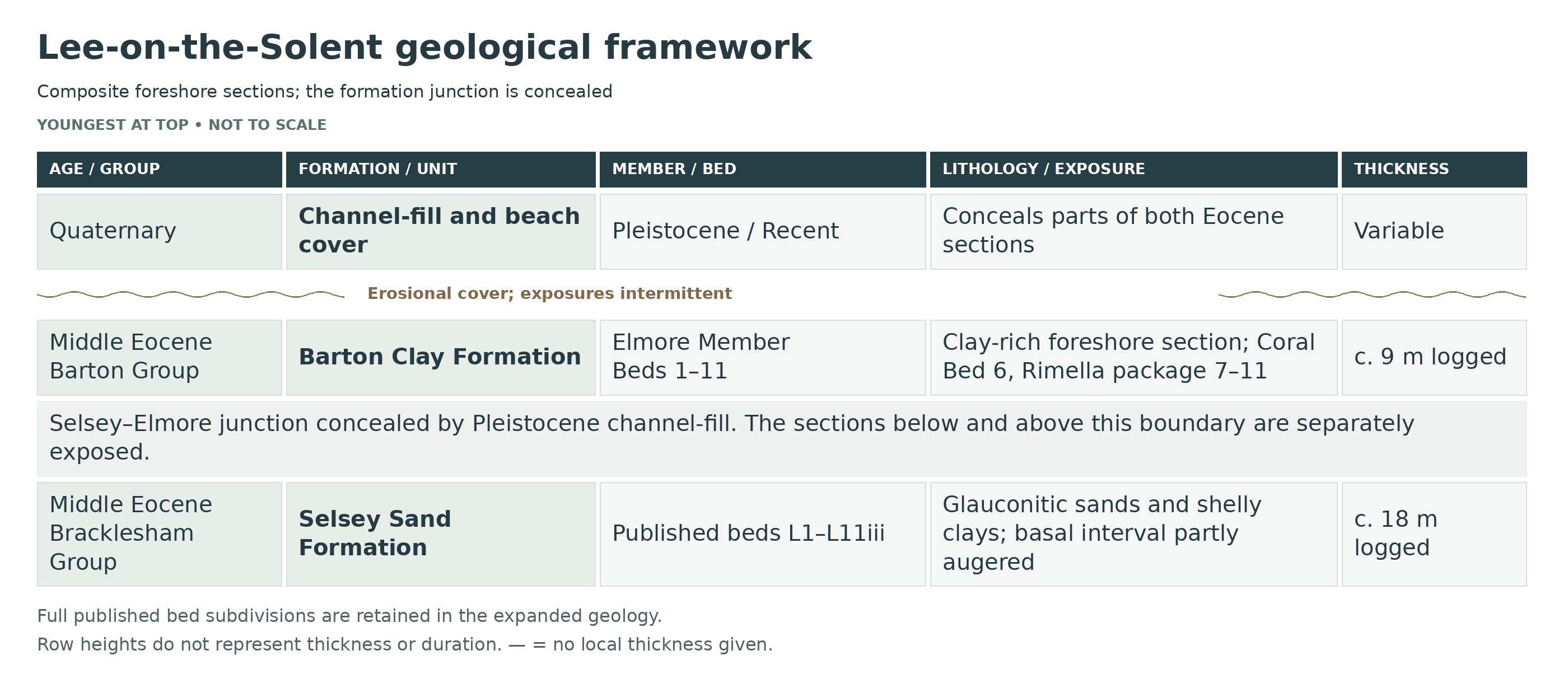
This is a composite stratigraphic breakdown of Lee-on-the-Solent, where the lower foreshore exposes fossil-rich upper Selsey Sand Formation and the separate Elmore foreshore exposes the lower Elmore Member of the Barton Clay Formation. The locality is one of the key middle Eocene vertebrate sites in the Hampshire Basin, but the section is low, tide-dependent and now partly concealed by Pleistocene channel-fill, beach deposits and sea-defence works.
Section Architecture
Lee-on-the-Solent is not a single continuous cliff log. The Selsey Sand Formation is best logged on the lower foreshore between Knight’s Bank, Monk’s Hill and the eastern seafront, whereas the Elmore Member is exposed farther south-east at Elmore; the actual Selsey–Elmore junction is hidden beneath a Pleistocene channel-fill, and modern sand, shingle, algae and engineering works commonly mask large parts of the outcrop.
BRACKLESHAM GROUP
Selsey Sand Formation
Selsey Sand Formation Note
The published labels L1–L11iii are Kemp’s Lee-on-the-Solent bed numbers and are retained here exactly. Older literature called these beds the upper Selsey Formation or Selsey Division; in current BGS usage they belong to the Selsey Sand Formation. The Lee Selsey section is a glauconitic, fully marine, strongly bioturbated shallow-shelf succession and is especially important for shark, ray and teleost remains, with rare middle Eocene bird bones recorded from several levels.
Bed L1–L3v — Campanile Bed Package (c. 4.59 m; lowest part partly augered)
L1–L3v comprise the basal Campanile Bed package of the Lee section, although the classic fossiliferous Campanile horizon is not cleanly exposed in the main foreshore and the lowest bed L1 was proved only by auger; the basal part is exposed separately at Croften Cliff to the west. Grey glauconitic sand, laminated silty clay and bioturbated silty sand dominate, with abundant molluscs near the base and increasingly sandy, burrowed facies through L3i–L3iv. The package records shallow fully marine sedimentation on a glauconitic inner shelf, with alternating quieter mud settling and more active burrow-reworked sand deposition.
L1 (0.25 m)
Mollusc-rich grey glauconitic sand; this lowest interval was proved by auger.
L2 (0.11 m)
Laminated grey silty clay overlies L1.
L3i (0.46 m)
Grey glauconitic silty sand becomes sandier downwards.
L3ii (1.60 m)
Grey sandy silt contains fine glauconite.
L3iii (1.57 m)
Bioturbated grey-green silty sand contains fine glauconite.
L3iv (0.58 m)
Bioturbated grey-green glauconitic silty sand overlies L3iii.
L3v (0.02 m)
A very thin laminated grey clayey silt caps the package beneath L3vi.
Bed L3vi — Silt Bed (0.99 m)
Dark green-grey silty glauconitic sand with intense bioturbation at the upper contact and rare black pebbles throughout. Invertebrates, vertebrate debris and plant remains are all recorded from this bed, making it one of the lower fossil-yielding horizons in the Selsey succession at Lee. It represents a current-worked marine silt-sand floor with repeated burrowing and periodic terrestrial organic input.
Historical bird identifications reported by the GCR include Milvoides kempi from the interval L3vi–L5ii. This is the published range of the recovered material, not a claim that specimens were found in every intervening bed.
Bed L4 — Shell-Bearing Glauconitic Sand (0.50 m)
Green to dark green clayey, silty glauconitic sand with many bivalves and burrows infilled with glauconite. This is a shelly, heavily bioturbated marine sand bed formed during a short interval of greater sand input and benthic activity than in the finer beds above and below.
Bed L5i–L5ii — Amusium corneum Bed (2.24 m)
Grey-green to blue-grey sandy clay with fine glauconite, becoming more sandy and glauconitic upward, with thin burrows filled by fine pyritic sand and occasional concretions. Molluscs and vertebrate remains are frequent, especially in L5i, and this interval lies within the main bird-bearing middle part of the Selsey section at Lee. The bed records quiet shallow-marine clay deposition interrupted by burrowing, pyritization and local concentration of shell and vertebrate debris.
Bird material from L5i–L5ii was historically identified as Percolinus proudlocki, Parvirallus gracilis, Latipons gardneri and Latipons robinsoni. These are the reported historical identifications. The GCR explicitly notes Olson’s doubt about assigning the isolated bones of the latter three taxa to the rail family Rallidae; the family interpretation should therefore not be treated as settled.
L5i (1.60 m)
Stiff grey-green sandy clay has sparse glauconite, pyritic-sand-filled thin burrows and scattered concretions. Shark, ray and teleost remains are frequent.
L5ii (0.64 m)
Blue-grey sandy clay becomes sandier and more glauconitic towards its upper contact; molluscs and vertebrate remains occur.
Bed L6i–L6iii — Miocardia Bed (1.68 m)
Grey-blue to brown-grey silty to clayey glauconitic sands, with large calcareous concretions in L6i, some containing bored driftwood near the upper contact, and with rare bivalves, small gastropods and occasional Nummulites. This named bed represents shell-bearing shallow-marine sands with early concretion growth, woody drift input and a moderate benthic fauna on a glauconitic sea floor.
L6i (0.60 m)
Grey-blue silty sand with fine glauconite contains calcareous concretions about 100 mm across, sometimes enclosing bored driftwood near the top; rare bivalves and occasional Nummulites occur.
L6ii (0.45 m)
Stiff pale brown-grey silty sand contains fine glauconite, rare small bivalves and occasional Nummulites.
L6iii (0.63 m)
Grey to dark-green glauconitic clayey sand contains sparse bivalves and small gastropods.
Bed L7i — Lower Pinna Bed Sand And Pebbly Base (0.57 m)
Dark green-grey glauconitic sandy clay to silty sand, intensely bioturbated at the base, with occasional rounded black pebbles and large molluscs above. This bed marks the incoming of the Pinna Bed facies and records a shell-bearing, mobile shallow-marine substrate.
Bed L7ii — Main Pinna Bed (1.80 m)
Grey-brown stiff sandy clay, slightly slickensided at the top, with fine glauconite and large flat oval concretions in the upper part, many surrounding colonies of Pinna and concentrated Nummulites variolarius. Small molluscs are common throughout, and rare vertebrates occur in green-sand pockets. This is one of the classic Lee shell-and-vertebrate beds and represents a colonized marine bottom with local shell concentration and patchy early cementation.
Bed L7iii–L8 — Upper Pinna Bed Clays (2.79 m)
Grey-green stiff sandy silty clays with well-preserved bivalves, passing up into grey stiff clays with brown patches. These upper Pinna Bed muds represent quieter marine conditions than L7ii, with continued benthic life but less obvious sand concentration and more uniform muddy sedimentation.
L7iii (2.40 m)
Stiff grey-green sandy silty clay contains well-preserved bivalves throughout.
L8 (0.39 m)
Stiff grey clay shows slickensides and brown patches above the bivalve-bearing L7iii.
Bed L9 — Lower Brook Bed (0.76 m)
Green-grey sandy clay to silty sand with fine glauconite, thin burrows filled with pyritic sand and a more sandy middle part. A diverse invertebrate fauna and vertebrate remains are recorded from this bed, which is one of the more productive fossil horizons on the Selsey foreshore. It represents a burrowed shallow-marine silt-sand bed with repeated pyrite formation and shell/vertebrate accumulation.
Bed L10 — Upper Brook Bed (1.06 m)
Grey-green stiff slickensided clay in which molluscs and Nummulites are concentrated in small sandy lenses. Compared with L9, this bed is muddier and more condensed in appearance, suggesting quieter background sedimentation interrupted by localized shell and larger-foraminiferal concentrations.
Bed L11i–L11ii — Lower Nummulites variolarius Bed (0.55 m)
Green-grey sandy clay overlain by a very thin grey stiff clay, with abundant Nummulites and large molluscs. This is the lower part of the topmost nummulitic Selsey package and records a strongly shelly, larger-foraminiferal shallow-marine bottom.
L11i (0.50 m)
Green-grey sandy clay includes finely glauconitic silty-sand patches, plentiful Nummulites and large molluscs.
L11ii (0.05 m)
A very thin stiff grey clay contains only rare molluscs; the abundant fossils in L11i must not be assigned indiscriminately to this clay.
Bed L11iii — Upper Nummulites variolarius Bed (0.51 m)
Grey glauconitic sandy clay weathering yellow-brown and packed with Nummulites variolarius, molluscs and lignitized driftwood. This is the distinctive top of the Selsey Sand Formation at Lee, comparable with the classic Variolarius Bed of the Isle of Wight, and it is best interpreted as a very shallow warm-marine shell-and-nummulite facies, below the concealed transition to the Barton Clay.
Variolarius Bed beneath the Elmore foreshore section (about 1.35 m)
GCR Table 4.5 separately records glauconitic shelly sandy clay with abundant molluscs and nummulites beneath the Elmore Member. Its approximate 1.35 m thickness belongs to that Elmore foreshore record. It is a comparison with the north-western Selsey log, where L11i–L11iii total 1.06 m, and is neither an extra bed above L11iii nor an identical measurement of the same exposure.
Total Thickness Of The Logged Upper Selsey Sand Formation At Lee-on-the-Solent: Approximately 18.0 Metres, Although The Lowest Part Is Partly Augered And The Top Contact With The Elmore Member Is Concealed
BARTON GROUP
Barton Clay Formation
Elmore Member
Fragmentary bird bones from the Elmore Member were reported as a radius tentatively assigned to Presbyornithidae, a carpometacarpus assigned to Phasianidae and a tarsometatarsus tentatively assigned to Psittacidae. These records retain the source’s family-level uncertainty and member-level provenance; they are not assigned to any individual numbered Elmore bed.
Elmore Member Note
The numbered units 1–11 are the published Elmore succession of Kemp and co-workers and are retained exactly. The published Elmore section covers approximately 9 m (reported as 9.05 m by Kemp and co-workers; the rounded values reproduced in GCR Table 4.5 sum to 9.04 m), and most beds are heavily decalcified; apart from the Coral Bed, fossils are usually preserved as pyritic moulds, phosphatic nodules or microfossil residues of diatoms and agglutinating foraminiferids. Regionally the Selsey–Barton boundary is an omission surface, but at Lee the actual junction is concealed by Pleistocene deposits.
Bed 1 — Basal Glauconitic Sandy Clayey Silt (0.98 m)
Mid-green glauconitic sandy clayey silt forming the basal exposed Elmore facies. Although the actual basal surface is hidden, this unit represents the incoming of fine muddy Barton facies above the nummulitic top-Selsey beds and records low-energy marine deposition with dispersed glauconite ; microfossils and vertebrate remains are documented from the Elmore succession, without assigning their abundance specifically to Bed 1.
Bed 2 — Pale Blue Stiff Clay, Increasingly Sandy Downward (1.54 m)
Pale blue stiff clay becoming sandier and more glauconitic downward, with slickensiding in the lower part. This is a quiet-water mud unit with strong compaction fabrics ; diatoms are documented from the Elmore succession as a whole.
Bed 3 — Green Silty Glauconitic Sand With Clay-Filled Burrows (0.32 m)
A thin green silty glauconitic sand penetrated by clay-filled burrows. This bed marks a brief renewal of sandier input and active bioturbation on an otherwise muddy sea floor.
Bed 4 — Mid-Green Finely Glauconitic Sandy Clay (0.60 m)
Finely glauconitic sandy clay with some medium-grained quartz and glauconite. The coarser admixture suggests slightly more energetic sediment influx than in the surrounding units, but the bed remains a marine mud-rich facies rather than a true sand body.
Bed 5 — Thick Lower Elmore Clay (2.15 m)
Pale blue-green stiff slightly sandy clay, slickensided at upper and lower contacts and glauconitic in the lower part. This is the thickest lower unnamed Elmore clay and another substantial argillaceous unit, representing prolonged low-energy muddy marine sedimentation before the incoming of the Coral Bed.
Bed 6 — Coral Bed (0.90 m)
Pale blue-green shelly sandy clay with interspersed siltstones. This is the only Elmore bed at Lee to retain obvious calcareous macrofossils in place and yields solitary corals, bivalves and serpulids. It is the key marker horizon of the lower Elmore Member at Lee and records a shelly marine bottom with firmer substrate and a brief interval of better carbonate preservation.
Bed 7 — Rimella canalis Bed, Basal Nodular Unit (0.42 m)
Pale blue-green sandy clay with nodular claystones and siltstones throughout. This bed is probably the source of some of the Elmore vertebrate fauna, and phosphatic nodules at or close to this level yield rare pyritized gastropods together with crustacean remains. It marks the base of the published Rimella canalis Bed package.
Bed 8 — Rimella canalis Bed, Lower Pyritic Clay (0.80 m)
Pale blue stiff pyritic clay, slickensided at the upper contact. This is a reduced, low-energy muddy sublayer within the Rimella canalis Bed package and an argillaceous level in the Elmore succession.
Bed 9 — Rimella canalis Bed, Laminated Middle Unit (0.35 m)
Pale blue-green laminated clay with very fine glauconitic sand and tabular siltstones at the upper contact. Fine lamination indicates quiet settling punctuated by thin silt influxes. The tabulated local description does not assign a nummulitid occurrence to this individual bed.
Bed 10 — Rimella canalis Bed, Upper Pyritic Clay (0.46 m)
Pale blue stiff pyritic clay. Macrofaunal evidence is sparse and the unit represents another quiet-water reducing clay phase within the upper part of the Rimella canalis Bed package.
Bed 11 — Rimella canalis Bed, Top Sandy Clay With Burrows And Lignite (0.52 m)
Pale blue-green pyritic glauconitic sandy clay with clay-filled burrows and mollusc-bored lignite. Poorly preserved moulds of bivalves, scaphopods and gastropods characterize the published Rimella canalis Bed package (Beds 7–11), rather than being assigned exclusively to Bed 11, and the lignite and bored woody fragments show repeated organic input to the sea floor. This is the highest exposed Elmore bed at the locality, but the member continues upward regionally beyond the visible foreshore.
Total Thickness Of The Exposed Elmore Member At Elmore: 9.05 Metres, Representing Only The Lower Part Of A Regionally Thicker Member
Pleistocene And Recent Cover
At Elmore, a Pleistocene channel-fill masks the junction between the Nummulites variolarius Bed of the Selsey Sand Formation and the basal Elmore Member. Elsewhere along the shore the Eocene beds are blanketed or intermittently hidden by Pleistocene and Recent sands, gravels, shingle and mud, and modern coastal engineering has further reduced the continuity of exposure.
Exposure And Collecting Note
Lee-on-the-Solent is best treated as a foreshore collecting and correlation locality rather than a measured cliff section. Classical exposures were modified or locally buried by sea-defence and engineering works, especially in the late twentieth century, so productive ground is now patchier and strongly dependent on tide, storm cleaning and temporary stripping of beach cover.
Depositional Environment
The Lee-on-the-Solent middle Eocene succession is wholly marine. The upper Selsey Sand Formation records a glauconitic shallow-shelf to very shallow inner-marine system with bioturbated sands, shelly clays, drifting wood, local Pinna colonies, diverse mollusc beds and a topmost nummulitic facies characteristic of warm shallow-marine conditions. The overlying Elmore Member records renewed muddy marine transgression above a regional omission surface, with decalcified glauconitic clays and silts, diatom- and agglutinated-foraminifera-rich microfacies, a discrete coral-shell horizon, phosphatic crustacean and vertebrate nodules, and a higher pyritic Rimella canalis Bed package.
Total Thickness Covered Here: Approximately 18 Metres Of Upper Selsey Sand Formation And 9.05 Metres Of Lower Elmore Member Are Documented At Lee-on-the-Solent, But They Are Exposed In Separate Low-Foreshore Sections Rather Than As A Single Continuous Face
References
Fisher, O. (1862). On the Bracklesham Beds of the Isle of Wight Basin.
Kemp, D.J., King, A.D., King, C. & Quayle, W.J. (1979). Stratigraphy and biota of the Elmore Formation (Huntingbridge division, Bracklesham Group) at Lee-on-the-Solent, Gosport, Hampshire.
Kemp, D.J. (1985). The Selsey Division (Bracklesham Group) at Lee-on-the-Solent, Gosport, (Hants).
Curry, D., King, A.D., King, C. & Stinton, F.C. (1977). The Bracklesham Beds (Eocene) of Bracklesham Bay and Selsey, Sussex.
Edwards, R.A. & Freshney, E.C. (1987). Lithostratigraphical classification of the Hampshire Basin Palaeogene deposits (Reading Formation to Headon Formation).
British Geological Survey Lexicon of Named Rock Units: Bracklesham Group, Selsey Sand Formation and Barton Clay Formation.
Dineley, D. & Metcalf, S.J. (1999). Fossil Fishes of Great Britain, Geological Conservation Review account for Lee-on-Solent.
Benton, M.J., Cook, E. & Hooker, J.J. (2005). Mesozoic and Tertiary Fossil Mammals and Birds of Great Britain, Geological Conservation Review account for Lee-on-the-Solent.
Kemp, D.J. (1999). Recent coastal protection and associated temporary exposures to the Middle Eocene coastal sections at Lee-on-the-Solent, Gosport, Hampshire.
Barnet, J. (2023). Geological evolution of the Hampshire Basin during a global climate transition from hothouse to coolhouse in the Palaeogene.
SAFETY
Check local tide times, weather and sea conditions before visiting. The open foreshore avoids the need to work beneath cliffs, but loose shingle, slippery surfaces, soft mud and tidal channels still require care. Keep children closely supervised, stay out of the water and retain a clear return route from exposed banks. Do not collect during storms; if the tide or ground makes the route uncertain, turn back.
EQUIPMENT
Lee-on-the-Solent is an excellent location for fossil collecting and, in most cases, very little equipment is required. The majority of fossils can be found loose within the shingle or on the surface of the foreshore, so a good eye and patience are often all you need to make successful finds.
However, many of the fossils here—particularly shells—can be fragile and easily damaged, so it is important to bring wrapping materials such as tissue, newspaper or bubble wrap. Small Tupperware-style containers or specimen boxes are highly recommended to keep your finds safe during transport.
A pair of tweezers can also be useful for picking up smaller or delicate specimens from the shingle, especially in wet conditions. While tools are generally not necessary, a small hand trowel should be used only where permitted to move loose beach material, never to excavate attached bedrock or the in-place fossil beds.
As the foreshore is made up of pebbles, shingle and uneven ground, it is advisable to wear sturdy footwear with good grip. A small bag or backpack is also useful for carrying your finds and equipment comfortably along the beach.
CLEANING AND TREATING
Support fragile shells, teeth and matrix, then remove only loose sediment with a very soft brush. Do not give every specimen a fixed 24-hour soak: water can soften clay-rich matrix and harm unstable or pyritic material. Salt removal needs a specimen-specific plan. Avoid heat and rapid drying, keep unstable pyritic finds dry and supported, and seek preparation advice for important or crumbling specimens.
Paraloid B-72 can help selected fragile areas after testing, but sound fossils do not automatically need coating. It is not a waterproof seal, and complete removal from porous fossils or matrix cannot be guaranteed. Keep specimens supported in stable storage and record any treatment; important finds should be assessed before adhesive or consolidant is applied.
IDENTIFY YOUR FINDS
Need help identifying a fossil? Share clear photos, where you found it and its size with the community.
FURTHER READING
Lee-on-Solent — GCR fossil fishes
Solent Estuaries Introduction — Ian West
Lee-on-the-Solent to Itchen Estuary SSSI: citation
ACCESS RIGHTS
This site is a site of special scientific interest (SSSI). Designation does not itself grant access or collecting permission. Follow current local notices and permissions; digging the bedrock clay (which is rarely exposed at this location and not needed to find fossils) is not permitted.
It is important to follow our ‘Code of Conduct’ when collecting fossils or visiting any site. Please also read our ‘Terms and Conditions‘
LINKS
♦ Fossil Discussions
♦ Fossil Articles
♦ Buy Fossils, Tools and Equipment
♦ Buy Crystals, Meteorites, and Artefacts
♦ Join Fossil Hunts
♦ UK Fossils Network