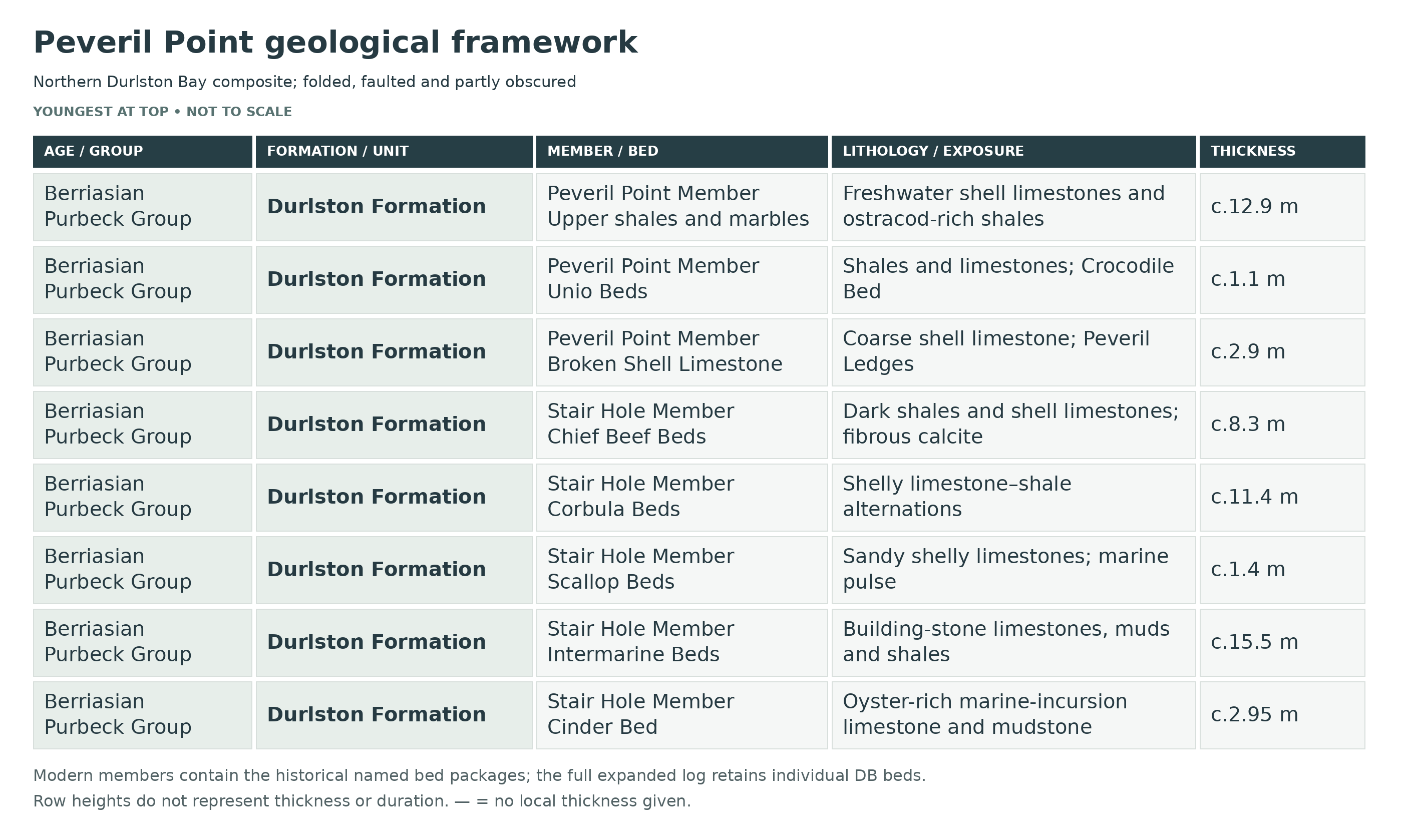
The stretch of coastline from Peveril Point into the eastern half of Durlston Bay exposes part of the renowned Purbeck Limestone Group, one of the most important Late Jurassic–earliest Cretaceous sequences in Britain. This section is particularly known for its accessible ledges and foreshore exposures, where fossils can be found without venturing too far into the more hazardous parts of the bay. Although finds can be small and require careful searching, this area offers a rewarding introduction to the complex lagoonal environments of the Purbeck beds, with a mix of vertebrate fragments, shells and microfossils regularly discovered.


FIND FREQUENCY: ♦♦♦♦ – This section can be productive, with fossils regularly found along the foreshore. While many specimens are small, consistent searching of shingle, ledges and softer layers can yield a good range of material, making it a reliable area compared to the more challenging western section.
CHILDREN: Close adult supervision is needed on slippery rock ledges; keep clear of cliffs and any section without a safe return route.
ACCESS: Paths and steps lead to the foreshore. Uneven limestone ledges and the tide can limit progress into Durlston Bay.
TYPE: Foreshore and limestone ledges. Collect only permitted loose material.
DIRECTIONS
♦ Head to Peveril Point Car Park, located at the eastern end of Swanage. Access is via the A351 into Swanage, following signs towards the seafront and then continuing east along Peveril Point Road.
♦ The car park is situated close to the coast and offers direct access to the headland. From here, follow the coastal path or steps down towards the foreshore.
♦ Once on the beach, you can begin searching immediately and work your way south-west into Durlston Bay, towards the middle section.
♦ The most productive areas are typically along the foreshore ledges and shingle, particularly after periods of erosion.
♦ Postcode for parking: BH19 2AP, Google Maps Link
♦ What3words collecting area: ///tasters.irritable.misfits
VIDEO FILM
FOSSIL HUNTING
This section of coastline forms the eastern part of Durlston Bay, where the Purbeck Limestone Group is exposed along accessible ledges and foreshore platforms. While still part of an SSSI, and subject to strict collecting rules, this area offers a more approachable introduction to the complex fossil assemblages of the Purbeck lagoons.
Fossils here are typically small, fragmentary and require careful searching, rather than large, obvious specimens. The most common finds include fish remains, particularly teeth, scales and bone fragments from species such as Lepidotes and hybodont sharks including Hybodus. These are often found loose within the shingle or weathering out from softer layers.
Crocodile material is also present, although less common, including teeth and scutes from species such as Goniopholis. Turtle remains, particularly fragments of shell from Pleurosternon, can occasionally be found, usually as worn pieces along the tideline.
Bivalves and freshwater shells are common throughout this section, particularly within softer beds, including species such as Unio, Viviparus and other lagoonal molluscs. These often occur in clusters and can help identify fossil-bearing horizons.
Microfossils are an important part of this site. Careful collection and sieving of sediment can yield ostracods and foraminifera, along with very small vertebrate remains. A fine mesh (around 0.5mm) is required to recover the smallest material.
The Crocodile Bed at Peveril Point is DB221, within the Unio Beds above the Broken Shell Limestone; plants, fish remains, turtles and crocodiles have been recorded from this interval. It is different from the classic Mammal Bed, DB83, much lower in the succession below the Cinder Bed. A loose vertebrate fragment or a dark shale alone cannot establish which of these horizons supplied it.
Collecting is best carried out by searching the foreshore and loose material, particularly after periods of erosion. This section rewards patience and attention to detail, rather than heavy tools.


Some of the most significant fossil discoveries and scientific milestones from Durlston Bay, focused on the stretch from Peveril Point to the middle of the bay, include the earliest mammal finds from the Purbeck beds, Samuel Beckles’ famous mammal excavations, classic work on the fish- and reptile-bearing Middle Purbeck beds, and the later bed-by-bed revision of the northern half of the bay.
1854 – Rev. P. B. Brodie made the first mammal discoveries from Durlston Bay
The first discoveries of fossil mammals from Durlston Bay were made around 1854 by the Reverend P. B. Brodie, who sent his finds to Richard Owen. These early discoveries helped establish the northern half of the bay as one of the classic British localities for Purbeck mammal remains.
1850s – Samuel Beckles opened the famous mammal excavations near the top of the cliffs
Shortly after Brodie’s finds, Samuel Beckles organised excavations in the northern part of Durlston Bay. These workings, later known as Beckles’ Mammal Pit, produced many mammal fossils and became one of the most famous vertebrate localities in the Purbeck Limestone Group.
19th century – the Peveril Point to mid-bay section became recognised as one of the finest Purbeck vertebrate localities in Britain
The northern half of Durlston Bay soon became famous not just for mammals, but also for its rich reptile and fish faunas. The beds in this part of the bay are especially important because they preserve a wide range of small vertebrates in the Middle and Upper Purbeck succession.
1915–1919 – A. Smith Woodward showed that the Middle Purbeck beds of Durlston Bay were exceptionally important for fossil fishes
Woodward’s work demonstrated that some of the best fish specimens from Durlston Bay came from the Intermarine Member and Upper Building Stones in the northern and central part of the bay. This helped establish the locality as one of the most important Late Jurassic to earliest Cretaceous fish sites in Britain.
1969 – Torrens renewed detailed attention on the Durlston Bay bed succession
Twentieth-century work revived close study of the numbered bed succession in Durlston Bay, helping tie older discoveries to a more precise stratigraphic framework. This was an important step towards the detailed DB bed numbering later used through the bay.
1979 – Clemens and colleagues placed the Durlston Bay mammal fauna into a modern scientific framework
Modern work on the Purbeck mammals showed that Durlston Bay contains a diverse early Cretaceous mammal fauna including triconodonts, docodonts, multituberculates, symmetrodonts and eupantotheres. This confirmed the importance of the northern half of the bay as one of Britain’s key early mammal sites.
1980s – the reptile fauna of northern Durlston Bay was recognised as exceptionally important
Later studies showed that the bay is arguably Britain’s most important fossil reptile site for this age, with abundant lizards, turtles, crocodilians, pterosaurs and dinosaurs. Much of the fame of the northern and central bay comes from the small size, diversity and fine preservation of these vertebrates.
1991 – Nunn published a detailed geological map of the northern part of Durlston Bay
Nunn’s mapping of the Peveril Point area and the northern part of Durlston Bay was one of the most important modern milestones for this stretch of coast. It clarified the detailed structure and bed relationships in the part of the bay most associated with the mammal pits and classic Purbeck vertebrate horizons.
1993 – Clements published the bed-by-bed reappraisal of Durlston Bay
Clements’ reappraisal of the Durlston Bay stratigraphy provided the standard modern DB bed framework. This was especially important for the northern half of the bay because it allowed historic mammal, fish and reptile discoveries to be tied more accurately to individual horizons.
Modern understanding – the Peveril Point to mid-bay stretch remains one of the key Purbeck vertebrate sections in Britain
Today the northern half of Durlston Bay is recognised as a classic section for Purbeck mammal, fish and reptile faunas, as well as for the detailed stratigraphy of the Purbeck Limestone Group. Its importance lies not only in the famous historic finds, but in the way those discoveries can be related to one of the best exposed and best studied Purbeck successions in the country.
GEOLOGY
The coast from Peveril Point south to the central Cinder Bed ledge exposes the Durlston Formation of the Purbeck Limestone Group. This northern Durlston Bay subsection records earliest Cretaceous, Berriasian lagoonal, coastal-plain and freshwater environments; the older part of the regional Purbeck succession lies outside this subsection.
In this northern section, the cliffs and foreshore are dominated by the upper part of the Durlston Formation, particularly the Peveril Point Member. These beds consist of alternating limestones, clays and shales deposited in fluctuating lagoonal conditions, where salinity regularly changed between freshwater and brackish.
Several distinctive horizons can be recognised. In upward stratigraphic order, the Broken Shell Limestone forms the base of the Peveril Point Member, followed by the Unio Beds and then the Upper Cypris Clays and Shales, including the Marble Beds rich in freshwater gastropods such as Viviparus. Shell-rich limestones, quieter muddy beds and vertebrate-bearing horizons record repeated environmental changes.
These alternating beds reflect repeated environmental changes, with quiet lagoonal muds giving way to more active conditions. Fossils are often preserved within softer layers or weathered out onto the foreshore, making this section particularly useful for observing the changing depositional environments within the Purbeck sequence.
Although the full sequence is not as clearly exposed here as farther south in the bay, this part of the bay provides an excellent introduction to the lagoonal and freshwater systems that dominated the Purbeck landscape.

This is a detailed stratigraphic breakdown of the northern half of Durlston Bay, from Peveril Point south to the middle of the bay at the Cinder Bed ledge and central faulted spur. The section is important because it contains the type sections of the Peveril Point and Stair Hole members of the Durlston Formation, with the Purbeck Marble, Broken Shell Limestone, Chief Beef, Corbula and Cinder beds all represented in one classic Berriasian coastal succession.
PURBECK GROUP
Durlston Formation (Berriasian, Lower Cretaceous)
Section Character And Scope
This northern Durlston Bay page covers the coast from Peveril Point south to the middle of the bay and stops at the Cinder Bed ledge and its central faulted repetition. Beds below the Cinder Bed in the lower Purbeck succession are excluded here and belong with the separate middle-bay-to-Durlston-Head section.
Numbering And Stratigraphic Order
The individual descriptions below follow Clements’ measured local section, primarily observed in 1963–1965 with later checks. Thicknesses are his published measurements or explicitly labelled historical estimates; paired-bed totals are not separate thicknesses for each bed. These detailed records do not imply that every bed remains exposed today. The older rounded member totals are quoted from the BGS composite and should not be recalculated by adding obscured historical extensions.
The coast is commonly walked southward from Peveril Point down-section, but the breakdown below is arranged in normal stratigraphic order from the basal Cinder Bed upward into the top of the Durlston Formation. The DN bed numbers are site-use interval labels only; formal Clements DB bed numbers are retained wherever they are securely established. In older terminology, the Stair Hole Member corresponds broadly to the upper part of the traditional “Middle Purbeck Beds” above the Cinder Bed, and the Peveril Point Member corresponds to the traditional “Upper Purbeck Beds”.
Stair Hole Member
Bed DN1 — Cinder Bed (formal DB111; c. 2.95 m)
The Cinder Bed forms the basal bed of the Durlston Formation and the lowest horizon included in this northern Durlston Bay section. It is a bluish-grey, massive oyster-rich shelly limestone and calcareous mudstone, packed with Praeexogyra distorta in a matrix of calcareous mudstone and muddy micrite. The bed is divisible into three internal units, DB111a–c, of which the lowest is the more limestone-rich and the upper two are relatively more clayey. Associated fossils include Serpula coacervata, the echinoid Hemicidaris purbeckensis and rarer “Protocardia” major. This is the clearest marine-incursion bed of the northern bay, recording a short-lived transgression into the Purbeck lagoonal system. In the field it forms the main ledge at the middle of the bay and is repeated again on the central faulted promontory.
DB111a (1.47 m)
The basal Cinder subdivision forms a more limestone-rich shell bank with smaller Praeexogyra than in the clayier upper two parts; the complete three-part bed totals 2.95 m.
DB111b (0.97 m)
The middle Cinder subdivision is relatively clay-rich, contrasting with the more limestone-rich base.
DB111c (0.51 m)
The upper Cinder subdivision is the top clay-rich part of the oyster bank, with Praeexogyra debris in calcareous mudstone and micrite.
Bed DN2 — Lower Intermarine Freshwater Return: Soft Cinder To Lias Rag (formal DB112–120 in part; lower part of the 15.5 m Intermarine Beds)
Immediately above the Cinder Bed the succession becomes unexpectedly fresh to nearly fresh rather than remaining near-marine. The basal Ptychostylus Bed (DB112) carries abundant Ptychostylus; the Downs Vein (DB113), about 0.86 m thick, is a massive shell limestone crowded with small lamellibranchs and has yielded fish, turtle, pterosaur and crocodilian remains as well as trackway records from correlated Purbeck quarry horizons; the Laper and Underpicking (DB114) are argillaceous ostracod biomicrites with desiccation cracks and footprint records at correlated horizons; and the Planorbis–Lias Rag part of the interval (DB115–116 and associated beds) contains Physa bristovii, Planorbis, charophytes, silicified conifer wood and other low-salinity fossils. These beds record a brief post-Cinder return to shallow freshwater or nearly freshwater shelly flats and lake-margin carbonate muds. They are important because they show that the marine Cinder incursion was followed rapidly by renewed lacustrine conditions.
DB112 (0.23 m)
Thin ostracod–bivalve limestones grade through muddy shell limestone into dark shale, with Ptychostylus in this post-Cinder interval.
DB113 (0.86 m)
Massive small-bivalve limestone contains a thin lenticular chert seam near its top: the Downs Vein.
DB114 (0.94 m)
Thin limestone–shale alternations range from fine calcareous shale to muddy ostracod limestone; the broader narrative retains the Laper/Underpicking names.
DB115 (0.43 m)
Grey shale and calcareous clay contain ostracod-rich patches, selenite and charophyte remains.
DB116a (0.15–0.20 m)
Thin rough shelly limestones have contorted lamination and abundant ostracods; their muddy character gives a shaly appearance.
Ensom’s 1995 Durlston Bay table marks DB116a with a plus sign, meaning a possible footprint record. It is retained as tentative, not a confirmed track.
DB116b (0.56 m)
Cream micrite and biomicrite grade locally into biosparite, with irregular lamination, cross-bedding, abundant ostracods and gastropods.
Ensom’s 1995 table records a footprint at DB116b in Durlston Bay itself; this is a direct coastal occurrence, distinct from inland quarry material.
DB117 (0.11 m)
Ostracod-rich dark calcareous shaly clay contains seams grading into muddy ostracod biosparite.
A direct Durlston Bay footprint occurrence is recorded at the DB117/118 interface by Ensom (1995). The two-bed notation is retained rather than assigning the record exclusively to either bed.
DB118 (0.30 m)
Hard cream micrite and ostracod biosparite alternate in fine laminae, with small-scale cross-bedding.
DB119 (0.43 m)
Dark ostracod shale alternates with muddy ostracod limestone and contains nearly horizontal burrows.
DB120 (0.41 m)
Very thinly and evenly bedded shell calcarenite contains scattered quartz grains, ostracods and harder cemented seams.
Ensom’s 1995 table records a direct local footprint occurrence at DB120/121. This interface record is not reassigned to one of the two individual beds.
Bed DN3 — Main Intermarine Building-Stone Shell-Beach Interval: Freestone, Sugar, Roach And Thornback (formal DB121–128 in part)
This middle part of the Intermarine Beds contains the classic upper building-stone limestones of Durlston Bay, including the Freestone and Sugar beds (DB121–123) and the Roach–Thornback interval (DB125). These are massive shell-debris limestones, mostly early-cemented biosparrudites or coarse biosparites, deposited as low-salinity lagoonal shell-beaches or beachrock-like shoal-margin bodies. The Roach is particularly important because it is the most famous dinosaur footprint bed in the Purbeck building stones; many classic footprint slabs came from quarries on this same horizon, and the equivalent shell-flat facies explains why such horizons could preserve tracks, but quarry specimens are not automatically Durlston Bay finds. This interval represents broad shell flats and beach ridges on the margin of the Purbeck lagoon, repeatedly exposed and reworked by waves and storms.
DB121 (0.48 m)
Massive cream bivalve biosparite contains shells and fragments in a sparry matrix with poor lamination.
DB122 (0.18 m)
Rubbly sandy biomicrite contains shell fragments, ostracods and Praeexogyra; lamination is poorly developed.
DB123 (0.23 m)
Massive pale biosparite contains recrystallised bivalves, including Praeexogyra, and scattered quartz grains.
DB124a (0.30 m)
Rough bedded shell-fragment limestones include micritic patches and scattered quartz grains.
DB124b (0.05 m)
A calcareous shale parting contains abundant ostracods and scattered gastropods, with slight decalcification.
DB124c (0.09 m)
Rough sandy biosparite–micrite has good lamination and abundant Hydrobia.
DB125 (0.79 m)
Massive cream shell biosparite has good bedding lamination and white bivalve shells, with Viviparus and ostracods.
DB127–126 (0.33 combined m)
Thin sandy muddy shell limestones alternate with calcareous mudstone and micrite, containing bivalves and gastropods. The lowest 0.18 m, DB126, is more shaly; it is included within the combined DB127–126 thickness of 0.33 m.
DB128 (0.23 m)
Shaly calcareous mudstone has even lamination defined by very thin, continuous sandy seams.
Bed DN4 — Upper Intermarine Shaly And Ferruginous Building-Stone Interval: Shingle, Shed Bed, Under Rag, Red Rag, Royal And Laning Vein (formal DB129–145)
Higher in the Intermarine Beds the succession becomes more variable and muddier, but still includes important shell limestones and marker beds. The Shed Bed and Lead Bed (DB129b) are relatively soft laminated grey beds, rich in carbonate sand and mud, with small channels, ripples and storm-cycle lamination; the top surface behaves as a minor hardground with scattered attached Praeexogyra. At the base of the Shed Bed, at the junction with the Shingle, a crocodile skull of Goniopholis simus was found. The Under Rag (DB131) is a rough sandy muddy shell limestone with abundant bivalves and gastropods, especially Viviparus, and carries a leaf bed on its top. The Red Rag (DB133), about 0.74–0.79 m thick, is a conspicuous coarse mottled ferruginous biosparrudite with cross-lamination, discontinuous shaly beds, pockets at its base, and concentrations of bones, coprolites and plant debris on its upper surface; it also preserves a famous elongate groove interpreted as a tool mark or possible carcass-drag structure. Higher up, the Royal Limestone (DB140) and the Laning Vein interval (DB141–144; c. 1.62 m) continue the shell-limestone and muddy-limestone alternation. Collectively these beds record storm-reworked lagoon-margin shell sands, carbonate tempestites, local hardgrounds and increasing terrigenous and kaolinitic input under a wetter climate than that of the lower Purbeck.
DB129a (0.25 m)
The basal part of the Shed/Lead Bed interval is more firmly cemented than most of the overlying sandy calcareous mudstone; harder seams also recur above.
DB129b (within 1.63 m combined DB129)
Sandy calcareous mudstone grades into muddy biosparite and shelly sandstone, with abundant ostracods and shell debris; this is the main Shed/Lead Bed interval.
DB130 (0.43–0.48 m)
Shaly calcareous mudstone contains decayed shells, concentrated white shell bands and sandy shell-fragment seams.
DB131 (0.69–0.76 m)
Under Rag is a rough sandy muddy shell limestone grading into very sandy calcareous mudstone, with abundant molluscan debris.
DB132 (0.25–0.30 m)
Laminated pale calcareous mudstone contains sandy, ostracodal and bivalve-fragment seams and bedding-parallel sand strings.
Ensom prints the Durlston Bay record as DB132/133 with a plus mark. His key identifies that mark as a possible footprint, so both the interface notation and the uncertainty are preserved.
DB133 (0.74–0.79 m)
Red Rag is coarse mottled bivalve biosparite with variable sand, muddy seams and shell-rich concentrations; the main narrative retains its field structures.
DB134 (0.61 m)
Dark shale contains a decayed white bivalve-shell band, selenite and some fibrous calcite.
DB135 (0.27 m)
Greenish-grey shale has selenitic, sandy-looking texture and more calcareous bivalve-rich bands; it weathers rusty brown.
DB136 (0.065 m)
Rough muddy limestone contains coarse white shell fragments in a matrix grading towards shale.
DB137 (0.15 m)
Dark shale is packed with coarse shell debris, much of it decayed white, and resembles a muddy limestone.
DB138 (0.86 m)
Shell-rich crumbly dark shale contains thin muddy and pinkish bivalve limestones, becoming more calcareous centrally.
DB139 (0.18 seen m)
Thin sandy muddy limestones alternate with shale and show oscillation ripples and good lamination.
DB140a (0.30 m)
The Royal Limestone changes upwards from rough bivalve biosparite into more compact, finer-grained limestone.
DB140b (0.12 m)
Buff blocky marl separates the basal Royal Limestone from the shalier beds above.
DB140c (0.21–0.30 m)
Dark shale contains thin limestone beds.
DB140d (0.12–0.20 m)
A bivalve biosparite overlies the shalier central subdivision.
DB140e (0.05 m)
A thin shale–marl parting caps Clements’ DB140 subdivisions.
DB141 (c. 0.15 m)
Cream sandy muddy biosparite contains thin irregular calcareous-clay wisps and abundant shell fragments.
DB142 (0.065 m)
Sandy calcareous shale has thin muddy limestone laminae and abundant fossils, including bivalves, ostracods and charophyte fragments.
DB143 (0.13 m)
Rough muddy sandy biosparite contains abundant ostracods and common bivalves, with more argillaceous seams.
DB144a (0.46 m)
The lower DB144 limestone is massive but better laminated, very sandy and dominated by coarse shell fragments; it lacks the better-preserved whole shells of DB144b.
DB144b (within 1.27 m combined DB144)
Massive cream biosparite contains coarse sand-sized shell debris and scattered whole bivalves and gastropods; it forms the main Laning Vein limestone.
DB145 (0.10 m)
Finely laminated purple-grey shale contains thin calcareous laminae, selenite and small sedimentary structures.
Bed DN5 — Scallop Beds (formal DB146–153; c. 1.4 m)
The Scallop Beds are a thin but important near-marine interval above the Intermarine building-stone succession. They consist mainly of hard sandy shell limestones with Chlamys and other more marine molluscs, showing a salinity rise almost comparable with that of the Cinder Bed below. Although the unit is not thick, it is stratigraphically important because it marks a second clear marine pulse into the lagoonal basin before the overlying muddier Corbula-dominated succession developed.
DB146 (0.15 m)
Rubbly sandy limestone grades between calcareous shale, mudstone and incompletely cemented shell limestone.
DB147 (0.18 m)
Massive pinkish sandy bivalve limestone contains glauconite, well-preserved small bivalves and a gastropod-rich band.
DB148 (0.36 m)
Rough blue-grey sandy bivalve limestone and shelly mudstone contain dark shells in a light matrix.
DB149 (0.33 m)
Thin sandy limestones and calcareous mudstones alternate with shale; glauconite and bivalves are common, with an iron-rich basal band.
DB150 (0.025 m)
A persistent thin sandy ostracod limestone contains small bivalves, glauconite and altered iron sulphides.
DB151 (0.20 m)
Thin rough sandy limestone and calcareous mudstone contain abundant bivalves, including scallop-like forms, and pyrite.
DB152 (0.20 m)
Massive pinkish sandy bivalve biosparite and shell-rich sandstone include subordinate muddy limestone.
DB153 (0.10 m)
Rubbly bivalve limestone grades into muddy micrite and calcareous mudstone, with pyritised shell fragments.
Bed DN6 — Corbula Beds (formal DB154–189; c. 11.4 m)
The Corbula Beds form a thick succession of limestones and shales best exposed on the shore south of Peveril Point. The classic Corbula Beach Bed is easily recognized, and the member as a whole contains abundant Corbula alata, together with Neomiodon, Praeexogyra and “pecten”-type bivalves. The fauna and lithology indicate fluctuating brackish to near-marine lagoonal conditions rather than normal marine shelf sedimentation. This interval is also a major fossil horizon: insects occur within it, including fossil wasps from DB175; fishes and turtles are well known; and footprint records from this broad interval must be distinguished from inland quarry occurrences at equivalent horizons. The Corbula Beds therefore form one of the most biostratigraphically and collector-significant parts of the northern bay section.
DB154 (0.66 m)
Rough thin bivalve limestones alternate with shale and become shalier downwards; distorted shells give the limestone an irregular fabric.
DB155 (c. 1.22 m)
Dark shale contains pale calcareous-mudstone bands, abundant ostracods and poorly preserved bivalves.
DB156 (0.10 m)
Thin sandstone beds are irregularly separated by shale.
DB157 (0.05 m)
Calcareous sandstone has disturbed muddy-micrite seams and a sparry-calcite cement.
DB158 (0.23 m)
Muddy pale micrite contains very thin sandstone laminae defining its bedding.
DB159 (0.23 m)
Thin rough shelly sandstone and sandy biosparite intergrade; bedding lamination is irregular.
DB160 (0.15 m)
Soft shale contains selenite, very thin siltstone laminae and bivalve casts, with yellow weathering efflorescence.
DB161 (0.86 m)
Three massive sandy limestone bands are separated by two rubblier intervals; lithologies range from calcareous clay to sandy micrite.
DB162 (0.10 m)
Calcareous dark shale includes thin muddy limestone laminae and abundant secondary calcite and sulphide-weathering products.
DB163 (0.21–0.23 m)
Thin rough muddy shell limestones become more massive downwards; bivalves are abundant and comparatively well preserved.
DB164 (0.86 m)
Dark shale contains fibrous calcite, calcite-coated ostracods and decayed bivalve fragments.
DB165 (0.30–0.38 m)
Hard pale nodular-looking micrite contains scattered bivalves and insect remains.
DB166 (0.41 m)
Dark shale contains decayed white bivalve debris, including a concentrated shell band about 0.05 m thick, and altered sulphides.
DB167 (0.18 m)
Hard pale biosparite contains fine shell debris, occasional quartz grains and micrite bands near its base and middle.
DB167 middle insect-bearing micrite band (0.025 m)
A 25 mm micrite band in the middle of this biosparite yields insects in Clements’ local log. This thin fossil horizon is included within the 0.18 m whole-bed thickness.
DB168 (0.46 m)
Soft grey shale contains fibrous calcite, selenite and yellow weathering efflorescence; Clements recovered agglutinated foraminifera rather than gastropods or ostracods from his sample.
DB169 (0.20 m)
Thin grey muddy limestone contains abundant poorly preserved bivalves and granular secondary calcite.
DB170 (0.18–0.38 m)
Soft shale has yellow efflorescence, selenite and occasional silt laminae; sparse ostracods occur.
DB171 (0.15–0.41 m)
Rough thin-bedded bivalve limestone grades into muddy shell limestone and micrite, with iron-stained fractures and secondary calcite.
DB172 (c. 0.46 m)
Soft grey shale contains thin siltstone laminae and casts of bivalves and ostracods, with selenite and secondary calcite.
DB173 (0.20 m)
Massive creamy-pink coarse bivalve biosparite contains sparse ostracods.
DB174a (0.06 m)
Dark gypsum-rich shale forms the base of DB174.
DB174b (0.06 m)
Hard grey muddy biomicrite has disturbed lamination, abundant ostracods and common bivalves.
DB174c (0.09 m)
A thin gypsum-rich shale caps the three-part DB174 interval.
DB175 (0.36 m)
Finely laminated pale micrite has pellet-rich and algal laminae, possible fucoid traces and insect remains, becoming more shaly downwards.
DB176 (0.25 m)
Massive muddy biomicrite contains abundant poorly preserved bivalves and scattered gastropods.
DB177 (0.17 m)
Grey ostracod shale contains selenite and iron-rich alteration products, with sparse Hydrobia.
DB178 (0.67 m)
Pinkish gastropod–bivalve biosparite contains quartz sand and thin micrite seams; Hydrobia is particularly abundant.
DB179 (0.13 m)
Hard greenish-grey muddy micrite forms a distinctive vertically jointed marlstone.
DB180 (0.43 m)
Dark shale contains pyrite, selenite and scattered bivalve debris; Ptychostylus and ostracods were recovered.
DB181 (0.18 m)
Grey bivalve biosparite grades into silty-looking muddy limestone.
DB182 (0.19 m)
Dark shale contains thin limestone seams, fibrous calcite, abundant poorly preserved bivalves and ostracods.
DB184–183 (0.36 combined m)
Thin rough DB184 limestone passes down into pink biosparite and biomicrite of DB183, the historical Toad’s Eye, with a central micrite seam and well-preserved molluscs.
DB185 (0.05 m)
A thin shale parting contains fibrous calcite, selenite and iron-stained weathering products.
DB187–186 (0.46 combined m)
Thin muddy sandy limestones of DB187 pass down into about 0.30 m of massive pinkish bivalve biosparite in DB186. Sand grains and fossil-rich seams occur.
DB189–188 (c. 0.16 combined m)
Thin rough bivalve biosparites of DB189 pass down into a more massive basal DB188 layer about 0.065 m thick; quartz grains, shale wisps and secondary calcite occur.
Bed DN7 — Chief Beef Beds (formal DB190–219; c. 8.3 m)
The top of the Stair Hole Member consists of the Chief Beef Beds, a dark, soft, organic-rich shaly interval with bands of shell limestone and numerous fibrous calcite “beef” veins. Neomiodon shells are common and aragonite was locally preserved long enough to contribute carbonate to the later fibrous calcite during burial. These beds are characteristically paper-shaly and weather soft in the cliff, but are one of the most distinctive lithologies in the bay because of the abundance of beef seams. A dinosaur footprint occurrence is documented from DB216 within this interval. The Chief Beef Beds represent quiet brackish lagoonal mud accumulation under low-energy, organic-rich conditions, and they form the transitional upper mud-rich part of the Stair Hole Member immediately beneath the coarse Broken Shell Limestone.
DB190 (c. 0.46 m)
Soft, sandy-looking shale contains many calcite-coated ostracods, selenite and small possible algal nodules.
DB191 (c. 0.53 m)
Dark shale contains scattered decayed bivalves and a fibrous-calcite seam at its base; this is not the confirmed Chief Beef footprint bed.
DB192 (0.10 m)
Another decayed white bivalve-shell band contains little shale and scattered altered pyrite and selenite.
DB193 (c. 0.38 m)
Dark shale contains selenite and abundant poorly preserved ostracods coated with secondary calcite.
DB194 (0.05 m)
A thin concentration of decayed bivalve shells has little shale matrix, common ostracods and partial shell pyritisation.
DB195 (c. 1.22 m)
Dark shale has a central fibrous-calcite seam, white siltstone laminae, selenite and poorly preserved ostracods.
DB196 (0.05 m)
Decayed pale bivalve shells occur in a shaly matrix with selenite and sparse ostracods.
DB197 (0.25 m)
Dark shale contains plentiful decayed white bivalve fragments, selenite and scattered white siltstone laminae.
DB198 (0.057 m)
A decayed white bivalve-shell band has a shaly matrix, scattered gastropods, fibrous calcite and calcite-coated ostracods.
DB199 (0.30 m)
Dark shale contains iron-rich nodules, selenite, poorly preserved ostracods and bivalve casts.
DB200 (0.33 m)
Pale-grey to pink ostracod biosparite is thinly bedded above and more massive below; scattered bivalves and gastropods occur.
DB201 (0.05 m)
Hard ostracod shale passes into muddy ostracod limestone, with mixed ostracod types in the sample.
DB202 (0.11 m)
Rough laminated muddy limestone grades into ostracod biosparite, with freshwater-type and marine-type ostracods occurring in different concentrations.
DB203 (0.30 m)
Dark shale contains selenite and iron-rich alteration products; ostracods survive mainly as casts.
DB204 (0.17 m)
A massive pale shell-fragment biosparite contains vertical burrows, poorly preserved bivalves and an ostracod-rich surface.
DB205 (0.33 m)
Decalcified paper shale contains bands of decayed white shells and abundant selenite, weathering brown.
DB206 (0.13 m)
Massive grey bivalve-fragment biosparite is partly darkened by pyritisation; an ostracod-rich surface occurs.
DB207 (0.69 m)
Dark paper shale has yellow weathering efflorescence, selenite and thin white siltstone laminae.
DB208 (0.038 m)
Thin bivalve biosparite contrasts dark shells with a white matrix; lamination is disturbed and altered pyrite abundant.
DB209 (0.27 m)
Paper shale with fibrous calcite contains poorly preserved ostracods and decayed white bivalve fragments, with thin iron-stained seams.
DB210 (0.11 m)
Laminated muddy ostracod biosparite contains concentrations of ostracod shells in bands.
DB211 (0.06 m)
Calcareous ostracod shale contains abundant fibrous calcite, thin ostracod-biosparite seams and pale-pink micrite intraclasts.
DB212 (0.09 m)
Pale ostracod biomicrite contains bands of carapaces and fragments, micrite intraclasts and scattered iron-rich nodules.
DB213 (0.15 m)
Ostracod shale contains thin limestone seams, fibrous calcite and iron-sulphide weathering products; a possible faecal pellet was noted.
DB214 (0.025 m)
A thin laminated ostracod biosparite grades into very muddy ostracod limestone and contains disseminated altered pyrite. Fish and plant fragments are common, with scattered bivalves and pink micrite intraclasts.
DB215 (0.69 m)
Finely laminated grey shale contains abundant ostracods, flattened decayed bivalves and scattered gastropods.
DB216 (0.56 m)
Thinly bedded shell-fragment limestone alternates with muddy limestone and calcareous shale. This is the Chief Beef footprint horizon documented by Ensom.
Ensom marks the DB216 footprint record with an asterisk: he considered the impressions to have originated slightly higher and to be transmitted replicas on underlying bedding surfaces. The record is local, but its printed bed level need not be the original trampling surface.
DB217 (0.08 m)
Ostracod-rich calcareous shale becomes more lime-rich upwards, forming impure limestone laminae.
DB218 (0.23 m)
Massive pale-grey biosparite contains sand-sized, mainly ostracodal shell fragments and poorly developed lamination.
DB219a (0.05 m)
Gritty calcareous shale and thin muddy biosparite contain secondary calcite and iron-stained weathering products.
DB219b (0.41 m)
Dark shale contains fibrous calcite, selenite and iron sulphides; ostracods are poorly preserved and partly decalcified.
Stair Hole Member: Approximately 39.5 Metres Calculated From The Older BGS Composite Packages
Peveril Point Member
Bed DN8 — Broken Shell Limestone / Soft Burr (formal DB220; c. 2.9 m)
The Broken Shell Limestone forms the conspicuous Peveril Ledges and defines the base of the Peveril Point Member. It is a thick, coarse, shell-fragment bioclastic limestone or biosparrudite, rich in bivalve debris and forming one of the strongest ledges in the whole bay. Fish and turtle remains are characteristic, and fragmented reptile debris is common; dinosaur footprints have also been recorded from this bed. Sedimentologically it is a shallow, energetic shell-bank or shell-beach deposit laid down in a very low-salinity lagoonal to marginal coastal setting rather than in open marine water. At Peveril Point its top surface also shows small circular solution-collapse pits formed long after lithification.
DB220 (2.90 m)
The Broken Shell Limestone is a massive pale biosparite dominated by coarse shell fragments, with scattered whole shells and a porous weathered surface.
Bed DN9 — Unio Beds Including The Crocodile Bed (formal DB221–223; c. 1.1 m average)
Above the Broken Shell Limestone lie the Unio Beds, a thin but very fossiliferous interval of soft green glauconitic shale, dark grey pyritic shale and irregular limestone bands rich in Unio porrectus and Viviparus. The most important subhorizon is DB221, a complex bed 0.38–0.53 m thick with rough limestones, clays and shales, abundant plant remains, fish teeth and scales, bones, coprolites and shell debris. Its top is the classic Crocodile Bed, a rough light-grey biosparite with strong brown staining, very abundant Viviparus, calcite-lined cavities and hydrocarbons. Turtles and crocodiles, including Goniopholis, have long been recorded from the Unio interval at Peveril Point. The whole package represents shallow freshwater to very low-salinity lacustrine marginal deposits, with vertebrate and plant debris washed into quiet lake-edge settings.
DB221 (0.38–0.53 m)
The complex Unio/Crocodile Bed combines limestone, clay and shale; bivalves, Viviparus, bones, teeth and plants are especially concentrated towards its upper part.
DB221 upper Crocodile Bed component
The rough upper shell limestone is rich in Viviparus and plant debris, with bones and teeth concentrated towards the top of the complex bed.
DB221 middle thin-bedded component
Thin, discontinuous, irregular bands of calcareous clay, shale and limestone form the middle part.
DB221 lowest persistent limestone
The basal limestone is firmly cemented to DB220 and crowded with bivalves identified historically as “Unio”. These three components have no separately published numerical thicknesses here; together they belong to the 0.38–0.53 m DB221 package.
DB222 (0.46 m)
Soft grey shale contains selenite and pyrite-weathering nodules, with sparse gastropods and ostracods in the sample.
DB223 (0.15 m)
Greenish shell-fragment biosparite contains ostracods, scattered quartz grains and altered charophyte oogonia.
Bed DN10 — Upper Ostracod Shales, Purbeck Marbles And Upper Viviparus-Rich Clays (formal DB224–246, including historically recorded upper beds; c. 12.9 m in the older partly obscured composite estimate)
The highest beds exposed in the northern bay belong to the historical Upper Cypris Clays and Shales, now forming the upper part of the Peveril Point Member. They are mainly grey pyritic and locally sideritic shales crowded with freshwater to oligohaline ostracods, especially Cypridea, and they contain the three principal Purbeck Marble horizons of Peveril Point: the Green Marble (around DB234–237), the Lower Purbeck or Red Marble (DB241) and the Upper Purbeck or Blue Marble (DB244). These are Viviparus-rich gastropod biomicrudites or packstones, darkened by pyrite and commonly coloured green, blue or red by authigenic glauconite and iron oxides. The uppermost part includes the historical Viviparus Clays. Clements did not see DB245–246, which he listed from Bristow; those historical upper records are identified separately below rather than presented as newly observed exposure. At Peveril Point these beds are folded and faulted into the Blue Marble Syncline and related minor crumples, so their true thickness is not obvious in the foreshore exposure. The environment was a low-energy freshwater to very slightly brackish lake, rich in pond snails and ostracods, representing the final freshwater-dominated phase of the Durlston succession before the last limestones disappear beneath the overlying Wealden muddy clastics north of the point.
DB224 (0.53 m)
Soft shale alternates with thin greenish bivalve limestones containing ostracods, scattered gastropods and charophyte remains.
DB225 (0.15 m)
Grey-green shell-fragment biosparite is more shaly towards its top; dark shell debris contrasts with a pale matrix.
DB226 (0.05 m)
Thin shell-fragment biosparites alternate with shale and contain ostracods, gastropods and bivalves, with abundant secondary calcite.
DB227 (0.28 m)
Gypsum-rich grey shale contains many partly decalcified ostracods and altered pyrite.
DB228 (0.025 m)
Thin grey ostracod-biosparite layers alternate with shale; poorly preserved bivalves occur with iron-sulphide weathering products.
DB229 (0.13 m)
Pale calcareous shale contains abundant ostracods, selenite and limonite, with local weakly cemented concentrations.
DB230 (0.025 m)
Lens-like grey ostracod biosparite has disturbed, poorly developed lamination and abundant Cypridea carapaces.
DB231 (0.038 m)
Broken grey shale has plentiful juvenile and adult ostracod carapaces, locally concentrated with small fibrous-calcite seams.
DB232 (0.06 m)
A bedded grey shell-fragment biosparite is rich in ostracods; Clements recovered no gastropods from his sample.
DB233 (1.52 m)
Greenish-grey calcareous shale weathers yellow and contains much selenite and limonite; ostracods and scattered gastropods occur.
DB234 (0.05 m)
The lowest Green Marble subdivision is laminated grey biosparite, rich in ostracods and Viviparus debris, weathering brown with limonite and selenite.
DB235 (0.018 m)
Calcareous shale contains ostracod-rich limestone laminae and abundant gastropods.
DB236 (0–0.012 m)
An intermittent, very thin cream ostracod biosparite contains shell fragments and abundant Viviparus.
DB237 (0.38 m)
The upper Green Marble subdivision is massive grey Viviparus biosparite.
DB238 (0.76 m)
Grey-green calcareous shaly clay contains occasional sandy biosparite laminae; its upper sampled part contains Viviparus and ostracods.
DB239 (0.30 m)
This upper Unio bed comprises iron-stained green biosparites interleaved with thin shale; conspicuous freshwater bivalves accompany gastropods and ostracods.
DB240 (1.91 m)
Grey shale contains thin shelly limestones, sandy biosparite laminae and calcareous sandstone; Unio occurs near the base and Viviparus is abundant in sampled lower levels.
DB241 (0.81 m)
The Lower Purbeck or Red Marble is massive greenish Viviparus biomicrite with rough lamination and largely fragmented shells.
DB242 (incomplete section)
At the base, Clements saw 0.15 m of shale with thin limestones; above an unmeasured interval he recorded 0.30 m of iron-stained calcareous shale with sandstone laminae. The intervening gap was estimated at about 2.90 m; Bristow’s whole-bed estimate was 3.35 m.
DB243a (0.08–0.10 m)
Soft grey-green calcareous clay grades into muddy biomicrite; gastropods, bivalves and ostracods are abundant.
DB243b (0.012 m)
A very thin laminated shale overlies the softer shelly calcareous clay.
DB244a (0.11 m)
The lowest Blue Marble subdivision was logged as a Viviparus limestone.
DB244b (0.038 m)
A thin, well-laminated, gastropod-rich calcareous clay separates the harder Blue Marble limestones; Viviparus and ostracods occur.
DB244c (0.76 m)
The upper Blue Marble is a bedded, fawn gastropod biomicrite containing micrite intraclasts, clayier seams and abundant Viviparus.
DB245 (0.30 m; historical, not seen by Clements)
Bristow recorded gastropod-rich clay above the Blue Marble; Clements did not see it.
DB246 (1.22 m; historical, not seen by Clements)
Bristow’s upper sands, clays and shales were not seen by Clements; retain this as a historical continuation, not a currently exposed bed.
Peveril Point Member: Approximately 16.9 Metres Calculated From The Older BGS Composite Packages
Structural Style
The northern Durlston Bay section is composite and structurally disturbed rather than a single flawless dip section. At Peveril Point, the upper marbles and associated shales are folded into minor Lulworth-crumple style structures, including the Blue Marble Syncline, and some beds become locally steep or even vertical. In the middle of the bay, southward-downthrow normal faults repeat the Cinder Bed and part of the lower Stair Hole Member on the central promontory. This means that the coastal traverse shows the full Durlston Formation superbly, but not as a perfectly uninterrupted simple cliff log.
Depositional Environment
The northern half of Durlston Bay records repeated oscillation between marine, brackish and freshwater conditions on the Purbeck coastal plain. The Cinder Bed marks a short normal-marine incursion with oysters and echinoids. The lower Intermarine Beds above it records renewed freshwater or nearly freshwater lake and shelly-flat conditions, followed by broad low-salinity shell-beaches and storm-reworked lagoonal carbonate sands in the main building-stone interval. The Scallop Beds record another salinity rise; the Corbula and Chief Beef beds show the development of muddier brackish lagoons with rich invertebrate and insect faunas and widespread organic accumulation; and the Broken Shell, Unio and Upper Ostracod–Purbeck Marble beds of the Peveril Point Member record the shift into shallow freshwater to oligohaline lakes with pond snails, freshwater bivalves, ostracods, fish, turtles and crocodiles, immediately below the onset of the overlying Wealden clastic regime.
Total Thickness Covered Here
The older BGS composite bed-package estimates give a calculated total of about 56–57 m for the northern Durlston Formation succession: approximately 39.5 m for packages assigned here to the Stair Hole Member and 16.9 m for those assigned to the Peveril Point Member. These approximate sums are not independently measured Clements totals for the modern members, and include historical or partly obscured upper intervals; they do not describe one fully exposed present-day face. The topmost transition into the Wessex Formation lies north of the main bay foreshore and is not the focus of this section.
References
Clements, R.G. (1993). Type-section of the Purbeck Limestone Group, Durlston Bay, Swanage, Dorset. Proceedings of the Dorset Natural History and Archaeological Society, 114, 181–206.
Westhead, R.K. & Mather, A.E. (1996). An updated lithostratigraphy of the Purbeck Limestone Group in the Dorset area. Proceedings of the Geologists’ Association, 107, 117–128.
Arkell, W.J. (1947). The Geology of the Country around Weymouth, Swanage, Corfe and Lulworth. Memoir of the Geological Survey of Great Britain.
Barton, C.M., Woods, M.A., Bristow, C.R. & Newell, A.J. (2011). South Dorset and south-east Devon and its World Heritage Coast. British Geological Survey Special Memoir.
British Geological Survey Lexicon entries and A Stratigraphical Framework for the Lower Cretaceous of England, for the Durlston Formation, Stair Hole Member and Peveril Point Member.
Nunn, J.F. (1991). A geological map of Purbeck Beds in the northern part of Durlston Bay. Proceedings of the Dorset Natural History and Archaeological Society, 113, 145–148.
Dineley, D.L. & Metcalf, S.J. (1999). Fossil Fishes of Great Britain, Geological Conservation Review Series, Durlston Bay account.
Benton, M.J. & Spencer, P.S. (1995). Fossil Reptiles of Great Britain, Geological Conservation Review Series, Durlston Bay account.
Benton, M.J., Cook, E., Grigorescu, D., Popa, E. & Tallódi, E. (2005). Mesozoic and Tertiary Mammals and Birds of Great Britain, Geological Conservation Review Series, Durlston Bay account and table of designated stratal units.
Jarzembowski, E.A., Siveter, D.J., Palmer, D. & Selden, P.A. (2010). Fossil Arthropods of Great Britain, Geological Conservation Review Series, Durlston Bay account.
Marshall, J.D. (1982) on Purbeck beef; El-Shahat, A. & West, I.M. (1983) on petrography and geochemistry of the Durlston Purbeck limestones; West, I.M. and related Wessex Coast field guides on Peveril Point and middle Durlston Bay; Ensom, P.C. (1983, 1994) and West & El-Shahat (1985) on dinosaur footprints and Purbeck vertebrate-bearing horizons.
SAFETY
Check current local tide predictions before visiting and plan the return journey in advance. Swanage has a double-high-water pattern, with water remaining high for a prolonged period and a relatively short low-water window; do not plan from a simple count of daily tidal movements. The sea can reach the cliff bases and headlands. Leave exposed ledges before the rising sea cuts off the way back, and turn back if there is no safe route clear of the cliffs.
The foreshore can be uneven, with slippery limestone ledges and algae-covered rocks, especially in wet conditions. Extra care should be taken when walking across these surfaces.
The cliffs are unstable and prone to rockfall and minor slumping, so avoid standing close to the cliff base and remain aware of your surroundings at all times.
EQUIPMENT
Fossil collecting along this section of coast requires minimal tools, as most material is found loose on the foreshore or within softer beds. Due to SSSI restrictions, hammering of cliffs or bedrock is not permitted, and collecting should be limited to loose material only.
A small trowel or hand tool can be useful for gently working through softer clays and shales, particularly when searching for small fossils such as fish remains or shell material. A fine mesh sieve (around 1mm) can also be helpful for recovering microfossils from sediment samples.
It is recommended to bring tissue, small containers or specimen bags, as many fossils are fragile and easily damaged. A backpack is useful for carrying finds and any collected sediment.
The foreshore can be uneven, so sturdy footwear with good grip is strongly advised.
CLEANING AND TREATING
Stable shell limestone may need only gentle surface cleaning. Keep small bones, teeth and fragile shale specimens supported, and avoid scrubbing away fine detail. Do not apply a fixed 24-hour soaking treatment to every find: water can destabilise soft matrix and fragile material. An unusual vertebrate specimen is best left unprepared for specialist assessment; avoid rapid drying and direct heat.
Do not coat sound fossils routinely. Paraloid B-72 can be useful when a specimen genuinely needs consolidation, but treatment should be chosen and documented by someone familiar with the material. Solubility does not guarantee complete removal from porous fossils. A resin coating is not a substitute for dry storage or a cure for pyrite decay.
IDENTIFY YOUR FINDS
Need help identifying a fossil? Share clear photos, where you found it and its size with the community.
FURTHER READING
Deposits Magazine – Fossil insects from the Lower Cretaceous of southern England
Deposits Magazine – Book review: A Guide to Fossil Collecting on the East Dorset Coast
Durlston Bay: Peveril Point — Ian West
Durlston Bay — GCR fossil fishes
ACCESS RIGHTS
This site is a site of special scientific interest (SSSI). This means you can visit the site, but hammering the bedrock is not permitted. For full information about the reasons for the status of the site and restrictions, download the PDF from Natural England.
It is important to follow our ‘Code of Conduct’ when collecting fossils or visiting any site. Please also read our ‘Terms and Conditions‘
LINKS
♦ Fossil Discussions
♦ Fossil Articles
♦ Buy Fossils, Tools and Equipment
♦ Buy Crystals, Meteorites, and Artefacts
♦ Join Fossil Hunts
♦ UK Fossils Network