

Once a thriving community with locally mined ironstone shipped from its own harbour, Port Mulgrave is now closed, but highly productive for a wide range of ammonites, along with reptile remains and more. It is one of the best locations for collecting in Yorkshire.




DIRECTIONS
♦ Head towards Hinderwell and you will see a turnoff to the east towards Port Mulgrave. Follow the road all the way down, which will veer northwards and lead to a small parking area just past some houses. The road reaches a dead end at some houses.
♦ Park in the area by the side of the road. This parking area has been made available by the kind permission of the locals. However, it is essential that parking spaces are left available for local people and their families. If it looks like the parking area is becoming a little crowded, especially at weekends and during the summer holidays, park in The Badger and Hounds car park in Hinderwell, where you will be warmly received for a pint after some hard work fossilling. Ensure you keep the area clean and tidy, and park sensibly.
♦ Access can be made to the beach by a footpath leading down the high cliff. Note that there are many steps to climb down (and back up).
♦ Ref: Postcode to car park: TS13 5LD, Google Maps
♦ What3Words: ///mango.extra.manuals
DOWNLOAD THE UKF BOOKLET TO FOSSIL HUNTING AT PORT MULGRAVE
PROFILE INFO
FIND FREQUENCY: ♦♦♦♦♦ – Port Mulgrave yields excellent ammonites and dinosaur/reptile remains can also sometimes be found. However, there is quite a lot of competition. The best time to collect is after winter storms or scouring conditions.
CHILDREN: ♦♦ – Due to the difficult walk down to the beach, this location is not suitable for young children, but is acceptable for mature family groups.
ACCESS: ♦♦ – You can park at the top of the cliff top and there is a very long way down to the beach by an endless number of steps. ENSURE PARKING SPACES ARE LEFT AVAILABLE TO LOCAL PEOPLE.
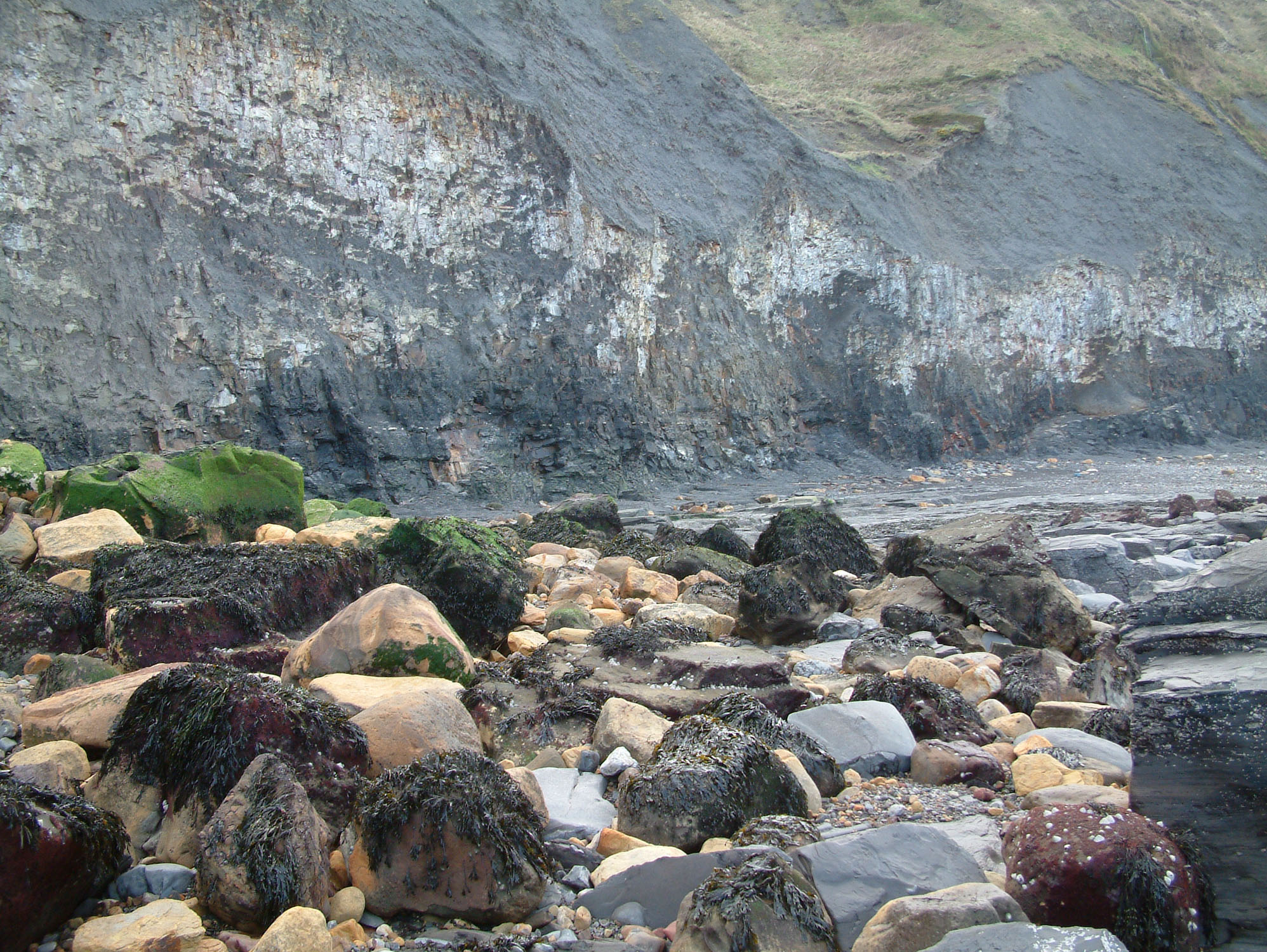
TYPE: – Most fossils can be found on the foreshore, especially after storms or scouring conditions, within nodules or loose in the shingle. However, fossils are also commonly seen in the cliff and on the scree slopes, either in nodules or loose.
VIDEO FILM
FOSSIL HUNTING
From the beach steps at Port Mulgrave, both ends of the bay are productive for fossil collecting, with each area offering something slightly different. The combination of frequent cliff falls, storm exposure and a wide foreshore makes this one of the most exciting and varied fossil sites along the North Yorkshire coast.
At the north end of the bay, just beyond the remains of the old harbour works, fossiliferous nodules can be found at beach level and scattered across the foreshore. These hard, rounded concretions often contain ammonites in excellent condition, many preserved with fine ribbing and strong keels. Species commonly encountered here include Dactylioceras commune, recognised for its evenly spaced ribbing, and larger forms such as Hildoceras bifrons, which displays elegant, sweeping ribs and a more compressed shell form. Careful splitting of nodules can reveal beautifully detailed specimens, often with both halves present.
Further north, towards the landslip area, plant material becomes more common. Fossilised remains of horsetail plants, belonging to the genus Equisetites, can sometimes be found preserved within shale blocks. These represent vegetation that once grew on nearby land and was washed into the Jurassic sea, where it became buried and fossilised. Their segmented stems and jointed appearance make them distinctive among the otherwise marine fossil assemblage.
The middle section of the bay is particularly notable for vertebrate remains. This is the area from which many reptile and occasional dinosaur specimens have been recovered. After strong storm tides, bones may be visible in the cliff face just above eye level or washed out onto the foreshore below. These remains often belong to marine reptiles such as ichthyosaurs and plesiosaurs, though isolated bones are more commonly found than complete specimens. Fragments of dinosaur bone have also been discovered here, likely washed out from terrestrial deposits and reworked into the marine sediments.
When searching this central stretch, focus on areas of shingle and freshly fallen shale. Fossils frequently accumulate in these natural traps after erosion. Ammonites can often be found loose amongst the debris, sometimes already weathered free from their nodules.
The south side of Port Mulgrave, around the small adjoining bay, is particularly rich in ammonites. Many specimens found here are exceptionally well preserved, often retaining crisp rib detail. In addition to Dactylioceras species, collectors may encounter Eleganticeras elegantulum, a smaller but finely ornamented ammonite, as well as other Liassic forms depending on the precise layer exposed. Reptile remains can also be found in this southern area, although they are less frequently encountered than in the central section of the bay.
Port Mulgrave offers a wide range of fossil types beyond ammonites. Brachiopods such as Terebratula punctata can be found within certain layers, distinguishable by their symmetrical shells. Bivalves and other molluscs are also present, along with occasional fish remains, including scales and isolated bones. Belemnites may be discovered weathered free from softer shale, appearing as smooth, bullet-shaped guards.
Successful collecting here relies on carefully examining nodules and scanning exposed rock surfaces for ammonites just “peeping” out from the stone. Often only a small section of ribbing or the curve of a whorl is visible. These specimens can usually be prepared and cleaned further at home, revealing far more detail once the surrounding matrix is carefully removed.
As always at Port Mulgrave, take care beneath unstable cliffs and remain aware of tide times. With patience and attention to fresh exposures, this locality can yield some of the most diverse and rewarding finds on the Yorkshire coast.


GEOLOGY
Port Mulgrave exposes a particularly important section of Lower Jurassic strata within the Cleveland Basin. The sequence here spans the upper part of the Pliensbachian Stage (Middle Lias) and into the Toarcian Stage (Upper Lias), representing deposition approximately 185–180 million years ago.
The geology is especially significant because it records the transition from iron-rich shallow marine environments to deeper, organic-rich offshore conditions — a change that is directly linked to the abundance of marine reptile and vertebrate material found at this locality.
Cleveland Ironstone Formation
(Pliensbachian – Middle Lias)
Towards the north side of Port Mulgrave, particularly around Brackenberry Wyke, the Cleveland Ironstone Formation is well exposed within a large landslip complex. Here, substantial blocks of ironstone and associated mudstones have slipped seaward, providing excellent three-dimensional exposures.
The Cleveland Ironstone Formation at Port Mulgrave is divided into:
- The Penny Nab Member (lower)
- The Kettleness Member (upper)
These members consist of cyclically deposited mudstones, siltstones and ironstone bands. The ironstone seams formed under specific chemical conditions on the Jurassic seabed, when reduced sediment input and particular redox conditions allowed iron to concentrate and lithify.
The ironstone blocks exposed in landslip areas often yield plant remains, indicating that terrestrial vegetation was periodically washed into the marine environment. These plant fragments provide evidence of nearby landmasses bordering the Jurassic sea.
Sedimentologically, this formation reflects a shallow to moderately deep marine shelf setting, with repeated environmental fluctuations that influenced sediment composition and fossil preservation.
Whitby Mudstone Formation
(Toarcian – Upper Lias)
Overlying the Cleveland Ironstone Formation is the Whitby Mudstone Formation, which dominates much of the central and southern exposures at Port Mulgrave.
Grey Shale Member
On the foreshore north of the old harbour and within the middle of Rosedale Wyke Bay, the Grey Shale Member is clearly exposed. These fine-grained marine mudstones were deposited in quieter offshore conditions.
Within these shales, fossils are often found grouped in concentrated pockets. Belemnites frequently occur in dense accumulations — sometimes referred to as “belemnite battlefields” — representing mass mortality or current-sorted assemblages. Shell beds of bivalves and other marine organisms also occur as small colonial clusters or death assemblages, where organisms were buried together by sediment influx.
These groupings provide valuable palaeoecological insight into seabed communities and post-mortem transport processes.
Mulgrave Shale Member
South of the old harbour, the cliffs expose the Mulgrave Shale Member, one of the most significant geological units at Port Mulgrave.
This member includes the famous Jet Rock, historically mined for jet — a compact, lignite-like material formed from fossilised wood under pressure in anoxic marine conditions. The remains of the old jet workings and harbour structures can still be seen today, providing a visible link between the geology and the industrial heritage of the area.
The Mulgrave Shale Member consists largely of dark, bituminous shales, deposited in deeper water under low-oxygen (anoxic) bottom conditions. These restricted environments slowed decay and scavenging, allowing exceptional fossil preservation.
Further south past Rosedale Wyke Bay, these bituminous shales are exposed on the foreshore. It is from this horizon that many of Port Mulgrave’s most important fossil finds originate, including:
- Ammonites preserved within sideritic nodules.
- Marine reptile remains (ichthyosaurs and plesiosaurs).
- Occasional dinosaur material, likely derived from nearby terrestrial sources and reworked into the marine sediments.
The presence of vertebrate material in this unit is closely linked to the anoxic depositional environment, which enhanced preservation potential during the Toarcian.


SAFETY
Common sense when collecting at all locations should be used and knowledge of tide times is essential. It is easy to get cut off at Port Mulgrave, as the sea always reaches the base of the cliff. You should ensure you return in good time. Also be aware of sticky areas on the slippages, as it is easy to get stuck especially after rain. After heavy rainfall, the steps down to Port Mulgrave can be extremely slippery, so extra care is needed.
EQUIPMENT
At Port Mulgrave, a keen eye and patience are essential, as fossils can occur within nodules on the foreshore, in fallen shale from cliff slips, or occasionally protruding from exposed bedrock. A geological hammer (16–24 oz) and flat chisel are recommended for carefully splitting siderite nodules, while a lump hammer may be useful for larger, tougher concretions; however, controlled, precise blows are always preferable to avoid damaging specimens. Eye protection should be worn at all times when striking rock, and sturdy boots with good grip are vital due to uneven shale, loose shingle and potentially slippery surfaces. As parts of the bay are affected by tides and unstable cliffs, always remain aware of your surroundings and avoid working directly beneath overhangs. Wrap any finds securely in paper or bubble wrap and store them in a solid container to prevent breakage on the walk back.
CLEANING AND TREATING
Begin by removing any loose sediment very carefully using a soft toothbrush. Take your time, as many fossils—particularly pyritic specimens—are fragile and easily damaged. Once cleaned, fossils should be desalinated by soaking them in fresh water for at least 24 hours to remove residual salt. After soaking, allow specimens to dry naturally at room temperature. Do not dry them on radiators or other heat sources, as rapid drying can cause cracking or long-term damage.
Once fully dry, we recommend sealing fossils with Paraloid B-72, dissolved in acetone. This is a museum-grade consolidant that is widely available in pre-mixed bottles. Paraloid B-72 is stable, long-lasting, and does not yellow or react chemically over time. Importantly, it is also fully reversible, making it suitable for scientifically important or display-quality specimens.
Some collectors prefer to treat ammonites with artists’ varnish. This is acceptable for common species that are not of scientific importance, as it enhances colour and contrast and can make a specimen really “pop”. However, varnish is not reversible and is therefore not recommended for rarer or research-grade fossils.
ACCESS RIGHTS
This site is a site of special scientific interest (SSSI). This means you can visit the site, but hammering the bedrock is not permitted. For full information about the reasons for the status of the site and restrictions, download the PDF from Natural England.download the PDF from Natural England.
It is important to follow our ‘Code of Conduct’ when collecting fossils or visiting any site. Please also read our ‘Terms and Conditions‘
LINKS
♦ Fossil Discussions
♦ Fossil Articles
♦ Buy Fossils, Tools and Equipment
♦ Buy Crystals, Meteorites, and Artefacts
♦ Join Fossil Hunts
♦ UK Fossils Network


