Redcliff Point is one of Dorset’s most rewarding Upper Jurassic fossil localities, exposing both the fossil-rich Oxford Clay Formation and the overlying Corallian Group within a spectacular coastal setting. The foreshore yields a diverse range of fossils, including ammonites, belemnites, large bivalves, trace fossils and occasional vertebrate remains, while the Oxford Clay has historically produced marine reptiles and giant oysters such as Gryphaea dilatata. Fresh erosion, heavy rain and scouring tides regularly expose new material, making this an excellent destination for the dedicated fossil collector.


FIND FREQUENCY: ♦♦♦♦ – After storms, rough tides and rain there is a good supply of fossils to be found around Redcliff Point and the end of Bowleaze Cove.
CHILDREN: ♦♦ – Redcliff Point is not suitable for young children or the elderly. The terrain is very rocky, with large boulders and seaweed. It can be hazardous. It is also a long, tide-dependent walk.
ACCESS: ♦♦♦ – Redcliff Point can be tricky for some, either scrambling over the large boulders from Bowleaze Cove. The approach from Blackhead is also a long walk. Do not use ropes or improvised cliff descents.
TYPE: Look for loose fossils between rocks on the open foreshore, keeping well clear of cliff bases, fresh falls and slipped ground.
DIRECTIONS
♦ This locations best done together with Bowleaze Cove. Parking to the west of Osmington, just past the Waterside | Bowleaze Cove Holiday Park, at the end of Bowleaze Coveway Road. Parking is free here, but if the area is full, there is a public car park at the bottom of the hill.
♦ Walk back down the road towards the Southside Funfair. A path leads past the café and toilets, and onto the beach. From here, walk east along the beach.
♦ Do not use ropes or improvised descents at Redcliff Point. The foreshore walk can be difficult; allow enough time to return by your outward route before the tide cuts it off.
VIDEO FILM
FOSSIL HUNTING
Redcliff Point is one of the best places on the Weymouth coast to collect fossils from both the Oxford Clay Formationand the overlying Corallian Group. The constantly eroding cliffs and extensive foreshore provide a steady supply of fossil-bearing material, particularly after storms, heavy rain and periods of beach scour. Fossils can be found throughout the area, both within fallen blocks and loose amongst the shingle and boulders.
The Oxford Clay yields a rich marine fauna, with the giant oyster Gryphaea dilatata being one of the most common fossils. Large specimens can often be found loose on the beach. The wider Oxford Clay and Corallian succession includes other bivalves such as Modiolus bipartitus, Pleuromya alduini, Lopha gregarea, Plagiostoma rigidum and Thracia depressa. Gastropods are also present, including Bourguetia saemanni. These records should not all be assigned to one clay bed: retain matrix and provenance information when recording loose finds.
Ammonites are among the most sought-after finds. The Oxford Clay has yielded Cardioceras and perisphinctid ammonites, particularly from sideritic concretion horizons. Fragments are common, but complete specimens can still be found after fresh erosion. The overlying Corallian rocks produce additional ammonite species including Cardioceras cordatum, Perisphinctes and Euaspidoceras, often preserved within hard calcareous sandstone blocks.
The Corallian succession is also rich in bivalves and belemnites. Species such as Myophorella (Trigonia) hudlestoni, Trigonia reticulata and the belemnite Pachyteuthis abbreviata can be found in loose blocks on the open foreshore, well clear of cliff bases. The Myophorella clavellata-rich Trigonia Beds belong to the younger Clavellata Formation, above the Osmington Oolite; a loose shell should not be assigned to the lower Redcliff succession from its beach position alone.
One of the most distinctive features of Redcliff Point is the abundance of trace fossils preserved within the Corallian sandstones. Large fallen blocks commonly display spectacular examples of Thalassinoides, Rhizocorallium, Scolicia, Spongeliomorpha, Gyrochorte and Diplocraterion. These ancient burrows and feeding traces record the activity of organisms living within the Jurassic seabed and are often among the easiest fossils to find.
Vertebrate remains are less common but remain a possibility. The Oxford Clay has historically yielded marine reptile material, including plesiosaurs, marine crocodilians such as Steneosaurus and Metriorhynchus, and other vertebrate remains. Isolated bones and vertebrae occasionally occur in loose material on the foreshore; do not approach fresh falls to search for them.
Search loose material on the open foreshore in settled weather and sea conditions, well clear of cliff bases, fresh falls and slipped ground. The varied ammonites, shells and trace fossils make Redcliff Point an interesting Upper Jurassic locality, but do not enter a hazardous area to reach newly exposed material.


Key fossil discoveries, stratigraphic records and site-history milestones from Redcliff Point, Dorset.
1923–1925 – Upper Oxford Clay subdivision recognised
S.S. Buckman separated the Weymouth-area Upper Oxford Clay into three main parts. At Redcliff Point this framework helped place the fossiliferous Furzedown, Jordan Cliff and Bowleaze clays, including beds with pyritised Cardioceras scarburgense, Quenstedtoceras ammonites and common Gryphaea dilatata.
1933 – Callovian–Oxfordian boundary noted
W.J. Arkell drew early attention to the Callovian–Oxfordian boundary at Ham Cliff, on the east side of Redcliff Point. This was an important step towards recognising the locality as more than a normal fossil cliff, because the boundary later became the focus of international Oxfordian Stage work.
1937 – systematic microfossil sampling
C.D. Ovey collected 25 samples at two-foot intervals from the Upper Oxford Clay at Redcliff. The samples provided a rare bed-by-bed microfossil collection from the Dorset Oxford Clay and became the basis for the locality’s later foraminiferal study.
1947 – Ham Cliff section fixed beside Redcliff Point
Arkell referred to the boundary exposure about 200 m east of Redcliff Point as Ham Cliff. That name and position gave later workers a precise reference section for the clay succession and the Callovian–Oxfordian transition.
by 1948 – Redcliff ammonites established in the Corallian record
Redcliff Point material from the Nothe Grit and Preston Grit had been worked into the classic record of English Corallian ammonites. Important Redcliff fossils include the holotype of Cardioceras persecans from the Nothe Grit, the holotype of Cardioceras cautisrufae from the Preston Grit, and recorded ammonites such as Cardioceras zenaidae, Aspidoceras paucituberculatum and Aspidoceras catena.
1953 – Redcliff foraminifera described
Tom Barnard described foraminifera from the Upper Oxford Clay of Redcliff Point, recognising 23 species, including four new forms. The work made the locality important for micropalaeontology and showed that the clays could be used for detailed fossil correlation as well as for larger ammonites and bivalves.
1956 – holothurian sclerites added to the fossil record
Holothurian sclerites from the Oxford Clay at Redcliff were described, including new taxa such as Rhabdolites dorsetensis. These tiny fossils are exceptionally abundant in the clay and add another useful microfossil group to the Redcliff boundary section.
1985 – Redcliff became a key Jordan Cliff Clay exposure
Sea defences at Furzy Cliff made much of the Jordan Cliff Clay type locality inaccessible. The northern side of Redcliff Point therefore became especially useful for seeing the unit, where well-preserved Gryphaea dilatata, Modiolus bipartitus and other bivalves are common.
1986 – Redcliff Formation and Corallian beds revised
J.K. Wright’s revision clarified the Redcliff Formation around Redcliff Point and Ham Cliff. It recorded the sharp erosive base of the Nothe Grit above the Oxford Clay, the lower Nothe Clay at Redcliff with bivalve-rich sandy limestones, ammonite-bearing Nothe Grit concretions, and Preston Grit blocks with trace fossils and frequent ammonites.
1995–1999 – expanded stage-boundary section clarified
Fresh exposure during the 1990s allowed the Ham Cliff section at Redcliff Point to be logged and interpreted in detail. The work showed an expanded ammonite-bearing succession across the Callovian–Oxfordian boundary, with the transition from Quenstedtoceras to early Cardioceras faunas visible in a way rarely seen elsewhere in Britain.
2001–2002 – conservation and reference-site status recognised
Redcliff Point lies within the South Dorset Coast SSSI, became part of the Dorset and East Devon World Heritage coast in 2001, and the Ham Cliff boundary section was recorded as a Geological Conservation Review site in 2002. This placed the locality in a protected setting and raised its profile as a reference section for Oxford Clay fossils, Corallian rocks and Jurassic stage-boundary research.
2003–2006 – candidate Oxfordian GSSP sampled
An international team began a detailed assessment of the Redcliff/Ham Cliff section as a candidate global reference point for the base of the Oxfordian Stage. More than 30 ammonite faunas were recorded through the boundary interval, alongside sampling for foraminifera, nannofossils, ostracods, holothurian sclerites, belemnite isotope work and magnetic data; the section was re-checked in 2006.
2008 – mollusc isotope work tested the boundary record
Carbon and oxygen isotope work on Redcliff Point macrofossils tested whether the fossils retained useful environmental signals. Belemnites including Hibolithes hastata, Gryphaea and Cardioceras ammonites were shown to be well enough preserved to help interpret water conditions and support a relatively continuous boundary record.
2009–2010 – Cardioceras redcliffense used to mark the Oxfordian base
Integrated work on the Redcliff Point candidate section placed the base of the Oxfordian at the first occurrence of Cardioceras redcliffense in the Ham Cliff beds. The case was supported by ammonites, belemnites, foraminifera, calcareous nannofossils, ostracods, holothurian sclerites, isotope results and magnetostratigraphy, making Redcliff one of Europe’s most complete Callovian–Oxfordian boundary sections.
2014–2015 – Oxfordian boundary task group reviewed the site
A specialist Oxfordian boundary meeting at Weymouth reviewed the Ham Cliff section, carried out new geochemical, nannofossil, microfossil and ammonite sampling, and continued collecting through the summer. Around 3,000 ammonite specimens were added for study, strengthening Redcliff Point’s role in testing a practical ammonite biohorizon framework for the stage boundary.
by 2024 – Redcliff Point remained a leading Oxfordian candidate
International stratigraphic work had narrowed the search for a formal Oxfordian boundary reference section to two main candidate sites, one of them Redcliff Point. The locality therefore remains important not only for collectors of ammonites, bivalves, trace fossils and microfossils, but also for deciding how the base of the Oxfordian Stage should be defined worldwide.
GEOLOGY
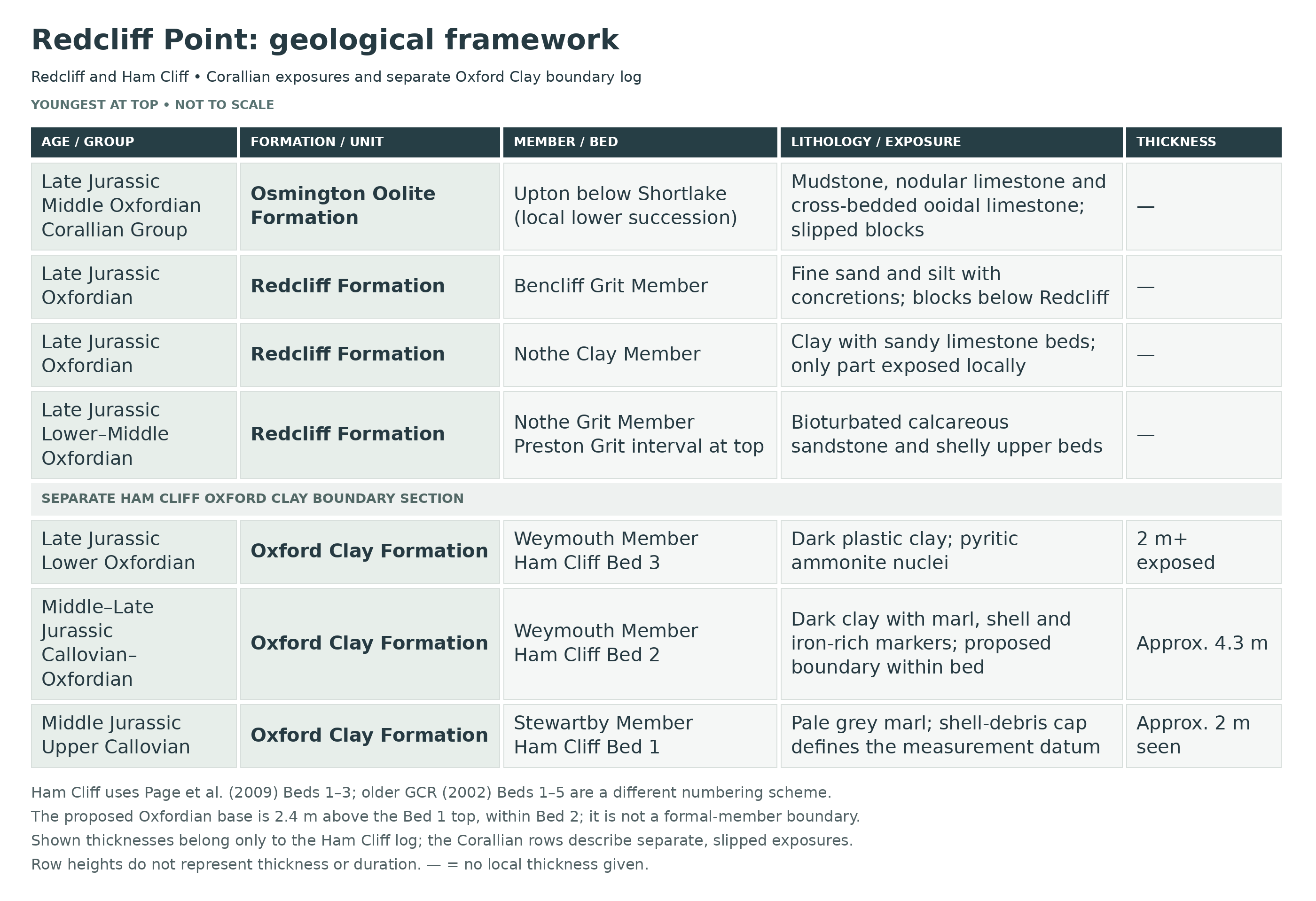
Redcliff Point and the adjoining Ham Cliff expose a structurally complex succession of Oxford Clay and Corallian rocks. The Ham Cliff Oxford Clay section crosses the Middle Jurassic–Late Jurassic boundary, from the Callovian into the Oxfordian. The younger Redcliff and Osmington Oolite formations are Oxfordian. Faulting, landslip and beach cover mean that these exposures must be combined carefully rather than treated as one uninterrupted cliff log.
The small River Jordan enters the sea at the western end of the locality. Historically, its gravels have yielded remains of Ice Age mammals, including elephant, hippopotamus and bison, derived from Pleistocene deposits further inland.
The cliffs and foreshore around Redcliff Point are dominated by the Redcliff Formation, particularly the upper part of the Nothe Grit Member including its upper Preston Grit interval. These units consist of calcareous sandstones and sandy limestones deposited in a shallow marine environment during the Oxfordian Stage of the Late Jurassic. The harder nature of these rocks results in extensive boulder fields and fallen blocks across the foreshore, many of which are highly fossiliferous.
The shelly Preston Grit interval yields bivalves and ammonites, including published records of Cardioceras cautisrufae and Cardioceras zenaidae. The record of Cardioceras cordatum belongs to lower Nothe Grit beds and should not be applied throughout the Preston interval. These distinct faunal levels help explain why loose fossils from different sandstone blocks should not automatically be assigned to the same bed.
One of the most distinctive features of the Corallian rocks at Redcliff Point is the abundance of trace fossils. Large sandstone blocks frequently display spectacular examples of Thalassinoides, Rhizocorallium, Diplocraterion, Scolicia, Spongeliomorpha and Gyrochorte, providing evidence of the diverse organisms that once inhabited the Jurassic seabed.
Above the Nothe Grit, the Redcliff Formation includes the Nothe Clay and Bencliff Grit. The overlying Osmington Oolite Formation is represented here by Upton and Shortlake member beds, including the separately measured rotated block described below. The Clavellata Formation, with its well-known Trigonia Beds, is younger still; it must not be inserted into this lower Osmington log.
The succession records repeated changes in mud, sand and carbonate deposition, rather than one uninterrupted shallowing trend. Wright’s measured Red Cliff section shows that even the ooidal limestones pass westwards into a muddier, deeper-water facies: poorly sorted ooids and mudstone distinguish this exposure from a simple, continuously wave-washed sandbank. Compare the matrix as well as the fossil when relating loose material to the detailed log.

This is a composite stratigraphic breakdown of Redcliff Point and the immediately adjacent Ham Cliff and Red Cliff undercliff, where the Callovian–Oxfordian boundary succession in the Oxford Clay is juxtaposed by faulting and landslip against the sandy Redcliff Formation and the lower Osmington Oolite. The locality is especially important because Ham Cliff remains a current candidate section for the base of the Oxfordian, while the point and undercliff preserve the Preston Grit, Nothe Clay, Bencliff Grit and a measured 12-bed Red Cliff block through the Upton and Shortlake members.
Section Architecture
Redcliff Point is not a single simple cliff log. The point itself is formed mainly by Oxford Clay of the Weymouth Member, but only a short distance away the Corallian is downfaulted and then exposed west of the point in low cliffs, undercliff slips and foreshore ledges. In addition, the classic Callovian–Oxfordian boundary sequence lies in a near-horizontal Oxford Clay block at Ham Cliff about 200 m east of the point, and the lower Osmington Oolite is best known from a rotated slipped block at Red Cliff rather than from an intact upright face. The whole locality therefore has to be treated honestly as a composite of faulted, repeated and landslipped exposures.
Oxfordian Boundary Status
The Ham Cliff boundary section near Redcliff Point is listed in the International Commission on Stratigraphy’s 2024 report as one of two candidate localities for the base of the Oxfordian, and the working definition is tied to the base of the Cardioceras redcliffense Horizon. That means Redcliff Point is scientifically exceptional, but it should still be described as a candidate and working-definition section rather than as a formally ratified Oxfordian GSSP.
ANCHOLME GROUP
Oxford Clay Formation (Callovian To Oxfordian)
Stewartby Member
Bed RC1 – Ham Cliff Bed 1 / Tidmoor Point Clay Beds (c. 2 m Exposed)
Medium-pale grey marl, relatively hard when dry, with the top c. 15 cm crowded by fine shell debris, some recognisable as fragments of Oxytoma. Meleagrinella cf. braamburiensis, Dicroloma and Mecochirus occur, and the bed yields a remarkably detailed terminal Callovian ammonite succession. The top of Bed 1 provides the most persistent datum in the Ham Cliff boundary section and has been used as the measurement reference for the higher beds. Ammonites: The Bed 1 succession includes historical Quenstedtoceras praelamberti records, typical Q. lamberti and higher Quenstedtoceras assemblages with Euaspidoceras hirsutum, Hecticoceras, Alligaticeras and Kosmoceras. In Page and colleagues’ scheme, the α–γ Q. paucicostatum transients belong to the overlying Bed 2, not Bed 1. Biochronology: terminal Callovian, Lamberti Chronozone, Lamberti Subchronozone. Depositional Environment: quiet open-marine mud sedimentation with exceptionally high biostratigraphic resolution.
Page and colleagues (2009) place Beds 2–3 in the Weymouth Member and Bed 1 in the Stewartby Member. Their proposed stage boundary is inside Bed 2, not at that lithostratigraphical member boundary. Earlier Ham Cliff publications use different bed numbering; the three-bed scheme below must not be equated numerically with GCR 2002 Beds 1–5.
Bed 1: Historical Praelamberti Horizon (LL1)
Callomon’s earlier record lies 3.0–about 2.75 m below the top of Bed 1 and includes Euaspidoceras. It was not exposed during the 2003 survey, so it is not included in the approximately 2 m then visible.
Bed 1: Lamberti Horizon (LL2a)
Typical Quenstedtoceras lamberti was recorded about 2 m or more below the top of the bed; the associated fauna was incompletely characterised in the 2009 account.
Bed 1: Higher Quenstedtoceras Assemblage, Lower Recorded Interval
At about 1.65–0.95 m below the top, Page and colleagues record common Vertumniceras-like morphs with Kosmoceras, Hecticoceras and Grossouvria. Their LL2b assignment remains qualified.
Bed 1: Higher Quenstedtoceras Assemblage, Upper Recorded Interval
At 0.5–0.2 m below the top, the source records Quenstedtoceras with Euaspidoceras, Hecticoceras, Alligaticeras and Kosmoceras, again tentatively within LL2b.
Bed 1: Shell-Debris Cap (Upper Approximately 15 cm)
Fine shell debris, including recognisable Oxytoma fragments, makes the uppermost marl the most persistent local datum. All the following positive heights are measured upward from this bed top.
Weymouth Member
Bed RC2 – Ham Cliff Bed 2, Trans-Boundary Mudstone Package (c. 4.3 m)
Dark grey clays with paler marl “Bristol bands” and frequent thin pyritic burrow fills. Crushed aragonitic ammonites occur in bands, pyritic nuclei are locally preserved, and partial phosphatic infills of body chambers occur at certain levels. Benthos is sparse but includes oxytomid bivalves, a band of Gryphaea ex gr. dilatata, frequent Hibolithes and, in the lower part, abundant Mecochirus. Several sub-continuous marker horizons occur within the bed, notably a shell-rich seam with small ferruginous nodules at c. 1.2 m above the base, a Gryphaea band at c. 2.15 m, and ferruginous lenticles around c. 2.5 m. This is the critical Redcliff trans-boundary bed: the working base of the Oxfordian is placed 2.4 m above the top of Bed 1, at the base of the Cardioceras (Pavloviceras) redcliffense Biohorizon within Bed 2. The woodhamense Biohorizon follows higher in Bed 2; the scarburgense Biohorizon is recorded in Bed 3 above, not in the same bed. Ammonites: Cardioceras (Pavloviceras) redcliffense, C. woodhamense, with persistent but diminishing Quenstedtoceras paucicostatum transients low in the bed. Marker-Bed Significance: this bed is one of the most important Oxfordian boundary intervals in Europe and has yielded ammonites, foraminifera, calcareous nannofossils, ostracods, holothurian spicules and stable-isotope data across the stage boundary.
Bed 2: Paucicostatum α Interval (LL3a; 0.1–0.8 m)
Common Quenstedtoceras paucicostatum transient α occurs with rare Hecticoceras and possible Poculisphinctes in the dark clay.
Bed 2: Paucicostatum β Interval (LL3b; 0.85–1.45 m)
The β transient, corresponding to Q. paucicostatum sensu stricto in this scheme, is common; Euaspidoceras hirsutum is frequent.
Bed 2: Ferruginous Shell Seam (About 1.2 m)
A shell-rich seam contains small ferruginous nodules. Page and colleagues correlate it with Callomon’s older Bed 3; it is not their own Bed 3.
Bed 2: Paucicostatum γ Interval (LL3c; Approximately 1.55–2.1 m)
The reported lower limit is questioned in the primary text. Common γ-transient ammonites occur with rare Alligaticeras.
Bed 2: Gryphaea Band (About 2.15 m)
This separately recorded oyster concentration lies below the proposed Oxfordian datum. It includes early dilatata-like forms and is not itself equated with the stage boundary.
Bed 2: Upper Paucicostatum γ–Peltoceras Interval (LL3d; 2.2–2.3 m)
The source distinguishes abundant γ-transient ammonites accompanied by frequent juvenile Peltoceras from the lower γ interval.
Bed 2: Proposed Redcliffense Horizon (Ox1; 2.4–2.5 m)
In the 2009 proposal, the first Cardioceras redcliffense assemblage begins 2.4 m above the Bed 1 datum. This is a source-specific candidate boundary interpretation, not an already ratified GSSP.
Bed 2: Ferruginous Lenticles (Around 2.5 m)
The lenticular iron-rich band is impersistent and may locally be double. No uniform continuous bed or thickness is invented.
Bed 2: Woodhamense Horizon (Ox2; 3.1–3.2 m)
Cardioceras woodhamense is abundant at this recorded level, succeeding the redcliffense assemblage in Page and colleagues’ local scheme.
Bed RC3 – Ham Cliff Bed 3 / Basal Furzedown Clay Beds (2 m+ Exposed)
Dark grey, plastic clays with abundant mainly juvenile oxytomid bivalves and Dicroloma; Hibolithes is uncommon. Pyritic ammonite nuclei with crushed middle and outer whorls are common at certain levels, and the top passes transitionally into the silty Jordan Cliff Clay above. Ammonites: Cardioceras ex gr. scarburgense, including common morph mariae, with occasional juvenile Peltoceras. Biochronology: basal Oxfordian, Mariae Chronozone, Scarburgense Subchronozone. Interpretation: continuation of offshore mud deposition above the boundary, but now within fully Oxfordian cardioceratid-bearing clays of the lower Weymouth Member.
Bed 3: Lower Scarburgense Assemblage (4.5–4.7 m Above The Bed 1 Datum)
The lower recorded Ox3 assemblage is dominated by scarburgense morphs, with occasional mariae morphs and juvenile Peltoceras. These heights remain tied to the same datum, not the base of Bed 3.
Bed 3: Higher Scarburgense Assemblage (About 6.1–6.2 m Above The Datum)
The higher Ox3 record includes common mariae morphs. A still younger Ox4 fauna was reported from higher ground but was not continuously exposed with the boundary log, so it is not inserted as another measured bed here.
Measured Boundary Study: Foraminifera
Across the measured boundary study, Page and colleagues record assemblages commonly dominated by epistominids, especially Epistomina mosquensis. An influx of early planktonic forms immediately above the proposed boundary includes material identified as ?Globuligerina oxfordiana, whose generic assignment is explicitly unresolved. Many tests survive as pyritic internal moulds after loss of the original aragonitic wall; this is not an assertion that the same fauna occurs in every numbered bed.
Measured Boundary Study: Ostracods
Lobocythere scabrabucki dominates the common, well-preserved ostracod assemblages in many samples from the terminal Callovian–Lower Oxfordian section. This is a sampled boundary-interval record, not a new named marker bed.
Measured Boundary Study: Holothurian Sclerites
Sea-cucumber skeletal elements are particularly abundant in the Oxford Clay here. The study recalls Rhabdolites dorsetensis among taxa described from Redcliff material; possible stratigraphical value does not establish a newly measured bed or a uniform distribution.
Measured Boundary Study: Calcareous Nannofossils
The 2009 samples contain diverse assemblages dominated by Watznaueria britannica, with Zeugrhabdotus erectus, podorhabdids and Stephanolithion bigotii. The reported maximum form of the last taxon places the samples within NJ14. Reworked Early Jurassic nannofossils also occur, especially lower in the section, and must not be mistaken for the depositional age of the Oxford Clay.
Bed RC4 – Jordan Cliff Clay On The North Side Of Redcliff Point (9 m Historical Type-Section Context)
The former Furzy Cliff type exposure comprised about 1 m of fissile clay and 8 m of blocky silty mudstone. These published values describe the historical type section, not a measured 9 m at Redcliff. At Redcliff Point it is notably better exposed than at its old type locality at Furzy Cliff and yields abundant, well-preserved Gryphaea dilatata; Modiolus bipartitus is also recorded. Compared with the finer clays below, the member is distinctly siltier and records a shallowing phase within the Oxford Clay. Depositional Environment: offshore marine mud sedimentation still below fair-weather wave base, but with increased quartz-sand input, a more substantial epifauna and a firmer sea floor than in the underlying boundary clays.
Bed RC5 – Small Repeated Bowleaze Clay Exposure At The South-Eastern End Of Redcliff Point
A small low-cliff exposure at the south-eastern end of the point yields Cardioceras spp. from soft, plastic calcareous clays referable to the Bowleaze Clay subdivision of the Weymouth Member. This is not the full Bowleaze Cove section repeated in miniature, but a local structural reappearance showing that higher Weymouth Member beds are faulted or slipped into the point area. It is important because it proves that Redcliff Point itself contains more than one Oxford Clay level and should not be simplified into a single undivided mudstone outcrop.
CORALLIAN GROUP
Redcliff Formation (Oxfordian)
Nothe Grit Member
Bed RC6 – Main Nothe Grit West Of Redcliff Point (full member thought to be c. 9 m; upper two-thirds best exposed here)
Fine-grained, argillaceous sandstone in medium to thick beds, grey to yellow-brown, intensely bioturbated and locally packed with calcareous concretions. No single complete section through the member is visible at Redcliff, but the upper two-thirds are well represented in the low cliff west of the point. The basal junction with the Oxford Clay is a sharp erosive non-sequence, best seen nearby at Ham Cliff, demonstrating a major facies break from offshore mud to sandy shelf sediment. Scattered concretions yield ammonites preserved in honey-coloured calcite. Ammonites: Cardioceras (Cardioceras) cordatum, C. persecans and related cardioceratids. Depositional Environment: shallow offshore to subtidal sand deposition with intense seabed burrowing and repeated early cementation.
Bed RC7 – Preston Grit (highest c. 1.5 m of the low cliff)
The Preston Grit forms the highest part of the low cliff from the Bowleaze side eastwards to Redcliff Point and is one of the best fossil-yielding beds in the immediate tract. It consists mainly of medium-grained, shelly, calcareous sandstone, weathering into blocks on the upper shore that reveal abundant bivalves, superb trace fossils and frequent ammonites. The bed records a more energetic sand phase than the Nothe Grit below and is among the most collector-useful horizons at the site. Typical Fossils: abundant bivalves including Myophorella hudlestoni in fallen blocks, plus well-developed burrow systems. Ammonites: Cardioceras (Cardioceras) cautisrufae and C. (Subvertebriceras) zenaidae. Interpretation: shell-rich, current-worked marine sandstone laid down under shallower and more turbulent conditions than the Nothe Grit below.
Nothe Clay Member
Bed RC8 – Nothe Clay Member At Redcliff (lower c. 8 m visible of a c. 12 m member)
A fine-grained, plastic grey clay succession in which muddy intervals alternate with sandy limestones rich in bivalves. At Redcliff the lower c. 8 m can be examined, though the member is commonly affected by slumping. Upward through the visible sequence the clastic content gradually increases, presaging the transition into the Bencliff Grit above. Typical Fossils: abundant bivalve faunas in the sandy limestones; ammonites are much less conspicuous than in the Preston Grit below. Depositional Environment: renewed quiet-water shelf-mud deposition, interrupted by shell-rich and locally sandier event beds, before a new progradation of sand into the area.
Bencliff Grit Member
Bed RC9 – Bencliff Grit Beneath Redcliff (mainly foreshore blocks and low platform outcrop)
At Redcliff the Bencliff Grit is represented mainly by blocks and low foreshore ledges beneath the cliff rather than by one clean upright section. It consists of argillaceous fine-grained sandstone and siltstone, commonly enclosed in or associated with conspicuous calcareous “dogger” concretions. These concretions preserve excellent trace fossils and locally occasional bivalves and ammonites. In the broader Osmington area the member is celebrated for spectacular swaley cross-stratification, but at Redcliff the fossil and ichnological content of the concretionary blocks becomes the main practical field feature. Typical Fossils: excellent trace fossils, occasional bivalves and rare ammonites. Depositional Environment: storm-influenced shallow-marine sand and silt deposition, transitional upward from the Nothe Clay and recording renewed progradation of clastics across the shelf.
Published Thickness Of The Redcliff Formation In The Wider Redcliff–Osmington Composite Section: About 29.2 Metres, Though No Single Clean Exposure At Redcliff Point Shows The Formation In Full
Osmington Oolite Formation (Middle Oxfordian)
Red Cliff Section Note
Hundreds of blocks derived from the large landslip west of Redcliff Point litter the undercliff and beach. The most useful section is a rotated slipped block at Red Cliff that preserves a published 12-bed section through the upper part of the Upton Member and the overlying Shortlake Member. Those bed numbers are retained below exactly, although the section is landslipped and therefore must not be mistaken for an undisturbed vertical cliff face.
Upton Member
Bed RC10 – Red Cliff Bed 1 (?A5b) – Nodular Micritic Limestone (seen to 0.45 m)
Nodular micritic limestone with very scattered 0.5 mm ooids, many more immature 0.1–0.2 mm ooids and thin curving burrows. This is the basal bed of the rotated Red Cliff block and represents the upper part of the Upton Member only, not the whole member. The mixture of micrite, scattered ooids and burrows indicates carbonate mud containing a variable ooid component; Wright interprets the western Redcliff facies as relatively deeper than the better-sorted eastern ooid shoals.
Bed RC11 – Red Cliff Bed 2 (?A5c) – Medium Grey Silty Mudstone With Scattered Small Ooids (0.50 m)
A thin but distinctive ooid-bearing silty mudstone. The bed continues the more argillaceous character of the Upton Member at Redcliff and shows that the return to carbonate-rich sedimentation above the Bencliff Grit began in relatively deeper, more mud-dominated water than the later ooid-rich and muddy Shortlake facies above.
Bed RC12 – Red Cliff Bed 3 (?A5d) – Nodular Calcareous Mudstone With Six Nodule Bands (1.30 m)
Nodular calcareous mudstone with six bands of micritic nodules containing scattered ooids and, in places, ooid-filled burrows. This is one of the most diagnostic Upton beds in the Red Cliff block. It combines offshore muddy deposition with repeated early lithification into nodule bands, and its abundant immature ooids are one of the practical ways in which Upton concretions can be recognised in loose material.
Bed RC13 – Red Cliff Bed 4 (?A5f) – Sandy Marl With Ooidal And Shelly Grains (1.15 m)
Sandy marl with ooidal and shelly grains and two 0.15 m bands of nodular argillaceous micrite containing many immature ooids. This bed closes the Red Cliff Upton section and shows a clear upward increase in sand and ooids before the strongly ooidal Shortlake facies begins. Interpretation: progressive shallowing from muddy offshore carbonate deposition into a more agitated ooid-bearing shelf setting.
Upton Member Ammonites
Wright (2011) reports that all Red Cliff ammonites in his own collection came from the Upton Member; this is a statement about that collection, not every ammonite ever collected at Redcliff. His regional Dorset Upton table includes Perisphinctes (Kranaosphinctes) maximus, P. (K.) aff. ariprepes, P. oxoniensis, P. (Otosphinctes) ouatius, P. (O.) arkelli, P. (Dichotomosphinctes) antecedens, Goliathiceras aff. elegans and Cardioceras (Maltoniceras) vagum. Taken together, these indicate the lower Antecedens Subzone and show that the Upton Member at Redcliff belongs to the lower part of the middle Oxfordian ammonite succession rather than to the younger Shortlake fauna above.
Shortlake Member
Bed RC14 – Red Cliff Beds 5–6 (?A6b, part) – Lower White Oolite (1.05 m)
Bed 5 is a thick coarsely shelly oomicrite, overlain by Bed 6, a rubbly-weathering densely ooidal micrite described by Arkell as “weathering pellety”. Together they form the Lower White Oolite of the Red Cliff sequence. These beds are much more strongly ooidal than the Upton Member below and mark the clear establishment of the Shortlake ooid-facies system, although they still lack the major cross-bedding of the higher Shortlake units.
Red Cliff Bed 5 — Shelly Oomicrite (0.40 m)
Wright’s lower White Oolite starts with a distinct coarsely shelly oomicrite.
Red Cliff Bed 6 — Dense Ooidal Micrite (0.65 m)
The next limestone is rubbly-weathering and densely ooidal, with the pellety weathering described by Arkell. Beds 5–6 lack the conspicuous cross-bedding of Beds 8–10.
Bed RC15 – Red Cliff Bed 7 – Mudstone With Nanogyra nana (0.15 m)
A very thin but important shelly mudstone carrying Nanogyra nana. This bed interrupts the ooid-rich Lower White Oolite and demonstrates that muddy, shell-bearing pauses punctuated the ooid-rich and muddy Shortlake succession. It is also a useful marker because it separates the lower ooidal micrites from the thicker cross-bedded Middle White Oolite above.
Bed RC16 – Red Cliff Beds 8–10 (A6c, part) – Middle White Oolite With Mudstone Interbed (3.90 m)
This is the most spectacular Shortlake interval at Redcliff. Bed 8 is a thin-bedded to massive, cross-bedded, very poorly sorted oosparite; Bed 9 is a mudstone with bands of very fissile fine-grained sandy sparry limestone; Bed 10 is another thick cross-bedded, very poorly sorted oosparite. Profuse shale pellets indicate considerable scouring, and the whole package has long been noted as westwardly transitional toward the Forest Marble style of mixed ooid and mud deposition. Ammonites: the older GCR reports occasional cardioceratids and perisphinctids from the Redcliff Shortlake interval, without secure assignment to every individual bed, including Cardioceras (Maltoniceras) maltonense, Perisphinctes (Kranaosphinctes) aff. decurrens and P. (Dichotomosphinctes) aff. dobrogensis. Interpretation: Wright (2011) interprets the very poor ooid sorting and laminated mudstones as a westward transition into deeper-water clay facies. The actual cross-bedding and shale pellets remain important observations, but they do not justify simply transferring a very shallow, repeatedly current-sorted eastern shoal model to this local block.
Red Cliff Bed 8 — Lower Cross-Bedded Oosparite (1.90 m)
Thin bedding passes into more massive limestone; the ooids are very poorly sorted. This is the lower of two distinct carbonate packages within the Middle White Oolite.
Red Cliff Bed 9 — Mudstone And Fissile Sandy Limestone (0.70 m)
The intervening mudstone contains fine-grained sandy sparry limestone bands. It must not be absorbed into a single homogeneous cross-bedded bed.
Red Cliff Bed 10 — Upper Cross-Bedded Oosparite (1.30 m)
A separate upper, poorly sorted oosparite repeats the cross-bedded lithofacies above the muddy interval.
Bed RC17 – Red Cliff Bed 11 (?A7) – Upper Ooidal Mudstone And Coarsely Ooidal Micrite Bands (0.70 m)
Shelly, ooidal mudstone with bands and nodules of coarsely ooidal shelly micrite. This bed records waning energy above the major cross-bedded oosparites but remains distinctly more ooidal than any part of the Upton Member. It is a transitional upper Shortlake bed in which ooid-rich sediment was still common, but the sea floor was quieter and more muddy than during deposition of Beds 8–10.
Bed RC18 – Red Cliff Bed 12 (?A8) – Nodular Shelly Limestone With Irregular Clay Partings (seen to 1.4 m)
The highest bed seen in the Red Cliff block is a nodular limestone with irregular clay partings. Its base is more massive, coarsely ooidal and shelly, with well-preserved bivalves including pectinids, but upward it passes into more nodular shelly micrite with scattered coarse ooids. The top is only seen to 1.4 m, so the complete thickness is uncertain. This bed closes the local Red Cliff Shortlake section and represents the quieter upper part of the member before the higher Nodular Rubble facies enters farther east.
Shortlake Member Ammonites And Age
The older GCR reports a small Redcliff Shortlake fauna, while Wright’s 2011 collection from Red Cliff proved to be Upton material. The following member-age discussion uses the regional Dorset Shortlake fauna, not a list of fossils proven from each bed in the slipped block. Liosphinctes, Perisphinctes sensu stricto, Dichotomosphinctes and forms close to dobrogensis show that the member belongs to the upper Antecedens Subzone. In other words, Redcliff records a clear faunal shift upward from the lower Antecedens Upton fauna into a sparser but slightly younger Shortlake assemblage.
Higher Osmington Oolite Note
The Nodular Rubble Member is not securely or fully represented in the Red Cliff landslip block used here, and it is better logged farther east toward Bran Point and Black Head. It is therefore not forced into this Redcliff Point page.
Depositional Environment
The Redcliff Point locality records a long environmental progression across the Callovian–Oxfordian transition and into the Corallian shallow-shelf system. The Ham Cliff boundary beds of the Oxford Clay were deposited as open-marine mudrocks rich in ammonites, with the stage boundary lying within an expanded trans-boundary mudstone sequence that remained suitable for high-resolution biostratigraphy, microfossils and chemostratigraphy. Higher in the Weymouth Member, the Jordan Cliff and Bowleaze clays show shallowing and renewed slight deepening within offshore mud deposition, including storm-borne carbonaceous incursions in the broader Bowleaze interval. The Redcliff Formation marks abrupt sandy shallowing: Nothe Grit and Preston Grit represent burrowed shallow-shelf and shell-rich storm-worked sandstones; Nothe Clay records a temporary muddy deepening; and the Bencliff Grit records renewed sand-body progradation and storm reworking. The lower Osmington Oolite at Redcliff records the return of ooid-rich carbonate sedimentation, beginning in argillaceous ooid-bearing Upton offshore facies and passing upward into cross-bedded, poorly sorted ooid-rich carbonates, mudstones and upper ooidal micrites. The specific 2011 Redcliff interpretation is a westward transition into deeper clay facies, rather than a uniform very shallow ooid shoal. At Redcliff these ooid facies are already more clay-rich and westwardly transitional than the cleaner eastern sections around Bran Point.
Total Thickness Note
No honest single total thickness can be given for an undisturbed Redcliff Point cliff because the locality is structurally composite and partly repeated. What can be stated securely is that the Ham Cliff boundary section preserves more than 8 m of terminal Callovian to basal Oxfordian beds across the Bed 1–3 boundary interval, Jordan Cliff Clay reappears at the point but its quoted 9 m is historical Furzy type-section context, the Redcliff Formation is about 29.2 m thick in the wider Redcliff–Osmington composite section, and the published rotated Red Cliff block preserves 10.60 m in the listed upper Upton and Shortlake beds (a sum of the published entries, with both ends incompletely exposed) with Bed 12 still only seen in part.
References
Page, K.N., Meléndez, G., Hart, M.B., Price, G.D., Wright, J.K., Bown, P. and Bello, J. (2009). Integrated stratigraphical study of the candidate Oxfordian GSSP at Redcliff Point, Weymouth, Dorset.
Wright, J.K. (1986a). A new look at the stratigraphy, sedimentology and ammonite fauna of the Corallian Group (Oxfordian) of south Dorset.
Wright, J.K. (1986b). The Upper Oxford Clay at Furzy Cliff, Dorset: stratigraphy, palaeoenvironment and ammonite fauna.
Wright, J.K. (1997). Oxfordian ammonite faunas of south Dorset.
Wright, J.K. (2011). The ammonite faunas of the Osmington Oolite Formation (Jurassic, Middle Oxfordian) of the Dorset coast.
Wright, J.K. & Cox, B.M. (2001). Osmington, in British Upper Jurassic Stratigraphy (Oxfordian to Kimmeridgian), Geological Conservation Review Series 21.
Arkell, W.J. (1947). Geology of the Country around Weymouth, Swanage, Corfe and Lulworth.
Cope, J.C.W. (2007). Fieldtrip to the Corallian rocks of the Dorset coast.
International Subcommission on Jurassic Stratigraphy: Oxfordian working-group summary and current boundary status.
British Geological Survey Lexicon of Named Rock Units: Oxford Clay Formation, Weymouth Member, Redcliff Formation, Nothe Grit Member (including the historically separate Preston Grit subdivision), Nothe Clay Member, Bencliff Grit Member and Osmington Oolite Formation.
Page and colleagues (2009), printed pages 102–105: three-bed Ham Cliff log and measured biohorizon positions. Wright (2011): actual twelve-bed Red Cliff block and local facies interpretation. ICS 2024 report: Redcliff and Thuoux remain Oxfordian candidates.
SAFETY
Common sense should always be used when collecting, and checking tide times before visiting is essential. Redcliff Point is one of the easiest places along this stretch of coast to become cut off by the tide, as the sea frequently reaches the base of the cliffs and can quickly block the route back towards Bowleaze Cove.
The foreshore is made up of large boulders, rock ledges and fallen blocks, many of which can be extremely slippery, particularly when covered in seaweed or after wet weather. Extra care should be taken when crossing the rocky sections around the point itself.
The cliffs are actively eroding and subject to rockfalls and landslips. Freshly fallen material can be highly unstable, so avoid standing directly beneath the cliffs and keep well clear of any areas showing signs of recent movement.
Always allow plenty of time for your return journey and do not attempt to round Redcliff Point if there is any doubt about the state of the tide.
EQUIPMENT
A small pick, wood chisel or other pointed tool is often the most useful equipment at Redcliff Point, particularly for examining softer material derived from the Oxford Clay. Use all tools only on permitted loose material on firm, open foreshore, well clear of cliff bases, fresh falls and slipped ground. Many fossils weather naturally from the clay and can often be collected without the need for extensive digging or preparation.
For the harder Corallian rocks, a hammer, chisels and safety glasses may be useful, as ammonites, bivalves and trace fossils are commonly preserved within tough calcareous sandstone blocks. However, many fossils can simply be collected from naturally weathered fallen blocks on the foreshore.
Sturdy walking boots or wellington boots are strongly recommended, as the terrain consists of slippery rock ledges, boulders and uneven ground, especially after rain or rough weather.
Specimen bags, small containers and wrapping material are useful for transporting finds safely. Many fossils from the Oxford Clay can be cleaned more thoroughly at home once the surrounding clay has dried.
CLEANING AND TREATING
Support fragile shells and bones and remove only loose surface sediment with a very soft brush. Keep unstable material in its supporting matrix rather than probing it with a needle. Do not soak or dry every specimen to the same recipe: marine salts, clay-rich matrix and any pyrite require different treatment. Avoid heating or rapid drying, and get preparation advice before treating an important, wet or crumbling bone.
Paraloid B-72 may be useful for selected fragile areas after testing, but sound fossils do not automatically need coating. It is not a moisture seal or a cure for pyrite decay, and complete removal from porous bone or matrix cannot be guaranteed. Keep finds supported in stable storage, inspect susceptible specimens for deterioration, and record any adhesive or consolidant used.
IDENTIFY YOUR FINDS
Need help identifying a fossil? Share clear photos, where you found it and its size with the community.
FURTHER READING
Ham Cliff, Redcliff Point, Dorset – Geological Conservation Review
Bowleaze Cove to Redcliff Point – Ian West’s geological field guide
Bowleaze Cove: Mass movement and trace fossils
South Dorset and south-east Devon and its World Heritage Coast – BGS Special Memoir
ACCESS RIGHTS
This site is an SSSI and forms part of the UNESCO World Heritage Jurassic Coast. This means you can visit the site, but hammering the bedrock is not permitted. For full information about the reasons for the status of the site and restrictions please download the PDF from Natural England – SSSI Information – South Dorset
It is important to follow our ‘Code of Conduct’ when collecting fossils or visiting any site. Please also read our ‘Terms and Conditions‘
LINKS
♦ Fossil Discussions
♦ Fossil Articles
♦ Buy Fossils, Tools and Equipment
♦ Buy Crystals, Meteorites, and Artefacts
♦ Join Fossil Hunts
♦ UK Fossils Network