Reighton Gap is a useful stop along the Yorkshire coast, offering a mix of Kimmeridge Clay fossils and glacial erratics. When exposed, the clay can yield ammonites and marine shells, although productive layers are often covered and depend on scouring tides. The overlying boulder clay is particularly interesting, producing erratic fossils from Jurassic, Cretaceous and even Carboniferous rocks, giving a wide variety of finds in one location.


FIND FREQUENCY: ♦♦♦ – Fossils found here will mostly be from the boulder clay, which include: corals and crinoids from the Carboniferous period; ammonites, belemnites and other molluscs of Jurassic age; and Cretaceous echinoids. However, during scouring tides, when the Kimmeridge Clay is exposed, you can find flat ammonites and shells.
CHILDREN: ♦♦♦ – This location is suitable for children, but they may need help getting down, as the concrete path is badly slipped and cracked. The beach itself has soft sands and is ideal for children.
ACCESS: ♦♦♦ – There is parking at the top of the cliff with a slipway down; and you can immediately start finding fossils as soon as you enter the beach. Unfortunately, the slipway down is now badly slipped and there are some deep gaps in the concrete path.
TYPE: You can find fossils in the scree, foreshore exposure and in the cliff face. The sea often washes out fresh material, so there is always plenty to look through. Most fossils found here will be from the boulder clay.
DIRECTIONS
♦ To the north of the village of Reighton, along the A165, you will see signs to the Reighton Sands Holiday Village. Take this road, passing the holiday village to Reighton Gap. You will come to a gravel car parking area with a walk down to the beach.
♦ The concrete slipway down is slipped, being cracked and worn with parts that are a little steep. Near the bottom, the path can be muddy and slippery.
♦ Postcode to Parking at Reighton Gap, YO14 9SN, Google Maps Link
♦ What3Words to fossil site area: ///donates.painting.detergent
VIDEO FILM
FOSSIL HUNTING
Reighton Gap can be a very productive location for fossil collecting, particularly after periods of strong tides or storms. At such times the sea often washes away the fine clay from the beach and cliff base, naturally sieving the sediment and leaving behind concentrations of rocks, nodules and fossils along the foreshore. These conditions can make fossil hunting relatively easy, as specimens may simply be picked up from the beach surface. However, some of the best fossils are still found by splitting loose rocks and nodules.
Most fossils found at Reighton Gap come from the boulder clay rather than from the bedrock itself. These fossils are known as erratics, meaning they have been transported from elsewhere. During the last Ice Age, large glaciers moved southwards across Yorkshire, carrying rocks and fossils within the ice. As the glaciers melted, this material was deposited within the clay along the coast. As a result, fossils from many different geological periods can be found here, particularly from Jurassic and Cretaceous rocks of Yorkshire, along with occasional Carboniferous material.
Because of this glacial transport, a wide variety of fossils may be discovered. Ammonites are among the most common finds and may include species such as Dactylioceras commune, Hildoceras bifrons, Perisphinctes, Kosmoceras, Cardioceras, Pectinatites hudlestoni and Pectinatites pectinatus. Belemnites are also frequent and may include forms such as Passaloteuthis, Acrocoelites and Hibolithes. Marine bivalves are common and include species such as Gryphaea arcuata, Pecten, Inoceramus and Trigonia. Echinoids may also occur, particularly chalk-derived species such as Micraster and Echinocorys. Corals and other marine invertebrates can also occasionally be found within transported limestone blocks.
Vertebrate remains are rarer but can occur, as Jurassic marine reptile material is sometimes present within the glacial deposits. Isolated bones or fragments from reptiles such as Ichthyosaurus and Plesiosaurus have been reported from the Yorkshire coast and may occasionally appear amongst the erratic material washed out from the boulder clay.
Search loose material on the foreshore, keeping clear of the cliff base and active mudflows. Fossils are often hidden within the clay or trapped between rocks. Many of the best specimens are contained within hard nodules or limestone blocks, so bringing a hammer and splitting chisel can be useful. Some rocks display worn ammonites on the outer surface, which can indicate that well-preserved specimens may be present inside. Splitting these nodules carefully may reveal complete ammonites preserved in excellent condition.
During periods of strong scouring tides, parts of the Kimmeridge Clay may occasionally become exposed on the foreshore. When this happens, flattened ammonites and bivalves can sometimes be found weathering directly from the clay. The rare Reighton Gap foreshore section includes the Autissiodorensis–Elegans zonal boundary; younger Wheatleyensis, Hudlestoni and Pectinatus faunas are recorded in adjacent cliff-base exposures. Shortly beyond this area, the rocks transition into the Speeton Clay Formation further along the coast near Speeton.


Some of the main scientific milestones connected with Reighton Gap include early work on the Speeton Clay succession, later recognition of the importance of the Reighton Gap foreshore for the Kimmeridge Clay boundary beds, and the continued use of the Reighton Gap–Speeton section as one of Britain’s most important Lower Cretaceous reference localities.
1829 – John Phillips published one of the earliest major accounts of the Speeton succession
Phillips’ early nineteenth-century work established the Speeton coast as an important geological section, and the Reighton Gap to Speeton Cliffs stretch forms part of that classic Lower Cretaceous succession.
1974 – Neale’s classic work helped fix the importance of the Speeton Clay succession
Modern study of the Speeton Clay confirmed the scientific importance of the Reighton Gap–Speeton coast for Lower Cretaceous stratigraphy and fossil faunas, especially ammonites, belemnites and other marine fossils.
1992 – Rawson and Wright reinforced the importance of the section as Britain’s best marine Lower Cretaceous outcrop
Later synthesis work treated the Reighton Gap–Speeton section as the best and most complete development of marine Lower Cretaceous rocks in the British Isles, underlining its national importance.
1999 – the foreshore near Reighton Gap was recognised as a key section for the Lower–Upper Kimmeridgian boundary
Modern Geological Conservation Review work showed that exposures on the foreshore near Reighton Gap provide one of the only opportunities in the Cleveland Basin to observe the Lower–Upper Kimmeridgian boundary succession with diagnostic ammonite faunas.
2003 – the Reighton Gap area was included in wider work on key Jurassic–Cretaceous reference sections
Later stratigraphic studies continued to use the Reighton Gap–Speeton coast in discussion of important boundary and reference sections, reflecting its value for both Jurassic and Cretaceous geology.
Modern understanding – Reighton Gap remains best known for Kimmeridge Clay fossils, erratics and access to the Speeton succession
Today Reighton Gap is best known to collectors for occasional Kimmeridge Clay ammonites and shells when the foreshore is well scoured, together with a wide range of Jurassic, Cretaceous and Carboniferous erratic fossils from the boulder clay. Its greatest geological importance, however, lies in giving access to the classic Reighton Gap–Speeton coastal succession.
GEOLOGY
At Reighton Gap the geology is dominated by glacial deposits, although older Jurassic bedrock can occasionally be seen on the foreshore. The cliffs are largely composed of thick boulder clay, which was deposited during the Devensian glaciation in the late Pleistocene. This clay forms the steep and often unstable cliffs along this section of the Yorkshire coast. It typically appears as a reddish-brown to grey clay containing numerous stones, pebbles and large boulders that were transported by ice during the last Ice Age.
During the Devensian glaciation, ice advanced southwards along the North Sea coast, carrying material from northern Britain. As the glaciers moved, they eroded rocks from a wide range of geological formations across Yorkshire and beyond. These rocks were carried within the ice and eventually deposited as the glaciers melted and retreated. The result is the thick glacial till seen at Reighton Gap today. This material contains a mixture of rock fragments and fossils derived from many different geological periods, including Jurassic, Cretaceous and Carboniferous strata. These transported rocks are known as glacial erratics, and they are responsible for the wide variety of fossils that can be found along the beach.
The boulder clay cliffs are constantly being eroded by the sea. Wave action undercuts the base of the cliffs, causing regular slumping and landslips that release fresh material onto the foreshore. As the clay is broken down and washed away by the tides, the heavier stones and fossils become concentrated on the beach surface. This natural process continually exposes new erratics and fossils for collectors to find.
Beneath the glacial deposits lie the much older Jurassic rocks of the Kimmeridge Clay Formation, although these are rarely visible because they are usually buried beneath the thick glacial sediments. During periods of strong wave action or scouring tides, however, patches of the Kimmeridge Clay can sometimes be exposed on the foreshore. This dark blue-grey clay represents marine sediment deposited during the Late Jurassic, around 150 million years ago. The rare foreshore section includes the Autissiodorensis–Elegans zonal boundary; younger Wheatleyensis, Hudlestoni and Pectinatus faunas have also been recorded in adjacent cliff-base exposures.
The presence of both Jurassic bedrock and extensive glacial deposits makes Reighton Gap geologically interesting, as it illustrates two very different geological processes. The Jurassic rocks record conditions in a warm marine sea during the Late Jurassic period, while the overlying glacial sediments represent the much more recent effects of Ice Age glaciers that shaped the modern Yorkshire coastline. The constant erosion of the glacial cliffs continues to expose new material, ensuring that the beach at Reighton Gap remains a productive location for fossil collectors.

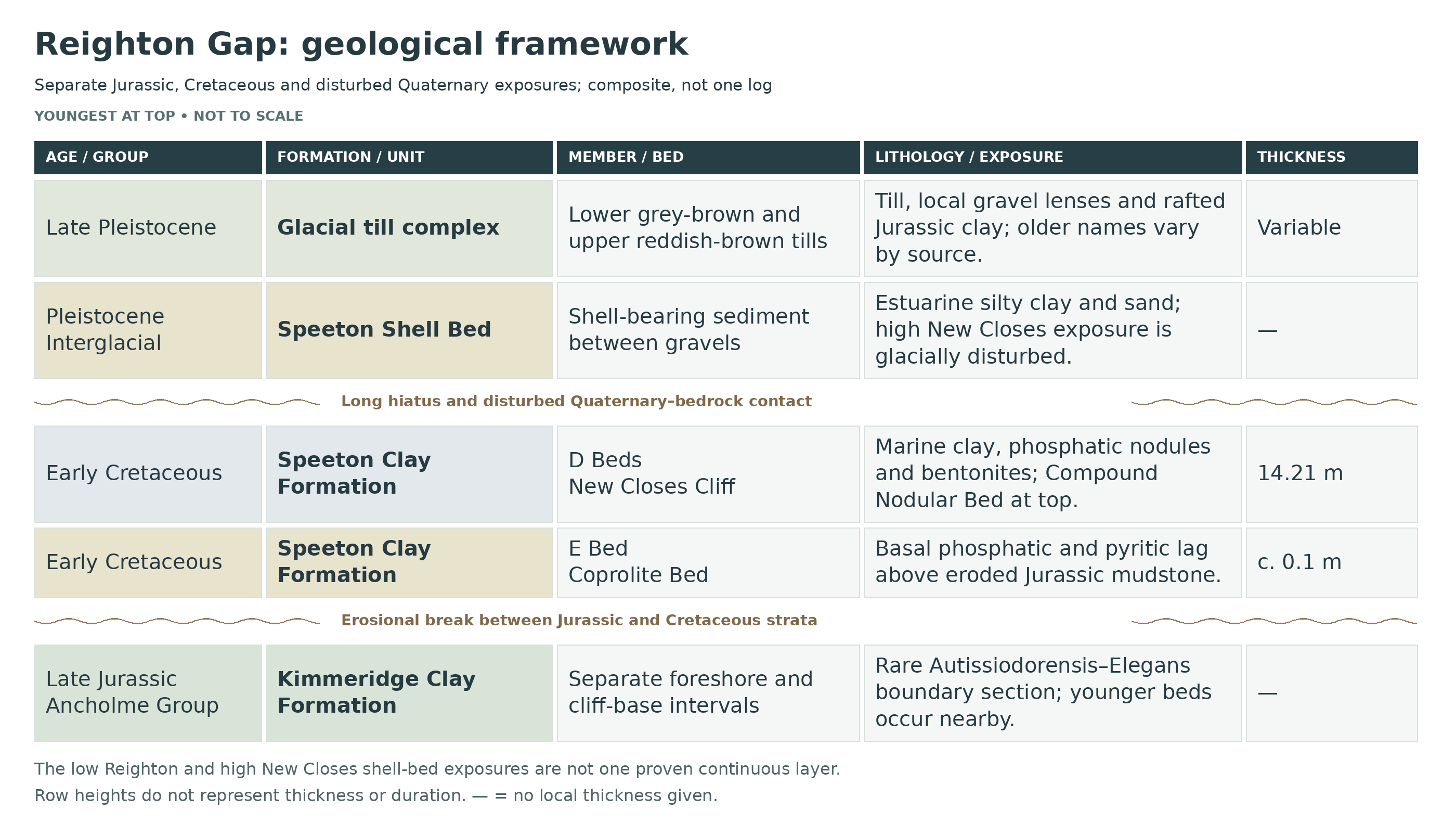
This is a composite stratigraphic breakdown of Reighton Gap and nearby New Closes Cliff, Yorkshire, where rare foreshore and cliff exposures show the Lower–Upper Kimmeridgian boundary, the eroded top of the Kimmeridge Clay beneath the basal Speeton Clay, and the famous glaciotectonically disturbed Speeton Shell Bed beneath Devensian tills. The locality is important because it links Upper Jurassic ammonite zonation, the basal Lower Cretaceous overstep, and one of the most debated interglacial shell-bed successions on the Yorkshire coast.
This chart combines separate exposures, not one continuous vertical log. The low Reighton Shell Bed and the high New Closes exposure are not joined by a continuous observed outcrop. The latter has been displaced by glaciotectonic deformation. The historical lower/upper till names vary between authors: the older excursion uses Skipsea and Withernsea correlations, while the GCR discussion groups the local Lower and Upper Till Series with Skipsea. Descriptive till names are therefore used in the chart. The Speeton Clay has no assigned formal parent group here; the Ancholme Group bar applies to the Kimmeridge Clay only.
Within the local cliff nomenclature, the published letters F–A are retained where appropriate: F is the Upper Jurassic Kimmeridge Clay, E the Coprolite Bed, and D the basal Speeton Clay seen around New Closes Cliff. The RG numbers used below for the composite Kimmeridge units, the Shell Bed and the Quaternary cover are site-use divisions for this locality and are not formal published bed numbers.
ANCHOLME GROUP
Kimmeridge Clay Formation (Upper Jurassic)
Bed RG1 — Lower Foreshore Kimmeridge Clay, Autissiodorensis Zone Composite Unit (c. 6 m seen)
This rare low-tide foreshore section near Reighton Gap consists of black, more or less hard shales with calcareous bands, numerous crushed ammonites concentrated in shell beds, and concretionary horizons that in the lowest beds may contain large uncrushed ammonites. The fauna includes Aulacostephanus autissiodorensis, A. kirghisensis, A. volgensis, Sphinctoceras sp. and abundant Subdichotomoceras cf. lamplughi. This is the lower half of the classic Callomon boundary section and is important because its ammonite assemblage has a distinctly Boreal aspect, with genera more characteristic of northern faunal provinces than of southern England. The lithology indicates offshore marine mud deposition, locally quiet enough for concretion growth and preservation of uncrushed cephalopods before compaction.
Bed RG2 — Upper Foreshore Kimmeridge Clay, Elegans Zone Composite Unit (c. 6 m seen)
Above the lower boundary-section shales lies a second c. 6 m unit of black hard shale crowded with layers of crushed but otherwise complete pectinatitid ammonites, especially Pectinatites of the elegans group and allied Arkellites-type forms. Lithologically it is not sharply distinct from the lower unit, and the key break is faunal rather than sedimentological. This upper unit marks the Upper Kimmeridgian Elegans Zone and makes Reighton Gap one of the few Yorkshire coastal sites where the Lower–Upper Kimmeridgian substage boundary can be observed directly rather than inferred from boreholes. Deposition remained in an offshore mudstone shelf setting, with shell concentrations and later compaction flattening much of the fauna.
Bed RG3 — F Bed / Uppermost Kimmeridge Clay Beneath The Coprolite Bed (composite upper cliff and foreshore interval)
At New Closes Cliff and adjacent beach exposures, the highest surviving Kimmeridge Clay beneath the Cretaceous unconformity forms the old F Bed of the Speeton succession. It consists of black pyritic shales and paper shales with large dolomitic concretions, and it commonly yields white flattened ammonites of the Pectinatites pectinatus group together with small flattened molluscs. Nearby exposures have also yielded younger Upper Kimmeridgian faunas of the Wheatleyensis, Hudlestoni and Pectinatus zones. This uppermost Jurassic interval is therefore a composite and exposure-dependent one rather than a neat single bed, but it is crucial because it records the last preserved Kimmeridgian mud deposition before later Jurassic and lowermost Cretaceous beds were removed by erosion.
Speeton Clay Formation (Lower Cretaceous)
Bed E — Coprolite Bed (c. 0.1 m)
The base of the Speeton Clay at Reighton Gap is the classic Coprolite Bed, a thin but prominent phosphatic lag resting sharply on the eroded Kimmeridge Clay. It appears hard and cindery in the cliff and consists of rolled and fragmentary phosphatic and pyritised bivalves, ammonites and bone fragments, representing the slowly accumulated sweepings of an old marine sea floor. It marks a major non-sequence, because younger Kimmeridgian and Portlandian strata are absent here. The bed was economically important in the 19th century, when it was mined for phosphate until landslipping closed the workings.
Bed RG4 — D7–D6 Lower D Beds, Including The Blue Bed (part of a 14.21 m D-bed succession)
The lowermost Speeton Clay above the Coprolite Bed consists of black, blue and brown clays that may be pyritic, glauconitic or selenitic, with scattered phosphatic nodules and several thin yellow-weathering bentonite horizons representing altered volcanic ash falls. The Blue Bed of D6 is the most distinctive named horizon in this lower part. The fauna includes ammonites and robust square-sectioned belemnites of the Acroteuthis lateralis group, and these beds have long been known as the old Lateralis Beds. Sedimentologically they represent very slow offshore marine mud accumulation on a condensation-prone sea floor, with phosphatic nodule growth and episodic ash input.
Individual Lower D Beds — Neale’s Published Speeton Composite
The order below runs from D8 above the Coprolite Bed upwards to D6A. Original inch values and observed ranges are retained; they are published composite-section measurements, not a new continuous measurement of today’s slipping cliff. Subdivisions are beds, not formal members. The Neale scheme distinguishes these individual units within the broader D-bed descriptions.
D8 — 12 in
Hard black shale; glauconite and quartz grains.
D7G — 17–18 in
Brown, glauconitic clay and mudstone.
D7F — 3 in
Blue clay, pale mottling.
D7E — 4½ in
Green-brown shaly mudstone. Neale’s 1962 collection records Laugeites? sp. at this, the lowest ammonite-bearing level in that study.
D7D — 6½–8 in
Blue clay; pyrite nodules and greenish burrows.
D7C — 8–9½ in
Green-black blocky shale.
D7B — 6 in
Grey-blue streaked mudstone. Neale records Tollia wrighti here and states that the D7A association also occurs in the underlying bed.
D7A — 10 in
Green-black shaly mudstone. Neale’s historical identifications include Tollia wrighti, Paracraspedites prostenomphaloides and Laugeites? sp.; the text also records them in D7B below.
D6J — 5–6 in
Soft blue clay; yellow efflorescence on weathering.
D6I — 18½–22 in
Pale-blue mudstone. Small ammonites were identified by Neale as Subcraspedites aff. cristatus. This retains the original identification and bed provenance, not a claim that the historical generic assignment remains current.
D6H — Stone Band — 4–7 in
Hard pale limestone lenticles form a conspicuous marker between similar mudstones. Neale reports Paracraspedites stenomphaloides, using that spelling and historical identification.
D6G — 8 in
Pale-blue shale with blocky fracture. Neale records Paracraspedites subtzikwianus from this bed; this is the historical identification in the 1962 account.
D6F — 3½ in
Shaly mudstone darker than D6G.
D6E — 4 in
Dark mottled shale.
D6D — 3¾ in
Pale-blue mudstone.
D6C — 2¼ in
Dark shale.
D6B — 2 in
Pale streaked muddy band.
D6A — 22 in In Neale’s Composite
Pale bluish-buff mudstone with two ammonite-bearing levels, subdivided in Neale’s original account. The sub-beds below retain his top-down Greek suffixes and published measurements, rather than being forced into an exactly summed modern measurement.
D6A α — 1 in
A thin bed at the junction with D5.
D6A β — 7 in
Brown laminated mudstone with pale-green mottling. Neale records Tollia stenomphala and T. cf. tolmatschowi.
D6A γ — 1–2 in
Strongly mottled sediment between β and δ.
D6A δ — 13 in
Greenish or bluish, relatively homogeneous mudstone with darker streaks or large mottles; it breaks into blocks. Neale records Tollia pseudotolli and large bivalves.
Bed RG5 — D5–D4 Middle D Beds, Including The Lingula Bed And Astarte Bed
Higher in the D Beds, brown and grey marine clays include two of the best-known named marker horizons at this end of the Speeton section: the Lingula Bed and the shelly Astarte Bed. These levels are more obviously fossiliferous than much of the lower D succession and help to break up an otherwise clay-dominated cliff sequence. Phosphatic nodules remain common, confirming that deposition was still extremely slow. The fauna includes bivalves, brachiopods and crustaceans in addition to the characteristic belemnites.
Bed RG6 — D3–D1 Upper D Beds, Including The Exogyra Band, Remanié Horizon And Compound Nodular Bed
The upper part of the D Beds becomes increasingly nodular and condensed. Notable horizons include an Exogyra-bearing band in D3, a dark glauconitic remanié horizon in the D2 interval, and the fossiliferous Compound Nodular Bed at the top, D1, where isolated nodules record more than one phase of nodule growth. Large plesiosaur bones have been found in the higher D Beds, and the bed-top nodular concentration is one of the clearest signs at Reighton of prolonged sea-floor residence and repeated early lithification. Together the D Beds span Berriasian, Valanginian and part of the Hauterivian and form the only Lower Cretaceous bedrock division regularly visible in the immediate Reighton Gap–New Closes sector.
Upper D Marker Horizons In The Hull Geological Society Field Log
The field log records named and lettered horizons within the Speeton coastal composite. It is a schematic logged succession, not a continuously exposed Reighton cliff or a new numerical thickness survey. Its labels are retained without inventing a correlation between every historical sub-bed scheme.
D5 — Lingula Bed
Dark-brown clay forms the marked Lingula horizon above the lower D succession.
D4B — Pale Stripe
The field log distinguishes a pale stripe within the D4 clay interval; it does not provide a separately written lithological description for every adjoining D4 sub-bed.
D3A — Exogyra Horizon
Pale sediment and brown nodules mark the Exogyra-bearing horizon. A further drawn nodule level is labelled D3E in this field scheme; it is not silently renamed to fit another author’s subdivision.
D2D — Remanié Horizon
Dark glauconitic sediment forms the recorded reworked horizon below D1.
D1 — Compound Nodular Bed
The upper-D marker is the compound nodule horizon. Its distinctive multistage nodules are retained in the detailed account above; no unverified sub-bed thickness is added.
Total Thickness Of The D Beds At New Closes Cliff: 14.21 Metres
Speeton Shell Bed — Interglacial Estuarine Unit; Age Debated
Bed RG7 — Lower Gravel (c. 0.6 m)
The shell bed at New Closes Cliff rests on an eroded and contorted surface of Speeton Clay and is separated from it by a basal angular chalk gravel with quartzite erratics, the Lower Gravel of later authors. This bed is important because it shows that the shell-bearing loam did not accumulate directly on a quiet undisturbed clay surface. In places southeast of Reighton Gill, thinner chalky gravels with estuarine shells appear to be lateral equivalents of part of this lower shell-bed package.
Bed RG8 — Speeton Shell Bed Proper (shell-bearing loam and sand, c. 3 m; commonly within a 2–5 m gravel–loam–gravel package)
The classic high-level Shell Bed is composed of grey to blue-black silty clay below, passing up through blue-brown silty clay into brownish silt and fine sand or sandy loam. Flat lamination, ripple cross-lamination, trough bedding and local bioturbation are present, and downward-tapering cracks in the central part have been interpreted either as frost cracks or desiccation cracks formed during brief emergence. Iron-rich layers occur in the lower half. The fauna is a temperate estuarine to shallow brackish-water assemblage, including Macoma balthica, Scrobicularia piperata, Cerastoderma edule, Mytilus edulis, Littorina littorea, L. rudis, Peringia ulvae (recorded as Hydrobia ulvae in the historical source) and Utriculus obtusus, broadly comparable with the modern Humber estuary. A second, much rarer lower outcrop occurs near Reighton Gap at beach level, where similar shell-bearing sediment lies between Kimmeridge Clay and Skipsea Till; because no continuous exposure links the two, and because both are disturbed, their exact relationship has long been debated. The safest interpretation is that the Shell Bed represents a temperate estuarine interglacial deposit that was later compressed, faulted and in part displaced before or during Devensian glaciation. Its exact age remains controversial, with pollen evidence traditionally suggesting an Ipswichian-type temperate episode but amino-acid results and structural arguments allowing an older interglacial age.
Bed RG9 — Upper Gravel (c. 0.6 m)
A second angular chalk-flint gravel overlies the Shell Bed and separates it from the Devensian till cover. This Upper Gravel is generally less intensely deformed than the shell-bearing loam below and is commonly more nearly horizontally bedded, suggesting that it post-dates much of the main thrusting and folding that affected the lower part of the shell-bed succession. Together with the Lower Gravel it records cold-stage slope or solifluction-style gravel accumulation bracketing the temperate estuarine phase.
Total Thickness Of The Speeton Shell Bed Package At New Closes Cliff: Commonly 2–5 Metres, Of Which The Shell-Bearing Estuarine Unit Itself Is About 3 Metres Thick
NORTH SEA COAST GLACIGENIC SUBGROUP
Holderness Formation (Late Devensian)
Bed RG10 — Lower Grey-Brown Till / Skipsea Till Of Older East Yorkshire Usage
From the car park cliffs down to Reighton Gill, much of the section consists of greyish-brown till forming roughly the lower half of the cliff, though it is commonly obscured by slumped material. This diamicton is the lower Devensian till of the Reighton section and is widely referred to in older East Yorkshire literature as the Skipsea Till. At New Closes Cliff it overlies the shell-bed package, with the Upper Gravel intervening above the shell-bearing sediment. Stone-fabric work shows an overall northeast–southwest movement direction for the ice responsible for this lower till, consistent with the lower tier of the late Devensian North Sea ice mass.
Bed RG11 — Upper Reddish-Brown Till, Inter-Till Gravels And Jurassic Clay Rafts / Withernsea Till Of Older East Yorkshire Usage
The upper cliff is commonly occupied by reddish-brown till, much of it downslipped over the lower grey-brown till. Thin gravels may separate the two tills or occur in the lower part of the upper till, and on the southeast side of Reighton Gill a 2–3 m gravel rises rapidly through the cliff for about 100 m. Near its southeastern extremity a large contorted raft of grey Jurassic clay sits high in the upper till, showing that pre-existing bedrock masses were torn up and transported by the glacier. In older local usage this upper till is called the Withernsea Till. Its fabric indicates a more north-northwest–south-southeast movement, showing that the upper part of the two-tiered ice sheet was more strongly steered by local topography, especially the Chalk escarpment.
Structural Style And Exposure
Reighton Gap is a shifting composite locality, not a neat permanent measured section. The rare Kimmeridge boundary succession is exposed only when beach sand has been stripped from the foreshore near low water, and the classic Callomon section remains largely dependent on unusually favourable conditions. The New Closes Cliff beds are affected by landslipping, glaciotectonic compression and minor folding, so the Shell Bed and the upper Speeton Clay cannot be treated as an undisturbed layer cake. Most of the cliff line is occupied by rotational slips, downwashed till and temporary mudflows, and the exact outcrop pattern changes from season to season.
Stratigraphic Significance
The Reighton Gap sector is important at three very different stratigraphic levels. First, the foreshore near the old bunker yields a rare Lower–Upper Kimmeridgian boundary section not exposed elsewhere in the Cleveland Basin. Second, New Closes Cliff shows the top of the Kimmeridge Clay cut by the Coprolite Bed at the base of the Speeton Clay, clearly demonstrating the regional erosional break that removed younger Jurassic strata. Third, the Speeton Shell Bed is central to reconstructions of post-Hoxnian to pre-Ipswichian or Ipswichian-age coastal history in East Yorkshire, because it preserves a temperate estuarine fauna and a complex record of glaciotectonic deformation beneath the Devensian tills.
Depositional Environment
The succession at Reighton Gap records a dramatic environmental range. The Kimmeridge Clay formed as offshore marine mud on the Cleveland Basin shelf, with shell beds and concretionary horizons developing during pauses in sedimentation and under locally oxygen-restricted bottom waters. The Coprolite Bed is a condensed marine lag formed on an erosional sea floor. The D Beds of the Speeton Clay represent renewed offshore marine mud deposition in an Early Cretaceous Boreal sea, again with very slow accumulation, phosphatic nodule growth and occasional volcanic ash input. After a very long break, the Speeton Shell Bed records temperate estuarine sedimentation in shallow brackish water, probably during an interglacial episode. The overlying gravels and tills record cold-climate slope processes and direct glacigenic deposition during the Late Devensian.
Total Thickness Covered Here
The immediately relevant Reighton Gap–New Closes Cliff bedrock succession includes about 12 m of rare Lower and Upper Kimmeridgian boundary foreshore section, an additional uppermost Kimmeridge interval beneath the Coprolite Bed in the cliff and beach, the 0.1 m Coprolite Bed itself, and 14.21 m of D Beds of the Speeton Clay. Above the eroded bedrock surface lies a shell-bed package commonly 2–5 m thick, followed by a thick but variable Devensian till cover that forms most of the present cliff. Because the Jurassic, Cretaceous and Quaternary components are only intermittently and separately exposed, Reighton Gap is best understood as a composite locality rather than as one single continuous log.
Individual Sedimentary Divisions Of The High Shell Bed
Edwards’s New Closes description separates approximately 1 m of blue-black silty clay below, 1 m of blue-brown silty clay in the middle and 1 m of brownish silt and fine sand above. Other published logging found somewhat coarser sediment. The colours are partly weathering effects and should not be treated as three formal members. Flat lamination, ripple cross-lamination, trough bedding and bioturbation are preserved; deformation is strongest below and decreases upward. The lower gravel, about 0.6 m, contains angular chalk and quartzite erratics; a similar thickness of upper gravel separates the shell-bearing sediment from till. The higher and lower outcrops remain separate evidence points, and their debated age and structural relationship are not resolved by the chart.
References
Lamplugh, G.W. (1881c, 1889, 1896, 1924) on the Speeton Shell Bed, the Speeton Series and the Yorkshire coastal Cretaceous.
Callomon, J.H. in Callomon & Cope (1971) and Cope, J.C.W. (1974; emended 1980) on the Kimmeridge Clay ammonite succession near Reighton Gap.
Neale, J.W. (1960, 1962, 1968) on the Upper and Lower D Beds of the Speeton Clay; Knox, R.W.O’B. & Fletcher, B.N. (1978) on bentonites in the Lower D Beds.
Kaye, P. (1964) on the Speeton Clay; Rawson, P.F. & Wright, J.K. (2000 and later editions) on the Yorkshire coast and Speeton stratigraphy.
Cox, B.M. Geological Conservation Review account: Speeton Sands; Evans, W.A. Geological Conservation Review account: Speeton.
Catt, J.A. & Penny, L.F. (1966) on the Pleistocene deposits of Holderness; Edwards, S.J. (1978, 1981, 1987), Thistlewood, A.J. & Whyte, M.A. (1993), and Wilson (1991) on the Speeton Shell Bed, glaciotectonics and amino-acid dating.
Neale, J. & Catt, J. in Yorkshire Rocks and Landscape on the Reighton Gap to Speeton coastal excursion.
British Geological Survey Lexicon entries for Kimmeridge Clay Formation, Speeton Clay Formation, Holderness Formation and Skipsea Till Member.
SAFETY
Common sense when collecting at all locations should be used. Take care when walking down the slipway and be sure to return before the tide turns, as the sea often reaches the base of the cliff. Keep away from the cliffs at all times.
EQUIPMENT
Equipment requirements at Reighton Gap are fairly simple, as many fossils can be collected directly from the foreshore. After strong or scouring tides, the sea often washes away much of the fine clay, leaving behind rocks, nodules and fossils concentrated on the beach surface. At such times, fossils can sometimes be picked up simply by carefully searching the foreshore.
A small geological pick or trowel can be useful for easing fossils from loose pieces of fallen clay on the foreshore, particularly where fossils are still partly embedded in the sediment. The clay can be quite firm when dry but softer after rain or high tides, making it easier to work with simple hand tools. In many cases, however, the most important piece of equipment is simply a good eye, as careful searching often reveals fossils hidden amongst the stones.
A geological hammer may also be useful for splitting loose rocks or nodules that show signs of fossils on the surface. Some of the best specimens can be found inside these rocks, especially if worn ammonites or shell fragments are visible externally. As always, care should be taken when using hammers, and safety goggles are recommended when breaking rocks.
Because many fossils can be fragile, it is important to bring wrapping materials such as tissue, newspaper or bubble wrap to protect your finds during transport. Small containers or specimen boxes can also be useful for delicate fossils.
For footwear, trainers or walking boots are usually sufficient for exploring the foreshore. However, after exceptionally high tides or periods of wet weather, the clay on the beach can become very soft and sticky. In such conditions, sturdy waterproof boots with good grip are advisable to prevent slipping and to make walking across the clay easier.
CLEANING AND TREATING
Begin by removing any loose sediment very carefully using a soft toothbrush. Take your time, as many fossils—particularly pyritic specimens—are fragile and easily damaged. Flattened Kimmeridge Clay fossils and pyritic specimens should remain supported in their matrix and need individual assessment before wet cleaning. Do not apply a fixed soaking time to every specimen. After any appropriate wet cleaning, allow specimens to dry naturally at room temperature. Do not dry them on radiators or other heat sources, as rapid drying can cause cracking or long-term damage.
Where consolidation is needed, Paraloid B-72 is a well-established conservation resin. It can often be re-dissolved, but removal from a porous fossil may be incomplete. Use it selectively after assessing the specimen and matrix; it is not a moisture-proof seal or a cure for pyrite decay.
Avoid cosmetic varnishing before identification and assessment, as coatings can obscure detail and complicate later preparation. Keep pyritic specimens in dry, monitored storage and check for cracking or powdery deposits; seek conservation advice if deterioration appears.
IDENTIFY YOUR FINDS
Need help identifying a fossil? Share clear photos, where you found it and its size with the community.
FURTHER READING
Deposits – A fossil hunter’s guide to the Yorkshire coast (Speeton–Holderness regional guide)
Yorkshire Geological Society – Jurassic, Cretaceous and Quaternary rocks of Filey Bay and Speeton
Geological Conservation Review – Speeton Sands (Reighton Gap Kimmeridge Clay)
Geological Conservation Review – Early Cretaceous fossil fishes
ACCESS RIGHTS
This site is a site of special scientific interest (SSSI). This means you can visit the site, but hammering the bedrock is not permitted. For full information about the reasons for the status of the site and restrictions, download the PDF from Natural England.
It is important to follow our ‘Code of Conduct’ when collecting fossils or visiting any site. Please also read our ‘Terms and Conditions‘
LINKS
♦ Fossil Discussions
♦ Fossil Articles
♦ Buy Fossils, Tools and Equipment
♦ Buy Crystals, Meteorites, and Artefacts
♦ Join Fossil Hunts
♦ UK Fossils Network