St Audries Bay is a quieter stretch of the Somerset Jurassic Coast, where Blue Lias cliffs and wave-cut platformsexpose fossil-bearing beds. The foreshore can yield ammonites, reptile remains and marine shells, particularly after erosion, and although less productive than nearby sites, its lower footfall makes it an appealing location for collectors seeking a more peaceful experience.


FIND FREQUENCY: ♦♦♦ – On the foreshore, St Audries Bay can be very productive and the best time to collect is during scouring conditions. Since this location has no nearby parking, the long walk means it has fewer collectors than other nearby locations.
CHILDREN: ♦♦♦♦ – This location is suitable for families
ACCESS: ♦♦♦ – A car park at St Audries Bay takes you directly onto the beach and it is easy to find.
TYPE: St Audries Bay is a foreshore and cliff location, and fossils can be found in both. However, the vast majority of fossils are found in rocks on the foreshore or exposed during scouring tides.
DIRECTIONS
♦ Access is by parking at the Pay and Display car park at St Audries Bay.
♦ From here follow the coastal path East where you will find steps to the beach.
♦ If visiting Doniford, you can walk along the beach, and even return via the coastal footpath, but please note between Doniford and St Audries Bay, is a water crossing called ‘The Swill’, after heavy rain and during winter the water can be fast flowing and deep.
♦ Postcode to the Car Park: TA4 4DP; Google Maps
♦ What3Words to best area: ///sweetly.clearcut.dinner
VIDEO FILM
FOSSIL HUNTING
Fossil collecting at St Audries Bay is mainly carried out on the foreshore, where the Lower Jurassic rocks are exposed across a wide wave-cut platform. Conditions here can vary greatly. At times the beach may be covered by sand or shingle, making collecting difficult, while after strong tides or winter storms the foreshore can be well scoured, exposing fresh rock surfaces and newly fallen material. When this happens the site can be very productive.
From the beach steps, walk westwards towards the headland where the Lower Jurassic Lias rocks are exposed. Most fossils are found on the wave-cut platform, amongst fallen blocks, or within scree slopes at the base of the cliffs. Fossils are sometimes also seen weathering directly from the cliff face, although extreme caution should always be taken when approaching the cliffs due to the risk of rockfalls. A hard hat is strongly recommended when working close to the cliff base.
Ammonites are the most common fossils at St Audries Bay and occur in several distinct layers within the Lower Lias. One of the most easily recognised horizons occurs approximately one metre above a prominent oyster bed, which forms a hard limestone platform on the foreshore near the Doniford headland. This layer often contains ammonites that have weathered free from the rock. Early Jurassic species such as Psiloceras planorbis, Psiloceras tilmanni and Caloceras johnstoni can be found here, representing some of the earliest ammonites of the Jurassic seas.
Further west along the foreshore additional ammonite-bearing beds occur. These may yield species such as Waehneroceras portlocki, Laqueoceras sublaqueus, Alsatites laqueus and Alsatites liasicus, which are often preserved as flattened impressions within the limestone or shale. Other ammonites that may occasionally be found in the Lias beds at St Audries Bay include Schlotheimia angulata, Schlotheimia complanata, Arnioceras semicostatum, Asteroceras obtusum and Oxynoticeras oxynotum. Many of these occur in higher beds and are most commonly discovered in fallen blocks or amongst boulders on the beach.
In addition to ammonites, a range of other marine fossils may also be encountered. Large oyster beds composed of Gryphaea arcuata are common in some layers and form distinctive fossil accumulations within the limestone. Other bivalves such as Cardinia listeri, Pecten and Plagiostoma may also be present. Brachiopods including Lobothyris punctata and Calcirhynchia calcaria occasionally occur within the limestones, while fragments of crinoids can sometimes be found scattered across bedding planes. Belemnites such as Passaloteuthis and Acrocoelites may also appear within some of the beds, although they are less common than ammonites at this location.
Many of the best specimens are found after recent cliff falls, when fresh blocks of fossil-rich limestone are exposed on the beach. After storms it is not unusual to find large ammonites weathered out of these fallen rocks lying loose on the foreshore. Because the cliffs here are continually eroding, new material is constantly being released, meaning that patient searching of the beach and boulder fields can often reward the careful collector.


Some of the most significant fossil and scientific milestones from St Audries Bay include the classic early Jurassic ammonite Psiloceras planorbis, the long-studied Triassic–Jurassic boundary succession, and the later recognition of the bay as one of the key British reference sections for the base of the Jurassic.
1824 – Psiloceras planorbis named from the west Somerset coast
The classic early Jurassic ammonite Psiloceras planorbis was named by Sowerby in 1824, and St Audries Bay is now recognised as the type locality for this important species. Because Psiloceras planorbis became the index fossil of the Planorbis Zone, the locality gained major importance in Jurassic stratigraphy.
1911 – Richardson published the classic description of the St Audries Bay succession
Richardson’s work provided one of the key early detailed accounts of the St Audries Bay section, including the uppermost Triassic beds, the transition into the Blue Lias, and the local marker beds used by later workers. This became one of the foundation studies for the geology of the bay.
1969 – the St Audries Bay area was discussed as a possible global standard for the base of the Jurassic
By the late 1960s, the importance of the St Audries Bay succession had grown to the point that it was being discussed as a possible global reference section for the base of the Jurassic System. This reflected the value of the locality for tracing the appearance of the earliest Jurassic ammonites.
1994 – St Audries Bay formally proposed as a candidate GSSP for the base of the Jurassic
In 1994, the St Audries Bay section was formally proposed as a candidate Global Stratotype Section and Point for the base of the Jurassic System. This was one of the most important scientific milestones in the history of the locality and confirmed its international value.
1995 – the bay’s importance for the base of the Hettangian and the planorbis Zone was reinforced
Further work in 1995 reinforced the importance of St Audries Bay as the type locality for Psiloceras planorbis and as one of the key British sections for the base of the Hettangian Stage. This cemented the bay’s place as one of the most important Lower Jurassic reference sites in Britain.
GEOLOGY
St Audries Bay displays one of the most complete and varied geological sections on the Somerset coast. The bay exposes rocks ranging from the Upper Triassic Mercia Mudstone Group through the Penarth Group and into the Lower Jurassic Blue Lias Formation, illustrating the major environmental changes that occurred at the end of the Triassic and the beginning of the Jurassic.
To the east of the bay the cliffs expose the distinctive red and brown mudstones of the Mercia Mudstone Group, deposited during the late Triassic in arid continental environments dominated by mudflats, lagoons and ephemeral lakes. These sediments were laid down in a largely desert-like climate before the sea flooded the region at the end of the Triassic. The headland known as Blue Ben clearly shows where these Triassic rocks are faulted against the younger Jurassic beds, creating a striking contrast between the red marls of the Mercia Mudstone and the darker grey marine sediments of the Jurassic.
Above the Mercia Mudstone Group lie the transitional marine sediments of the Penarth Group, which record the initial flooding of the area as sea levels rose during the Rhaetian Stage of the latest Triassic. These rocks represent the gradual shift from continental to marine conditions as the sea spread across southern Britain.
To the west of the bay the cliffs and foreshore are dominated by the Blue Lias Formation of the Lower Jurassic. These rocks consist of alternating bands of dark grey or black shale and pale limestone that form the distinctive stepped cliffs seen along much of the Somerset coast. The Blue Lias was deposited in a shallow marine sea around 200 million years ago, across the latest Triassic and earliest Jurassic interval. The alternating layers reflect periodic changes in sedimentation and water chemistry, producing cycles of mudstone and limestone deposition.
Within the Blue Lias at St Audries Bay the Aldergrove Beds are particularly well exposed. These beds consist of alternating grey mudstones and limestones that form a broad wave-cut platform across the foreshore when conditions allow. Continued erosion by the sea regularly exposes fresh rock surfaces, revealing the bedding planes and fossil-bearing layers within the formation.
Moving further west along the coast reveals progressively younger parts of the Blue Lias sequence. The cliffs and foreshore here provide excellent exposures of the early Jurassic marine sediments, showing the repeating limestone and shale cycles that characterise this formation. These rocks record the establishment of stable marine conditions following the Triassic–Jurassic transition and form an important part of the geological story of the Somerset coastline.

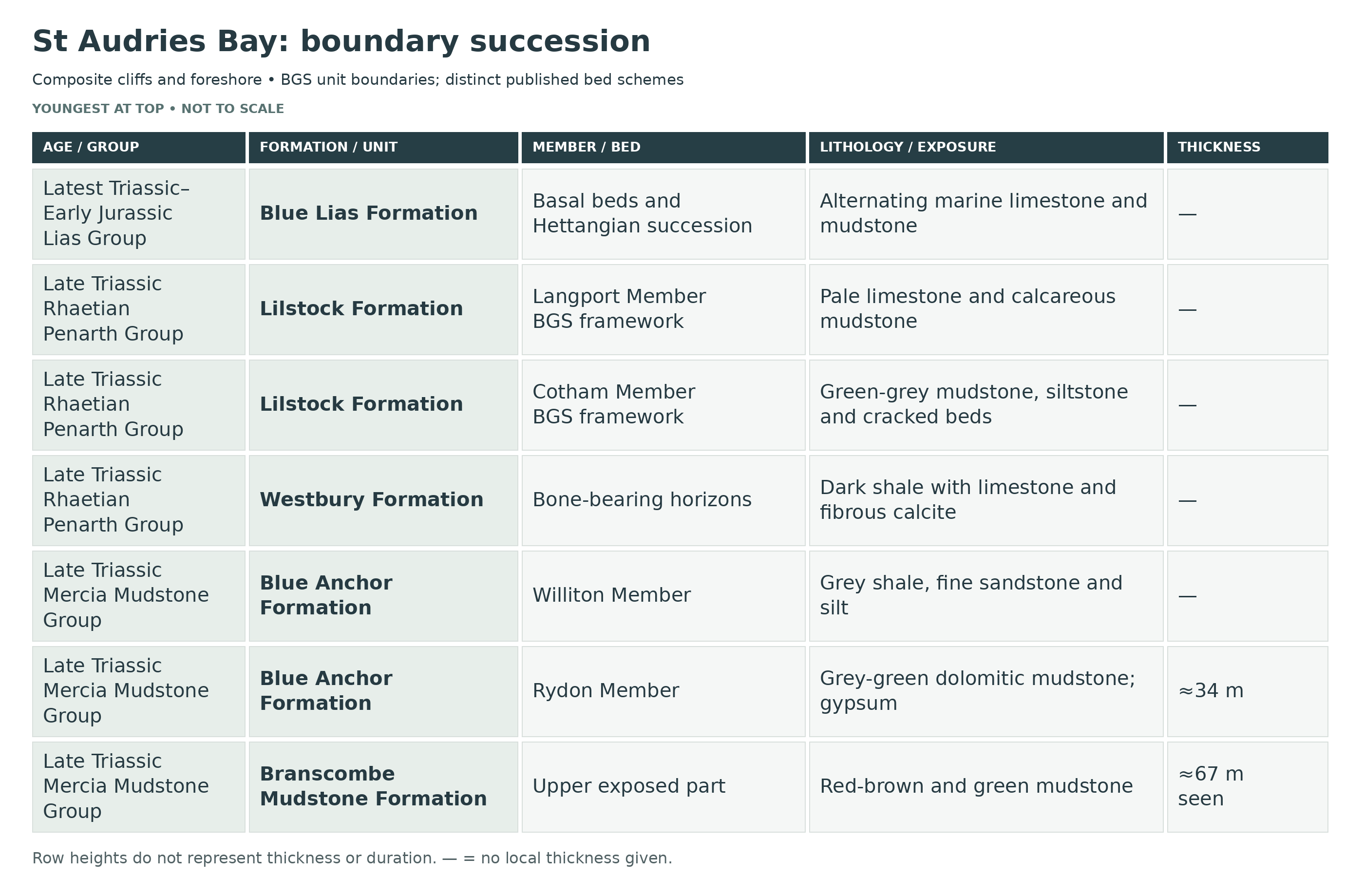
This is a detailed stratigraphic breakdown of St Audries Bay, one of Britain’s classic upper Triassic to lower Jurassic boundary sections, where the upper Branscombe Mudstone Formation, the Blue Anchor Formation, the Penarth Group and a long lower Blue Lias succession are exposed in a west-younging cliff-and-foreshore section. The locality is especially important for its Rhaetian marginal-marine and lagoonal beds, its historical role in debate over the base of the Jurassic, and the lower Hettangian ammonite succession of the wider Watchet Psiloceras planorbis type area.
Section Architecture
St Audries Bay is a composite cliff-and-foreshore section rather than a single simple vertical cliff log. The beds dip south-west, so progressively younger strata are exposed from east to west; the upper Mercia Mudstone Group dominates the eastern cliffs, the Penarth Group is best seen on the western side of the bay and on the foreshore, and the basal Blue Lias is most easily followed west of St Audries Slip and into the immediate westward continuation of the coast. Small faults, active landslip and foreshore stripping continually refresh the exposure, but they can also cause local repetition, omission and concealment.
Boundary And Nomenclature Note
The BGS Lilstock Formation is divided into Cotham and Langport members. Gallois (2009) uses a different division into Cotham, White Lias and Watchet Mudstone formations: his bed C7 lies at the base of the BGS Langport Member, so his whole C1–C10 succession cannot be relabelled as the BGS Cotham Member. Both source schemes are distinguished below. St Audries Bay was long discussed as a candidate reference section for the base of the Jurassic, but it is best treated as a key British boundary section rather than forced into a single globally definitive boundary horizon.
MERCIA MUDSTONE GROUP
Branscombe Mudstone Formation (Upper Triassic: Norian–Rhaetian)
Upper Branscombe Mudstone Formation (c. 67–68 m Seen)
The highest exposed Branscombe Mudstone Formation at St Audries Bay consists of red-brown to reddish and green mudstones with a few green siltstone beds. The mudstones weather blockily, and gypsum or anhydrite was originally abundant in nodules and veins, much of it now weathered out or represented by cavities and softer disrupted zones in the cliff; older cliff descriptions simply treated these as the red and green mudstones beneath the Tea Green Marl. Small faults affect the section, so minor repetition and omission can occur. Interpretation: low-relief continental mudflat, playa-lake and sabkha deposition close to sea level under strongly evaporitic conditions; body fossils are scarce and the unit is chiefly important as the substrate to the boundary succession above.
Blue Anchor Formation (Upper Triassic: Latest Norian–Rhaetian)
Rydon Member
Rydon Member (c. 30–34 m; Published Logs Vary Slightly)
The Rydon Member forms the classic Tea Green Marl and Grey Marl interval of older Somerset usage. At St Audries Bay it consists of grey, black, green and occasional red-brown dolomitic mudstones with more resistant dolomite bands, especially in the higher part of the member, and with common gypsum crystals that have often dissolved to leave cavities and local collapse breccias. The overall colour change from the red Branscombe mudstones below to cooler green-grey dolomitic beds above is very distinctive in the cliff. Fossils are sparse through most of the member. Interpretation: saline to hypersaline lakes and mudflats on an evaporitic plain, with repeated early dolomitization and intermittent emergence.
Williton Member
Williton Member (c. 2–3 m)
The thin Williton Member rests disconformably on the Rydon Member across an erosional surface penetrated by Diplocraterion burrows. It consists predominantly of grey and dark grey shales and marls with flaser- and lenticular-bedded fine sandstone and silt, together with harder siltstones at the top; older literature commonly referred to these beds as the Sully Beds. This is the most overtly marine part of the Blue Anchor Formation at St Audries Bay and has yielded trace fossils, fragmentary gastropods, vertebrate remains including Gyrolepis and Hybodus, and one of the most diverse palynomorph assemblages of its age known from Britain in the uppermost metre. Interpretation: shallow marine to marginal-marine transgression across the evaporitic plain, with tidal or storm-reworked silt and sand laminae.
Total Thickness Of The Upper Mercia Mudstone Group Here: Approximately 104 Metres Seen, Comprising c. 67 m Of Branscombe Mudstone Formation And About 37 m Of Blue Anchor Formation, Though Minor Faulting Produces Local Repetition Or Omission
PENARTH GROUP
Westbury Formation (Rhaetian)
Basal Westbury Transgressive Shale And Bone-Bed Interval (Basal c. 0.36 m)
The basal Westbury Formation marks the main Rhaetian marine transgression at St Audries Bay. The lowest c. 0.36 m is black shale with minor bone-bed material and vertebrate debris, locally with reworked coarse particles and phosphatic grains, forming the classic transgressive lag at the base of the Penarth Group. Pyrite is common, and the fauna is already fully marine in aspect. Typical fossils from this basal transgressive interval and closely adjacent beds include scales and teeth of fishes such as Acrodus, Birgeria, Dalatias, Gyrolepis and Hybodus, together with rarer reptile debris. Interpretation: rapid marine flooding of the west Somerset shelf, with storm reworking and concentration of vertebrate remains into thin laggy horizons.
Main Westbury Shale–Limestone–Beef Cycles (Partial Upper Log; Not The Whole Formation)
Above the basal lag, the Westbury Formation consists of repeated black shale–dark limestone–beef cycles. Thinly laminated black and very dark grey shales with green marl wisps and partings alternate with hard dark grey earthy limestones, dark silty calcareous marl and several fibrous calcite “beef” seams with cone-in-cone structure. Crushed bivalves are common at many levels, and the fauna includes Chlamys, Protocardia and Rhaetavicula, together with ophiuroids, fish remains and marine reptile debris. Interpretation: shallow marine shelf sedimentation under fluctuating energy conditions, with low-energy organic-rich mud deposition punctuated by storm reworking, shell concentration and early diagenetic cementation.
Individual Horizons In The Partial Upper Westbury Log
Listed upwards from the lowest seen shale in GCR24. Repeated shale and calcite entries are separate horizons; the log starts within the formation and is not its complete thickness.
Basal seen black shale (0.15 m seen)
This locally measured horizon is retained separately in the published shale–limestone–marl succession.
Fibrous calcite seam (0.03 m)
This fibrous calcite “beef” seam records mineral growth within the sedimentary sequence.
Dark earthy limestone (0.13–0.20 m)
This locally measured horizon is retained separately in the published shale–limestone–marl succession.
Black shale (0.03 m)
This locally measured horizon is retained separately in the published shale–limestone–marl succession.
Dark-grey earthy limestone (0.08–0.10 m)
This locally measured horizon is retained separately in the published shale–limestone–marl succession.
Fibrous calcite seam (0.05–0.08 m)
This fibrous calcite “beef” seam records mineral growth within the sedimentary sequence.
Black shale (0.91–0.97 m)
This locally measured horizon is retained separately in the published shale–limestone–marl succession.
Fibrous calcite seam (0.03–0.08 m)
This fibrous calcite “beef” seam records mineral growth within the sedimentary sequence.
Very dark earthy limestone (0.03–0.05 m)
This locally measured horizon is retained separately in the published shale–limestone–marl succession.
Fibrous calcite seam (0.03–0.05 m)
This fibrous calcite “beef” seam records mineral growth within the sedimentary sequence.
Black shale (0.53–0.61 m)
This locally measured horizon is retained separately in the published shale–limestone–marl succession.
Fibrous calcite seam (0.03–0.05 m)
This fibrous calcite “beef” seam records mineral growth within the sedimentary sequence.
Hard silty calcareous marl (0.05–0.08 m)
This locally measured horizon is retained separately in the published shale–limestone–marl succession.
Black shale with green marl wisps (0.05–0.08 m)
This locally measured horizon is retained separately in the published shale–limestone–marl succession.
Black shale with green marl lens (0.03–0.05 m)
This locally measured horizon is retained separately in the published shale–limestone–marl succession.
Top black shale (0.05 m)
This locally measured horizon is retained separately in the published shale–limestone–marl succession.
Lilstock Formation (Rhaetian)
Conventional BGS Composite Member Log
These bottom-to-top entries reproduce the geological distinctions of the local Whittaker–Green log presented in GCR24. They belong to that particular composite exposure and are not added to the separately measured Gallois platform log.
Cotham Member
Basal pale-green marl (0.63 m)
Fissile marl contains contorted harder layers in places.
Calcareous siltstone or silty marl (0.15–0.19 m)
Hard partly laminated sediment has lens-like partings.
Green to olive mudstone (0.43 m)
Marly mudstone is more fissile at its upper and lower margins.
Contorted siltstone (0.20–0.28 m)
Hard calcareous siltstone is laminated below and slumped in its upper half.
Dark greenish-grey sandstone (0.03–0.04 m)
A thin sandstone separates the contorted interval from the overlying marl.
Fissile green marl (0.03 m)
This very thin marl separates the two sandstone horizons.
Greenish-grey sandstone (0.15–0.18 m)
Lamination occurs near the base; a cavity-bearing band lies below the top.
Upper laminated shale (0.38–0.46 m)
Greenish-grey shale becomes blockier in its uppermost part.
Langport Member
Basal porcellanous limestone (0–0.05 m)
A pale splintery fine limestone is locally absent.
Grey marl parting (0.03 m)
Marl separates the basal lens from the next limestone.
Laminated fine limestone (0.10–0.15 m)
Very fine grey limestone contains vertical calcite stringers.
Dark grey marly mudstone (0.06 m)
A shaly mudstone parting separates successive limestones.
Pyritic splintery limestone (0.10 m)
The hard grey limestone locally splits into two beds with a mudstone seam.
Grey blocky marl (0.05–0.06 m)
This thin mudstone lies below the silty limestone.
Pale-grey silty limestone (0.09–0.10 m)
A comparatively uniform limestone contains calcite stringers.
Greenish-grey silty mudstone (0.30–0.33 m)
Blocky marly mudstone becomes more fissile in its lowest part.
Four-bed limestone package (0.30–0.33 m)
Hard splintery brownish-grey limestones have irregular surfaces and a rubbly lowest bed.
Upper green-tinted mudstone (0.34 m)
Grey mudstone includes impersistent limestone beds.
Alternative Platform Log: Gallois (2009), C1–C10
The following published bed labels and measurements belong to Gallois’s alternative framework. C1–C6 correspond approximately to the conventional Cotham interval; C7 and higher lie in the BGS Langport interval. They are retained as a comparative local log, not as extra strata to be added to the BGS succession.
Bed C1 — Basal Slumped Lag Bed (0.12–0.35 m)
This published basal Cotham bed is one of the most distinctive soft-sediment horizons in the whole St Audries Bay boundary section. It is highly variable laterally, made up mainly of greenish-grey calcareous mudstones and silty mudstones with irregular slumped masses of more strongly cemented mudstone, streaks and clasts of dark grey Westbury mudstone, and an irregular erosive base. A basal lag with fish debris, sand grains and small black phosphatic pebbles is developed locally. Interpretation: abrupt change from open-marine Westbury shelf muds to very shallow Cotham lagoonal sedimentation, accompanied by erosion, reworking and local slumping of still-unconsolidated substrate.
Bed C2–C4 — Lower Cotham Slumped Mudstone And Muddy-Limestone Package (c. 1.0 m)
Beds C2 to C4 comprise a lower Cotham alternation of muddy limestones and greenish-grey weakly calcareous mudstone. Bed C3 is laminated and thinly bedded with coarse-silt lenses and isolated ripple patches, and both limestone beds may be locally slumped or internally disturbed. The interval records repeated early cementation of parts of the substrate within otherwise soft lagoonal mud. Interpretation: shallow-water lagoon or broad mudflat with intermittent traction currents, local dewatering and slump deformation.
Bed C5 — Rippled Sandstone / Calcarenite With Desiccation Cracks (0.33 m)
Bed C5 is a key marker horizon in the Somerset Cotham succession. It is a fine- to medium-grained sandstone or calcarenite with shell debris and siltstone, showing stacked wave-ripple sets, wavy bedding and mudstone partings. Small desiccation polygons occur within the bed, and larger sand-filled cracks descend from its base into the beds below. Interpretation: very shallow lagoonal or tidal-flat sand sheet laid down under wave or current action and then exposed, cracked and locally reworked.
Bed C6–C9 — Upper Cotham Mudstones And Porcellanous Limestones (c. 1.33–1.47 m)
The upper Cotham succession is thicker on the Somerset coast than in the Penarth area and at St Audries Bay forms a greenish-grey mudstone and muddy-limestone package with two especially important marker beds. Bed C7 is a thinly bedded laminated porcellanous micritic limestone that splits into thin slabs and has long been compared with a Cotham Marble equivalent; Bed C8 is laterally very variable, passing between mudstone, muddy limestone and porcellanous limestone in alternating lenticular or nodular beds; Bed C9 returns to greenish-grey mudstone. Bed C6 below remains thinly bedded, with laminated clay-rich beds alternating with more calcareous beds. Interpretation: fluctuating shallow lagoonal deposition with periodic carbonate precipitation, local emergence and strong lateral facies variability.
Bed C10 — Burrowed Hardground Limestone (0.07 m)
Bed C10 is a thin but highly significant limestone at the top of the Cotham Formation in Gallois’s scheme. It is argillaceous and strongly bioturbated, with abundant Thalassinoides and other burrow systems, and is capped by an irregular mineralized hardground with encrusting oysters. This surface marks a marked omission and forms the immediate foundation for the White Lias facies above. Interpretation: firmground to hardground development at the top of a very shallow lagoon or restricted shelf, following reduced sedimentation and marine reworking.
Gallois White Lias And Watchet Mudstone Above C10
Gallois White Lias Limestone Pair Within The Conventional Langport Interval (0.20–0.21 m In The Platform Section)
In the Gallois platform log the White Lias begins with a dense micritic laminated porcellanous limestone pair, two beds about 0.10 m thick separated by a very thin calcareous mudstone that fills hollows on the irregular top of the lower limestone. This is the classic White Lias facies of the Somerset coast and corresponds to the pale Sun Bed interval below the basal Blue Lias mudstone. The rock is hard, splintery and locally conchoidal, and forms one of the sharpest and most laterally persistent marker beds in the entire boundary succession. Interpretation: warm, very shallow carbonate lagoon or emergent carbonate-flat deposition with rapid precipitation of fine micrite.
Upper Langport Calcareous Mudstones And Shelly Limestones (0.28 m In The Platform Section; Thicker In The Composite Cliff Log)
Above the White Lias lies the interval named Watchet Mudstone Formation by Gallois. On the St Audries wave-cut platform it comprises pale grey to pale grey-green calcareous mudstone infilling hollows on the White Lias, a tightly cemented argillaceous limestone with moulds of Liostrea, Modiolus and other bivalves, and a further pale calcareous mudstone at the top; in the classical composite cliff log the same interval expands into several green-tinged marls and hard splintery limestones with pyrite and calcite stringers. It forms the hard grey calcareous mudstone package immediately beneath the fissile basal Blue Lias shale. Interpretation: slightly deeper but still very shallow restricted marine shelf or lagoonal mud deposition above the White Lias carbonate-flat phase.
Thickness Scope: Published Full Westbury Measurements Are About 9.6–10.6 m; The Short Upper Log Is Incomplete. Lilstock Is About 3 m In The Conventional BGS Scheme
Individual Beds Within The Grouped Platform Packages
Bed C2 (0.20 m)
Muddy limestone, locally slumped, forms a more strongly cemented part of the lower package.
Bed C3 (0.60 m)
Greenish-grey mudstone with thin lamination, silt lenses and isolated coarse-silt ripples is locally slumped.
Bed C4 (0.20 m)
Muddy limestone resembles a cemented version of C3, with isolated siltstone ripples and thin lenses; local slumping persists.
Bed C6 (0.50–0.60 m)
Greenish-grey mudstone alternates between laminated clay-rich layers and thicker, more calcareous layers.
Bed C7 (0.08–0.12 m)
Laminated porcellanous micritic limestone splits into thin slabs. This is the critical horizon placed at the Langport base in the BGS scheme.
Bed C8 (0.45 m)
Lenticular or nodular beds vary laterally from weakly cemented mudstone through muddy limestone to porcellanous limestone.
Bed C9 (0.30 m)
Greenish-grey mudstone, weakly calcareous in places, underlies the burrowed C10 limestone.
LIAS GROUP
Blue Lias Formation (Triassic–Jurassic Boundary Interval And Lower Jurassic)
Blue Lias Bed Numbering Note
The numbered beds below follow the formal Whittaker & Green bed numbering used throughout the west Somerset Lower Jurassic literature. At St Audries Bay the lowest Blue Lias is best seen in the cliff and foreshore west of St Audries Slip, and because the beds dip south-west and are locally faulted, the succession is followed laterally rather than as one single simple vertical face.
Beds 1–7 — Ammonite-Free Basal Interval (Basal c. 5 m)
Beds 1–7 are the ammonite-free basal interval. Historically the term Pre-planorbis Beds included beds 1–12; subsequent discoveries demonstrated ammonites in beds 8–12. At the very base, the Blue Lias begins at the sharp planar base of a fissile organic-rich mudstone resting on the hard grey calcareous mudstone at the top of the Langport Member; in the platform log this basal fissile mudstone is about 1.40 m thick and is capped by a 0.11 m tightly cemented bluish-grey argillaceous limestone. Higher beds in this lower package continue as mudstone–nodular limestone couplets. The macrofauna is dominated by bivalves, especially Liostrea hisingeri, with Camptonectes, Protocardia and Pteromya also recorded, but unequivocal ammonites were not recognized in the original scheme. Interpretation: normal-marine offshore shelf mud deposition with repeated early cementation into nodular limestones, representing the lowermost Blue Lias boundary interval.
Beds 8–12 — Lower Psiloceratid Boundary Interval
Beds 8–12 yield the lowest psiloceratids known from the St Audries Bay section and are critical to boundary work. The detailed bed 8 and bed 9 species identifications belong to adjacent Doniford specimens. St Audries specimens from those levels are too poorly preserved for comparable species determinations. Lithologically the interval still belongs to the basal Blue Lias rhythm of mudstones and rather nodular limestones, and preservation of ammonites is generally poorer than in the higher laminated mudstones. Stratigraphic significance: this is the lowest ammonite-bearing part of the St Audries Bay boundary succession and the level on which much of the British base-Jurassic discussion at the site has turned.
Beds 13–19 — Main Psiloceras planorbis Interval
Beds 13–19 contain unequivocal Psiloceras planorbis and form the classic lower Hettangian ammonite interval in the St Audries Bay section. The beds are alternating mudstones and limestones typical of the lower Blue Lias offshore facies, and are among the most important horizons for correlation within the wider Watchet district. Typical associated fossils in the lower Blue Lias include abundant bivalves such as Liostrea, Camptonectes, Protocardia and Pteromya, together with echinoids including Diademopsis and Eodiadema bechei. Ammonites: abundant Psiloceras planorbis. Interpretation: open offshore shelf sedimentation with periodic limestone formation and the first well-developed psiloceratid fauna of the area.
Beds 20–24 — Upper Planorbis Subzone, Including Bed 24
Beds 20–24 make up the upper part of the Planorbis Subzone and culminate in the famous laminated mudstone of Bed 24. This upper interval is more mudstone-rich, and Bed 24 itself comprises 2 m or more of hard indurated laminated mudstone packed with crushed iridescent ammonites referred to Psiloceras ex gr. planorbis; the upper part has also yielded bluntly ribbed forms referred to Psiloceras ex gr. plicatulum. Small pyritized colonies of Heterastraea, fish remains and occasional ichthyosaur material have been recorded from the Planorbis-zone mudstones. Stratigraphic significance: Bed 24 is one of the most distinctive and laterally useful lower Hettangian marker beds on the Somerset coast.
Beds 25–42 — Johnstoni Subzone (c. 3.4 m)
Bed 25 is a limestone band marking the first appearance of Caloceras and therefore the base of the Johnstoni Subzone. Beds 25–42, about 3.4 m thick, comprise limestones and mudstones, including hard laminated mudstone horizons that have yielded Caloceras johnstoni in Bed 36 and C. intermedium in Bed 37. The interval is less famous with collectors than the Psiloceras planorbis beds below, but it is crucial for detailed Hettangian subdivision in west Somerset. Interpretation: continued offshore Blue Lias deposition, with laminated mudstone episodes and recurring limestone development in a fully marine shelf setting.
Beds 43–79 — Liasicus Zone (c. 28 m)
The appearance of Waehneroceras sensu lato in Bed 43 marks the base of the Liasicus Zone. Beds 43–79 total about 28 m and are dominated, especially below about Bed 69, by mudstones with only subordinate limestones. Laqueoceras appears around Bed 67 and marks the boundary between the Portlocki and Laqueus subzones. The macrofauna becomes more diverse than in the Planorbis-zone beds below and includes Camptonectes, Gervillia, Lucina, Liostrea, Modiolus, Plagiostoma, Pseudolimea and the lowest local Gryphaea cf. obliquata. Interpretation: relatively expanded offshore mudstone deposition in the Bristol Channel Basin, with fewer limestones and a more mature early Jurassic marine benthos.
Beds 80–145 — Angulata Zone (c. 40 m To The Hettangian–Sinemurian Boundary Interval)
The base of the Angulata Zone is taken at the first appearance of Schlotheimia cf. amblygonia in Bed 80. From Bed 80 to Bed 145, a further c. 40 m of mudstones and nodular limestones are documented in the regional west Somerset reference succession, with the Complanata Subzone beginning at Bed 95 and the Depressa Subzone at Bed 134. The fauna is relatively sparse compared with lower Hettangian levels, but Gryphaea arcuata becomes increasingly common and the brachiopod Calcirhynchia calcaria is characteristic. These beds lead up to the Hettangian–Sinemurian boundary interval in Bed 145 in the regional framework; the formal GSSP is east of this bay at East Quantoxhead. Interpretation: continued open-marine Blue Lias deposition in a thick, basinward Hettangian succession.
Total Thickness Of The Blue Lias Formation Covered Here: About 74 Metres In The St Audries–Doniford Cliff Section, With Higher Intervals In Doniford Foreshore Exposures, With Higher Lower Jurassic Beds Exposed In Other Fault Blocks Along The Coast; East Quantoxhead And Lilstock Are East Of This Bay
Measured St Audries–Doniford Scope
The 2008 ISJS dossier describes about 74 m in the approximately 1.2 km cliff section from St Audries towards Doniford. Beds 80–135 account for about 32.8 m in the cliffs; beds 136–145, about 8.4 m, and beds 146–158, about 7.5 m, are measured on the Doniford foreshore. The formal Sinemurian GSSP lies about 3.5 km east-north-east at East Quantoxhead. These scopes must remain separate from a single St Audries cliff measurement.
Beds 13–15 — Locally Measured Shale Interval
The ISJS account records 0.61 m of shale between 5.42 and 6.03 m above the Blue Lias base in the local measured succession. This is an individually scoped interval within the broader planorbis-bearing package described above.
Individual Blue Lias Marker Horizons
The lower markers accompany the St Audries basal succession. The entries explicitly labelled regional belong to the wider correlated Somerset coast and are not an assertion of a complete St Audries cliff exposure.
Bed 8 — Lowest Local Psiloceras
Ammonites occur at this level, but the St Audries material is too poorly preserved for the detailed species comparison established from Doniford specimens.
Bed 9 — Neophyllites And Early Psiloceratids
The detailed Neophyllites and early Psiloceras determinations belong to adjacent Doniford specimens; St Audries bed 9 specimens are less securely identified.
Bed 24 — Laminated Planorbis Mudstone
This indurated laminated mudstone records abundant crushed iridescent Psiloceras in the regional correlation. The separately discussed grouped interval retains its detailed fossil and thickness context.
Bed 25 — Basal Johnstoni Limestone
The incoming of Caloceras marks this limestone and the base of the Johnstoni Subzone.
Bed 36 — Caloceras johnstoni Horizon
Hard laminated mudstone carries the published Caloceras johnstoni record.
Bed 37 — Caloceras intermedium Horizon
The adjacent numbered mudstone horizon carries the distinct Caloceras intermedium record.
Regional Bed 43 — Liasicus-Zone Marker
The incoming of Waehneroceras sensu lato identifies the regional zonal boundary; it is not a separate formal member.
Regional Bed 67 — Laqueus-Subzone Marker
The first Laqueoceras record is placed around this bed in the regional framework.
Regional Bed 80 — Angulata-Zone Marker
The source uses Schlotheimia cf. amblygonia to identify this regional boundary.
Regional Bed 95 — Complanata-Subzone Base
This numbered marker begins the regional Complanata subdivision of the upper Hettangian.
Regional Bed 134 — Depressa-Subzone Base
This is the published regional lower boundary of the Depressa interval below bed145.
Depositional Environment
The St Audries Bay succession records a major environmental shift across the late Triassic–early Jurassic transition. The upper Branscombe Mudstone Formation represents continental playa-lake and sabkha deposition on a low-relief evaporitic plain; the Rydon Member continues that evaporitic regime in dolomitic lake and mudflat facies; the Williton Member records the first clear shallow-marine incursion. The Westbury Formation marks a fully marine transgression across the shelf, with black shales, storm-reworked shell debris, beef seams and vertebrate-rich lag deposits. The Cotham Member records a return to very shallow lagoonal, tidal-flat and intermittently emergent conditions, including dewatering, slumping and desiccation cracking, while the Langport Member formed in warm very shallow carbonate lagoons and restricted shelf settings. The Blue Lias Formation then records establishment of an offshore early Jurassic sea in the Bristol Channel Basin, with alternating mudstones and limestones, progressive development of ammonite zonation from the lowest psiloceratids upward, and one of the fullest British Hettangian successions known onshore.
Composite-Section Scope: Do Not Sum Incompatible Platform, Cliff And Regional Logs Into One Exposed Thickness
Published BGS Measured Cliff Log: Beds 1–135
Whittaker and Green describe the traverse starting near Doniford at ST 0979 4332 and working east. Their Figure 13 identifies beds 1–135 as measured in the St Audries cliffs; the ISJS account scopes this as the approximately 1.2 km St Audries–Doniford cliff section. This is the exact local traverse, not the whole 20 km Somerset composite. Entries follow the source from youngest to oldest. Bed numbers, ranges and unnumbered sub-beds are kept distinct. Fossil names and zone labels are historical identifications as published, not a new taxonomic revision. Thicknesses are local measurements or estimates, not present-day exposure guarantees.
Blue Lias Formation
Historical source division: Schlotheimia angulata Zone
Blue Lias Formation
Published bed 130–135 — Shales with two limestone bands at middle and base (1.12 m)
Shales with two limestone bands at middle and base.
Published bed 129 — Shale with nodular and lenticular limestones near the base (1.85 m)
Shale with nodular and lenticular limestones near the base.
Published bed 128 — Limestone (0.10–0.15 m)
This limestone interval is lenticular in places.
Published bed 127 — Shale (0.76 m)
The recorded interval consists of shale.
Published bed 126 — Limestone (0.30–0.33 m)
Limestone. brachiopod recorded in the original log sp.
Published bed 124–125 — Shale (2.04 m)
Shale. Large Schlotheimia.
Published bed 117–123 — Limestones in three bands alternating with shales (1.14 m)
Limestones in three bands alternating with shales.
Published bed 115–116 — Shale (2.87 m)
The recorded interval consists of shale.
Published bed 107–114 — Limestones in four bands alternating with shales (1.26 m)
Limestones in four bands alternating with shales.
Published bed 106 — Shale (1.50 m)
The recorded interval consists of shale.
Published bed 103–105 — Limestones in two bands with shale between (0.43 m)
Limestones in two bands with shale between.
Published bed 102 — Shale (1.22 m)
The recorded interval consists of shale.
Published bed 101 — Limestones with a shale parting (0.46 m)
Limestones with a shale parting.
Published bed 100 — Shale (0.41 m)
The recorded interval consists of shale.
Published bed 99 — Limestones in three bands separated by shales (0.69 m)
Limestones in three bands separated by shales.
Published bed 98 — Shale (0.41 m)
The recorded interval consists of shale.
Published bed 97 — Limestone (0.33 m)
The recorded interval consists of limestone.
Published bed 96 — Shales with three limestone bands (2.43 m)
Shales with three limestone bands.
Published bed 94–95 — Limestones in two bands alternating with shale (1.93 m)
Limestones in two bands alternating with shale.
Published bed 93 — Limestone (0.05–0.10 m)
This limestone interval is lenticular.
Published bed 92 — Shale (0.91 m)
The recorded interval consists of shale.
Published bed 91 — Limestone (0.05–0.10 m)
This limestone interval is lenticular.
Shale (0.13 m)
The recorded interval consists of shale.
Limestone (0.09 m)
This limestone interval is slabby and regular.
Published bed 90 — Shale (1.40 m)
The recorded interval consists of shale.
Published bed 89 — Limestones in five bands alternating with shales (1.59 m)
Limestones in five bands alternating with shales.
Published bed 88 — Shale (1.63 m)
The recorded interval consists of shale.
Published bed 87 — Limestones in three bands separated by shales (0.84 m)
Limestones in three bands separated by shales.
Published bed 80–86 — Shales with two bands of limestone (4.78 m)
Shales with two bands of limestone.
Historical source division: Alsatites liasicus Zone
Published bed 79 — Limestones in nine bands alternating with shales (2.46 m)
Limestones in nine bands alternating with shales.
Published bed 78 — Shales with three limestone bands (2.10 m)
Shales with three limestone bands.
Published bed 77 — Limestone (0–0.10 m)
This limestone interval is lenticular.
Published bed 76 — Shale (1.09 m)
The recorded interval consists of shale.
Published bed 75 — Limestone (0.20–0.28 m)
This limestone interval is in places present as two beds.
Published bed 74 — Shale (1.09 m)
The recorded interval consists of shale.
Published bed 73 — Limestones with a mudstone parting (0.38 m)
Limestones with a mudstone parting.
Published bed 72 — Mudstone (0.43 m)
The recorded interval consists of mudstone.
Published bed 71 — Limestone (0.05–0.10 m)
This limestone interval is lenticular.
Published bed 70 — Shale (0.20–0.25 m)
The recorded interval consists of shale.
Published bed 69 — Limestone (0.23–0.25 m)
This limestone interval is persistent but slightly lenticular in places.
Published bed 66–68 — Shales (4.37 m)
This shales interval is mainly fissile but some calcareous and blocky. Laqueoceras laqueus, Waehneroceras cf. megastoma and W. portlocki.
Published bed 65 — Limestone (0.08–0.10 m)
This limestone interval is persistent.
Published bed 62–64 — Shale (2.28 m)
This shale interval is blocky in lowest 0.30 m. W. cf. megastoma and W. portlocki.
Published bed 57–61 — Shale (2.21 m)
This shale interval is with flat limestone lenses and nodules in topmost 0.05 m. Heterastrea sp., Waehneroceras megastoma, W. portlocki and Psilophyllites sp.
Published bed 56 — Mudstone (0.51 m)
The recorded interval consists of mudstone.
Published bed 55 — Limestone (0–0.15 m)
This limestone interval is persistent nodule bed.
Published bed 50–54 — Shale and calcareous mudstone (4.53 m)
Shale and calcareous mudstone. Psilophyllites? and Waehneroceras sp.
Published bed 49 — Shale and mudstone (0.46 m)
Shale and mudstone, very calcareous.
Limestone (0.–0.20 m)
This limestone interval is elongated large nodules.
Published bed 46–48 — Shale and mudstone (0.71 m)
Shale and mudstone. Lucina limbata.
Published bed 45 — Shale (2.23 m)
Shale. Psilophyllites sp. and Waehneroceras sp.
Limestone nodules (0–0.10 m)
Limestone nodules.
Published bed 43–44 — Shale and mudstone (2.67 m)
Shale and mudstone. Camptonectes sp. and Plagiostoma sp.; Waehneroceras prometheus at base.
Historical source division: Psiloceras planorbis Zone
Published bed 38–42 — Limestones in two bands with mudstone parting (0.41 m)
Limestones in two bands with mudstone parting.
Published bed 36–37 — Shale (1.42 m)
This shale interval is blocky in the topmost 0.48 m. Caloceras johnstoni and C. intermedium.
Published bed 35 — Limestones in two bands with a shale parting (0.22 m)
Limestones in two bands with a shale parting.
Published bed 32–34 — Shales with a limestone band (0.29 m)
Shales with a limestone band.
Published bed 31 — Limestone (0.10 m)
This limestone interval is ‘beefy’.
Shale (0.15–0.18 m)
The recorded interval consists of shale.
Limestone (0.19 m)
The recorded interval consists of limestone.
Published bed 30 — Shale (0.38–0.46 m)
Shale. Caloceras sp.
Published bed 25–29 — Limestones in three bands alternating with mudstones (0.89 m)
Limestones in three bands alternating with mudstones.
Published bed 23–24 — Shale (1.93 m)
Shale. Abundant Psiloceras planorbis, P. plicatulum, Anningella faberi, echinoid and fish fragments.
Published bed 20–22 — Limestone (0.28 m)
The recorded interval consists of limestone.
Published bed 17–19 — Shale (0.64 m)
Shale. P. planorbis.
Published bed 16 — Limestone (0.30 m)
The recorded interval consists of limestone.
Published bed 13–15 — Shale (0.61 m)
Shale. P. planorbis, Liostrea irregularis, echinoid fragments and thin-shelled bivalves cf. Anningella.
Historical source division: Pre-planorbis Beds (Triassic)
Published bed 12 — Limestone in one or two nodular beds (0.13–0.20 m)
Limestone in one or two nodular beds.
Published bed 9–11 — Shale (0.20–0.23 m)
The recorded interval consists of shale.
Published bed 8 — Limestone (0.22 m)
This limestone interval is slightly lenticular.
Published bed 7 — Shales with a limestone band near base (0.78 m)
Shales with a limestone band near base.
Limestone (0.06 m)
This limestone interval is passing laterally into hard calcareous mudstone.
Shale (0.24 m)
Shale. Protocardia sp. and echinoid fragments.
Limestone or hard calcareous mudstone (0.08 m)
Limestone or hard calcareous mudstone.
Shale (0.05 m)
The recorded interval consists of shale.
Limestone (0.08 m)
The recorded interval consists of limestone.
Shale (0.44 m)
Shale. Pteromya tatei.
Published bed 6 — Limestone (0.10–0.17 m)
This limestone interval is persistent but lenticular.
Shale (0.17 m)
This shale interval is with nodular limestone up to 0.13 m thick and with bivalves.
Limestone (0.30–0.33 m)
This limestone interval is massive, somewhat ‘beefy’.
Published bed 5 — Shale (0.43 m)
This shale interval is with persistent shelly bands and silty laminae. Plagiostoma sp. and Pteromya tatei.
Published bed 4 — Limestone (0–0.08 m)
This limestone interval is impersistent.
Shale parting (0–0.03 m)
Shale parting, not always present.
Limestone (0.38–0.46 m)
This limestone interval is with shelly bands; somewhat ‘beefy’ and laminated in places.
Published bed 3 — Shale (0.23 m)
The recorded interval consists of shale.
Published bed 2 — Limestone (0.11 m)
This limestone interval is laminated.
Published bed 1 — Shale with silty laminations (1.42 m)
Shale with silty laminations.
References
Whittaker, A. & Green, G.W. (1983). Geology of the Country around Weston-super-Mare.
Mayall, M.J. (1979, 1981, 1983) on the sedimentology and depositional environments of the Blue Anchor Formation and Penarth Group at St Audries Bay.
MacQuaker, J.H.S. (1984, 1994) on Westbury Formation sedimentology, cyclicity and transgressive bone-bed reworking.
Warrington, G. & Whittaker, A. (1984) on the Blue Anchor Formation and Triassic–Jurassic boundary beds of west Somerset.
Warrington, G., Cope, J.C.W. & Ivimey-Cook, H.C. (1994) on St Audries Bay as a candidate reference section for the base of the Jurassic System.
Warrington, G. & Ivimey-Cook, H.C. (1995) on the Triassic and Jurassic boundary succession of the Blue Anchor–Lilstock coast.
Page, K.N. & Bloos, G. (1998), and Bloos, G. & Page, K.N. (2000a, 2000b, 2002), on the basal Hettangian ammonite succession and the Hettangian–Sinemurian boundary in west Somerset.
Hounslow, M.W., Posen, P.E. & Warrington, G. (2004) on magnetostratigraphy and biostratigraphy at St Audries Bay.
Gallois, R.W. (2009). Lithostratigraphy of the Penarth Group of the Severn Estuary region and Somerset coast.
Benton, M.J., Cook, E. & Turner, P. (2002). Permian and Triassic Red Beds and the Penarth Group of Great Britain — St Audries Bay GCR account.
Simms, M.J., Chidlaw, N., Morton, N. & Page, K.N. (2004). British Lower Jurassic Stratigraphy — Blue Anchor–Lilstock Coast GCR account.
British Geological Survey Lexicon of Named Rock Units: Branscombe Mudstone Formation, Blue Anchor Formation, Westbury Formation, Lilstock Formation, Cotham Member, Langport Member and Blue Lias Formation.
GCR24: St Audries Bay
GCR30: Blue Anchor–Lilstock coast
Gallois (2009), Penarth Group Severn Estuary
Warrington et al., St Audries Bay GSSP proposal dossier (2008)
Whittaker & Green (1983), BGS Weston-super-Mare memoir
SAFETY
Common sense when collecting at all locations should be used and knowledge of tide times is essential. You can easily be cut off by the tide as the sea always reaches parts of the cliff. Be careful of falling rocks, as the cliffs are quite high and regularly fall.
EQUIPMENT
Equipment for fossil collecting at St Audries Bay is fairly simple, but a few tools can make searching more productive. A geological hammer and splitting chisel are useful for opening loose rocks and nodules on the foreshore, particularly limestone blocks that may contain ammonites or shells. However, it is important to remember that St Audries Bay is part of a Site of Special Scientific Interest (SSSI), and hammering on in situ bedrock or the cliffs is not permitted. Collecting should therefore be limited to loose material that has naturally fallen onto the beach.
Many fossils can also be found simply by carefully searching the foreshore, especially after scouring tides when sand has been removed and the wave-cut platform is exposed. A good eye is often the most useful tool, as fossils frequently weather out onto bedding surfaces or lie amongst the boulders.
It is advisable to bring wrapping materials such as tissue, newspaper or bubble wrap to protect fragile finds, along with small containers for transporting specimens safely. Sturdy walking boots with good grip are recommended, as the foreshore can be uneven and slippery, particularly when wet or covered in algae. Safety goggles are also recommended when using hammers to split loose rocks.
CLEANING AND TREATING
Let the specimen dry out so it’s easy to clean with a brush. Begin by removing any loose sediment very carefully using a soft toothbrush. Do not dry them on radiators or other heat sources, as rapid drying can cause cracking or long-term damage. We also advise against using water on the fragile flat ammonites.
Once fully dry, we recommend sealing fossils with Paraloid B-72, dissolved in acetone. This is a museum-grade consolidant that is widely available in pre-mixed bottles. Paraloid B-72 is stable, long-lasting, and does not yellow or react chemically over time. Importantly, it is also fully reversible, making it suitable for scientifically important or display-quality specimens.
Some collectors prefer to treat ammonites with artists’ varnish. This is acceptable for common species that are not of scientific importance, as it enhances colour and contrast and can make a specimen really “pop”. However, varnish is not reversible and is therefore not recommended for rarer or research-grade fossils.
IDENTIFY YOUR FINDS
Need help identifying a fossil? Share clear photos, where you found it and its size with the community.
FURTHER READING
Deposits Magazine – Fossils of the West Somerset coast (regional coast overview)
GCR / GeoGuide – St Audries Bay, near Watchet, Somerset
GCR / GeoGuide – Blue Anchor–Lilstock Coast, Somerset (regional stratigraphy)
British Geological Survey – Excursion to Minehead and district, West Somerset, 20–24 June 1913
ACCESS RIGHTS
This site is an SSSI. This means you can visit the site, but hammering the bedrock is not permitted. For full information about the reasons for the status of the site and restrictions please download the PDF from Natural England – SSSI Information
It is important to follow our ‘Code of Conduct’ when collecting fossils or visiting any site. Please also read our ‘Terms and Conditions‘
LINKS
♦ Fossil Discussions
♦ Fossil Articles
♦ Buy Fossils, Tools and Equipment
♦ Buy Crystals, Meteorites, and Artefacts
♦ Join Fossil Hunts
♦ UK Fossils Network