Thorncombe Beacon is a highly productive Jurassic location, yielding a wide range of fossils including ammonites, bivalves, brachiopods, belemnites, crinoids and occasional starfish specimens. The foreshore is scattered with fallen blocks from the cliffs above, many of which contain well-preserved fossils. However, the rock here is extremely hard, meaning extraction can be challenging and often requires patience and effort, particularly when working freshly fallen material after storms.


FIND FREQUENCY: ♦♦♦♦ – Fossils are frequently found, however they are less likely to be found loose. This is a specialist location in which you ideally need heavy lump hammers and heavy duty chisels to split blocks.
CHILDREN: ♦ – The foreshore at Thorncombe Beacon is very rocky. This site is only suitable for families with older children, as some of the boulders are extremely hard and large. Although you can find fossils on the foreshore, most have to be split from the rock using a geological hammer.
ACCESS: ♦♦♦ – There is a car park practically on the beach, with toilets and a pub next to it. However it can be a difficult walk when the beach between Seatown and Thorncombe Beacon Cliff is built up with pebbles, and then a field of large boulders awaits you round the corner.
TYPE: This is a foreshore and cliff location, so fossils can be found in both. Fossils are found in rocks on the foreshore,
DIRECTIONS
♦ Thorncombe Beacon is best reached via Seatown. Follow the narrow lane, just opposite the Castle Inn in Childeock. This road is not suitable for large vehicles, because of its width. There is a small car park, run by the Anchor Inn, at Seatown, which is highly recommended, as parking elsewhere is very limited.
♦ Parking along the roadside at the bottom is possible between the 1st October and the 24th May. The double yellow line parking restrictions only apply in peak season.
♦ Thorncombe Beacon is on your left (east) from the car park at Seatown.
♦ There is a charge for parking at Seatown.
♦ Postcode to parking: DT6 6JU. Google maps link.
♦ Fossil Location: What3Words: ///perused.silver.bless
VIDEO FILM
FOSSIL HUNTING
Thorncombe Beacon is a well-known fossil collecting site on the Dorset coast, but it is important to note that it lies within a Site of Special Scientific Interest (SSSI) and forms part of the Jurassic Coast World Heritage Site. Collectors must therefore follow the Fossil Code of Conduct at all times. Hammering directly on the cliff or bedrock is not permitted, and digging into the cliff or foreshore is strictly forbidden. The land is privately owned and damage has previously been caused by people using power tools and other inappropriate methods. Such activity is illegal and may result in prosecution. Fossil collecting should therefore be limited to loose material that has naturally fallen onto the foreshore.
Most fossils at Thorncombe Beacon come from loose blocks of the Junction Bed, a distinctive series of yellow, iron-rich limestones that weather out onto the beach from the cliffs above. These rocks often occur as layered blocks scattered across the foreshore and can contain large numbers of fossils. Many specimens can be found simply by searching the surface of these rocks, as weathering frequently reveals ammonites and shells. Carefully splitting loose blocks can sometimes reveal beautifully preserved fossils within the rock.
The ammonites at Thorncombe Beacon span several Lower Jurassic horizons. The older Dyrham beds contain forms such as Amaltheus margaritatus, A. stokesi, A. subnodosus and Lytoceras fimbriatum. The overlying Beacon Limestone, traditionally called the Junction Bed, contains Pleuroceras in its lower part and Toarcian genera such as Harpoceras, Hildoceras and Catacoeloceras higher up. Some horizons are condensed and reworked, but the different formations should not be treated as one fossil bed. Note the rock type and find position, and retain both pieces if a fossil-bearing block separates.
Other fossils are also common within the Junction Bed. Belemnites are frequently encountered, particularly species such as Passaloteuthis and Acrocoelites. Crinoid fragments are abundant and occasionally more complete stems can be found preserved within the limestone. Brachiopods such as Terebratula and Rhynchonella are also present, along with numerous bivalves including Gryphaea, Pecten and Trigonia. Gastropods are less common but may occasionally be discovered within the rock. Trace fossils produced by burrowing organisms can also be seen on bedding surfaces.
One of the characteristic fossils at Thorncombe Beacon is the brittlestar Palaeocoma milleri, known as P. egertoni in older accounts. It occurs in the Eype Starfish Bed at the base of the Down Cliff Sand Member. The fossils are concentrated on the underside of the lowest sandstone layer in this composite bed; the Starfish Bed does not also belong to the higher Thorncombe Sand Member. Examine naturally weathered loose slabs carefully and keep any delicate fossil supported in its rock.
It is also worth keeping an eye on the foreshore for occasional slips of Upper Greensand, which may sometimes become exposed after storms or periods of cliff collapse. In its freshly exposed state this rock can be relatively soft, becoming harder as it dries and oxidises in the air. Fossil shells can sometimes be found within these deposits and, when the rock is still soft, they can be extracted quite easily. As with all collecting along this stretch of coast, however, only loose material should be collected and the cliffs themselves should never be disturbed.


Some of the most significant fossil and scientific milestones from Thorncombe Beacon include the classic fossil-rich Jurassic succession, the beds that gave their name to the Thorncombe Sand Member, the later recognition of important erosional surfaces and condensed ammonite horizons, and the continued reputation of the coast below the beacon for ammonites and other Jurassic fossils.
1863 – John Day used the term Green Ammonite Beds for the fossil-rich Middle Lias succession of this coast
Day’s work on the west Dorset coast helped establish the Green Ammonite Beds as one of the classic fossil-bearing parts of the Jurassic succession. Although the term is more often associated with Seatown and Golden Cap, the same broader fossil-rich sequence continues through the Thorncombe Beacon coast.
Mid 20th century – Thorncombe Beacon became established as part of the classic west Dorset Lower Jurassic section
By the mid twentieth century, the coast around Thorncombe Beacon was already recognised as part of the important west Dorset Jurassic succession, with ammonite-rich beds, sandy members and condensed limestone horizons forming a key part of the regional stratigraphy.
1957 – Howarth documented major local omission and erosion surfaces in the Thorncombe Beacon succession
Howarth showed that important beds, including the Thorncombiensis Bed and overlying clays, are locally absent at West Cliff because of erosion and condensation. This was an important scientific milestone because it clarified how incomplete and complex the succession can be beneath the Beacon Limestone Formation in this area.
Late 20th century – the Thorncombe Sand Member became formalised in the modern Jurassic framework
Modern lithostratigraphic revision formalised the Thorncombe Sand Member as part of the Dyrham Formation. This gave Thorncombe Beacon a direct place in the modern naming of the Lower Jurassic succession of west Dorset.
1999 – the modern Dorset Jurassic framework formalised the Beacon Limestone Formation above the Thorncombe Sand Member
Revision of the Dorset coast succession replaced the old broad “Junction Bed” terminology with the Beacon Limestone Formation. At Thorncombe Beacon this clarified the relationship between the erosion surface at the top of the Thorncombe Sand Member and the condensed fossil-rich limestones above.
2000s – Thorncombe Beacon continued to be used as a reference area for Lower Jurassic stratigraphy
Modern synthesis work on British Lower Jurassic stratigraphy continued to use the Thorncombe Beacon coast as an important example of the west Dorset succession, especially for the relationship between sandy members, condensed limestones and fossil-rich ammonite horizons.
Modern collecting – the coast below Thorncombe Beacon remains known for ammonites and other Jurassic fossils
Field guides and collecting notes still describe the foreshore below Thorncombe Beacon as a well-known fossil site, especially for ammonites, with other Jurassic fossils also occurring in fallen blocks and foreshore material. Its importance today lies more in its rich succession and steady fossil yield than in a long list of named individual discoveries.
GEOLOGY
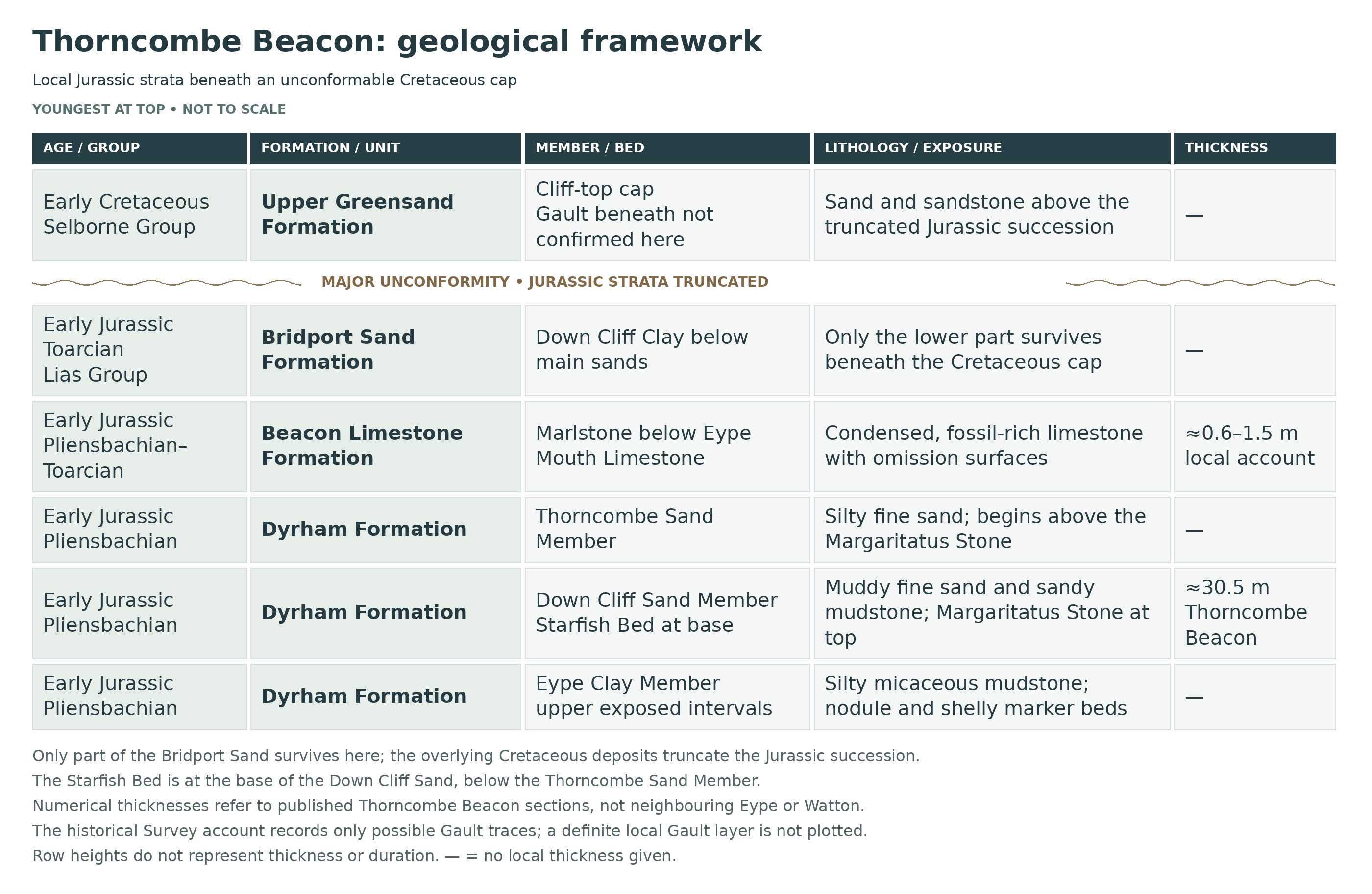
Thorncombe Beacon exposes a Lower Jurassic succession capped unconformably by Lower Cretaceous rocks. The Jurassic beds belong to three separate formations: Dyrham, Beacon Limestone and Bridport Sand. Their contrasting mudstones, sandstones and limestones contribute to the stepped, landslipped character of the cliffs.
The Dyrham Formation includes the Eype Clay, Down Cliff Sand and Thorncombe Sand members. The Eype Clay contains silty mudstone and harder fossil-bearing markers. The Starfish Bed lies at the base of the Down Cliff Sand Member, not at the base of the Thorncombe Sand. The latter begins above the Margaritatus Stone at the top of the Down Cliff Sand.
The Beacon Limestone Formation overlies the Thorncombe Sand across an erosional contact. Its thin, condensed limestones include the Marlstone and Eype Mouth Limestone members and are associated with the traditional Junction Bed. Above this is the Bridport Sand Formation, beginning with the Down Cliff Clay Member and passing into sandier strata.
At Thorncombe Beacon, only the lower part of the Bridport Sand succession survives beneath the later erosion surface. The Upper Greensand Formation forms the younger Cretaceous cap. The historical Geological Survey account records only possible traces of Gault beneath it, so a definite local Gault layer is not assumed here. Their presence must not be used to imply that a complete Jurassic sequence remains below them. The chart summarises the local succession without assigning regional formation totals to the visible cliff.

This is a detailed stratigraphic breakdown of the Jurassic and Cretaceous succession at Thorncombe Beacon, Dorset. The locality exposes the upper part of the Dyrham Formation, the Beacon Limestone Formation, parts of the Bridport Sand Formation, and the Lower Cretaceous cap, making it one of the most important composite cliff sections between Seatown and Eype Mouth.
TB numbers are editorial identifiers, not published bed numbers. The retained intervals are described with their named markers. Coastal reference values are explicitly labelled; visibility and completeness vary between exposures.
LIAS GROUP
Dyrham Formation (Lower Jurassic — Pliensbachian)
The Dyrham Formation beneath Thorncombe Beacon is made up of the Eype Clay Member, Down Cliff Sand Member and Thorncombe Sand Member. Together these record a major shallowing-upward trend from silty shelf mudstones into storm-worked silty sands and sandstones, and they form the main Jurassic cliff profile beneath the higher Toarcian and Cretaceous cover.
Eype Clay Member
Bed TB1 — Three Tiers Sandstone — Basal Marker Package
The Three Tiers marks the basal Eype Clay interval in the coastal reference succession. Three resistant, weakly laminated sandstone bands, each about 0.5–1 m in the published coastal account, alternate with sandy calcareous mudstone. The BGS memoir describes the complete package as up to 9 m; this is a coastal reference value, not a new measurement at this headland. Burrowing and bedding structures distinguish the sandstone bands. Lower parts may be obscured or outside the immediately visible cliff, so the full basal package is not promised at every point.
Bed TB2 — Lower Eype Clay
Pale grey, micaceous, variably silty mudstone with abundant small siderite nodules. This lower part of the member forms a soft, recessive cliff and is often obscured by slipped material from higher, more resistant beds. Away from Eype Nodule and Day’s Shell concentrations, body fossils are generally scarce, apart from crushed ammonites such as Amaltheus and Tragophylloceras. The mudstone records persistent fine sediment supply on the marine shelf.
Bed TB3 — Eype Nodule Bed
The Eype Nodule Bed is a useful marker within the silty mudstones. The BGS coastal account places it about 47 m above the member base, rather than simply halfway through the clay. It describes one or two levels of calcareous nodules, mostly less than 70 mm across, and records the bed at beach level at Eype Mouth. Some nodules were reworked into the succeeding shelly sandstone, with lateral changes associated with the Eypemouth Fault. Ammonites, bivalves and crinoid remains are recorded; weathering can leave the nodules projecting from softer mudstone.
Bed TB4 — Upper Eype Clay And Day’s Shell Bed
The upper part of the Eype Clay Member continues as pale grey silty mudstone and sandy mudstone with many small nodules, but becomes subtly sandier upward. Near the top lies Day’s Shell Bed, a fossil-rich shelly horizon about 1 m below the Starfish Bed in the published coastal account, representing a brief concentration of shell material immediately before the main sand influx that begins the Down Cliff Sand Member.
Published conventions differ: the BGS memoir gives about 65 m for the coastal Eype Clay and includes the basal Three Tiers; the Lexicon gives about 60 m. Some field accounts describe roughly 60 m of clay above the Three Tiers. These descriptions are not silently combined, and no fixed complete local member thickness is assigned in the chart.
Day’s Shell Bed — Upper Eype Clay Marker
This thin, laterally discontinuous shell-rich mudstone lies close below the Starfish Bed. The published coastal description gives less than 0.3 m and records juvenile molluscs with crinoid debris and other marine remains. The especially rich measured occurrence east of Seatown is comparative evidence, not a fossil guarantee for every Thorncombe exposure.
Eype Clay Thickness — Published Coastal Estimates
Down Cliff Sand Member
Bed TB5 — Eype Starfish Bed
The Starfish Bed marks the base of the Down Cliff Sand. It is a composite sandstone package with several sharp-based depositional units, laminated below and increasingly burrowed upwards. The ophiuroids occur on the lowest sole, not indiscriminately on every sandstone underside. GCR describes about 1 m, whereas the BGS memoir cites Woodward’s 1.4 m; these published measurements are not silently treated as one exact local thickness.
Typical Fossils
Brittle stars such as Palaeocoma, crinoid remains including Balanocrinus, and associated marine shelly fossils.
Bed TB6 — Lower Down Cliff Sands
Grey-brown, muddy, very fine-grained sands and sandy mudstones, closely interbedded and more resistant than the Eype Clay below. These beds form ledges and steeper cliff sections and record a low- to moderate-energy shallow-marine setting with a greater and more persistent influx of fine sand and silt.
Crinoid-Ossicle Marl Above The Starfish Bed
The coastal reference account records a marl about 0.2 m thick a few metres above the Starfish Bed, rich in crinoid ossicles. It is a separate horizon from the brittlestar-bearing sandstone, and should not be merged with the Starfish Bed.
Bed TB7 — Upper Down Cliff Sands And Margaritatus Stone
The upper part of the Down Cliff Sand Member becomes increasingly sandy upward and culminates in the Margaritatus Stone at the top of the member. This fossiliferous bluish sandy limestone forms the formal upper boundary marker and is one of the most important datums beneath Thorncombe Beacon. It marks the transition into the even sandier Thorncombe Sand Member above.
Margaritatus Stone — Top Of The Down Cliff Sand
The coastal memoir records an approximately 0.3 m ironshot limestone, blue internally and yellow when weathered, with some conglomeratic texture. Its named ammonites include Amaltheus margaritatus and A. subnodosus. The Blue Band follows above.
Published Down Cliff Sand Thickness: 30.5 m Beneath Thorncombe Beacon
Thorncombe Sand Member
Bed TB8 — Blue Band (Basal Thorncombe Sand)
A blue-grey mudstone directly above the Margaritatus Stone, marking the formal base of the Thorncombe Sand Member. It provides a useful transitional horizon between the sandier Down Cliff beds below and the yellow-weathering sands that dominate the main body of the member.
The BGS coastal reference describes the Blue Band as approximately 2 m of blue-grey shelly mudstone. This is a published coastal value, not an exact newly measured thickness for every exposure.
Bed TB9 — Lower Thorncombe Sands
Yellow-weathering silty, very fine-grained sands and sandy silts, locally bioturbated and with hummocky cross-bedding. These beds form resistant ledges and steep sandy cliff faces and represent a shallower, more energetic marine shelf than the units below, with stronger storm reworking and widespread benthic burrowing.
Bed TB10 — Impersistent Mid-Member Limestone
A local limestone band about 0.3 m thick where present, developed within the Thorncombe Sand Member. Although not everywhere visible, it is a useful internal horizon and suggests a short interval of reduced sand influx and local carbonate cementation or accumulation.
Bed TB11 — Upper Thorncombe Sands And Top Grey Mudstone
The uppermost Thorncombe Sand continues as yellow-weathering very fine sands and silty sands, passing up into a top interval of grey mudstone beneath the Beacon Limestone Formation. Following the BGS 2011 order, grey sandy mudstone lies above the Thorncombiensis Bed and varies laterally. The older GCR prose describes a different order around this marker, so the accounts are not assumed identical. BGS records 2.3–4.6 m in the coastal succession, thinning from Thorncombe Beacon towards Eype Mouth and removed east of there. It is not a uniform 2.3 m bed everywhere.
Thorncombiensis Bed
This distinct upper marker is described in the coastal memoir as about 0.35 m of brown calcareous mudstone and limestone, rich in the brachiopod Gibbirhynchia thorncombiensis. Amaltheus gibbosus supplies the associated ammonite-zone evidence. The variably preserved grey sandy mudstone lies above it and below the Beacon Limestone.
Thorncombe Sand Thickness — About 27 m In The BGS Coastal Reference Account
Beacon Limestone Formation (Upper Pliensbachian To Toarcian)
The Beacon Limestone Formation is the classic ‘Junction Bed’ interval of the Thorncombe Beacon area and the formation’s type section is in the cliff beneath the headland. It is highly condensed, ferruginous below and more nodular above, and represents a major break from the sand-dominated Dyrham Formation below to the sand–mud cycles of the Bridport Sand Formation above.
Marlstone Rock Member
The BGS memoir gives Marlstone Rock thicknesses of 0.3–0.45 m at Thorncombe Beacon. This local measurement is distinguished from more general coastal values and from nearby Watton, where this member is absent.
Bed TB12 — Lower Ferruginous Beacon Limestone
The lower part of the Beacon Limestone Formation is ferruginous and ooidal, commonly weathering reddish-brown, pinkish-brown or dark brown. Locally it may be conglomeratic. These beds represent a highly condensed marine limestone interval developed during a reduction in siliciclastic input and a phase of very slow sedimentation or non-sequence.
Howarth’s Lettered Western-Cliffs Layers
Howarth (1992, pp.24–26) describes the condensed Junction Bed between Seatown and Eypesmouth separately from Watton Cliff east of the fault. The lettered layers below are from that western framework. They vary laterally, may be absent, and no single block contains them all. Published zero-to-maximum ranges express that variability; they are not summed into a continuous local total.
Layer R — Dark Ooidal Conglomeratic Limestone
The lowest named layer is hard dark-grey limestone containing coarse iron-rich ooids and sandstone pebbles. Howarth gives an absent-to-0.25 m range for the western cliffs and an Apyrenum Subzone fauna.
Layer Px — Grey-Pink Limestone
A harder grey-pink limestone with scattered ooids, assigned to the Hawskerense interval. Its western-cliffs range is absent to 0.25 m, with Pleuroceras recorded.
Layer P — Fine-Ooidal Brown And Grey Limestone
This ooidal limestone contains occasional sandstone pebbles and spans the later Spinatum and Tenuicostatum intervals in Howarth’s account. The reported western-cliffs range is absent to 0.30 m. The Pliensbachian–Toarcian time boundary does not coincide automatically with a new formation boundary.
Eype Mouth Limestone Member
Bed TB13 — Upper Nodular Beacon Limestone / Junction Bed
The upper part of the Beacon Limestone Formation is nodular and fossil-rich, traditionally called the Junction Bed. It is one of the most important ammonite-bearing limestone intervals in west Dorset and occurs as hard fossiliferous blocks and in place beneath Thorncombe Beacon. The condensed nature of the bed means that faunas may be mixed, and the limestone often preserves ammonites, belemnites and bivalves in excellent relief.
Planar Hardground At The Marlstone–Eype Mouth Limestone Contact
The GCR describes a conspicuous planar hardground separating the members. It records an interruption and erosion of already firm sediment, rather than a continuously deposited contact.
Basal Stromatolitic Calcilutite
The basal Eype Mouth limestone is pink to buff and finely calcareous, with stromatolitic structures. The cited coastal account assigns its ammonites to the Serpentinum Zone; this is a source-specific local framework rather than an invented numbered bed.
Higher Pale Conglomeratic Limestone Layers
Paler conglomeratic beds above carry the younger Bifrons-to-Dispansum succession in the GCR scheme. Several planar erosion surfaces truncate ammonites and other fossils; pebble layers and worn skeletal material show reworking. Individual contacts and omitted intervals vary along the coast.
Layer N1 — Thorncombe White Nodular Limestone
Howarth gives 0.08–0.13 m for this white nodular limestone specifically at Thorncombe Beacon. It is the lower of the two named Thorncombe alternatives in the N/O interval, and belongs to the upper Exaratum Subzone.
Layer N — Thorncombe Ferruginous Seam
The overlying earthy iron-rich seam is 0.05–0.08 m in Howarth’s Thorncombe account. N and N1 are lateral equivalents of the three O layers at Ridge Cliff; those neighbouring O-layer thicknesses are not substituted into this locality. The source records Harpoceras serpentinum and other ammonites in the N/N1/O1 correlation interval.
Layer M — Massive Pink And Red-Patchy Limestone
A hard conglomeratic limestone, commonly massive rather than rubbly, with abundant large Harpoceras falciferum in the source collection. It belongs to the Falciferum Subzone and has an absent-to-0.23 m western-cliffs range.
Layer L — Pink-Yellow Rubbly Conglomeratic Limestone
This younger layer contains Hildoceras and other ammonites of the Commune and part of the Fibulatum intervals. Howarth records an absent-to-0.25 m range across the western cliffs.
Layer K — White Rubbly Conglomeratic Limestone
A thin white conglomeratic layer assigned to the Fibulatum and Crassum intervals, absent to 0.08 m in the western reference. Its characteristic ammonite record includes Hildoceras and Catacoeloceras.
Layer I — Pale Rubbly Limestone
The youngest layer in this particular lettered western log is pale and rubbly, absent to 0.08 m. Howarth assigns its Grammoceras fauna to the Striatulum Subzone. It is kept distinct from broader GCR/BGS summary age spans; the source does not show every younger biozone as a separate preserved lettered bed.
Lower Massive And Upper Pale Conglomeratic Eype Mouth Limestones
The broader BGS synthesis describes lower massive pink-red and higher pale conglomeratic limestones and gives a typical Eype Mouth Member thickness of 0.4–0.6 m at Thorncombe Beacon and adjoining western cliffs. Howarth’s lettered detail above supplies the finer framework without assuming every layer survives in one block. Its western-cliffs description and the structurally complex Watton succession are not merged.
Beacon Limestone Thickness — Typically 0.6–1.5 m Beneath Thorncombe Beacon
Bridport Sand Formation (Lower Jurassic — Toarcian)
The Bridport Sand Formation overlies the Beacon Limestone Formation and forms part of the upper cliff in the Lower Jurassic succession beneath the Cretaceous cap. At Thorncombe Beacon the basal part is the Down Cliff Clay Member, overlain by sands and sandstones of the undivided Bridport Sand Formation. Together these beds form unstable but resistant upper cliffs and large landslip systems.
Down Cliff Clay Member
Bed TB14 — Lower Down Cliff Clay
Grey, calcareous, bioturbated silicate mudstones, locally very finely sandy and micaceous, resting sharply on the fossiliferous fine limestones of the Beacon Limestone Formation. This is the basal clay-rich Toarcian unit at Thorncombe Beacon and records renewed muddy shelf deposition after the condensed Beacon Limestone interval. Fossils include ammonites, and the beds commonly become more sandy upward.
Bed TB15 — Upper Down Cliff Clay With Sandstone And Sandy Limestone Beds
The upper part of the Down Cliff Clay Member contains beds up to 0.5 m thick of pale grey calcareous very fine-grained silicate sandstone or finely sandy limestone. These harder beds create local ledges and show that the succession was already becoming more sand-rich before the main Bridport sands accumulated above.
Down Cliff Clay Thickness — 10–21 m In The Published Dorset Coastal Reference, Not A Single Measured Thorncombe Value
Bridport Sand Formation — Undivided Sands Above The Down Cliff Clay
Bed TB16 — Bridport Sands And Sandstones
Very fine-grained to fine-grained sands, silts and sandstones, generally grey when fresh but weathering yellow-brown in the cliffs. These beds are commonly micaceous and locally contain calcite-cemented harder bands. At Thorncombe Beacon they form the high sandy cliff mass above the Down Cliff Clay Member and below the Cretaceous cap, and they are responsible for large-scale rotational slips and slumps where undercut by the sea.
Cliff Character
The Bridport Sand Formation forms tall steep slopes and broken cliffs with large fallen blocks and active landslip systems. Fossils are less concentrated than in the Beacon Limestone below, but ammonites and other marine fossils occur in harder calcareous bands and nodules.
Total Thickness Of Bridport Sand Formation Visible In The Thorncombe Beacon Cliff Complex: Variable, But Forming Part Of The Lower Jurassic Cliff Face
Lower Cretaceous Cover
SELBORNE GROUP
Gault Formation — Possible Traces
Bed TB17 — Possible Gault Beneath The Cap
The historical Geological Survey account describes Upper Greensand above the Jurassic rocks at Thorncombe Beacon, with only possible traces of Gault. A securely measured Gault layer has not been established from the sources used for this chart, so its local presence and thickness are left qualified.
Upper Greensand Formation
Bed TB18 — Upper Greensand Cap
Glauconitic sands and sandstones forming the resistant cap of Thorncombe Beacon. This unit gives the headland much of its height and topographic prominence and protects the softer Jurassic beds beneath from rapid complete removal, while at the same time supplying large blocks and debris to active landslips on the slope below.
Depositional Environment
The Thorncombe Beacon succession records a progressive change from quiet muddy marine shelf conditions in the Eype Clay, through increasingly sandy and storm-influenced shelf deposition in the Down Cliff Sand and Thorncombe Sand members, into a condensed ferruginous and nodular limestone interval of the Beacon Limestone Formation, then back into muddier and sandier Toarcian marine shelf facies of the Bridport Sand Formation. The entire Jurassic sequence is finally truncated by a major Lower Cretaceous unconformity and capped by Upper Greensand, with Gault only tentatively reported beneath, which control the modern steep cliff and headland profile.
Total Thickness Note: No Single Complete Measured Thickness Is Assigned To This Composite And Partly Truncated Section
References
Howarth, M.K. (1957). The Middle Lias of the Dorset coast.
Hesselbo, S.P. & Jenkyns, H.C. (1995). A comparison of the Hettangian to Bajocian successions of Dorset and Yorkshire.
British Geological Survey Lexicon: Eype Clay Member, Down Cliff Sand Member, Thorncombe Sand Member, Beacon Limestone Formation, Down Cliff Clay Member and Gault Formation.
British Geological Survey Special Memoir: Geology of South Dorset and South-East Devon and its World Heritage Coast.
Seatown / Thorncombe Beacon field guides and related west Dorset coastal guides.
BGS 2011 coastal memoir: Dyrham, Beacon Limestone and Bridport Sand. BGS Lexicon: Down Cliff Clay. The source-to-bed research record distinguishes exact locality evidence, nearby reference measurements and historical terminology.
SAFETY
Common sense should always be used when collecting fossils at Thorncombe Beacon, and checking tide times before setting out is essential. If you are walking from Seatown, it is particularly important to double-check the tides, as once you round the headland at Thorncombe Beacon you cannot see how high the tide is at Seatown. The tide frequently reaches the base of the cliff along this stretch of coast and it is easy to become cut off once you are past the headland. For this reason, it is safest to plan your trip around low tide and begin your return journey while the tide is still falling or at its lowest point.
The cliffs at Thorncombe Beacon are very high and prone to frequent rockfalls and landslips. Large sections of the cliff regularly collapse without warning, particularly after heavy rain or stormy weather. Fossil hunters should never work directly beneath the cliffs and should keep a safe distance at all times, as falling rocks and debris pose a serious danger.
The foreshore itself can also be hazardous. The beach is made up of large, uneven and often slippery rocks, many of which are coated in algae or become slick when wet. Walking across these rocks can be difficult and there is a significant risk of slipping or twisting an ankle, especially when carrying equipment or concentrating on searching for fossils. Sturdy walking boots with good grip are strongly recommended to help reduce the risk of injury.
As with all coastal collecting, always remain aware of changing sea conditions, watch for rising tides and avoid collecting during rough weather or poor visibility. Taking care and planning your visit properly will ensure that fossil collecting at Thorncombe Beacon remains both safe and enjoyable.
EQUIPMENT
Thorncombe Beacon is a location where you often have to work for your finds, but it is important to remember that it lies within a Site of Special Scientific Interest (SSSI) and forms part of the Jurassic Coast World Heritage Site. As such, hammering directly on the cliff or bedrock is not permitted, and collecting should only be carried out on loose material that has naturally fallen onto the foreshore.
Most fossils are found within loose blocks of the Beacon Limestone (formerly known as the Junction Bed) that have weathered out of the cliffs. A strong geological hammer can be useful for breaking apart loose rocks and nodules that may contain fossils, and a splitting chisel may help to open layered blocks more cleanly. Safety goggles are strongly recommended when splitting rocks.
Because many fossils from this location can be fragile, particularly brittlestars such as Palaeocoma milleri, it is advisable to bring wrapping materials such as tissue, newspaper or bubble wrap to protect your finds. Small specimen boxes or containers can also be useful to prevent delicate fossils from being damaged during transport.
Sturdy walking boots with good grip are recommended, as the foreshore can be uneven and slippery, particularly after wet weather or high tides. As always along this stretch of coast, collectors should remain aware of tide times and avoid working too close to the unstable cliffs.
CLEANING AND TREATING
Begin by removing any loose sediment very carefully using a soft toothbrush. Take your time, as many fossils—particularly pyritic specimens—are fragile and easily damaged. Brittlestars, fragile matrix and pyritic specimens need individual assessment before wet cleaning; do not apply a fixed soaking time to every specimen. Keep delicate finds supported in their matrix. After any appropriate wet cleaning, allow specimens to dry naturally at room temperature. Do not dry them on radiators or other heat sources, as rapid drying can cause cracking or long-term damage.
Where consolidation is needed, Paraloid B-72 is a well-established conservation resin. It can often be re-dissolved, but removal from a porous fossil may be incomplete. Use it selectively after assessing the specimen and matrix; it is not a moisture-proof seal or a cure for pyrite decay.
Avoid cosmetic varnishing before identification and assessment, as coatings can obscure detail and complicate later preparation. Keep pyritic specimens in dry, monitored storage and check for cracking or powdery deposits; seek conservation advice if deterioration appears.
IDENTIFY YOUR FINDS
Need help identifying a fossil? Share clear photos, where you found it and its size with the community.
FURTHER READING
Deposits Magazine – Collecting fossils on the Jurassic Coast: The Eype Starfish Bed (Seatown–Eype coast)
Deposits Magazine – Book review: A Guide to Fossil Collecting on the West Dorset Coast
Thorncombe Sand Member — BGS Lexicon
Beacon Limestone Formation — BGS Lexicon
Geology of south Dorset and south-east Devon and its World Heritage Coast — BGS
ACCESS RIGHTS
This site is an SSSI and forms part of the UNESCO World Heritage Jurassic Coast. This means you can visit the site, but hammering the bedrock is not permitted. For full information about the reasons for the status of the site and restrictions please download the PDF from Natural England – SSSI Information – West Dorset
It is important to follow our ‘Code of Conduct’ when collecting fossils or visiting any site. Please also read our ‘Terms and Conditions‘
LINKS
♦ Fossil Discussions
♦ Fossil Articles
♦ Buy Fossils, Tools and Equipment
♦ Buy Crystals, Meteorites, and Artefacts
♦ Join Fossil Hunts
♦ UK Fossils Network