Totland Bay, on the western coast of the Isle of Wight, is a lesser-known but highly rewarding fossil collecting location. Covering the stretch from the south side of the bay to just before Hatherwood Point, this area exposes part of the Headon Hill Formation, with slipped blocks scattered across the foreshore. Although access can be challenging due to landslips and debris, the bay can yield a wide variety of fossils, particularly gastropods and vertebrate remains.


FIND FREQUENCY: ♦♦♦♦ – Natural erosion and slumping expose fossiliferous material along the south Totland–Headon Hill coast. Fossils can be found by searching the shingle along the foreshore, while many of the larger fallen blocks are packed with gastropods.
CHILDREN: ♦♦♦ – Suitable for children, provided care is taken on the foreshore. Some areas can be uneven and rocks may be slippery, particularly in wet conditions or where seaweed is present.
ACCESS: ♦♦♦ – Parking is located at the opposite side of the bay, with a short walk along the concrete seawall to reach the main collecting area. The route involves navigating fallen trees and uneven ground, and some rocks and steps down from the seawall can be slippery.
TYPE: – Cliffs and foreshore. Fossils are commonly found loose along the foreshore and can be easily picked up. Gastropods and bivalves can also be extracted from larger fallen blocks of the Hatherwood Limestone.
DIRECTIONS
♦ Head to Totland Esplanade car park (chargeable), on the seafront near the pier. Access is via Madeira Road, following signs towards the seafront and pier.
♦ Check current local notices before setting out. Where the promenade is open, head south-west towards Widdick Chine, following current signs and barriers.
♦ Continue to the southern end of the promenade, near Widdick Chine. Use the beach access only where it is open, and follow any signs or barriers; steps can be slippery.
♦ Once on the foreshore, search loose foreshore material well clear of the cliffs and unstable slipped ground. Continue towards Hatherwood Point only while the tide, waves and ground conditions allow a safe return.
♦ Postcode for the seafront: PO39 0BQ; Google Maps.
♦ What3Words: Best area for fossils: ///escalates.mushroom.canines
VIDEO FILM
FOSSIL HUNTING
Totland Bay’s southern shore and the Headon Hill–Hatherwood Point tract are particularly rewarding for freshwater gastropods in pale limestone. The local limestones contain pond snails such as Galba and planorbids, with Viviparus in some freshwater assemblages. Look for coiled shells, shell-filled natural breaks and moulds where the shell has dissolved. The Hatherwood Limestone Member is especially characteristic of Headon Hill, but other limestone horizons occur in the succession too, so every loose pale block should not automatically be assigned to that member. Delicate shells may crumble with the surrounding rock; keep good examples in their matrix and avoid forceful splitting.
Brackish-water shell assemblages occur in the associated clays, marls and sands. The historically named Corbicula pulchra Bed in the Totland Bay Member contains a different fauna from the freshwater limestone, including Melanopsis, Theodoxus and corbiculid bivalves. Some Theodoxus shells retain traces of original colour pattern. Higher in the composite succession, the Colwell Bay Member contains cerithiid gastropods, oysters and corbiculids reflecting stronger marine influence. Keep specimens from different rock types separate rather than treating all of these shells as one Hatherwood Limestone fauna.
The Totland Bay Member also preserves vertebrate remains, including fish, turtles, crocodilians such as Diplocynodon and small mammals. These are much less obvious than the shell fossils. Turtle shell plates, isolated teeth and small bones may occur in loose material, while scientifically studied mammal concentrations come from particular fine-grained horizons near the How Ledge Limestone. Those research assemblages do not mean that mammal teeth are common casual finds throughout the bay. Keep small fragments with their locality and matrix information, and seek specialist identification before preparation.
Fish remains include small bones, teeth and scales that are easy to overlook among fine loose material. A hand lens is useful for distinguishing a smooth tooth surface or patterned scale from an ordinary mineral grain. Record the precise collecting spot for any isolated shark tooth and retain any attached matrix: the surrounding late Eocene succession contains several different freshwater, brackish and marine-influenced facies, so an unidentified loose tooth should not automatically be assigned to a particular member or species.
The best collecting is usually achieved by searching through slipped limestone blocks and loose foreshore material, particularly after storms or periods of active erosion. Many of the most productive blocks lie scattered across the beach, and a single block can yield multiple fossils if worked carefully.
Unlike softer clay locations such as Colwell Bay, Totland rewards those willing to work the harder limestone material. However, success depends on patience and careful technique, as well as favourable conditions exposing fresh material.


Some of the most significant fossil discoveries and scientific milestones from Totland Bay include the classic late Eocene plant-bearing beds, important mammal and reptile faunas from the Totland Bay Member, and the later formalisation of the Headon Hill succession in which Totland Bay became a key reference locality.
1881 – Keeping and Tawney documented the stratigraphy of the Totland Bay and Headon Hill succession
One of the earliest important scientific milestones for Totland Bay came with the classic work of Keeping and Tawney, who documented the stratigraphy of this late Eocene section. Their work helped establish the importance of the Totland Bay–Headon Hill coast in the geological literature.
1889 – Reid and Strahan recorded plant fossils from the Totland Bay succession
Plant fossils from the Totland Bay and Headon Hill coast were recorded by Reid and Strahan in 1889. This marks one of the earliest major published milestones for the site’s palaeobotany and helped show that the succession preserved important late Eocene vegetation as well as shells and vertebrates.
1963–1964 – Marjorie Chandler described key plant fossils from the Totland Bay succession
Chandler’s work added important plant records from the Totland Bay and Headon Hill coast, including material from the lower Bembridge Limestone. This helped establish the area as one of Britain’s key late Eocene plant-bearing successions.
1974 – Bosma described rodent faunas from the Totland Bay Member
The Totland Bay Member proved to be important for vertebrate palaeontology as well as plants. Bosma described rodent faunas from horizons low in the member and from the grey-green marl beneath the How Ledge Limestone, helping establish Totland Bay as a significant mammal locality.
1974 – Daley and Edwards documented the molluscan assemblages of the Headon Hill succession
Work on the molluscan faunas helped clarify the changing freshwater, brackish and lagoonal environments represented in the Totland Bay and adjacent members. This was an important step in understanding the palaeoecology of the coast.
1977 – Feist-Castel described the charophyte succession through the Totland Bay and Headon Hill beds
Charophytes were described from several horizons through the Headon Hill Formation along this coast, including beds in the Totland Bay Member. This made the area especially important for late Eocene charophyte biostratigraphy.
1980 – Rage and Ford described reptiles from the productive marl below the How Ledge Limestone
The grey-green marl immediately below the How Ledge Limestone became recognised as a highly productive vertebrate horizon. Rage and Ford described reptiles from this level, including lizards and snakes, confirming the importance of Totland Bay for small vertebrate faunas.
1985 – Insole and Daley designated Headon Hill as the type section for the Headon Hill Formation
This was one of the most important modern milestones for the locality. Headon Hill was designated the type section for the Headon Hill Formation, and the Totland Bay Member became one of the formally recognised members within that succession. This gave Totland Bay a direct place in the modern stratigraphic framework of the Isle of Wight.
1993 – Headonophis described from beds just below the How Ledge Limestone
A new genus of snake, Headonophis, was described from lignitic clay immediately below the How Ledge Limestone. This is one of the more important named vertebrate discoveries from the Totland Bay Member succession.
1995 – Hooker and colleagues carried out a major multidisciplinary study of the Bembridge Limestone at Headon Hill
Important work on the Bembridge Limestone integrated plant remains, mammals, invertebrates, palynology, organic geochemistry and stable isotopes. This helped show how valuable the Totland Bay–Headon Hill coast is for reconstructing late Eocene environments and habitats.
Modern understanding – Totland Bay is recognised as one of Britain’s key late Eocene reference localities
Today Totland Bay is important for its plant-bearing beds, freshwater limestones, charophytes, molluscs, turtles, crocodilians including Diplocynodon, fishes, rodents and other mammals from the Totland Bay Member and adjacent beds. Its significance lies in combining rich fossils with one of the best exposed late Eocene successions in Britain.
GEOLOGY
The geology at Totland Bay is part of the Headon Hill Formation, representing late Eocene freshwater to lagoonal environments. The sequence exposed along this stretch of coast includes the Totland Bay Member and the overlying Hatherwood Limestone Member, both of which can be seen within slipped material and cliff exposures.
The Totland Bay Member consists mainly of clays and marls deposited in freshwater and estuarine environments, reflecting a landscape of lagoons, rivers and coastal plains. These sediments are often soft and prone to erosion, which helps release vertebrate remains such as crocodile, turtle and fish material onto the foreshore.
Higher in the composite Headon Hill succession, above the intervening Colwell Bay and locally developed Linstone Chine members, lies the Hatherwood Limestone Member, a more resistant unit composed of pale limestones formed in shallow, often freshwater conditions. These limestones are particularly rich in gastropods and are responsible for the fossil-rich blocks found scattered across the beach.
The contrast between soft clay and more resistant limestone encourages landslipping, which mixes blocks from different levels on the foreshore. Fresh breaks and wave-washed surfaces may reveal shells, but displaced blocks do not preserve a trustworthy upright sequence. The major landslide of December 2012 occurred near Warden Point on the Totland–Colwell coast, separate from the southern Totland–Hatherwood collecting tract described here. Its history should not be used to assign an origin or date to every landslip deposit in this guide.

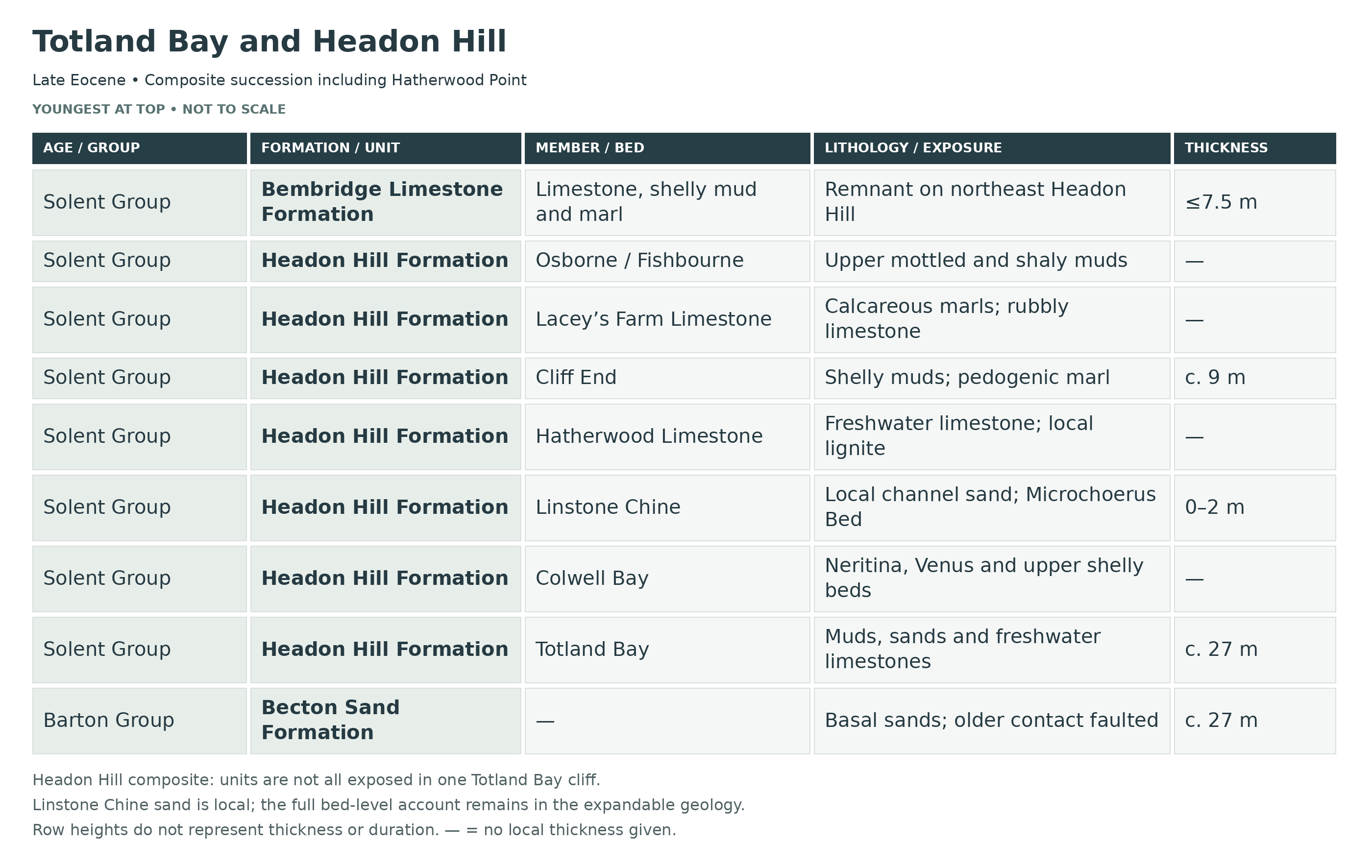
This is a composite stratigraphic breakdown of Totland Bay and the Headon Hill–Hatherwood Point tract, where a near-complete late Eocene succession runs from the Becton Sand up through the Headon Hill Formation into the Bembridge Limestone. The locality is one of Britain’s key Headonian sections because it is the type area for the Headon Hill Formation and several of its members, and it preserves four superposed European mammal biozones together with freshwater limestones, lignites and marginal-marine beds.
The TB1–TB20 labels below are editorial guide divisions. Numerical subdivisions are explicitly tied to the Headon Hill composite in GCR Table 3.3, unless another source is named. They are not a new measured log of Totland beach. Published bed TB33 in the How Ledge study is a separate author’s numbering scheme. Member totals from different sections should not be added to manufacture a local measured thickness.
Section Architecture
This is not a single simple cliff log. The locality is a composite of the western and north-facing cliffs of Headon Hill above Hatherwood Point, the south-western end of Totland Bay, and the north-eastern slope of Headon Hill where the thin remnant of Bembridge Limestone is exposed. The lower part of the succession is best seen at or below the western cliff face and around the Totland end of Headon Hill, whereas the uppermost Headon Hill Formation and Bembridge Limestone are more discontinuously exposed farther north-east.
Structural And Scope Note
The beds north of Alum Bay Chine dip only gently and lie in a broad shallow synclinal structure, in marked contrast to the steeply dipping Alum Bay succession immediately south-west of the reverse fault at Alum Bay Chine. This page covers the Totland Bay–Headon Hill outcrop up to Hatherwood Point and does not continue into the fuller Colwell Bay type section beyond the bay mouth, except where those named members are necessarily represented within the Headon Hill succession itself. The Barton Clay contact is faulted out at the western end, so the practical basal bedrock unit in this locality is the Becton Sand.
BARTON GROUP
Becton Sand Formation (Upper Eocene)
Bed TB1 — Becton Sand At The Base Of Headon Hill (c. 27 m)
The Becton Sand forms the basal sandy unit of the Totland Bay–Hatherwood Point section. At Headon Hill it is about 27 m thick and crops out above the foreshore north of Alum Bay Chine, where it passes beneath the lower Headon beds. Lithologically it is mainly pale fine-grained sand with silty interbeds and local clayey partings, representing the island expression of the upper sand-dominated Barton Group. The depositional setting was marginal-marine to inner-neritic, probably ranging from beach or upper shoreface to shallow sublittoral conditions. The junction with the older Barton Clay is faulted out in this locality, so the base of the sand cannot be logged here as a normal conformable transition.
SOLENT GROUP
Headon Hill Formation (Upper Eocene: Priabonian)
The Headon Hill Formation is the principal unit exposed between Totland Bay and Hatherwood Point and is the type section for the formation itself and for the Totland Bay, Hatherwood Limestone and Lacey’s Farm Limestone members. The succession records repeated shifts between freshwater lakes, marshes, low-salinity lagoons, estuarine waters, channel sands, palaeosols and calcrete-bearing limestones. Because different parts of the cliff and foreshore expose different members best, the bed-by-bed scheme below is a composite one tied to the published Headon Hill log and to the laterally variable outcrops on Headon Hill.
Totland Bay Member
Bed TB2 — Lower Totland Bay Green Clays, Sands And Basal Freshwater Limestones (lower c. 5.7 m of the resolved Headon Hill log)
The Totland Bay Member begins sharply above the Becton Sand and is composed of green clays, silts and fine sands with several thin freshwater limestones and lignitic partings. In the broader lower part of the member lie the classical lower Headon fossil horizons and their Isle of Wight equivalents, including the Cyrena cycladiformis Bed near the base; the named Mammal, Crocodile and Chara beds are chiefly mainland reference horizons and are not inserted here as separately established local beds. Six charophyte species have been recorded about 1 m above the base of the member, and a green silty clay with shell fragments about 2.5 m above the base has yielded a micromammal fauna. Freshwater turtles, fishes, the alligator Diplocynodon and early Headonian mammals occur in this lower part. Depositional environment: shallow freshwater to slightly brackish ponds, marshes and muddy channel-margin settings on a low-relief coastal plain, with intermittent emergence and palaeosol development. Mammal correlation: early Headonian stehlini–depereti interval.
Basal green clay and fine sand (3.5 m)
The lowest unit included in GCR Table 3.3 is green clay with intercalated very fine-grained sand.
Lower thin limestone (0.3 m)
A thin freshwater molluscan limestone separates the basal clay–sand unit from the next clay package.
Blue and green clay (1.9 m)
This mud-dominated package lies above the thin limestone and below the thicker middle freshwater limestone.
Bed TB3 — Middle Totland Bay Limnaean Limestones And Warden Ledge Interval (c. 5.2 m in the cited composite log)
This part of the member comprises pale freshwater limestones separated by green clays and pale sands. One of these middle limnaean limestone levels is represented north-eastwards by the Warden Ledge limestone, which crops out between Totland Bay and the Warden Point–Colwell sector and is only thinly represented at Hatherwood Point itself. Freshwater gastropods are characteristic, especially Galba, planorbids and Viviparus. These limestones are the first clear freshwater carbonate marker beds of the Headon Hill succession and record short-lived shallow lake expansions alternating with muddier marsh and sandy marginal-lake or crevasse-channel facies.
Middle freshwater limestone (1.8 m)
This thicker limestone overlies the lower blue-green clays in the tabulated Headon Hill log.
Green clay and pale sand (3.0 m)
The succeeding clastic interval separates the two middle limestone horizons.
Upper thin freshwater limestone (0.4 m)
This thin limestone caps the middle package below the 3.7 m mixed marl, clay, sand and lignite interval.
Bed TB4 — Upper Totland Bay Clays, Sands, Lignites And Shell-Bed Complex Below The How Ledge Limestone (c. 3.7 m)
The upper clastic package beneath the How Ledge Limestone consists of marls, green and grey clays, fine sands and thin lignitic horizons. It includes the Corbicula pulchra Bed and associated green carbonaceous clays, with a mixed low-salinity molluscan fauna in which Potamomya, Melanopsis, Theodoxus and Corbicula are characteristic; Theodoxus shells may preserve original pigmentation and colour patterns. Plant-bearing horizons in this upper part include the Limnocarpus band, with an exclusively aquatic flora of pondweeds (Limnocarpus), water-lilies (Sabrenia) and water-soldiers (Stratiotes), and in-situ conifer stumps with Glyptostroboxylon wood have been recorded from this tract. These beds represent fluctuating freshwater to brackish lake-margin and marsh deposits, with local stagnant-water organic accumulation and repeated salinity changes before the widespread How Ledge freshwater limestone developed.
Bed TB5 — How Ledge Limestone (c. 2.0–2.6 m)
The How Ledge Limestone is the key marker bed of the Totland Bay Member and forms one of the most prominent cream-coloured bands on Headon Hill. It is traceable for about 3.75 km from south-west Headon Hill through Totland Bay to Colwell Bay, and farther to Hordle Cliff on the mainland, where it becomes more marly. At Headon Hill it is a composite freshwater limestone horizon with two limestone units separated by clays; the micromammal-bearing bed TB33 in the studied south-west Headon section is a green silty clay about 0.35 m thick within this interval. Fossils include abundant pulmonate gastropods such as Lymnaea and Australorbis, other planorbids, occasional land snails, Viviparus, charophytes, ostracods, teleost fish, crocodilians, turtles, amphibians, lizards, snakes and micromammals. The freshwater ostracod and molluscan assemblage indicates a very shallow lake or lake-margin, commonly less than a metre deep and potentially emergent, with rooted water plants and algal mats. This bed is one of the most important lake-margin limestones in the British upper Eocene and belongs high in the Totland Bay Member, within the early Headonian vectensis–nanus interval.
Individual How Ledge units in Vasileiadou and colleagues (2022)
Published TB31–TB34 are that paper’s stratigraphic bed numbers, distinct from this guide’s editorial TB1–TB20 labels. Measurements refer to southwest Headon Hill.
Published TB31 — Lower How Ledge limestone
The lower limestone generally has a sharp base; locally it grades down into sand that itself cuts sharply onto older strata.
Published TB32 — Intervening shelly clay
Shelly clay above the lower limestone grades into TB33. Its greater shell abundance distinguishes it from the overlying vertebrate-rich clay.
Published TB33 — Green-to-buff clay (c. 0.35 m at southwest Headon Hill)
Green silty clay with calcareous patches becomes buff upwards, loses shells and gains vertebrate remains, ending in thin black non-shelly clay. Bedding and bioturbation are absent. The study sampled its upper 20 cm. Mammal bones and teeth indicate predation and scavenging, limited weathering and little water transport; this lake-margin accumulation differs from a floodplain-pond assemblage.
Published TB34 — Upper How Ledge limestone
The upper limestone sharply overlies TB33. The authors interpret renewed base-level rise and reduced clastic input after shallowing through the intervening clays.
Total Thickness Of The Totland Bay Member In The West Totland–Headon Tract: About 27 Metres, Although The Best-Resolved Hatherwood Composite Log Mainly Subdivides Its Upper Part
Colwell Bay Member
Bed TB6 — Basal Neritina Bed And Omission Surface (c. 3.0 m)
The Totland Bay–Colwell boundary is an interburrowed omission surface penetrated by Thalassinoides, marking a clear shift from mainly freshwater Totland Bay facies into more brackish and marine-influenced Colwell Bay conditions. At Headon Hill the fully marine Brockenhurst Bed is absent, and the basal Colwell succession is represented instead by marginal-marine beds comparable with the Neritina and Roydon interval, including dark brown clayey sand, sandy clay and shelly silt. Cerithiids, oysters and corbiculids dominate these low-diversity faunas. Depositional environment: estuarine to lagoonal transgressive mud and sand laid down in a paralic embayment where salinity increased but normal marine conditions were not fully developed.
Bed TB7 — Venus Bed (c. 4.4 m)
The main body of the Colwell Bay Member at Headon Hill consists of blue-green, grey and brown sandy clays and muddy sands representing the Venus Bed. The bivalve traditionally known as Venus incrassata, now Sinodia suborbicularis, is especially characteristic. Low-diversity assemblages with cerithiids such as Batillaria and Potamides, oysters such as Ostrea velata and corbiculids typify the member; the rarely exposed middle part is rather more marine in aspect, and foraminifera suggest that salinities may at times have approached normal marine values. This bed package represents the major transgressive event in the Headon Hill succession.
Bed TB8 — Upper Colwell Lymnaea Limestone And Batillaria Beds (c. 2.2 m)
The upper part of the member comprises a thin freshwater limestone, above which are greenish fine-grained sands and silty clays with shell seams, the upper shelly interval termed the Batillaria Bed in the Headon Hill succession. This upper interval records short-lived freshening within the general Colwell Bay transgression, followed by return to shallow brackish-water sedimentation. At Headon Hill the member is distinctly less marine than at Whitecliff Bay, and the whole Colwell package is a little over 9 m thick rather than the 30 m developed in the eastern Isle of Wight.
Thin Lymnaea Limestone (0.2 m)
GCR Table 3.3 distinguishes this freshwater limestone above the Venus-bed sandy clays.
Upper blue-green clay and sand (2.0 m)
These beds overlie the thin limestone and complete the table’s local Colwell Bay Member succession. The named Batillaria horizon is shown in the Headon Hill GCR log; it is not used to imply identical preservation at Colwell Bay.
Linstone Chine Member
Bed TB9 — Linstone Chine Channel Sand And Microchoerus Bed (0–2 m At Headon Hill; Up To 4 m At The Type Section)
This localised channel-fill sand body is a fine- to medium-grained sand with plant debris, incised into the Colwell Bay Member. It is best developed at the Totland end of Headon Hill and can thin to nothing toward Hatherwood Point, so it must be treated as a laterally variable channel unit rather than as a persistent sheet bed. Its basal bed is the Microchoerus Bed, a buff clay-rich sand with wood debris and mammal remains, including the primate Microchoerus erinaceus. Depositional environment: marginal-marine to estuarine channel fill, cut into the upper Colwell Bay succession.
Hatherwood Limestone Member
Bed TB10 — Lower Hatherwood Limestone (c. 3.5 m)
The lower Hatherwood Limestone is composed of pale, soft to well-lithified fossiliferous freshwater limestones that are unique to Headon Hill and form a major back-scar on the seaward cliff above Hatherwood Point. Root tubes, hardpans and banded limestones or pedogenic crusts occur within the succession, showing repeated soil-forming overprint. The molluscan assemblages are mainly freshwater, especially Galba and planorbids, but hydrobiid-rich intervals and rare foraminifera indicate that saline influence occasionally penetrated the lake system. The member lies in a paralic setting rather than in a permanently isolated inland lake.
Bosma HH3 — Brown silty marl below the lignite
Bosma’s HH3 locality yielded rodents from brown silty marl beneath the Hatherwood lignite. It is separate from the lignite itself and from the marl locality above it.
Bed TB11 — Hatherwood Lignite Bed (0.4–0.7 m)
The famous Hatherwood lignite is a discontinuous carbonaceous clay and lignitic shell marl resting in hollows on an irregular internal erosion or solution surface within the limestone, placed about 8 m above the older “Chara Bed” datum in the GCR palaeobotanical account. Those positions belong to that published framework: the GCR32 composite table used above instead assigns 3.5 m to the lower limestone. The older Chara datum is not inserted as a separately established modern Totland bed, and the differing measurements are not combined. This is the richest mammal horizon in the Headon Hill Formation, yielding the most extensive Headon Hill fauna from a single bed. Turtles, mammals and rodent remains occur in and around the lignite, including the primates originally referred to Adapis and Microchoerus, several species of Palaeotherium, the creodont Hyaenodon, and the pantolestid Dyspterna hopwoodi. The bed represents localized organic accumulation in hollows on a karstic or exposure-modified limestone surface, followed by renewed flooding and burial. Mammal correlation: Headonian pseudosiderolithicus–thaleri interval, broadly equivalent to MP18.
Bosma HH4 — Brown silty marl above the lignite
Bosma’s HH4 locality lies in brown silty marl above the lignite. The intervening lignite is 0.5 m thick in her local framework. HH3 and HH4 are fossil-locality labels, not additional formal members or a new whole-member thickness.
Bed TB12 — Upper Hatherwood Limestone And Palaeokarst Surface (c. 2.8 m)
The upper Hatherwood beds are pale fossiliferous limestones with irregular internal bedding surfaces, hardpans, root-related hollows and marked evidence of pedogenic alteration. At Hatherwood Point a destructive internal surface descends well below the centre of the member, and lignites fill hollows in its extremely irregular profile. Collapse breccias, pothole-like solution features and other palaeokarst structures have been described from the member as a whole, together with calcrete fabrics indicating alternation of wetter and drier conditions. Brackish-water forms become more common upward, and derived Upper Cretaceous microfossils show that nearby Chalk uplands were already being eroded. This is the classic Headon Hill freshwater limestone in which subaerial exposure, soil formation and renewed lacustrine flooding can be studied in unusual detail.
Theodoxus planulatus horizon
The Headon Hill GCR log places the Theodoxus planulatus Bed above the lignite within the Hatherwood Limestone. It is a fossil-defined marker within the carbonate unit; no separate measured thickness is assigned here.
Nystia horizon
The higher marker is labelled the Nystia headonensis Bed in GCR Figure 5.28, whereas BGS lists a Nystia polita Bed after Jackson (1925). These differing historical labels are recorded without inventing two separate successive beds or resolving their taxonomic equivalence without further evidence. Both sources place their named marker within the Hatherwood Limestone.
Total Thickness Of The Hatherwood Limestone Member At Hatherwood Point: About 7–8 Metres In The Best Exposed Cliff, Reaching About 9 Metres In The Type Section
Cliff End Member
Bed TB13 — Cliff End Muds, Shell Layers And Pedogenic Marl (c. 9.0 m)
Above the Hatherwood Limestone lie grey-green and brown muds and marls, shaly in part, with thin shell layers dominated by Potamomya and Viviparus, together with a few thin sands. A hard marl horizon less than 0.5 m thick occurs about halfway up the member at Hatherwood Point; it contains knobbly and cylindrical concretions, has a sharp irregular top, and passes downward into marls with vertical red streaks. These are pedogenic features and show that at least part of the member was exposed subaerially. The member as a whole records nonmarine coastal-plain sedimentation in mudflats, marshes and ponds after the more persistent carbonate-lake phase of the Hatherwood Limestone.
Lacey’s Farm Limestone Member
Bed TB14 — Lower Lacey’s Farm Marls And Concretionary Sandy Interval (c. 3.0 m)
The lower part of the Lacey’s Farm Limestone Member is a succession of pale-green marls passing upward into green sandy marl and sand with calcareous concretions. Mammal remains occur at least in the lower part of this unit, although preservation is generally poorer than in the Hatherwood lignite. Deposition took place in a nonmarine lacustrine to palustrine setting in which muddy carbonate sediment accumulated on a low-energy coastal plain and began to acquire strong pedogenic overprinting. Mammal correlation: still within the Headonian pseudosiderolithicus–thaleri interval.
Lower pale-green marl (2.5 m)
This is the lower muddy division of the Lacey’s Farm interval in Table 3.3.
Sandy marl and sand (0.5 m)
Green sand and sandy marl with calcareous concretions overlie the pale-green marl and underlie the rubbly limestone.
Bed TB15 — Main Lacey’s Farm Rubbly Arenaceous Limestone (c. 3.7 m)
This upper limestone forms the highest major limestone scar above Hatherwood Point. It consists of hard to soft limestones and calcareous sandstones, often nodular or rubbly, with marked internal surfaces, banded crust-like horizons and a distinct top surface locally overlain by pebbles or limestone concretions. The member provides one of the clearest examples in the whole section of calcrete profile development. Northwards it grades laterally into marl and limestone and ultimately dies out. Depositional environment: shallow nonmarine carbonate accumulation repeatedly interrupted by emergence, soil formation and calcretization.
Fishbourne Member
Bed TB16 — Basal Sandstone, Grey-Green Shaly Muds And Local Leaf Bed (c. 4.7 m)
The Fishbourne Member is represented at Headon Hill by a basal brown sandstone with a thin pale-green marl at its base, overlain by grey-green shaly muds. Thin shell beds may occur, but the member is mainly muddy and relatively unobtrusive in the cliff. Reid and Strahan reported a Leaf Bed from the Fishbourne Member at this locality, although no detailed flora has been described from it. The member records marginal-marine to nonmarine sedimentation, probably in low-energy ponds, channels and mudflat waters on a coastal plain that still lay close to brackish embayments.
Basal brown sandstone (0.7 m)
The table records brown sandstone with a thin pale-green marl at its base.
Upper grey-green shaly mud (4.0 m)
The overlying shaly mud completes the 4.7 m tabulated Fishbourne interval. The GCR 15 narrative instead quotes 3.9 m for the member; these are retained as differing published section estimates, not averaged.
Osborne Member
Bed TB17 — Osborne Red-Green Mottled Fluviatile Muds (c. 6.8 m)
The Osborne Member is formed of red and green colour-mottled calcareous clay and silt, generally poorly exposed and commonly vegetation-covered. It is largely unfossiliferous and records a nonmarine fluviatile to floodplain environment with prolonged oxidation, waterlogging and soil mottling. In the Headon Hill composite it forms the highest part of the Headon Hill Formation beneath the thin Bembridge Limestone remnant on the north-eastern slope.
Total Thickness Of The Headon Hill Formation In The Hatherwood Point–Totland Bay Composite Section: About 63 Metres Above The Becton Sand, Although The Formation Reaches Greater Thicknesses Elsewhere In The Western Isle Of Wight
Bembridge Limestone Formation (Upper Eocene)
Bed TB18 — Lower Main Bembridge Limestone Succession (c. 5.0 m)
The Bembridge Limestone at Headon Hill is preserved as a thin remnant, best exposed on the north-eastern slope of the hill. Its lower part consists of many white to pale-brown limestone beds representing shallow nonmarine carbonate accumulation. Hooker and co-workers showed that these limestones yielded a complex freshwater and terrestrial signal: calcite casts of Celtis edwardsii, charophytes, fruits of Stratiotes and Caricoidea, leech cocoons, pellets of wood-feeding termites, land snails together with freshwater molluscs, and a diverse mammal fauna. The oldest fauna from the lower limestone indicates open wooded habitats around a freshwater lake or palustrine complex.
Bed TB19 — Middle Shelly Muds (c. 1.4 m)
Grey, blue or green shelly muds overlie the main limestone package and represent a quieter water, more muddy phase within the Bembridge Limestone succession. These beds still belong to a freshwater to marginal-lacustrine system but record a reduction in carbonate hardness and probably greater persistence of standing water than in the lower limestones. They also form part of the mammal-bearing upper sequence recognized in the Headon Hill multidisciplinary studies.
Bed TB20 — Upper Grey Marls And Brown-Black Shelly And Non-Shelly Muds (c. 1.0 m)
The topmost preserved Bembridge Limestone strata at Headon Hill are grey marls with intercalated brown to black shelly and non-shelly muds. Bosma’s original HH6–HH7 localities and later collecting by Hooker and co-workers showed that these beds contain numerous mammal horizons, including black muds with shell fragments that yielded the rodent Ectropomys exiguus. The higher Bembridge Limestone fauna indicates more closed wooded habitats than the lower limestone fauna and is correlated with the medium–curtum interval, commonly placed near European mammal reference level MP19. Local lignitic palaeochannel muds in the upper part are unique to this locality. No younger Bouldnor Formation is logged in this page, because the Bembridge Limestone is the highest bedrock unit actually exposed within the chosen Totland Bay–Hatherwood Point tract.
Total Thickness Of The Bembridge Limestone Formation At Headon Hill: Up To About 7.5 Metres
Depositional Environment
The Totland Bay–Hatherwood Point succession records the final infilling of a shallow marine basin and its passage into a low-relief paralic landscape of lakes, marshes, channels and calcareous flats during late Eocene time. The Becton Sand represents marginal-marine to shallow sublittoral sand deposition. The Totland Bay Member records freshwater to slightly brackish ponds, marshes and channel sands with several freshwater limestones, culminating in the widespread How Ledge lake-margin limestone. The Colwell Bay Member is the main transgressive interval, with brackish to near-marine estuarine and lagoonal faunas. The Linstone Chine Member records a local channel cut into the Colwell succession. The Hatherwood Limestone is a freshwater limestone complex uniquely developed on Headon Hill, repeatedly exposed, calcretized and locally karstified, with a vertebrate-rich lignite in an internal erosion surface. The Cliff End, Lacey’s Farm, Fishbourne and Osborne members record mainly nonmarine coastal-plain, lacustrine, palustrine and fluviatile deposition with strong pedogenic overprint. The Bembridge Limestone at the top represents renewed freshwater limestone and marl sedimentation in a lake–marsh system bordered by open woodland to denser forest.
Total Thickness Covered Here: Approximately 95–100 Metres Of Upper Eocene Stratigraphy From The Becton Sand Formation Through The Headon Hill Formation To The Top Of The Bembridge Limestone Formation Across The Composite Totland Bay–Headon Hill–Hatherwood Point Section
Separate southwestern Headon Hill reference log: GCR10 (1995)
This southwestern log differs from GCR32 Table 3.3 above. Each retains its own thicknesses; no sum or forced bed crosswalk is made.
SOLENT GROUP
Headon Hill Formation
Totland Bay Member
Basal green clay
At least 1.1 m exposed.
Green sandy clay
0.7 m above the basal clay.
Lower limnaean limestone
0.25 m carbonate bed.
Blue and green clays
1.0 m muddy interval.
Next limnaean limestone
0.8 m carbonate bed.
Green clays and pale sands
4.4 m clastic interval.
Upper thin limnaean limestone
0.4 m carbonate bed.
Marls, clays, sands and lignites
4.6 m mixed interval.
How Ledge Limestone
Approximately 2.0 m.
Colwell Bay Member
Neritina interval
2.5 m of sand, clay and lignite.
Venus interval
Approximately 4.4 m of coloured sandy clay.
Upper limnaean limestone
0.2 m carbonate bed.
Upper blue-green clays and sands
2.0 m clastic interval.
Linstone Chine Member
White and grey sands
0.8 m; Microchoerus Bed at base.
Hatherwood Limestone Member
Lower limestone
2.7 m.
Lignite Bed
0.7 m.
Upper limestone
2.8 m.
Cliff End Member
Clays and marls
Up to 6.6 m seen; incomplete member.
References
Hopson, P.M. & Farrant, A.R. (2015). Geology of the Isle of Wight, British Geological Survey sheet explanation.
Insole, A.N. & Daley, B. (1985). A revision of the lithostratigraphical classification of the late Eocene and early Oligocene strata of the Hampshire Basin, southern England.
Daley, B. & Balson, P. (1999). British Tertiary Stratigraphy, Geological Conservation Review Series 15, including the Headon Hill and Totland Bay and Headon Hill site accounts.
Cleal, C.J., Thomas, B.A., Batten, D.J. & Collinson, M.E. (2001). Mesozoic and Tertiary Palaeobotany of Great Britain, Geological Conservation Review Series 22, Headon Hill and Totland Bay account.
Hooker, J.J., Collinson, M.E. & Sille, N.P. (1995). Reconstruction of land and freshwater palaeoenvironments near the Eocene–Oligocene boundary using multi-proxy evidence from Headon Hill, Isle of Wight.
Hooker, J.J. (1987, 1992) and Hooker, J.J. et al. (2005) on the Headon Hill mammal succession, Headonian biozones and correlations.
Cray, P.E. (1973). The stratigraphy and mammalian palaeontology of Headon Hill.
Bosma, A.A. (1974). Micromammals and the stratigraphy of Headon Hill.
Murray, J.W. & Wright, C.A. (1974) on the foraminifera of the Headon Hill succession.
Keen, M.C. (1977). Ostracod assemblages and depositional environments of the Headon Hill and Bembridge successions.
Paul, C.R.C. (1989). Freshwater molluscs from the Hatherwood Limestone Member.
Vasileiadou, K., Hooker, J.J. & Collinson, M.E. (2022). Taphonomy of an Eocene micromammal assemblage in the How Ledge Limestone, Headon Hill.
Newell, A.J. & Evans, D.J. (2011). Timing of basin inversion on the Isle of Wight and evidence from the Headon Hill Formation.
Keeping, H. & Tawney, E.B. (1881). Classical early descriptions of the Headon Hill and How Ledge succession.
Checked sources: Hopson and Farrant (2015), Isle of Wight: Barton and Solent groups; Daley and Balson (1999), GCR 15: Headon Hill, pp. 125–134, Figure 5.28; GCR 32, Table 3.3: Simplified sedimentary log for Headon Hill; Cleal and colleagues (2001), GCR 22: Headon Hill and Totland Bay; Vasileiadou, Hooker and Collinson (2022), Taphonomy of an Eocene micromammal assemblage.
Additional comparison: GCR10, southwestern Headon Hill log; GCR32, Bosma mammal-horizon records.
SAFETY
Common sense should always be used when collecting, and checking tide times is essential, as the sea can reach the base of the cliffs and it is easy to become cut off. Always ensure you begin your return before the tide turns.
The foreshore at Totland Bay can be difficult to navigate, with large fallen blocks, debris and tree trunks resulting from past landslips. Many rocks are slippery, particularly where covered in seaweed, so extra care should be taken when moving across the beach.
The cliffs are unstable and subject to further slumping, so avoid standing close to the cliff base at all times. With careful planning and awareness, Totland Bay can be explored safely and offers a rewarding fossil hunting experience.
EQUIPMENT
A hand lens, wrapping material and rigid specimen boxes are useful for the delicate shells and small vertebrate remains. Examine naturally weathered surfaces first. If working a small loose limestone block is permitted and necessary, wear eye protection and keep others clear; never hammer in-situ beds or work beneath the cliffs.
For softer sediments, examine loose material without digging into the cliff or unstable slipped ground. It is also advisable to bring tissue, wrapping material or small containers, as many fossils—especially shells—are fragile and easily damaged.
Given the uneven terrain, a sturdy bag or backpack is useful for carrying both tools and finds. Waterproof footwear with good grip is also strongly recommended due to slippery surfaces.
CLEANING AND TREATING
Start with a soft brush on stable specimens. Do not prescribe a fixed soak for every find: delicate shells, soft marl and clay-rich matrix may be damaged by water or handling. Keep fragile or potentially important finds supported and seek preparation advice before soaking or removing matrix. If a robust, water-safe specimen needs salt removal, choose the treatment for that material and let it dry gently at room temperature, away from heaters.
Do not routinely varnish or seal every fossil. Paraloid B-72 can help consolidate a specimen that is genuinely friable, but the method should suit its condition. Although the resin is soluble, treatment cannot always be completely reversed after it penetrates a fossil. Seek specialist advice for important material and record any treatment.
IDENTIFY YOUR FINDS
Need help identifying a fossil? Share clear photos, where you found it and its size with the community.
FURTHER READING
Deposits Magazine – Book review: Isle of Wight: Landscape and Geology, by John Downes
GCR / GeoGuide – Headon Hill, Isle of Wight
GCR / GeoGuide – Headon Hill (Alum Bay–Totland), Isle of Wight
GCR / GeoGuide – Headon Hill, Isle of Wight — fossil mammals
British Geological Survey – Geology of the Isle of Wight (island-wide geological context)
ACCESS RIGHTS
This site is a site of special scientific interest (SSSI). This means you can visit the site, but hammering the bedrock is not permitted. For full information about the reasons for the status of the site and restrictions, download the PDF from Natural England.
It is important to follow our ‘Code of Conduct’ when collecting fossils or visiting any site. Please also read our ‘Terms and Conditions‘
LINKS
♦ Fossil Discussions
♦ Fossil Articles
♦ Buy Fossils, Tools and Equipment
♦ Buy Crystals, Meteorites, and Artefacts
♦ Join Fossil Hunts
♦ UK Fossils Network