Whitby is one of the most iconic fossil localities on the Yorkshire coast, renowned for its rich Jurassic heritage and dramatic cliff scenery. While access to parts of the foreshore is tide-dependent and requires careful planning, the rewards can be considerable. The area is celebrated for its abundant ammonites, marine reptile remains and diverse shell beds, as well as for jet — fossilised wood from ancient conifer-like trees that became highly prized in Victorian jewellery. Its reputation means it is rarely quiet, but with patience and good timing.


FIND FREQUENCY: ♦♦♦♦♦ – Whitby yields excellent ammonite specimens and dinosaur/reptile remains, but attracts a lot of collectors. Storms and scouring can expose fresh material, but visit only once the weather and sea have settled and the tide allows a safe return.
CHILDREN: ♦ – Due to the dangerous access to this location, young children should not visit the beach at Whitby.
ACCESS: ♦♦♦ – Access is made from Whitby’s East Pier. You will need to wait until you can get round, as the tide comes very high and you must ensure you can return in good time.
TYPE: Most fossils can be found on the foreshore at Whitby, especially after storms or scouring conditions, within nodules or loose within the areas of shingle and shale. However, fossils are also commonly found in the cliff and on the scree slopes, either in nodules or loose.
DIRECTIONS
♦ Access this location from the East Pier at Whitby. However, this can only be done about three to four hours after high tide and you must ensure you return in good time.
♦ Postcode to Car Park: YO22 4EH, Google Map Link You can sometime park closer when the town is not so busy, but if planning to walk to Saltwick Bay and return via the Coastal footpath, this is the best car park.
♦ Dinosaur Footprints: What3Words: ///absent.trackers.vibrating
♦ Main fossil site: What3Words: ///icebergs.slab.positives
DOWNLOAD THE UKF BOOKLET TO FOSSIL HUNTING AT WHITBY
VIDEO FILM
FOSSIL HUNTING
Whitby is one of the most famous fossil localities in the UK, with a long history of ammonite collecting and marine reptile discoveries. Most fossils are found within foreshore nodules or loose amongst shale and shingle, particularly after winter storms have stripped away sand and exposed fresh material. The foreshore is by far the most productive area to search.
Look carefully for rounded siderite nodules, as these frequently contain well-preserved ammonites. Often the outer whorl of the shell can be seen faintly around the edge of the nodule, showing ribbing or a curved profile. Nodules are commonly trapped beneath larger rocks or concentrated in natural shingle accumulations where wave action has sorted heavier material. Splitting these nodules may reveal classic Whitby ammonites such as Dactylioceras commune and Hildoceras bifrons. Other ammonites recorded from the exposed succession include Cleviceras exaratum and Pseudolioceras species. Many ammonites from the Alum Shale Member have the inner whorls dissolved away, leaving the characteristic hollow centre.
In addition to ammonites, bivalves such as Dacryomya ovum and Pleuromya species are common, often preserved flattened within shale. Belemnites are abundant, usually found as smooth calcite guards weathered free from softer rock. Pyritised fossils are occasionally encountered, although these require careful storage to prevent deterioration.
Search loose material on the open foreshore, keeping well away from cliff bases and freshly exposed faces. Ichthyosaur and plesiosaur bones have both been recorded from the Whitby Mudstone Formation, typically preserved within large nodules or weathered from shale after heavy rain or high tides. Vertebrate remains are rare but possible, and any significant finds should be treated with care.
Past the coastguard station, the Alum Shale Member is well exposed and fossil-rich. This unit contains abundant Dactylioceras and Hildoceras, alongside Dacryomya ovum, Pleuromya species and other marine invertebrates. Reptile remains have occasionally been found in the cliff face or washed onto the foreshore below these beds.
Higher on the shore and at the foot of the cliffs, the Whitby Mudstone and Alum Shales also contain fossil wood and pyritic mudstone. Poor-grade (crushed) jet is frequently seen within these beds, reflecting the organic-rich nature of the sediments. The Cement Shales form the upper part of the Alum Shale Member and are overlain by the Dogger and Saltwick formations.
Beyond the coastguard station, large blocks of fine-grained sandstone with sideritic concretions appear on the foreshore. This is the famous Whitby Plant Bed, which yields exceptionally preserved Middle Jurassic plant fossils. Genera recorded here include Williamsonia, Baiera, Coniopteris and Czekanowskia, along with occasional conifer remains and cycad-like foliage. These plants represent vegetation that once grew on nearby delta plains and was buried rapidly in fine sediment.
At the small bay, the Dogger Formation reaches beach level. The Whitby Plant Beds in this area are particularly productive, preserving leaves as delicate carbon impressions on sandstone bedding planes. Tree trunks and branches may occasionally be found as flattened carbon bands or mineralised casts.


Some of the most significant fossil discoveries and scientific milestones from Whitby include the earliest recorded marine reptile finds from the Yorkshire coast, the famous Whitby fossil crocodiles, the long scientific history of its ammonites and jet-rock fossils, and the continued importance of the Whitby collections and coast in Jurassic palaeontology.
1758 – one of the earliest recorded Whitby marine reptile finds was described from the alum rock
In 1758, a fossil skeleton from the Whitby alum shales was described by local writers. Later reviews show that this specimen was clearly an early crocodile, making it one of the earliest recorded Jurassic vertebrate discoveries from the Whitby coast.
1819 – the first recorded ichthyosaur from the Yorkshire coast was collected near Whitby
The Whitby–Saltwick coast produced the first recorded ichthyosaur from the Yorkshire coast in 1819. This marked the beginning of Whitby’s long reputation for important marine reptile discoveries from the Lower Jurassic rocks.
1821 – another Whitby ichthyosaur was found and described by George Young
A second ichthyosaur from the Whitby area was found in 1821 and described by the Reverend George Young. This helped establish Whitby as one of the classic British localities for early marine reptile discoveries.
1822 – plesiosaur remains had already been found from the Whitby coast
By 1822, Young and Bird had recorded plesiosaur remains from the Whitby area. This showed that the coast was yielding more than just ammonites and ichthyosaurs, and added another major reptile group to Whitby’s growing Jurassic importance.
1823 – the Whitby Literary and Philosophical Society was founded to keep important local fossils in Whitby
Concern that major Whitby fossils were being lost to collections elsewhere helped drive the creation of the Whitby Literary and Philosophical Society in 1823. Its museum went on to become one of the main homes for the area’s Jurassic discoveries.
1824 – Brown Marshall found the famous fossil crocodile later known as Teleosaurus chapmani
In 1824, Whitby carpenter Brown Marshall spotted the snout of a fossil crocodile sticking out of the cliff and excavated most of the skeleton by working on ropes. The specimen was bought for the museum and became one of Whitby’s great early fossil showpieces.
1824–1828 – George Young and Young & Bird published the classic early Whitby fossil accounts
George Young’s 1824 work and the later publications by Young and Bird helped make Whitby one of the best-known Jurassic fossil localities in Britain. These studies documented the coast’s reptiles, ammonites and other fossils, and were among the earliest illustrated geological accounts of the area.
Before 1842 – the first Whitby plesiosaur skeleton had been collected
The first plesiosaur skeleton from the Whitby coast had been collected by 1842, although it was described somewhat later. This added to Whitby’s already important early record of Jurassic marine reptiles.
1868 and 1884 – Martin Simpson published major ammonite work based on Whitby fossils
Martin Simpson’s studies of Yorkshire ammonites helped cement Whitby’s reputation as one of the classic British ammonite localities. His work built on the earlier foundations laid by Young, Bird and Phillips and became central to the fossil literature of the Yorkshire Jurassic.
19th–20th centuries – Whitby’s Jurassic succession remained a key research section
The Whitby–Saltwick coast featured repeatedly in major geological descriptions during the nineteenth and twentieth centuries, including work by Phillips, Tate and Blake, Fox-Strangways, Herries and Howarth. This confirmed Whitby as a reference area for the Toarcian Whitby Mudstone Formation and its rich ammonite faunas.
Modern understanding – Whitby remains one of Britain’s classic Jurassic fossil localities
Today Whitby is still best known for ammonites from the Whitby Mudstone Formation, together with belemnites, bivalves, fossil wood, jet and marine reptile remains. The Whitby Museum collections, built from discoveries made from the early nineteenth century to the present day, remain an important scientific resource.
GEOLOGY
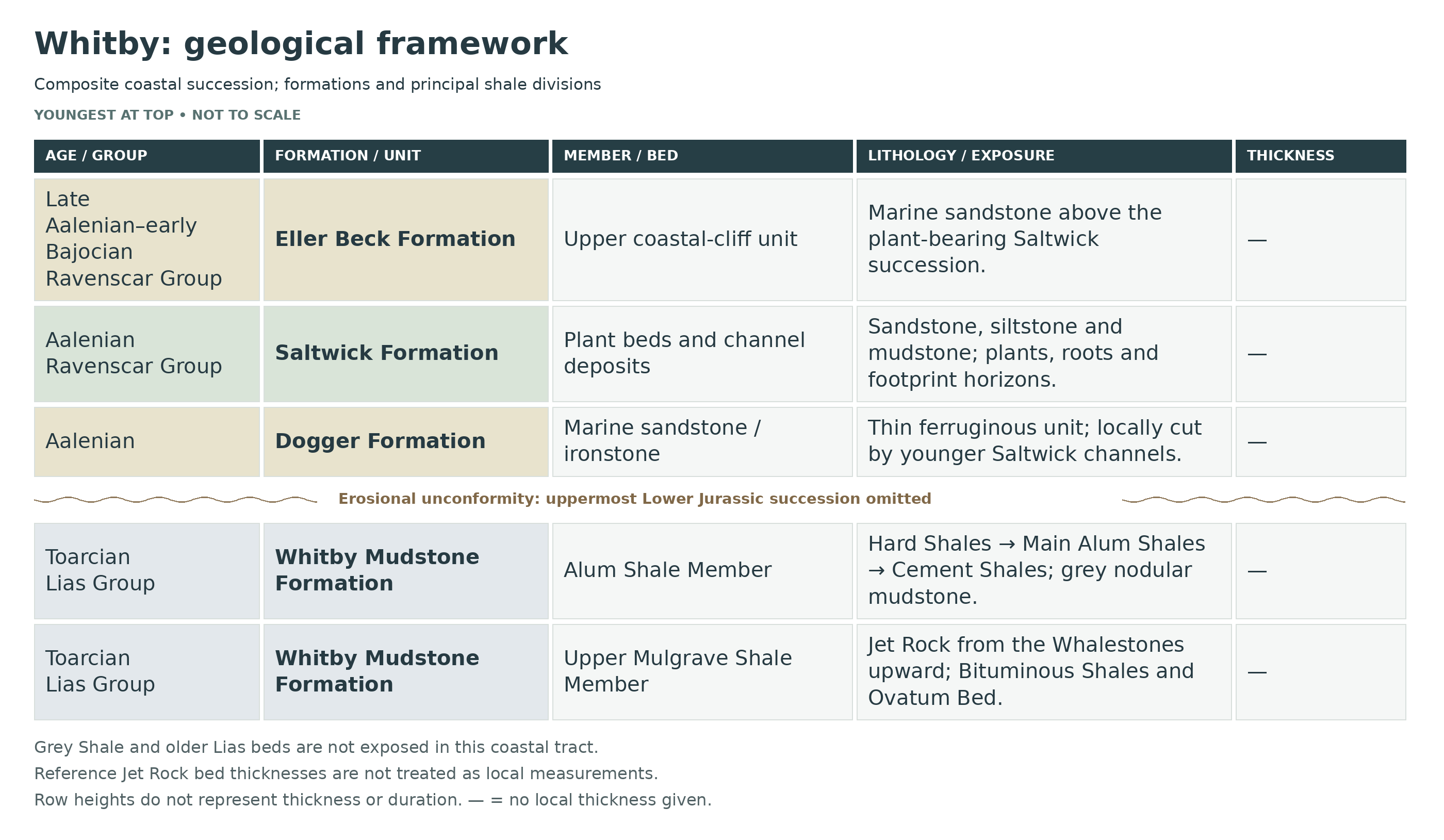
Whitby exposes one of the most important Lower Jurassic successions in the UK, with extensive outcrops of the Whitby Mudstone Formation visible along the foreshore and within the East Cliff. The exposed marine succession was deposited during the early Toarcian, when the region lay beneath the sea within the Cleveland Basin.
Whitby Mudstone Formation
The dominant unit at Whitby is the Whitby Mudstone Formation, composed largely of dark grey marine shales and mudstones deposited in relatively deep, low-energy offshore conditions.
The most prominent subdivision visible on the foreshore and at the foot of the cliffs is the Alum Shale Member. This unit consists of grey, generally non-bituminous mudstone with frequent layers of grey calcareous concretions, particularly concentrated within the lower Hard Shale Beds and upper Cement Shale Beds. These concretions commonly contain ammonites and other marine fossils.
The central portion of the Alum Shale, known as the Main Alum Shale, is softer, less silty and typically less calcareous. It weathers to pale grey and yellow tones and is often more prone to erosion. Fossils are abundant throughout the Alum Shale Member, including ammonites, bivalves and belemnites, reflecting thriving marine ecosystems during deposition.
The organic content of parts of the Whitby Mudstone Formation contributed to the formation of jet, which was historically mined in the area and became famous during the Victorian era.
Cement Shales and Overlying Units
The uppermost beds of the Whitby Mudstone Formation are the Cement Shales, which form a more resistant unit near the top of the Lower Jurassic sequence. These shales contain harder calcareous bands and concretions and lie immediately below the erosional unconformity at the top of the locally preserved Lower Jurassic succession.
Overlying the Cement Shales is the Dogger Formation, representing a significant environmental shift. The Dogger consists largely of sandstones and ironstones deposited in shallower marine to nearshore conditions during the early Middle Jurassic (Aalenian Stage). The Dogger records renewed shallow-marine deposition across an erosional unconformity; the overlying Saltwick Formation records the subsequent non-marine phase.
Above the Dogger lies the Saltwick Formation, part of the Ravenscar Group, which represents deltaic and fluvial environments. These rocks contain the famous Whitby Plant Beds, recording a landscape of river channels, lagoons and coastal plains.
At the top of the section, the Eller Beck Formation typically comprises marine ironstone, sandstone and mudstone, marking a return to more marine-dominated conditions later in the Middle Jurassic.
East Cliff
Whitby’s East Cliff is composed predominantly of dark grey, highly fossiliferous shales of the Whitby Mudstone Formation. These Toarcian-aged rocks are rich in ammonites and other marine fossils and provide one of the clearest exposures of Lower Jurassic strata on the Yorkshire coast.
Frequent landslips and coastal erosion continually expose fresh material, making Whitby both geologically instructive and palaeontologically productive. The visible succession — from offshore marine shales through shallower sandstones and into deltaic deposits — records a major environmental transition within the Jurassic period.

This is a detailed composite stratigraphic breakdown of the Whitby East Cliff–Saltwick coast, where the type section of the Alum Shale Member and part of the type section of the Whitby Mudstone Formation expose the classic lower Toarcian Jet Rock and Alum Shale succession beneath the unconformable Dogger and lower Ravenscar Group. The locality is internationally important for ammonite zonation, jet- and alum-bearing shales, and the fossil fish and marine reptile faunas that made Whitby one of Britain’s classic Jurassic sites.
The Dogger Formation has no assigned parent group in the BGS framework; the Lias Group heading applies only to the underlying Lower Jurassic formations, and the Ravenscar Group begins with the Saltwick Formation.
The W identifiers are guide-only display labels; the accompanying Howarth bed numbers are the published stratigraphical notation. They should not be confused with each other.
The Jet Rock figures for Howarth Beds 35–40 in the GCR synthesis are reference measurements and descriptions drawn from the Port Mulgrave section, not independent measurements of every bed at Whitby or Saltwick Bay. The named marker horizons are documented on this foreshore, but their reference thicknesses must not be added to make a new local measured log. The Bituminous Shales description is based on Saltwick Nab, and the Alum Shale account on the Saltwick Nab–Whitby tract. The chart consequently gives no local thickness for its Jet Rock row.
Section Architecture
Whitby is not a single simple cliff log. The classic section runs from Whitby East Pier through The Scar, Long Bight and Saltwick Nab into Saltwick Bay, with the lower Toarcian beds folded into a broad asymmetric syncline; the lowest strata actually seen in the main Whitby–Saltwick foreshore are around Howarth Bed 35 in the middle of the Jet Rock, whereas the lower Grey Shale Member and older underlying beds are not normally exposed in this particular coastal tract. Up-section, the Alum Shale Member is truncated by the Dogger unconformity, so the higher Peak Mudstone and Fox Cliff Siltstone members of the Whitby Mudstone Formation are absent at Whitby and cannot be forced into a false continuous cliff log.
LIAS GROUP
Whitby Mudstone Formation (Lower Jurassic: Toarcian)
Mulgrave Shale Member
Bed W1 — Howarth Bed 35, Whalestones (0.92 m)
The Whalestones are a conspicuous low-tide marker bed of large ovoid calcareous concretions, some up to about 3 m long and 1 m thick, set in grey bituminous shale. They form one of the most recognisable features on the outer foreshore between Black Nab and Whitestone Point and mark the lowest level normally seen in the Whitby–Saltwick type section. Ammonites: Cleviceras exaratum is characteristic, with less frequent Harpoceras serpentinum and Lytoceras crenatum. Belemnites: Acrocoelites trisulculosus and A. ilminsterensis. Interpretation: laminated, strongly oxygen-restricted offshore mud in which early diagenetic carbonate nucleated into giant concretions during the lower part of the Toarcian oceanic anoxic interval.
Bed W2 — Howarth Beds 36–38, Middle Jet Rock (c. 2.88 m)
This interval consists of grey bituminous shale with two prominent concretionary horizons: the almost spherical “Curling Stones” of Bed 37 and the more weakly concretionary shales above and below. Bedding is finely laminated, burrowing is effectively absent, and the rock is markedly richer in organic matter than the Alum Shale above. Poor-grade jet and compressed fossil wood may occur, though the best jet-bearing levels are patchy in the Whitby area and more famously worked farther along the coast. Ammonites: still within the exaratum–elegans part of the Serpentinum Zone, with Cleviceras and Harpoceras associations. Depositional Environment: quiet offshore marine mud deposited beneath severely oxygen-depleted bottom waters, with almost no benthic disruption.
Bed W3 — Howarth Bed 39, Top Jet Dogger (0.23 m)
This thin continuous argillaceous limestone forms a persistent band near the top of the Jet Rock. Despite its old field name, it is not the overlying Aalenian Dogger Formation but a limestone within the lower Toarcian bituminous shale succession. It is useful as a field marker because it separates lower laminated jet-bearing shales from the giant-concretion horizon above. Typical Fossils: belemnites, especially Acrocoelites trisulculosus. Interpretation: a brief more calcareous episode during otherwise bituminous mud deposition.
Bed W4 — Howarth Bed 40, Millstones (0.30 m)
The Millstones are giant flattened lenticular concretions, commonly more than 4.5 m across and about 0.3 m thick, resting in or on a thin laminated limestone and standing proud on the outer foreshore. They preserve the sedimentary lamination within them and are one of the classic Whitby collector landmarks. Ammonite Horizon: elegans part of the exaratum interval. Interpretation: exceptionally strong early carbonate cementation within laminated organic-rich mud, developed during the peak restricted facies of the Jet Rock.
Bed W5 — Howarth Beds 41–43, Lower Bituminous Shales / Tubularis Interval (13.8 m)
This thick lower Bituminous Shales package comprises grey to dark grey bituminous shale with a row of scattered pyrite-skinned concretions and a conspicuous shell-rich level containing abundant Pseudomytiloides near the middle. Lamination is still clear but generally less perfect than in the Jet Rock below, and the rock contains less bitumen overall. Ammonites: Harpoceras of the falciferum group, including H. mulgravium, with Dactylioceras and Nodicoeloceras incrassatum. Belemnites: Parapassaloteuthis and Acrocoelites; Youngibelus tubularis and Y. simpsoni are specifically recorded from Bed 43 rather than the entire grouped interval. The base of Howarth Bed 41 is effectively a parastratotype for the base of the Falciferum Subzone. Depositional Environment: offshore, still markedly dysoxic to anoxic, but with slightly more episodic faunal colonisation of the water column and more abundant pyritization than in the lower Jet Rock.
Bed W6 — Howarth Beds 44–45, Middle Bituminous Shales (3.5 m)
Grey bituminous shale with a basal row of scattered concretions. This is one of the most ammonite-rich parts of the Mulgrave Shale Member in the Whitby–Saltwick section. Ammonites: Harpoceras of the falciferum group, with Dactylioceras and occasional Phylloceras heterophyllum. Interpretation: continued restricted offshore mud deposition within the classical Harpoceras falciferum fauna, still strongly affected by low-oxygen bottom conditions.
Bed W7 — Howarth Beds 46–47 (lower part), Upper Bituminous Shales (4.98 m)
Grey bituminous shale with a 0.13 m sideritic mudstone at the base. The facies remains dark and organic-rich but is less massively concretionary than lower in the member. Fossils: Dactylioceras, Parapassaloteuthis polita, Acrocoelites subtenuis, A. vulgaris and Simpsonibelus dorsalis. Interpretation: upper part of the restricted Mulgrave sea-floor mudstone regime, still largely inhospitable to benthos and prone to pyrite formation.
Bed W8 — Howarth Bed 47 (upper part) And Bed 48, Ovatum Interval And Ovatum Bed (c. 1.0 m Total Including 0.25 m Ovatum Bed)
This is the classic marker at the top of the Mulgrave Shale Member. Grey bituminous shale with occasional Ovaticeras ovatum passes up into the Ovatum Bed itself, a double row of large sideritic concretions and pyritic masses that can be traced at the base of the cliff between Jump Down Bight and Saltwick Nab. “Belemnite battlefields” may occur at this level, with dense concentrations of belemnites on bedding planes. Ammonites: Ovaticeras ovatum with rare Dactylioceras and Phylloceras. Stratigraphic Significance: this is the formal lithological boundary between the Mulgrave Shale and Alum Shale members at Whitby. Interpretation: a condensed and concretion-rich uppermost restricted-marine horizon formed during slight facies change and episodic reworking at the close of Mulgrave deposition.
Individual Bituminous Shale Horizons — Original Log And Later Revision
Howarth’s original account locates the detailed Bituminous Shales section at Saltwick, but explicitly identifies Bed 41 thickness as measured at Port Mulgrave and Runswick. The later GCR divisions are retained where they revise the older zonal scheme. Broken OCR is not used to reconstruct unverified individual thicknesses.
Bed 41
Bituminous shale with crushed, commonly pyritised ammonites. Howarth’s thickness was obtained at Port Mulgrave and Runswick, rather than newly measured in Saltwick Bay.
Bed 42
Scattered oval, pyrite-skinned concretions, commonly with bivalve remains projecting from their tops.
Bed 43
Bituminous shale with widely scattered doggers about four feet below the top, often enclosing large ammonite body chambers. Youngibelus tubularis and Y. simpsoni are restricted to this bed in the later source.
Bed 44
A scattered concretion row with pyrite concentrations and Harpoceras falciferum.
Bed 45
Grey bituminous shale.
Bed 46
Red-weathering sideritic mudstone, 0.13 m in the GCR synthesis.
Bed 47, Upper Part
Grey bituminous shale, 0.75 m in the revised GCR division, with occasional Ovaticeras ovatum.
Bed 48 — Ovatum Bed
A separate 0.25 m concretionary horizon with siderite, pyrite and locally concentrated belemnites.
Alum Shale Member
Bed W9 — Howarth Beds 49–50, Hard Shales (6.4 m)
The Hard Shales are grey non-bituminous shales with scattered concretions, pyritic masses and a 0.13 m red sideritic mudstone cap. They mark a decisive lithological change above the darker Mulgrave Shales below: lamination is less perfect, benthic disturbance is less completely suppressed, and the rock is more calcareous in places. Ammonites: Dactylioceras commune and D. temperatum, with Hildoceras of the lusitanicum group. The base of Bed 49 marks the base of the Commune Subzone in Howarth’s scheme. Depositional Environment: still offshore marine mud deposition, but under less severely oxygen-poor conditions than the Jet Rock and Bituminous Shales.
Bed W10 — Howarth Beds 51–54, Lower Main Alum Shales (9.5 m)
This thick interval of grey shale with bands of calcareous nodules forms a major part of the classical Whitby East Cliff foreshore and lower cliff section. The shales weather to brittle flakes and were historically worked on a large scale for alum manufacture, especially at Saltwick Nab and Black Nab. Ammonites: abundant Dactylioceras commune and related forms, with Hildoceras of the lusitanicum group and rarer Frechiella subcarinata. Other Fossils: large driftwood logs, belemnites, Gresslya and locally abundant Dacryomya ovum. Many of the early Whitby marine reptile finds, including crocodiles and ichthyosaurs from The Scar and the old alum workings, probably came from this broader Main Alum Shale interval. Interpretation: offshore mud accumulation with more active bottom life than in the Mulgrave Shales, but still relatively quiet and fine-grained.
Bed W11 — Howarth Beds 55–59, Upper Commune-Subzone Main Alum Shales (2.8 m)
Grey shale with calcareous nodule bands continuing the Main Alum facies but with a more distinctive athleticum-fauna. Ammonites: Dactylioceras athleticum, other Dactylioceras, Hildoceras of the lusitanicum group, Pseudolioceras lythense, Phylloceras heterophyllum and Lytoceras cornucopia. Interpretation: continued open offshore mud deposition with recurring concretion growth and rich nektonic faunas.
Bed W12 — Howarth Beds 60–63 (part), Lower Fibulatum-Subzone Main Alum Shales (1.33 m)
Grey shale with calcareous nodule bands, faunally distinct from the commune beds below. The base of Bed 60 at Whitby corresponds to the base of the Fibulatum Subzone. Ammonites: Peronoceras fibulatum, P. turriculatum, P. perarmatum, P. subarmatum, Pseudolioceras lythense and Hildoceras of the bifrons plexus. Interpretation: continued marine mud sedimentation, but with a more advanced lower Bifrons-zone fauna and well-developed biostratigraphic precision.
Bed W13 — Howarth Beds 63 (part)–64, Upper Main Alum Shales / Braunianus Horizon (1.9 m)
Shale with bands of calcareous nodules marking the top of the Main Alum Shales proper. Ammonites: Peronoceras fibulatum, P. turriculatum, Zugodactylites braunianus, Pseudolioceras lythense, Hildoceras of the bifrons group, Phylloceras heterophyllum and Lytoceras cornucopia. This interval corresponds to the braunianus Biohorizon and records the upper part of the Main Alum Shale faunal turnover. Historical Note: these upper Main Alum beds were among the principal alum-working shales of the Whitby coast.
Bed W14 — Howarth Beds 65–71, Lower Cement Shales (1.85 m)
The Cement Shales begin with grey shale containing several rows of calcareous concretions and more resistant horizons than in the softer Main Alum Shales below. The nodules in this upper subdivision were formerly worked for cement manufacture. Ammonites: Hildoceras of the bifrons group with occasional Phylloceras heterophyllum and rare Lytoceras cornucopia. Other Fossils: belemnites remain common, and bivalves such as Nuculana and Gresslya occur. Interpretation: more calcareous offshore shale sedimentation, still fully marine, with repeated concretion growth.
Bed W15 — Howarth Bed 72 (lower part), Vortex Interval Of The Cement Shales (1.5 m)
The lower part of Bed 72 is grey shale with calcareous nodules belonging to the fibulatum–vortex part of the Bifrons Zone. Ammonites: Porpoceras cf. vortex, P. verticosum and Hildoceras of the bifrons group. Belemnites: several Acrocoelites and Simpsonibelus species remain characteristic. Interpretation: uppermost preserved Cement Shale below the highest preserved lower Toarcian strata at Whitby.
Bed W16 — Howarth Bed 72 (upper part), Crassum Interval Of The Cement Shales (2.5 m)
The uppermost preserved Whitby Mudstone at Whitby belongs to the crassum part of the Bifrons Zone. Grey shale with calcareous nodules yields Catacoeloceras crassum, Hildoceras semipolitum and Hildoceras of the bifrons group. The base of this unit at Whitby is a parastratotype for defining the Crassum Subzone in Howarth’s revised scheme. Interpretation: upper lower Toarcian offshore mud deposition immediately before the regional erosional break at the base of the Middle Jurassic.
Bed W17 — End-Lower Jurassic Omission Surface And Dogger Unconformity
At Whitby the Alum Shale Member is cut by a sharp erosional surface beneath the Dogger Formation. This surface records late Lower Jurassic uplift, gentle folding and erosion, which removed the uppermost Alum Shale as well as the higher Peak Mudstone and Fox Cliff Siltstone members that are preserved elsewhere in the basin. Derived ammonites, belemnites and phosphatic nodules in the overlying Dogger demonstrate the magnitude of the break, and large burrow systems pipe Dogger sediment downward into the shale beneath.
Original Whitby–Saltwick Bed Descriptions Where Independently Legible
Howarth states that Beds 49–72 were measured between Whitby and Saltwick Nab, and his numbered specimens in that table came from this locality. The legible individual descriptions below supplement the later GCR ranges. Where the original table has not been verified completely, no missing per-bed number or thickness is reconstructed; the independently supported GCR package remains the stated level of detail.
Howarth Bed 72 — Original Local Lithology And Fossil Levels
The 1962 Whitby–Saltwick section describes grey shale with sideritic bands and lenses, including a particularly persistent horizon near the top. These original observations supplement the later GCR subdivisions above. Historical determinations record Catacoeloceras crassum at one and three feet below the top, with Collina mucronata at three feet. At five feet below the top, C. crassum, C. mucronata, Hildoceras bifrons and H. cf. semipolitum are common. Occasional C. crassum and Catacoeloceras sp. occur eight to ten feet below the top; H. bifrons is recorded in the basal five feet. These are the historical identifications and within-bed positions in Howarth’s original measured local account, not a replacement for later revised zonal assignments. No missing Beds 55–71 measurements are inferred.
Howarth Bed 49 — Hard Shale
Grey shale contains sporadic calcareous doggers and pyrite masses about four feet below its top. The original local collection includes Dactylioceras commune and D. temperatum; crushed D. commune is frequent in the upper half.
Howarth Bed 50 — Sideritic Marker
A continuous red-weathering sideritic mudstone contains crushed D. commune. The original table gives five inches; this remains separate from the older broader Hard Shale package.
Howarth Bed 51
Grey shale contains scattered doggers about two feet below the top and occasional nodules elsewhere. The source records abundant D. commune, with D. temperatum, Hildoceras sublevisoni and Phylloceras heterophyllum.
Howarth Bed 52
Red-weathering sideritic lenses contain central grey limestone; D. commune and H. sublevisoni are recorded.
Howarth Bed 53
Grey shale has scattered nodules and pyrite masses about three feet above its base, with D. commune and P. heterophyllum.
Howarth Bed 54
Small grey limestone nodules occur in shale. The locality-specific fauna includes D. commune, D. praepositum, D. temperatum, H. sublevisoni and Frechiella subcarinata.
Dogger Formation (Middle Jurassic: Aalenian)
Bed W18 — Basal Dogger Ferruginous Sandstone / Ironstone (c. 0.75 m At East Cliff, But Locally Channelled And Cut Out)
At Whitby East Cliff the Dogger is a coarse, sometimes pebbly, ferruginous sandstone or ironstone forming an inclined bench near the foot of the cliff. It contains berthierine (chamosite) ooids, reworked phosphate nodules and broken ammonite and belemnite fragments derived from the underlying Whitby Mudstone. Westward along the shore it may thin drastically or be almost entirely removed by sandstone-filled channels cut down from the Saltwick Formation above. Depositional Environment: shallow marine transgressive sandstone and ironstone laid down across an erosional surface after a major hiatus.
RAVENSCAR GROUP
Saltwick Formation (Middle Jurassic: Aalenian)
Bed W19 — Lower Saltwick Channel Complex And Whitby Plant Bed
The lower Saltwick Formation above the Dogger consists of grey mudstones, siltstones and yellow-grey sandstones of fluvial to estuarine aspect, with channel fills, plant debris and synsedimentary disturbance. Around Long Bight and the East Cliff section, sandstone-filled channels may cut deeply enough to thin or almost remove the Dogger below. The fine sandstones and siltstones immediately above the Dogger contain abundant plant remains traditionally referred to as the Whitby Plant Bed, and large sandstone-filled root systems descend downward into the Dogger and even into the top of the Alum Shale. Interpretation: fluvial, floodplain and estuarine or delta-plain sedimentation following marine Dogger deposition.
Long Bight Main Whitby Plant Bed
The main museum-quality plant horizon is near the base of the Saltwick Formation and is best exposed at Long Bight. Some classic material came from fallen blocks, so not every recorded taxon has a secure bed position.
Jump Down Bight Zamites Bed
The GCR identifies a separate, higher bennettitalean-rich bed at Jump Down Bight. Associated organs include Zamites gigas fronds, Williamsonia gigas female reproductive structures and Weltrichia sol male structures. This is a documented higher horizon, rather than a synonym for the basal Long Bight bed.
Saltwick Equisetum And Coniopteris Beds
Harris lists these named plant horizons at Saltwick separately from the Whitby Long Bight and Jump Down Bight sites. The table locates collecting places; it does not establish a measured vertical separation between all the named beds.
Saltwick Matonidium Bed
The GCR specifically records a bed with well-preserved Matonidium goeppertii fronds at Saltwick. Its geographic record is retained without assigning a numerical thickness or an unproven correlation to the basal Plant Bed.
Saltwick Waterfall Bed And E. laterale Bed Above It
Harris records the Waterfall Bed and a separate E. laterale bed above it. This limited stated relative position is preserved; the whole Harris list is not transformed into a single complete upward sequence.
Long Bight Fallen Blocks And Rail Hole Bight Records
The source also lists Long Bight fallen blocks and Rail Hole Bight. These are distinct collecting-provenance records, not automatically additional measured in-situ beds. The geographically separate Haggerlyth and inland Spittal Beck records are not added to this East Cliff–Saltwick succession.
Bed W20 — Unio Bed (0.05 m Skin On Fallen Blocks; c. 6.2 m Above The Dogger)
The Unio Bed is a thin reddish sideritic siltstone horizon lying about 6.2 m above the Dogger. It is most often recognised on fallen blocks rather than as a continuously clean in situ ledge and contains occasional freshwater bivalves traditionally called Unio. It is one of the best field datums in the lower Saltwick succession at Whitby and marks a definite freshwater influence within the mainly fluvial-deltaic sequence.
Bed W21 — Main Saltwick Fluvial Sandstones, Mudstones And Footprint Horizons (Total Saltwick Thickness About 30 m At East Cliff)
The main body of the Saltwick Formation at Whitby East Cliff consists of cross-stratified yellow-grey sandstones, grey mudstones and siltstones with erosive channel bases, plant remains, rootlets, local seatearth-like horizons and abundant evidence of non-marine deposition. Dinosaur footprints occur in fallen blocks from at least two horizons, one at the Unio Bed and another about 6 m higher, including tridactyl bipedal prints and parts of sauropod tracks; some tridactyl traces have been interpreted as swim traces. Depositional Environment: river channels, floodplain muds and vegetated overbank settings on a low-relief delta plain or paralic coastal plain.
Eller Beck Formation (Middle Jurassic: Late Aalenian–Early Bajocian)
Bed W22 — Eller Beck Marine Sandstones (c. 6 m)
The highest unit normally seen in the Whitby East Cliff section is the Eller Beck Formation, a package of orange-weathering marine sandstones resting above the non-marine Saltwick beds. This marks a renewed marine incursion into the Ravenscar coastal plain system and completes the lowest Middle Jurassic succession visible at Whitby. Interpretation: shallow-marine clastic deposition above the fluvial Saltwick Formation, showing rapid lateral and vertical environmental change during late Aalenian–early Bajocian time.
Depositional Environment
The Whitby succession records a major shift from restricted offshore early Toarcian black-shale sedimentation into more oxygenated offshore mud deposition and then across a marked erosional break into Middle Jurassic shallow-marine, fluvial and marine-again conditions. The Mulgrave Shale Member, including the Jet Rock and Bituminous Shales, formed in oxygen-poor to anoxic offshore waters and yields laminated bituminous mudstones, jet, pyritized fossils and sparse benthos. The Alum Shale Member records somewhat less restricted offshore marine mud deposition, with more common concretions, widespread bivalves such as Dacryomya ovum, richer ammonite zonation and the classic reptile-bearing alum shales of Whitby and Saltwick. After uplift and erosion at the end of the Lower Jurassic, the Dogger records shallow-marine transgression, the Saltwick Formation records fluvial to delta-plain and estuarine sedimentation with plants and dinosaur footprints, and the Eller Beck Formation records renewed marine flooding.
Total Thickness Covered Here: Approximately 55 Metres Of Middle Whitby Mudstone Formation Exposed In The Whitby East Pier–Saltwick Nab Section, Overlain By About 0.75 Metres Of Dogger Formation, 30 Metres Of Saltwick Formation And 6 Metres Of Eller Beck Formation In The East Cliff Composite Section
Individual Beds Within The Middle Jet Rock
Within the grouped Beds 36–38, Bed 36 is grey bituminous shale (1.08 m in the GCR reference log); Bed 37 is the Curling Stones horizon (0.30 m), with near-spherical calcareous concretions up to 0.45 m across and pyritic skins; and Bed 38 is grey bituminous shale with occasional calcareous concretions (1.50 m). The GCR records Acrocoelites trisulculosus and A. ilminsterensis in these beds. These values retain the explicitly qualified Port Mulgrave reference-section provenance above.
References
Howarth, M.K. (1962). The Jet Rock Series and the Alum Shale Series of the Yorkshire coast.
Powell, J.H. (1984). Lithostratigraphic nomenclature of the Lias Group in the Yorkshire Basin.
Simms, M.J., Chidlaw, N., Morton, N. & Page, K.N. (2004). British Lower Jurassic Stratigraphy, including the Whitby to Saltwick GCR account.
Benton, M.J. & Spencer, P.S. (1995). Fossil Reptiles of Great Britain, Whitby–Saltwick GCR account.
Dineley, D.L. & Metcalf, S.J. (1999). Fossil Fishes of Great Britain, Whitby Coast GCR account.
Fox-Strangways, C. & Barrow, G. (1915). The geology of the country between Whitby and Scarborough.
British Geological Survey Lexicon of Named Rock Units: Whitby Mudstone Formation, Mulgrave Shale Member, Alum Shale Member, Dogger Formation and Saltwick Formation.
Whyte, M.A. & Romano, M. on the Whitby–Saltwick Lower to Middle Jurassic coastal excursion and the Saltwick dinosaur footprint horizons.
SAFETY
Common sense when collecting at all locations should be used and knowledge of tide times is essential. It is very easy to get cut off at Whitby, as the sea always reaches the base of the cliff. You should ensure you return before the tide turns. Also be aware of sticky areas on the slippages, as it is easy to get stuck, especially after rain.
EQUIPMENT
At Whitby, most fossils are found within foreshore nodules or loose amongst shale and shingle, particularly after storms have exposed fresh material. A geological hammer (16–24 oz) is essential for splitting siderite nodules that commonly contain ammonites, while a sturdy flat chisel can help guide controlled blows and reduce the risk of damaging specimens. A small hand pick can be useful for carefully working softer shale or investigating larger nodules that may contain vertebrate remains. Eye protection should always be worn when striking rock, and strong, waterproof boots with good grip are vital due to uneven boulders, loose shale and slippery surfaces. As reptile material can occasionally be found in the cliff face or freshly fallen debris, never work directly beneath unstable sections and always check tide times before collecting along the foreshore. Wrap any finds securely and store them in a rigid container to prevent damage during transport.
CLEANING AND TREATING
Begin by removing any loose sediment very carefully using a soft toothbrush. Take your time, as many fossils—particularly pyritic specimens—are fragile and easily damaged. Fragile shale fossils and pyritic specimens should remain supported in their matrix and need individual assessment before wet cleaning. Do not apply a fixed soaking time to every specimen. After any appropriate wet cleaning, allow specimens to dry naturally at room temperature. Do not dry them on radiators or other heat sources, as rapid drying can cause cracking or long-term damage.
Where consolidation is needed, Paraloid B-72 is a well-established conservation resin. It can often be re-dissolved, but removal from a porous fossil may be incomplete. Use it selectively after assessing the specimen and matrix; it is not a moisture-proof seal or a cure for pyrite decay.
Avoid cosmetic varnishing before identification and assessment, as coatings can obscure detail and complicate later preparation. Keep pyritic specimens in dry, monitored storage and check for cracking or powdery deposits; seek conservation advice if deterioration appears.
IDENTIFY YOUR FINDS
Need help identifying a fossil? Share clear photos, where you found it and its size with the community.
FURTHER READING
Deposits – Whitby Jet and the Toarcian Oceanic Anoxic Event
Deposits – The dinosaur footprints of Whitby (Part 4)
Yorkshire Geological Society – Lower–Middle Jurassic sequences between Whitby and Saltwick
Whitby Museum – Geology and Fossils
Whitby Museum – Jet FAQ
ACCESS RIGHTS
This site is a site of special scientific interest (SSSI). This means you can visit the site, but hammering the bedrock is not permitted. For full information about the reasons for the status of the site and restrictions, download the PDF from Natural England.
It is important to follow our ‘Code of Conduct’ when collecting fossils or visiting any site. Please also read our ‘Terms and Conditions‘
LINKS
♦ Fossil Discussions
♦ Fossil Articles
♦ Buy Fossils, Tools and Equipment
♦ Buy Crystals, Meteorites, and Artefacts
♦ Join Fossil Hunts
♦ UK Fossils Network