Smallmouth Sands, located within Portland Harbour near Weymouth, is one of the UK’s most remarkable yet often overlooked fossil sites, exposing the Upper Jurassic Kimmeridge Clay. It is one of the most diverse assemblages of Kimmeridge Clay reptiles anywhere in the world. Fossils are typically tiny but abundant, with collectors finding vertebrate remains, fish, and shells scattered across the foreshore, especially after favourable tides and storms.


FIND FREQUENCY: ♦♦♦♦ – Fossils are abundant, but typically very small. With careful searching, it is possible to find numerous fragments of bone, teeth and shells, particularly from vertebrates including pterosaurs.
CHILDREN: ♦♦♦ – Suitable for older children, but patience is required as fossils are small and not always obvious. The terrain is generally safe, though not ideal for very young collectors.
ACCESS: ♦♦♦♦ – Good access from Sandsfoot Castle with a short walk down to the foreshore. The beach is relatively easy to reach and sheltered within Portland Harbour.
TYPE: – Foreshore. Fossils are found loose within the shingle and clay-rich areas, often requiring slow, careful searching rather than simply picking up large specimens.
DIRECTIONS
♦ Head towards Weymouth and follow signs for Sandsfoot Castle, located off Old Castle Road (B3157).
♦ Park along Old Castle Road where parking is free. Just before Sandsfoot Castle.
♦ Walk down the road and follow the footpath that goes beside the fence along the right side, round the Castle Cove Sailing Club. Continue along the coastal path until it gains access to the beach.
♦ Once on the foreshore, head south–west (right) along the shoreline.
♦ Postcode for parking: DT4 8QE, Google Maps Link
♦ What3Words collecting area; ///cherry.beams.moved
VIDEO FILM
FOSSIL HUNTING
Smallmouth Sands is a very different type of fossil site compared to most along the Jurassic Coast, and success here comes from slow, careful searching rather than looking for large, obvious specimens. The foreshore within Portland Harbour exposes the Kimmeridge Clay, but because the shore lies within sheltered Portland Harbour, protected by the harbour breakwaters, erosion is relatively low. Fossils are released gradually and tend to accumulate as small, scattered material within the shingle and clay patches.
Smallmouth Sands has a well-documented pterosaur record. The public GCR describes fragmentary historical museum material, while a published 2025 meeting abstract reports more than 500 disarticulated elements referred broadly to rhamphorhynchid and monofenestratan pterosaurs. Further taxonomic work is needed; isolated fragments should not be assigned confidently to a particular species or feeding type from appearance alone.
Alongside the pterosaurs, a wide range of other vertebrate material can be found. Bones and teeth from marine reptiles are regularly recorded, including ichthyosaurs such as Ophthalmosaurus, plesiosaurs and pliosaurs, along with marine crocodiles including Metriorhynchus and Steneosaurus. Turtle remains are also present, although less common, typically as small fragments of shell. Most of this material is disarticulated and worn, having been transported and broken down before burial, so complete specimens are extremely rare.
There is a large “dome” of Lower Kimmeridge Clay situated just offshore in Portland Harbour and within the clay platform. This is gradually winnowing out and bringing vertebrate remains into Smallmouth Sands. This is where the larger reptile remains are coming from, and they can often be found washed up in front of the rock defences.
Fish remains are relatively common when conditions are right, particularly small teeth, scales and vertebrae, which are often mixed in with finer sediment and shingle. These can include a variety of marine fish, although they are usually fragmentary and require careful observation to spot. Occasional dinosaur material has also been recorded, but this is very rare and typically limited to small, worn bone fragments that have been washed into the marine environment.
Shell material is present but less dominant than at nearby locations such as Wyke Regis. Bivalves such as Deltoideum delta can be found, along with other oyster fragments including Nanogyra and occasional ammonites, although these are not a defining feature of the site.
Fossils may occur in low-cliff exposures, loose foreshore material and deposits reworked from Portland Harbour. These sources must be distinguished: a find lying in one collecting bay does not by itself establish its original geological bed. Published accounts describe variable, slipped exposures and a mixture of isolated and occasionally associated vertebrate remains.
Smallmouth Sands is a GCR conservation site and an SSSI. Research is currently being carried out at this location, so it is vital that any collecting is done sensitively. We also ask that any important finds are documented. You can do this by contacting us, and we will forward the details to those currently researching the site.


A chronological record of publicly documented geological research, fossil discoveries and museum studies associated with the Smallmouth harbour-side section.
1865 – Early description of the harbour-side boundary succession
Waagen’s work on the beds near Sandsfoot formed part of the early definition of the base of the Kimmeridge Clay. The historical section extends towards Smallmouth and Ferry Bridge; it is distinct from the Fleet shore.
1874 – Weymouth pterosaur material named
Owen described fragmentary humeral and wing-phalange material as Pterodactylus manseli and P. pleydelli. These names became important in the historical Weymouth record, although later assessments questioned whether the fragments allowed confident taxonomic placement.
1875 – Turtle carapace material described
Seeley established Pelobatochelys blakei from carapace fragments. The published locality account identifies this material as an important element of the Smallmouth turtle record.
1884 – Reptile remains recorded in the historical section
Damon documented reptile-bearing beds between Sandsfoot and the old Portland Ferry Bridge. Later work used his numbered beds to discuss the provenance of large dinosaur bones and other marine and terrestrial reptiles.
1889 – Museum reptile material catalogued
Lydekker’s catalogues documented turtles, crocodylomorphs, plesiosaurs, pliosaurs and ichthyosaurs from the Weymouth Kimmeridge Clay. These records underpin much of the historical Smallmouth faunal list, with some identifications remaining uncertain.
1891 – Weymouth pterosaur bones reinterpreted
Lydekker reinterpreted some previously identified metacarpals as pterosaur quadrates and referred one to Pterodactylus suprajurensis, a name originally established from French material.
1904 – Broad ichthyosaur paddle named
Boulenger named Ichthyosaurus extremus from an unusually broad forelimb. Although its provenance was initially misunderstood, the specimen label was later recognised as recording Kimmeridge Clay from Smallmouth Sands.
1960 – Smallmouth provenance clarified
Delair drew attention to the Smallmouth locality written on the label of the paddle later assigned to Brachypterygius extremus, correcting earlier suggestions of a Lower Lias origin near Bath.
1986 – Matching ichthyosaur forelimbs linked
Delair recognised that the isolated forelimb in the Weston museum collection and the type paddle in the Natural History Museum belonged to the same individual. The association strengthened the significance of the historical Smallmouth material.
1995 – Reptile assemblage assessed in the Geological Conservation Review
The national review recognised Smallmouth as an exceptionally varied Kimmeridge Clay vertebrate locality, particularly important for turtles and pterosaurs. It documented historical specimens, uncertain identifications and the mixed provenance of some harbour-derived material.
May 2016 – Ichthyosaur skull recovered
An ophthalmosaurid skull was recovered from the Smallmouth foreshore. The subsequent published account places it in the Wyke Siltstone, KC5, within the Cymodoce-zone succession.
2018 – Skull recovery and preparation published
A detailed public account documented the May 2016 recovery and reconstruction of the skull. It considered Ophthalmosaurus the most likely identification while explicitly noting that further study was needed.
2025 – Pterosaur bone histology presented
A published meeting abstract reported more than 500 disarticulated pterosaur elements from Smallmouth. Histological study of eight specimens indicated juvenile, subadult and adult individuals, with further taxonomic work still required.
Named fossils and historical museum records from Smallmouth Sands and the documented harbour-side section. Older names and identifications follow the published GCR account and are not presented as a newly revised list of valid living taxonomic concepts; doubtful provenance and tentative assignments remain explicit.
Turtles
Pelobatochelys blakei Seeley, 1875
Named by Harry Govier Seeley in 1875. This is one of the key Smallmouth Sands turtles and the GCR account lists its type material as BMNH 41235, 44177–8 and R2. The published source says the material consists of fragments of a chelonian carapace and notes that it is known only from Dorset, especially the Smallmouth section. The original finder is not given in the source used here.
Tropidemys langi Rütimeyer, 1873
Named in 1873 by Rütimeyer. At Smallmouth Sands this species is represented by isolated carapace elements tentatively identified by Lydekker. The GCR account treats it as one of the important early cryptodiran turtles from the site. No original finder is stated in the source.
Acichelys (Eurysternum) sp.
This turtle is present at Smallmouth Sands as several remains of carapace and limbs in the British Museum collections. The GCR account says the material has not been properly described. Because it is left in open nomenclature, there is no species-level name confirmed in the source. Finder not stated.
Plesiochelys sp.
Represented at Smallmouth Sands by some carapace remains and limb bones. The GCR account notes that material presently referred to this genus had previously been identified in different ways and still needs restudy. Finder not stated in the source.
Pelobatochelys sp.
Additional material from the locality has been left simply as Pelobatochelys sp. in the GCR faunal list. This means the genus is recognised, but the material has not been tied confidently to a named species beyond the type material of P. blakei. Finder not stated.
Crocodiles and other crocodylomorphs
Dakosaurus maximus (Plieninger, 1846)
Named by Plieninger in 1846. Smallmouth material assigned to this species consists largely of teeth according to the GCR account. The account adds that Dakosaurus was the larger, shorter-snouted metriorhynchid in the fauna, reaching around 4 metres in body length. The original finder of the Smallmouth material is not stated in the source.
Metriorhynchus sp.
Smallmouth Sands has yielded teeth, vertebrae, scutes and skull fragments assigned to Metriorhynchus. The GCR account describes it as a long-snouted marine crocodylomorph highly adapted for aquatic life, with shortened paddle-like limbs. No species-level identification is confirmed in the source. Finder not stated.
Steneosaurus sp.
Represented by teeth and some vertebrae, scutes and skull fragments. The GCR account describes Steneosaurus as a medium-sized, long-snouted marine fish-eating crocodile. The material is not taken further than genus level in the source. Finder not stated.
Pterosaurs
Rhamphorhynchus manselii (Owen, 1874) — historical name
The public GCR lists type specimen BMNH 41970 and discusses the fragmentary Weymouth material originally named Pterodactylus manseli. Later authors disagreed over its placement. The GCR explicitly cautions that the preserved fragments lack diagnostic information for confident assignment; this entry records the historical material, not a newly established species from modern collecting.
Rhamphorhynchus pleydelli (Owen, 1874) — historical name
The GCR lists type specimen BMNH 42378 and relates Owen’s name to fragmentary humeral and wing-phalange material. It records later uncertainty over the pterosaurs’ affinities. The original finder is not established by this published account.
Rhamphorhynchus sp. — historical collection record
The GCR lists additional Smallmouth material under this generic identification. The published 2025 meeting abstract separately reports rhamphorhynchid and monofenestratan elements from the locality, without establishing a species name or exact bed for each piece.
Pterodactylus suprajurensis Sauvage, 1873 — historical referral
The GCR explains that this species was originally described from France. In 1891, Lydekker referred a Weymouth bone to it after reinterpreting material previously identified as metacarpals as pterosaur quadrates. The record is a historical referral, not evidence that the species was named from Smallmouth in 1873.
“Ornithocheirus sp.” — historical identification
The GCR faunal list records one specimen under this name in quotation marks. It should remain an uncertain historical museum identification; it is not assigned to a different group here.
Dinosaurs
Duriatitan humerocristatus (Hulke, 1874), historically Pelorosaurus humerocristatus
Named by John Whitaker Hulke in 1874 from a very large left humerus originally about 1.5 m long. Barrett, Benson and Upchurch placed the species in the new genus Duriatitan in 2010; the older combination is retained here to connect the historical GCR record with subsequent research. The GCR account says the type specimen is BMNH 44635 and notes that Hulke described it as a very large saurian limb-bone for progression on land. The specimen was enclosed in large septarian masses, which suggests it came from one of Damon’s septarian beds or from Portland Harbour. The original finder is not stated in the source.
Dacentrurus armatus Owen, 1875
Represented at Smallmouth Sands by a stegosaur vertebra, BMNH 15910, referred to this species. The GCR account notes that the short neural spine of the vertebra is diagnostic for the species. Original finder not stated in the source.
Megalosauridae indet.
A megalosaurid jaw fragment was dredged up in Portland Harbour in the 1980s, with associated ammonites indicating the autissiodorensis Zone. This is a key dinosaur record for the Smallmouth / Portland Harbour area, but the source does not name a species. The published source attributes the record to Powell, 1988, but does not give the finder’s name.
‘Hypsilophodontid’ indet.
The GCR account lists a hypsilophodontid record from Weymouth/Smallmouth based on a dentary tooth described by Galton. It later notes that Galton himself tentatively questioned whether the locality assignment might be wrong because of similarity to a Late Cretaceous tooth from Wyoming. So this is best treated as a doubtful historical record rather than a secure named species from Smallmouth.
Plesiosaurs and pliosaurs
Kimmerosaurus langhami Brown, 1981
Named by David Brown in 1981. The GCR account says BMNH R1798, a partial skull and mandible, most probably came from the cliff exposure between Sandsfoot Castle and the old Portland Ferry Bridge. This is one of the clearer named plesiosaur records tied to the Smallmouth section. The original finder is not given in the source used here.
Colymbosaurus trochanterius (Owen, 1840)
The GCR account says most of the plesiosaur remains from Weymouth are isolated vertebrae and limb bones assigned to this species, which it describes as the best-known and most abundant Kimmeridgian plesiosauroid, reaching around 6.6 m in length. Finder not stated for the Smallmouth material.
Cimoliasaurus brevior Lydekker, 1889
Named by Lydekker in 1889 on the basis of six associated centra of immature middle cervical vertebrae from Weymouth, with type specimen BMNH 41955. The GCR account says Brown later regarded the species as a nomen dubium, so it should be treated as part of the historical literature rather than a secure modern species concept for the site.
Pliosaurus brachydeirus Owen, 1841
Represented at Smallmouth by vertebrae and teeth assigned to this pliosaur species. The GCR account lists five specimens. Original finder not stated in the source.
Pliosaurus sp.
Additional pliosaur material from the locality is listed simply as Pliosaurus sp. in the GCR account. This indicates more pliosaur material is present than can be assigned confidently to a single named species. Finder not stated.
Liopleurodon macromerus (Phillips, 1871)
The GCR account says some pliosauroid vertebrae from Weymouth were identified as this species. It is part of the historical species list for the Smallmouth fauna, though not based on a dramatic single articulated find in the source. Original finder not stated.
Ichthyosaurs
Brachypterygius extremus (Boulenger, 1904)
One of the key named Smallmouth species. Boulenger named it in 1904 from a very broad right anterior paddle. The GCR account says Boulenger did not know the locality at first, but later work showed the label clearly gave the provenance as Kimmeridge Clay of Smallmouth Sands. It also notes that Delair concluded an isolated left forelimb in Weston Museum and the type specimen BMNH R3177 belonged to the same individual.
Macropterygius thyreospondylus (Owen, 1840)
Listed in the GCR account from Smallmouth material. The same account notes that some of the old Macropterygius species were regarded by McGowan as dubious because they were based on poor material, though not necessarily impossible to define. The Smallmouth record is therefore historical but should be used with caution.
“Ichthyosaurus sp.” — historical broad identification
The GCR lists vertebrae, limb bones, skull fragments and teeth under this broad historical heading, including associated material. A separate public 2018 account describes recovery of an ophthalmosaurid skull from Smallmouth in May 2016. That article favours Ophthalmosaurus but explicitly leaves the identification incomplete.
Published 2025 pterosaur research
Histological evidence from the Smallmouth assemblage
A published June 2025 meeting abstract reports more than 500 disarticulated pterosaur elements, referred broadly to rhamphorhynchids and monofenestratans. Study of eight specimens indicates different growth stages and calls for further taxonomic investigation. This public evidence does not establish the additional subgroup identifications or a species identification for each element.

Boundary beds — The uppermost Corallian and lowest Kimmeridge beds have yielded historical reptile material. The Inconstans and Nana beds are useful named markers, but many old finds lack a secure bed-level provenance.
Baylei-zone mudstones — The historical harbour-side log includes dark mudstones with Deltoideum delta and paler mudstones with thin ironstones. These geological intervals are better established than unsupported promises of a particular fossil yield in each numbered bay.
Wyke Siltstone — This shelly marker lies within the lower Cymodoce succession. The published 2018 skull-recovery account records an ophthalmosaurid skull from this horizon at Smallmouth, while leaving its final genus identification open.
Bay 4 — publicly documented pliosaur material — A public 2026 field account describes isolated pliosaur vertebrae, ribs and teeth collected from a restricted area in Bay 4 and attributed to the Rasenia cymodoce Biozone. The remains were found loose, and a species-level identification remained uncertain.
Pterosaur material — The published 2025 study concerns disarticulated pterosaur remains from Smallmouth as a locality. Its public abstract does not allocate specimen counts, particular subgroups or collection success rates to individual numbered bays.
Harbour-derived nodules — Some fossils from Mutabilis and higher ammonite zones are represented by nodules washed from Portland Harbour. They should not be treated as evidence for a continuous higher bed exposed in the adjacent modern shoreline.
GEOLOGY
Smallmouth Sands exposes the lower part of the Kimmeridge Clay Formation, of Late Jurassic age. Its Baylei- and Cymodoce-zone mudstones accumulated in a marine shelf setting, with thin shelly siltstones interrupting the mainly muddy succession.
The geology here is dominated by soft, dark mudstones and clays, which weather easily and break down into the fine sediments seen across the foreshore. Unlike more exposed parts of the Jurassic Coast, this section lies within the sheltered waters of Portland Harbour, where the harbour breakwaters have reduced marine erosion. As a result, erosion is relatively limited, and the beds are revealed gradually rather than through dramatic cliff falls.
This low-energy setting is key to the nature of the fossils found here. The sediments accumulated in calm conditions, but were occasionally disturbed by storm events, which introduced and mixed material from different environments. This has resulted in a complex fossil assemblage, where marine reptiles, fish, pterosaurs and shells occur together within the same horizons, often as broken and scattered remains.
The sequence at Smallmouth Sands spans parts of the Pictonia baylei Biozone and the Rasenia cymodoce Biozone, representing a well-defined interval within the Kimmeridge Clay. Although these divisions are subtle in the field, they reflect changes in the ammonite fauna and help to place the beds within the wider Upper Jurassic timeline.
The beds are gently dipping but commonly slipped or masked. The low harbour-side cliffs and foreshore provide discontinuous exposures; loose finds and harbour-derived nodules should not be arranged into a continuous measured succession solely from where they lie on the beach.

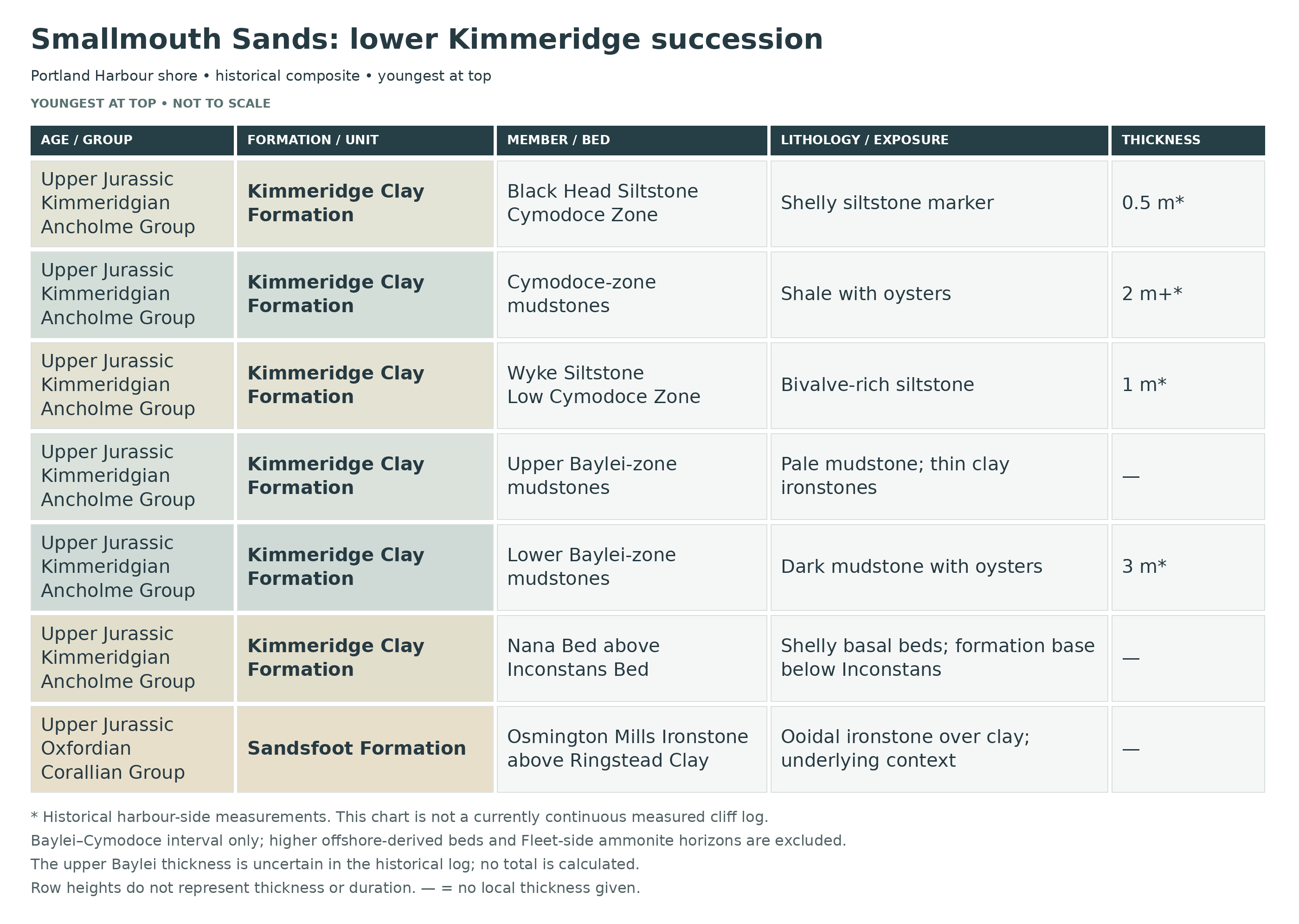
A detailed harbour-side succession at Smallmouth Sands, based on the published historical boundary sections. Separate Fleet exposures and material washed from Portland Harbour are distinguished from the local cliff-and-foreshore record.
Section Architecture
This account covers the harbour-side Smallmouth Sands foreshore and low cliffs south of Sandsfoot Castle, towards Ferry Bridge, approximately [SY 669 765]–[SY 672 772]. The published section is slipped and discontinuous. Its Baylei- and Cymodoce-zone mudstones must not be combined with the separate Fleet shore or with higher-zone material washed from the harbour floor.
Recent Research Note
The published GCR accounts document the harbour-side basal Kimmeridge succession and its historical vertebrate record. A published 2025 meeting abstract independently reports more than 500 disarticulated pterosaur elements from Smallmouth Sands. It does not assign those elements to individual numbered bays or one particular measured bed.
CORALLIAN GROUP
Sandsfoot Formation (Upper Oxfordian)
Ringstead Clay Member
Bed SM1 — Upper Ringstead Clay Member (poorly exposed contextual underlying beds)
Pale- to dark-grey variably calcareous mudstones, locally with fine calcareous laminae, pass upward into more reddish silty mudstone with siltstone lenses and the characteristic red-weathering, lens-shaped sideritic concretions of the member. In the narrow Smallmouth harbour-side section these beds are mostly contextual rather than spectacular, but they are important because they form the final Oxfordian mudstone phase beneath the condensed ironshot boundary bed. Fossils are sparse, with bivalves, echinoids and rare ammonites, and the member records quiet shelf-mud accumulation before the major omission surface at the top of the Corallian.
Osmington Mills Ironstone Member
Bed SM2 — Osmington Mills Ironstone Member / Upper Part Of The Historical Boundary Package
A thin pale ferruginous ooidal bed, included within the broader “Westbury Iron Ore Beds” package of older authors and distinguished here as the local Osmington Mills Ironstone Member. It is full of fossils, especially serpulids and the coarsely corrugated bivalve Ctenostreon, yet notably lacks true corals despite the older “Ringstead Coral Bed” terminology sometimes applied to it. The bed is a strongly condensed hiatal surface at the top of the Oxfordian succession and marks the last ironshot oolitic phase before the sharp incoming of basal Kimmeridge muds.
ANCHOLME GROUP
Kimmeridge Clay Formation (Lower Kimmeridgian)
Bed SM3 — Inconstans Bed (0.7 m)
Very dark grey shelly and bioturbated mudstone with ferruginous ooids and phosphatic pebbles resting sharply on the Oxfordian ironstone. The eponymous brachiopod Torquirhynchia inconstans is characteristic. This is the formal base of the Kimmeridge Clay Formation in the Dorset type area and the traditional local Oxfordian–Kimmeridgian boundary used in the cited Dorset framework. Lithologically it is an unmistakable transgressive base-bed, showing abrupt change from condensed oxic ironstone sedimentation below to darker offshore mud deposition above.
Bed SM4 — Nana Bed (0.25 m)
A thin but distinctive shell-rich bed dominated by the small oyster Nanogyra nana. It is one of the classic named lower Kimmeridge markers in the Weymouth district and lies low in the P. baylei succession. The bed is useful because it separates the basal boundary mudstone from the thicker oyster-rich and later ironstone-bearing mudstones above, while also recording one of the early shelly pulses during the first Kimmeridge marine mud accumulation.
Bed SM5 — Lower Baylei-Zone Dark Grey Mudstones With Deltoideum delta (c. 3.0 m)
Dark grey mudstones rich in the flat oyster Deltoideum delta. This is the lower, darker part of the Baylei-zone mudstone package and represents quiet, low-energy offshore shelf deposition with a benthic fauna dominated by oysters. At Smallmouth, old reptile finds from the lowest Kimmeridge were almost certainly derived in part from this broad interval and from nearby beds around it, though the modern harbour-side section rarely allows precise in-situ vertebrate logging.
Dark Baylei Mudstone — Historical Harbour-Side Measurement
The GCR historical composite records 3.0 m for the dark Deltoideum-rich mudstones. This is a published historical section value, not a newly measured thickness in the modern foreshore bays.
Bed SM6 — Upper Baylei-Zone Pale Grey Mudstones With Thin Tabular Clay Ironstones (historically ?6 m or more)
Paler grey mudstones contain thin tabular clay-ironstone seams, commonly reddish on weathering. They form a substantial part of the historical harbour-side Baylei succession below the Wyke Siltstone. The GCR records Pictonia below that marker, but does not provide a bed-by-bed assignment of modern collector bays to this interval.
Upper Baylei Estimate: Preserve The Historical Question Mark
The GCR prints an uncertain ?6 m or more for the pale mudstones with thin tabular ironstones at the base. The question mark and incomplete-thickness qualification are retained.
Bed SM7 — Wyke Siltstone (up to c. 1.0 m; KC5)
The historical harbour-side table records 1.0 m of shelly siltstone at this level. The GCR boundary account correlates the Wyke Siltstone with KC5 and notes abundant myid and other bivalves. Its detailed Rasenia horizons were documented on the separate Fleet shore and are not transferred to the Smallmouth bays.
Bed SM8 — Lower Cymodoce-Zone Shales With Deltoideum delta (c. 2.0 m or more)
The historical harbour-side section records 2.0 m or more of shale with Deltoideum delta above the Wyke Siltstone. The public source does not allocate numbered collecting bays or a distinct pterosaur concentration to this particular interval. It remains a mudstone package in the published section, without an invented bone bed.
Bed SM9 — Black Head Siltstone (0.5 m; KC8)
A second, thinner shelly siltstone 1–2 m above the Wyke Siltstone, correlating with KC8. It is a clear secondary marker in the Cymodoce-zone lower Kimmeridge and shows that brief higher-energy or shell-concentrating events continued within an otherwise mud-dominated sequence. Its importance is mainly stratigraphic, because it lets the foreshore clays above and below be fixed more securely within the lower Cymodoce succession.
Context SM10 — Higher Harbour-Derived Material And Exposure Limits
The public GCR distinguishes the lower harbour-side section from nodule-bearing clay of the Mutabilis and higher zones, known largely through material washed from the floor of Portland Harbour. Higher strata also occur offshore and on the north Portland shore. These records do not establish a continuous upper section through the modern Smallmouth foreshore.
Historical Bed-Number Cross-References — Harbour-Side Composite
The following are the published GCR cross-references, not invented modern bay numbers. They help compare earlier accounts without treating a collector bay as a formal bed.
Inconstans Bed (0.7 m)
Damon Bed 6; Salfeld Bed 18; Arkell Bed 11.
Nana Bed (0.25 m)
Damon Bed 7 in part; Salfeld Bed 19; Arkell Bed 12.
Dark Deltoideum Mudstone (3.0 m In GCR)
Damon ?Bed 7; Salfeld Bed 20; Arkell Bed 13. The uncertainty in the Damon correlation is preserved.
Pale Ironstone-Bearing Mudstones (?6 m Or More)
Damon Beds 8–11; Salfeld Beds 21–22. The source places thin tabular ironstones at the base.
Wyke Siltstone (1.0 m In The Historical Table)
Damon Bed 12; Salfeld Bed 23. Its separate Fleet-side type fauna is not transferred to Smallmouth.
Overlying Deltoideum Shales (2.0 m Or More)
Damon Bed 13 in part; Salfeld Bed 24 in part.
Black Head Siltstone (0.5 m)
The upper named marker in this historical lower Kimmeridge table has no added modern collector-bay crosswalk.
Historical Upper Oxfordian “Westbury Iron Ore Beds”
The older table groups Damon Beds 1–5 (questioned), Salfeld Beds 13–17 and Arkell Beds 8–10 under this historical label. It should not be equated wholesale with only the thin Osmington Mills Ironstone horizon; the modern underlying Ringstead Clay and ironstone are distinguished above.
Higher Harbour-Derived Nodules — Separate Context
The GCR lists an uncertain 20 m or more of Mutabilis-zone nodule-bearing clay, tentatively corresponding to Damon Beds 13 in part–17. Much of the evidence comes from nodules washed from Portland Harbour, with higher units offshore and on the north Portland shore. This is not appended to the modern numbered-bay log or included in a local exposed-thickness total.
Collector Horizon Note
The GCR describes much of the historical reptile material as isolated limb bones, vertebrae or teeth, although associated remains also occur. Some specimens came from the lower Kimmeridge beds, some probably from the highest Corallian, and others from the harbour. Provenance must therefore be assessed specimen by specimen rather than assigning the entire fauna to one bed.
Pterosaur Assemblage Note
The published 2025 meeting abstract reports more than 500 disarticulated elements referred broadly to rhamphorhynchid and monofenestratan pterosaurs. It describes histological study of eight specimens and evidence of juvenile, subadult and adult individuals, while calling for further taxonomic work. It does not justify a longer list of confidently identified pterosaur subgroups or exact modern bay-to-bed assignments.
Depositional Environment
The succession records the transition from upper Corallian mudstones and condensed ferruginous oolite into the mainly muddy lower Kimmeridge shelf deposits. Inconstans and Nana mark the basal boundary package; oyster-bearing mudstones and ironstone seams succeed them, interrupted by the Wyke and Black Head siltstones. Faulting, slipping and incomplete exposure complicate the local section. The harbour breakwaters and sheltered position within Portland Harbour have reduced marine erosion.
Total Thickness Note
The historic basal Kimmeridge section south of Sandsfoot Castle towards Smallmouth was reported as up to about 15 m thick, but is slipped, discontinuous and affected by shoreline development. This is not a fresh measurement of the modern numbered bays. Individual historical bed measurements are shown with that qualification; no total is calculated from the uncertain upper Baylei estimate. Higher-zone nodules have also been reported washed ashore from Portland Harbour and should not be treated as a continuous in-situ extension of the modern collecting section.
References
Benton, M.J. & Spencer, P.S. (1995). Smallmouth Sands, in Fossil Reptiles of Great Britain, GCR 10, pp. 174–179.
Cox, B.M. (2001). East Fleet–Small Mouth, in British Upper Jurassic Stratigraphy, GCR 21.
British Geological Survey Lexicon: Kimmeridge Clay Formation, Sandsfoot Formation and Ringstead Clay Member.
Meléndez and colleagues (2025). Osteohistology of pterosaur specimens from the Kimmeridge Clay Formation (Upper Jurassic) of Weymouth, UK. Published meeting abstract, Palæovertebrata 48(1), 286–287.
GCR East Fleet–Small Mouth: separate harbour and Fleet sections. GCR fossil reptiles, printed pages 174–175: historical harbour-side bed log and numbered cross-references. Meléndez and colleagues (2025): published meeting abstract independently confirming more than 500 pterosaur elements.
SAFETY
Common sense should always be used when collecting, and checking tide times is essential, as access to parts of the foreshore can be restricted as the tide rises.
Although this is a relatively sheltered location within Portland Harbour, the foreshore can be uneven, soft and slippery, particularly where clay is exposed or where seaweed has built up on the surface. Care should be taken when walking, especially near the tideline.
Some areas include soft clay and mud patches, which can be difficult to walk on, so it is best to stick to firmer ground and avoid venturing too far onto unstable surfaces.
The shoreline here is generally low and accessible, but occasional small slumps or erosion can occur along the banks. Avoid standing too close to recently eroded sections and always remain aware of your surroundings.
EQUIPMENT
Fossil collecting at Smallmouth Sands requires a slightly different approach to most coastal sites, as the majority of finds are very small and easily overlooked.
Use a small hand tool only to separate permitted loose clay or sediment on firm, safe foreshore, without digging into the banks or bedrock. Heavy tools are not needed. A fine mesh sieve (around 1–2mm) can help recover small teeth, bone fragments and microfossils from permitted loose sediment; keep each sample labelled with its collecting position.
Many collectors also find it useful to bring a hand lens or magnifying glass, as some of the most interesting specimens can be only a few millimetres in size.
It is advisable to bring tissue, small containers or specimen bags, as delicate fossils can be easily damaged. A tray or tub can also help when sorting through finer material.
Due to uneven ground and occasional soft patches, sturdy footwear is recommended. A bag or backpack will help carry finds and equipment comfortably along the foreshore.
CLEANING AND TREATING
Support small bones and teeth and remove only loose surface sediment with a very soft brush. Keep fragile specimens in their supporting matrix until they can be assessed. Do not apply a routine 24-hour soak to every find: water can damage clay-rich matrix or unstable mineralised material, while salt removal from marine finds needs a specimen-specific plan. Avoid heating or rapid drying, and seek preparation advice before treating an important or crumbling specimen.
Paraloid B-72 can be useful for selected fragile areas after testing, but a sound fossil does not automatically need coating. It is not a waterproof seal, and complete removal from porous bone or matrix cannot be guaranteed. Keep specimens supported in stable storage and record any treatment; important finds may need examination or sampling before an adhesive or consolidant is applied.
IDENTIFY YOUR FINDS
Need help identifying a fossil? Share clear photos, where you found it and its size with the community.
FURTHER READING
Deposits Magazine – Pliosaurs and predation at Smallmouth Sands: A collaborative collecting approach
Domestic Science: the recovery of an ichthyosaur skull
Geology of Portland Harbour — Ian West
ACCESS RIGHTS
This site is an SSSI, GCR conservation site and forms part of the UNESCO World Heritage Jurassic Coast. This means you can visit the site, but hammering the bedrock is not permitted. For full information about the reasons for the status of the site and restrictions please download the PDF from Natural England – SSSI Information – Chesil and the Fleet
It is important to follow our ‘Code of Conduct’ when collecting fossils or visiting any site. Please also read our ‘Terms and Conditions‘
LINKS
♦ Fossil Discussions
♦ Fossil Articles
♦ Buy Fossils, Tools and Equipment
♦ Buy Crystals, Meteorites, and Artefacts
♦ Join Fossil Hunts
♦ UK Fossils Network